
 Worksheets
DC to AC converter (Inverter)
Total questions: 48
Worksheet time: 48mins
What is an inverter?
A device which converts AC power to DC power
A device which converts DC power to AC power
A device which stores electrical energy
A device which measures voltage
Fill in the blank: The output voltage waveform of the inverter can be ________, quasi-square wave, or low distorted sine wave.
square-wave
triangular wave
sawtooth wave
rectified wave
Fill in the blank: One of the applications in industry is ________ AC drives.
Adjustable
Constant
Fixed
Manual
Fill in the blank: UPS stands for Uninterruptible Power Supply and is used in appliances like ________.
computers
refrigerators
televisions
washing machines
Which of the following semiconductor devices are widely used as switching?
Thyristor, BJT, GTO, IGBT, MOSFET
Diode, Resistor, Capacitor
Transformer, Inductor, Relay
None of the above
The output voltage in inverters for low to medium power applications is controlled using the ______ technique.
pulse width-modulation (PWM)
phase-shift modulation
frequency modulation
amplitude modulation
When a thyristor based inverter supplies an AC power to an isolated load, ______ techniques are required.
force commutation
natural commutation
resonant commutation
pulse width modulation
Thyristor based inverters are used only in ______ applications.
Low-power
Medium-power
High-power
All of the above
What is required to turn OFF a thyristor operating in the ON state?
Increasing the current flowing through it
Reducing the current flowing through it
Increasing the voltage across it
Reducing the voltage across it
Inverters are mainly classified based on the nature of input power source. Fill in the blank: One type of inverter is the ________ (VSI).
Voltage Source Inverter
Current Source Inverter
Power Source Inverter
Frequency Source Inverter
What is DC LINK in the configuration of inverters?
AC to DC converter and DC to AC inverter
Only AC to DC converter
Only DC to AC inverter
None of the above
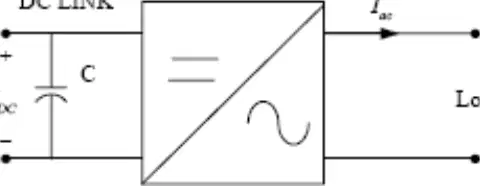
What is the function of the DC LINK in a two-stage static frequency converter?
The DC LINK rectifies and filters AC power at network frequency before being inverted to AC at an adjustable frequency.
The DC LINK directly converts AC to DC without any filtering.
The DC LINK increases the voltage of the AC supply before conversion.
The DC LINK acts as a transformer to step down the voltage.
What is supplied to a Current Source Inverter (CSI)?
Controlled voltage from a DC source
Controlled current from a DC source of high impedance
Alternating current from an AC source
Uncontrolled current from a DC source
Fill in the blank: The voltage source is first converted into a ________ and then used to supply the power to the inverter.
current source
power source
resistor
load
What is the most commonly used technique to control the output voltage of inverters?
Pulse-width modulation (PWM) inverter techniques
Resonant circuit switching
Transformer tap changing
Phase shifting
How can the output voltage of a square-wave inverter be varied?
By changing the frequency
By controlling the input DC voltage
By changing the load
By adjusting the output AC voltage
What is a Bridge Inverter?
A device that converts DC to AC using a bridge configuration
A device that stores electrical energy
A device that measures voltage
A device that increases current
A single-phase full bridge inverter can operate with ________ load and ________ load.
resistive; inductive
capacitive; resistive
inductive; capacitive
resistive; capacitive
In a Single-phase Half Bridge Type Inverter with resistive load, the gating circuit should be designed such that switches S1 & S2 should not turn-on at the same time.
True
False
In a Single-phase Half Bridge Type Inverter with resistive load, the diodes D1 & D2 do not play any role.
True
False
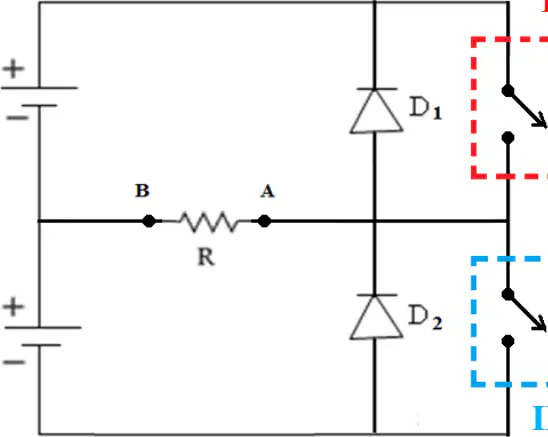
According to the operation of the circuit with a resistive load, during which period is switch S1 conducting?
0 ≤ t ≤ T/2
T/2 ≤ t ≤ T
0 ≤ t ≤ T
T/4 ≤ t ≤ 3T/4
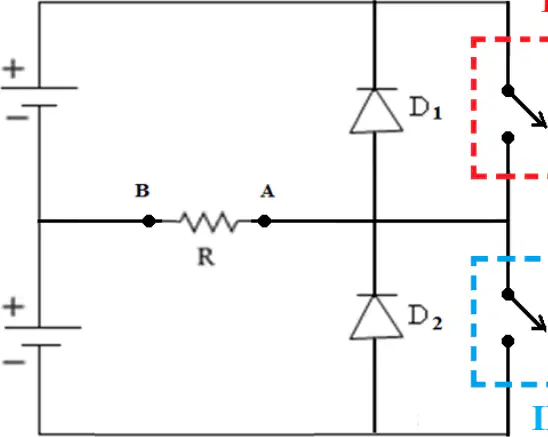
According to the operation of the circuit with a resistive load, during which period is switch S2 conducting?
0 ≤ t ≤ T/2
T/2 ≤ t ≤ T
0 ≤ t ≤ T
T/4 ≤ t ≤ 3T/4
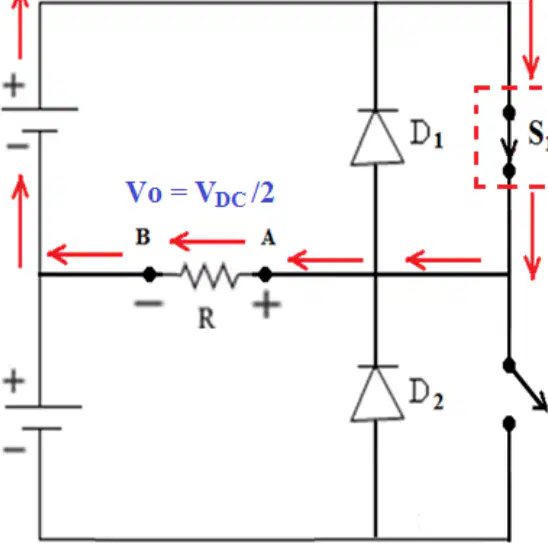
During Period-I (0 ≤ t ≤ T/2), the output voltage at load becomes positive. What is the value of output voltage at load?
VDC
VDC/2
0
-VDC/2
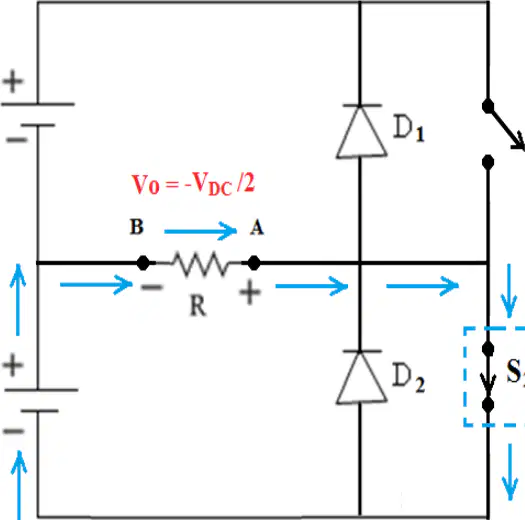
During Period-II at (T/2 ≤ t ≤ T), which switch is closed and which switch is open?
S1 is closed, S2 is open
S2 is closed, S1 is open
Both S1 and S2 are closed
Both S1 and S2 are open
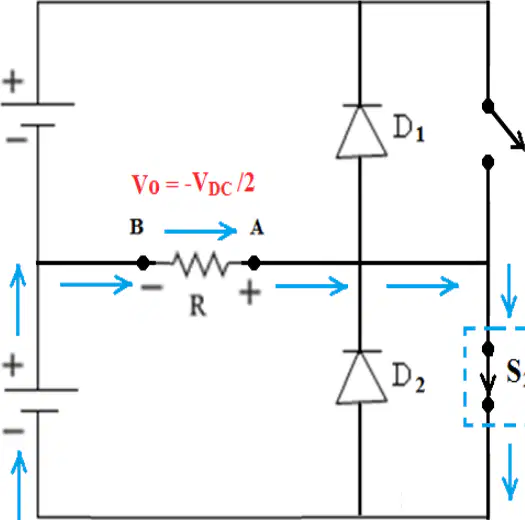
During Period-II, from which point to which point does the current flow through the resistive load?
From A to B
From B to A
From S1 to S2
From D1 to D2
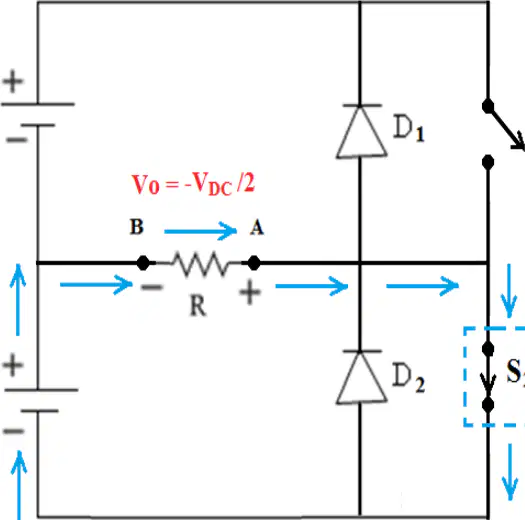
Fill in the blank: The output voltage at load during Period-II becomes negative, V₀ = _____
-V_DC/2
V_DC/2
0
V_DC
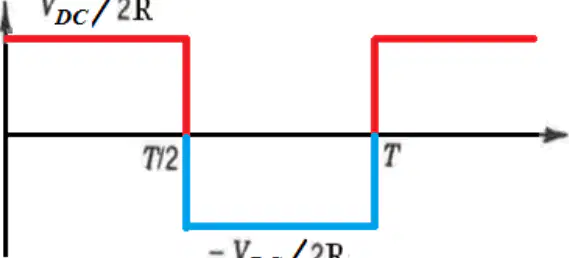
In Figure 4, what is the value of the output current i0 during the first half of the period?
VDC/2
VDC/2R
−VDC/2
−VDC/2R
What is the final expression for the RMS output voltage as shown in the image?
Vo(rms) = VDC/2
Vo(rms) = VDC/4
Vo(rms) = VDC
Vo(rms) = 2VDC
Which of the following steps is part of the derivation for the RMS output voltage?
Vo(rms) = sqrt{(1/T) ∫₀ᵀ (VDC/2)² dωt}
Vo(rms) = VDC/2
Vo(rms) = VDC/4
Vo(rms) = VDC
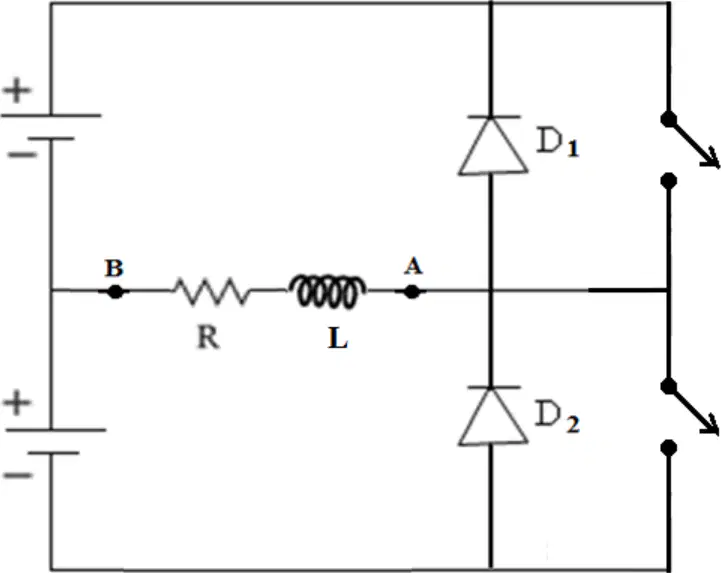
Refer to the diagram of the Single-phase Half Bridge inverter with resistive and inductive load. What type of load is connected in the circuit?
Resistive only
Inductive only
Resistive and Inductive
Capacitive only
In a Single-phase Half Bridge Type Inverter with resistive and inductive load (RL), what is the function of diodes D₁ & D₂?
They act as switches
They conduct for inductive load
They regulate voltage
They store energy
In a Single-phase Half Bridge Type Inverter, the gating circuit should be designed such that switch S₁ & S₂ should not turn-on at the same time.
True
False
Fill in the blank: Diodes D₁ & D₂ are connected across the switches. These diodes ________ for inductive load.
conduct
block current
increase resistance
reduce voltage
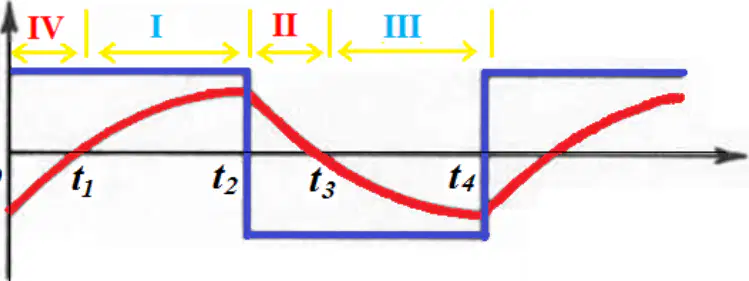
In Mode-I, which switch is conducting from t₁ < t < t₂?
S1
S2
S3
S4
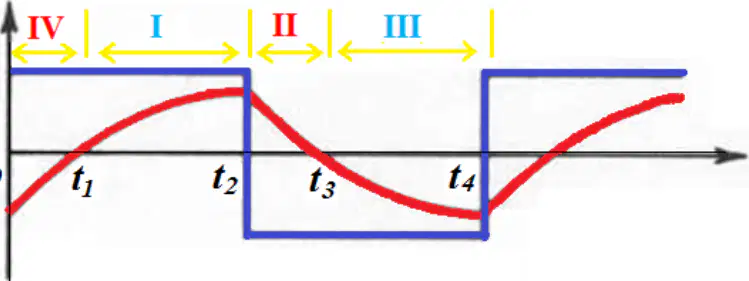
In Mode-II, which diode is conducting from t₂ < t < t₃?
D2
D1
D3
D4
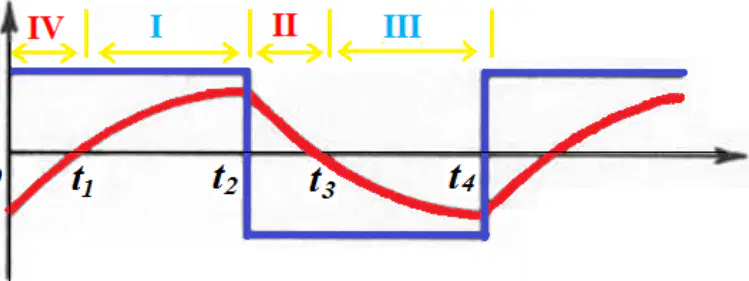
In Mode-III, which switch is conducting from t₃ < t < t₄?
S2
S1
S3
S4
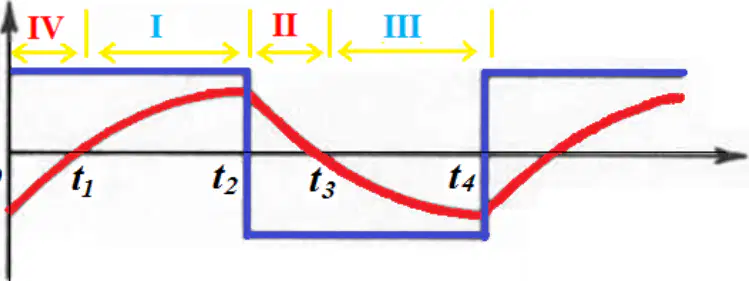
In Mode-IV, which diode is conducting from t₀ < t < t₁?
D1
D2
D3
D4
What is the value of output voltage (V0) during Modes-I at (t1 ≤ t ≤ t2)?
V0 = VDC/2
V0 = VDC
V0 = 0
V0 = -VDC/2
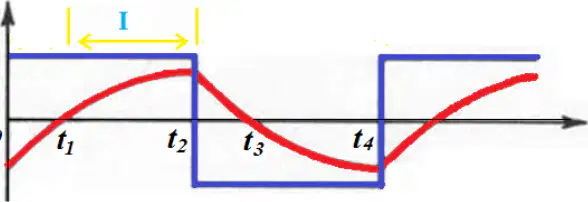
What does the red curve represent in the output waveform during Modes-I at (t1 < t < t2)?
The red curve represents the current (i0) through the RL load.
The red curve represents the voltage across the RL load.
The red curve represents the input supply voltage.
The red curve represents the power dissipated in the load.
During Mode-I at (t1 < t < t2), what happens to switch S1 at instant t1?
S1 is turned-off
S1 is turned-on
S1 is short-circuited
S1 is open-circuited
During Mode-I at (t1 < t < t2), current flows from DC supply to S1, then to RL load (A to B). What does the load voltage become?
Vo = +VDC/2
Vo = -VDC/2
Vo = 0
Vo = VDC
During Mode-I at (t1 < t < t2), the +ve load current increases gradually due to _________?
inductive load (charging)
capacitive load (discharging)
resistive load (constant current)
inductive load (discharging)
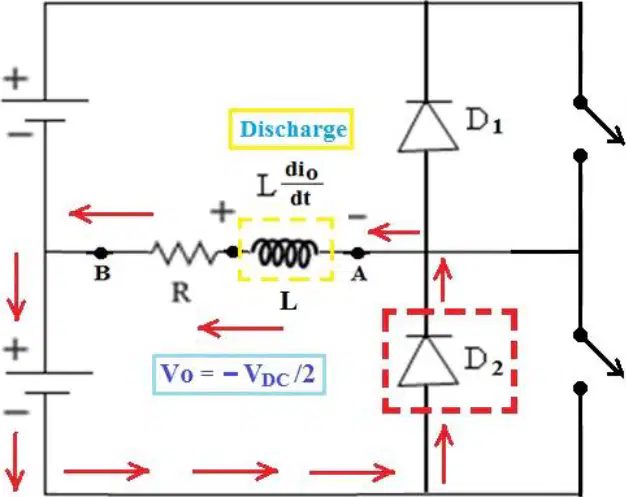
Refer to the diagram and description for 'Operation with RL load' during Mode-II (t2 ≤ t ≤ t3). What is the value of V0 during Mode-II?
V0 = VDC/2
V0 = -VDC/2
V0 = 0
V0 = VDC
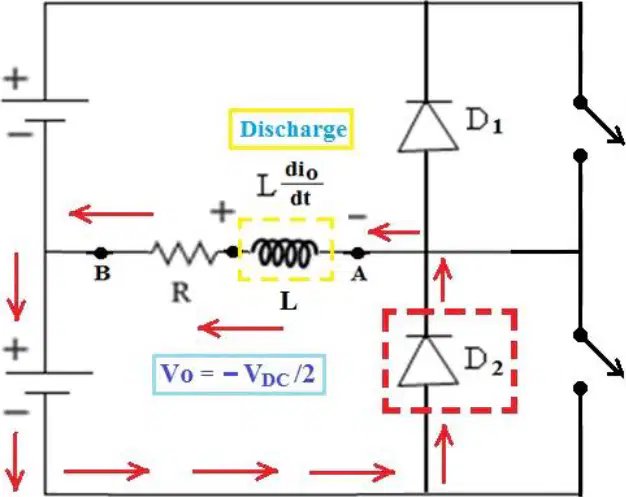
During Mode-II (t2 ≤ t ≤ t3) in the RL load circuit, which diode is conducting?
D1
D2
Both D1 and D2
Neither D1 nor D2
During Mode-II at (t2 < t < t3), at instant t2, which switch is turned off?
S1
S2
Both S1 and S2
None
During Mode-II at (t2 < t < t3), the load current is tried to ______ in the same direction by the load inductance.
maintained
reversed
interrupted
reduced
During Mode-II at (t2 < t < t3), this voltage polarity forward biases which diode?
D1
D2
D3
D4
In Mode-II, the stored energy in load is feedback to the DC supply and the load voltage becomes ______.
V0 = -VDC/2
V0 = VDC/2
V0 = 0
V0 = VDC

