
 Worksheets
DFT-SURGERY2 D1-14-10-2025-MAXEMO
Total questions: 10
Worksheet time: 8mins
The definitive anatomical position of a horseshoe kidney is typically at the L3-L5 vertebral level, lower than the normal T12-L3 position. This is a direct consequence of a specific embryological interaction during fetal development. Which structure physically prevents the normal cephalad migration of the fused renal mass?
Inferior mesenteric artery
Celiac trunk
Bifurcation of the abdominal aorta
Median sacral artery
A patient with ESRD from polycystic kidney disease is a candidate for renal transplantation. The native kidneys are noted to be massive, extending below the iliac crest and causing severe compressive symptoms, including early satiety and respiratory compromise. Which adjunctive surgical procedure should be strongly considered prior to or during transplantation?
Bilateral native nephrectomy
Laparoscopic cyst fenestration
Selective renal artery embolization
Splenectomy
During a retrograde pyelogram for evaluation of a long-segment mid-ureteric stricture, the surgeon notes a "pipe-stem" appearance of the ureter. Biopsy later confirms tuberculosis. Which primary parenchymal event is the most likely origin of this entire disease cascade?
Ulceration of the renal papillae
Formation of contained cortical granulomas
Initial hematogenous seeding of glomeruli
Development of a pyogenic perinephric abscess
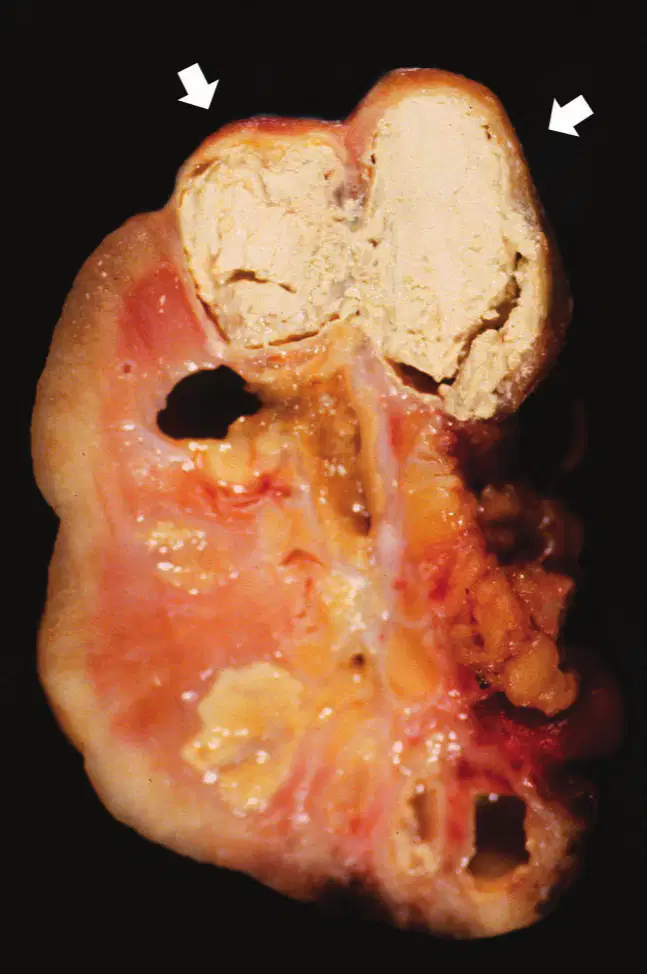
A patient undergoes a nephrectomy for a chronically infected, non-functioning kidney. On gross examination, the cut surface of the kidney is replaced by a solid, cheese-like, yellowish-white material. This finding, termed a "putty kidney," is the end result of which specific pathological process?
Caseous necrosis
Coagulative necrosis
Liquefactive necrosis
Fibrinoid necrosis
A patient with known metastatic renal cell carcinoma, evident by "cannonball" lesions in the lungs on imaging, presents with intractable gross hematuria and severe, debilitating flank pain from the primary tumor. What is the most appropriate management for his local symptoms?
Palliative (cytoreductive) nephrectomy
Systemic chemotherapy with gemcitabine and cisplatin
External beam radiation therapy to the lung metastases
Immediate initiation of lifelong hemodialysis
Assertion (A): A patient with long-standing benign prostatic hyperplasia may develop bilateral hydronephrosis and chronic kidney disease. Reason (R): The hypertrophied detrusor muscle in response to chronic obstruction transmits sustained high pressure to the ureters and renal pelves, causing obstructive uropathy.
Both Assertion (A) and Reason (R) are true, and (R) is the correct explanation of (A).
Both Assertion (A) and Reason (R) are true, but (R) is not the correct explanation of (A).
Assertion (A) is true, but Reason (R) is false.
Both Assertion (A) and Reason (R) are false.
Which of the following conditions represents an absolute indication for surgical management of benign prostatic hyperplasia, rather than continuing with medical therapy alone? I. Recurrent acute urinary retention II. Bladder stones secondary to BPH III. Bilateral hydronephrosis due to obstruction IV. A prostate-specific antigen (PSA) level of 5.0 ng/mL
I, II, and III are correct
I and IV are correct
Only II is correct
All I, II, III, and IV are correct
A male working in a petrol refinery presents with a single episode of profuse, painless hematuria. A cystoscopy reveals a solitary, papillary growth near the trigone. A biopsy is obtained for histopathological examination. What is the most probable finding?
Urothelial carcinoma
Squamous cell carcinoma
Adenocarcinoma
Nephroblastoma
A male patient with poorly controlled diabetes is brought to the emergency department with scrotal pain, rapidly progressing erythema, and crepitus. He is hypotensive and tachycardic. Following initial resuscitation with fluids and broad-spectrum antibiotics, what is the definitive and most crucial intervention?
Immediate and aggressive surgical debridement of all necrotic tissue
Administration of hyperbaric oxygen therapy
CT scan of the pelvis to map the extent of fascial plane involvement
Placement of a suprapubic catheter to divert urine
A patient presents with a persistent, velvety red plaque on the glans penis. A biopsy reveals squamous cell carcinoma in situ. What is the specific clinical diagnosis?
Erythroplasia of Queyrat
Bowen's disease
Leukoplakia
Balanitis xerotica obliterans

