Wayground logo

Free Printable Worksheets

Font size

S
M
L
XL
Worksheets

Rat Practical Review

Total questions: 67

Worksheet time: 37mins

Name
Class
Date
1.
Which species of rat are we studying?
a)
a) American
b)
b) Mentawai
c)
c) Bush
d)
d) Norway
2.
Which plane separates the superior half of the rat (eyes, back, ears) from the inferior half of the rat (legs, tail)?
a)
a) Sagittal
b)
b) Frontal
c)
c) Transverse
d)
d) Mid-sagittal
3.
How many openings exist in the female urogenital area, excluding the anus? How many openings exist in the male urogenital area, excluding the anus?
a)
a) 3, 3
b)
b) 3, 2
c)
c) 2, 2
d)
d) 2, 1
4.
What is the name for the long stiff hairs located on the face that have a sensory function?
a)
a) Whiskers
b)
b) Vibrissae
c)
c) Pinna
d)
d) Nares
5.
How many mammary papillae are generally found on a female rat?
a)
a) 2
b)
b) 6
c)
c) 12
d)
d) 24
6.

What is the name of the muscle attached to the skin in the head/throat area?

a)
a) platysma
b)
b) cutaneous
c)
c) nictitating
d)
d) perimysium
7.

When a muscle contracts, which attachment point will move? Which attachment point will remain stationary?

a)
a) origin/insertion
b)
b) insertion/origin
8.

Muscle fibers of any particular muscle will almost always run in opposite directions.

a)
a) True
b)
b) False
9.

What is the name of the tough connective tissue that wraps around individual muscles?

a)
a) cartilage
b)
b) serous membrane
c)
c) perimysium
d)
d) peritoneum
10.

Which muscle in the rat is the major chewing muscle?

a)
a) digastric
b)
b )sternohyoid
c)
c) mylohyoid
d)
d) masseter
11.

The posterior part of the pectoralis minor muscle is sometimes referred to as the______________.

a)
a) pectoralis major
b)
b) xiphihumeralis
c)
c) trapezoid
d)
d) epitrochlearis
12.

Which muscle has its origin on the scapula and insertion on the proximal radius?

a)
a) biceps brachii
b)
b) epitrochlearis
c)
c) triceps brachii
d)
d) latissimus dorsi
13.

What is the name of the tendon that connects the gastrocnemius to the calcaneous bone?

a)
a) rotator cuff
b)
b) anterior cruciate ligament (ACL)
c)
c) semitendinosus
d)
d) Achilles tendon
14.

Which muscle pulls arm towards the tail?

a)
a) serratus ventralis
b)
b) biceps brachii
c)
c) latissimus dorsi
d)
d) triceps brachii
15.

Name the connective tissue that is associated with the rectus abdominis.

a)
a) visceral peritoneum
b)
b) linea alba
c)
c) transversus abdominus
d)
d) external oblique
16.

What is the tongue covered with that houses the taste buds?

a)
a) parotid gland
b)
b) mesenteries
c)
c) papillae
d)
d) hard palate
17.

The palate separates the _____________ structures from the _____________ structures.

a)
a) abdominal, thoracic
b)
b) thoracic, oral
c)
c) nasal, cranial
d)
d) oral, nasal
18.

The two types of teeth in the rat are the ___________ teeth which are used for gnawing, and the __________ teeth which are used for crushing and grinding.

a)
a) molars, incisors
b)
b) molars, bicuspids
c)
c) incisors, molars
d)
d) canines, incisors
19.

What is the purpose of the epiglottis?

a)
a) prevent food from entering the respiratory system by covering the glottis while swallowing
b)
b) prevent air from entering the digestive system by covering the epiglottis while breathing
c)
c) prevent bacteria from entering the glottis
d)
d) the epiglottis serves no usable purpose
20.

Which gland is located between the larynx and the trachea?

a)
a) parotid gland
b)
b) lacrimal gland
c)
c) mandibular gland
d)
d) thyroid gland
21.

What are the translucent membranes attaching to and holding the internal organs in place called?

a)
a) parietal peritoneum
b)
b) visceral peritoneum
c)
c) mesenteries
d)
d) intestines
22.

What is the terminal portion of the colon called?

a)
a) anus
b)
b) rectum
c)
c) ileum
d)
d) jejunum
23.

Where should you look to locate the pancreas?

a)
a) on the greater curvature of the stomach
b)
b) by the ileum of the small intestine
c)
c) beneath the largest lobe of the liver
d)
d) in the mesentery proper next to the duodenum
24.

What organ is a storage organ for red blood cells and a site for the manufacture of white blood cells?

a)
a) spleen
b)
b) pancreas
c)
c) cecum
d)
d) gall bladder
25.

What is the distinct constriction formed by smooth muscle at the junction of the stomach and the small intestine called?

a)
a) mesentery proper
b)
b) jejunum
c)
c) vermiform appendix
d)
d) pyloric sphincter
26.

What light brown organ did you remove that is part of the immune system?

a)
a) liver
b)
b) lungs
c)
c) thymus gland
d)
d) thyroid gland
27.

In what structure do you find the vocal cords?

a)
a) trachea
b)
b) larynx
c)
c) esophagus
d)
d) bronchus
28.

What are the receiving chambers of the heart?

a)
a) coronary arteries
b)
b) tricuspid valve
c)
c) ventricles
d)
d) atria
29.

Which blood vessels return oxygen-rich blood back to the receiving chambers of the heart?

a)
a) pulmonary veins
b)
b) pulmonary arteries
c)
c) vena cavae
d)
d) coronary arteries
30.

What is responsible for drawing air into the lungs?
a)
a) the heart
b)
b) the bronchi
c)
c) the diaphragm
d)
d) visceral pleura
31.
Which of the following is NOT correct concerning the name of an artery?
a)
a. The name may change as it enters a different part of the body.
b)
b. It indicates where it is going.
c)
c. It may have a similar name to a vein if it runs with it.
d)
d. It adds an additional term to the name at a major junction.
32.
All rats will appear identical to each other in arrangement of their blood vessels.
a)
True
b)
False
33.
Into what two arteries does the brachiocephalic artery divide?
a)
a. aorta and left subclavian
b)
b. right jugular and right subclavian
c)
c. right common carotid and right subclavian
d)
d. left subclavian and left axillary
34.
What major artery leaves the left ventricle of the heart?
a)
a. pulmonary artery
b)
b. aorta
c)
c. vena cava
d)
d. coronary artery
35.
What arteries supply blood to the legs?
a)
a. brachial
b)
b. sacral
c)
c. renal
d)
d. common iliac
36.
Veins show more variation in arrangement than what is seen among the arteries.
a)
a. True
b)
b. False
37.
Where would the brachial vein be located?
a)
a. in the chest
b)
b. in the thigh
c)
c. in the neck
d)
d. in the upper arm
e)
e. in the lower arm
38.
What vein empties into the right atrium?
a)
a. aorta
b)
b. pulmonary vein
c)
c. vena cava
d)
d. pulmonary artery
39.
From what two vessels does the posterior vena cava form?
a)
a. ascending and descending aorta
b)
b. the right and left renal vein
c)
c. the right and left common iliac vein
d)
d. the right and left subclavian
40.
What blood vessels drain the head and throat?
a)
a. external and internal jugular veins
b)
b. right and left common carotid arteries
c)
c. right and left common iliac veins
d)
d. right and left subclavians
41.
In the female rat, what are the structure(s) that hold and nourish the developing embryos called?
a)
a. bladders
b)
b. uterus
c)
c. vagina
d)
d. uterine horns
42.
Which of the following glands does not aid in formation of semen?
a)
a. preputial
b)
b. glans
c)
c. seminal vesicles
d)
d. prostate
43.
What two parts make up the inside of the kidney?
a)
a. Hilus and medulla
b)
b. Cortex and medulla
c)
c. Hilus and adrenal
d)
d. Cortex and adrenal
44.
What is the female homolog of the male penis?
a)
a. vagina
b)
b. uterine horn
c)
c. clitoris
d)
d. ovary
45.
Which structure acts as the storage site for mature spermatozoa?
a)
a. Testis
b)
b. Vas deferens (Ductus deferens)
c)
c. Epididymis
d)
d. Coagulating glands
46.
What is the opening in the abdominal wall through which the vas deferens, testicular artery and vein, and testicular nerve pass through?
a)
a. deferens duct
b)
b. urethral canal
c)
c. testicular duct
d)
d. inguinal canal
47.
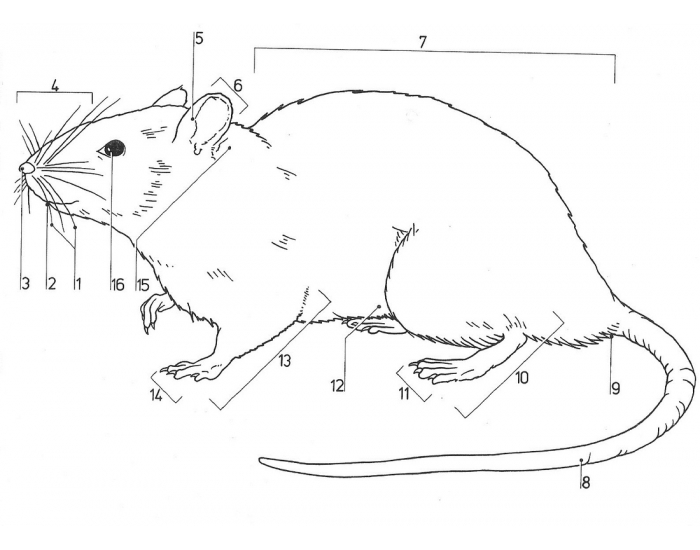
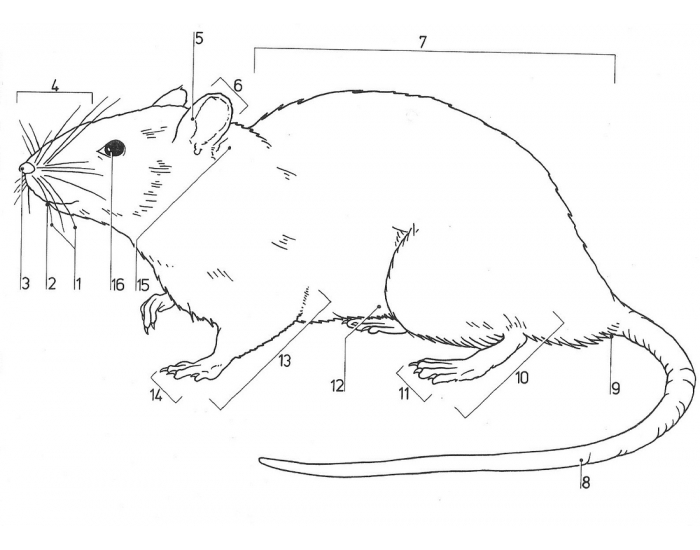
Structure #1 is the
a)
Vibrasse
b)
Nictitating membrane
c)
Incisors
d)
External Meatus
48.
Structure #6 is:
a)
Vibrasse
b)
Nictitating Membrane
c)
Incisors
d)
Pinna
49.

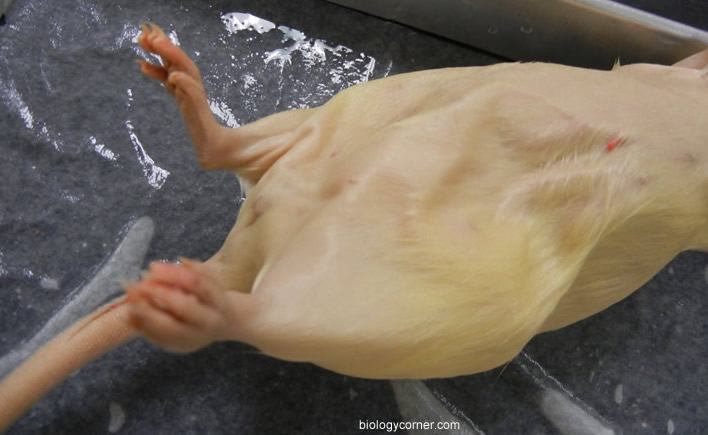
What is the gender of this rat?

a)

Male

b)

Female

50.

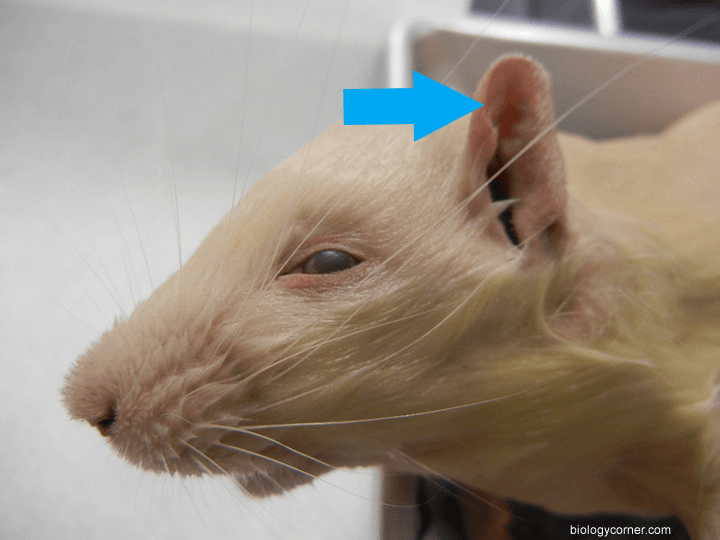
Identify this structure

a)

Vibrissae

b)

Pinnae

c)

Nictitating membrane

d)

Vulva

51.
What are referred to as the "whiskers" of the rat. They have a sensory function that allows the animal to judge the size of an opening that it is about to pass through?
a)
Vibrissae
b)
Diaphragm
c)
Rectum 
d)
Uterus 
52.

What side of the body is being shown in the picture?

a)

anterior

b)

posterior

c)

ventral

d)

dorsal

53.

What area of the rat is the pin in?

a)

anterior

b)

posterior

c)

ventral

d)

dorsal

54.
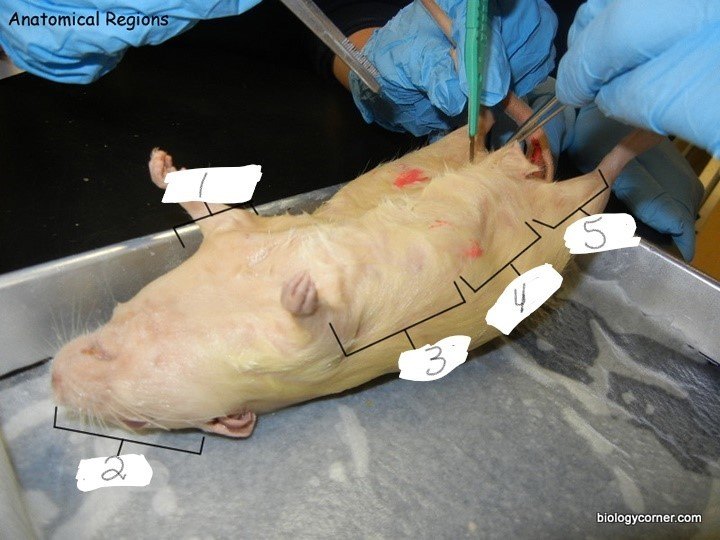
Which body region is indicated by #5?
a)
Pelvic
b)
Thoracic
c)
Abdominal
d)
Pectoral
55.

3

a)

Penis

b)

Vas deferens

c)

Bladder

d)

Prostate Gland

e)

Testes

56.

6

a)

Anus

b)

Urogenital Opening

c)

Scotum

d)

Urethral Orifice

e)

Vaginal Orifice

57.
The external oblique
a)
A
b)
B
c)
C
d)
D
58.
The pectoralis major
a)
A
b)
B
c)
C
d)
D
59.
a)

external oblique, compresses abdomen

b)

internal oblique, compresses abdomen

c)

latissimus dorsi, pulls arms caudally

d)

external oblique, pulls arms caudally

60.
a)

sternomastoid, mastoid

b)

sternohyoid, hyoid

c)

sternohyoid, sternum

d)

sternomastoid, sternum

61.

Click on the point that corresponds to the LARYNX

62.

Click on the point that corresponds to the TRACHEA

63.

Click on the point that corresponds to the ESOPHAGUS

64.

Click on the point that corresponds to the THYMUS GLAND

65.

Click on the point that corresponds to the LEFT LUNG

66.

This organ carries food from the mouth to the stomach

a)

larynx

b)

trachea

c)

esophagus

d)

diaphragm

67.

This organ separates the thoracic cavity from the abdominal cavity.

a)

larynx

b)

trachea

c)

esophagus

d)

diaphragm