
 Worksheets
Platform Technologies Midterm Examination - Multiple Choice
Total questions: 72
Worksheet time: 36mins
Which technology marked the first generation of computers?
Transistors
Vacuum tubes
Integrated circuits
Microprocessors
A modern computer typically consists of which of the following components?
A. CPU, input/output devices, and main memory
B. Punch cards, compiler, and tape drives
C. Keyboard, printer paper, and card reader
D. None of the above
What best describes the purpose of hardware architecture?
It specifies the computer’s physical structure and interconnections.
It defines how software communicates with the user.
It refers only to the external design of computer casing.
It manages files and directories in a computer system.
Which type of operating system is designed to handle multiple programs simultaneously?
Batch operating system
Multiprogramming operating system
Real-time operating system
Distributed operating system
Which of the following scenarios best illustrates the operating system acting as a resource manager?
A. A user typing a document in Microsoft Word
B. The OS allocating memory among multiple running programs
C. A printer connected to a laptop via Bluetooth
D. Installing an application from the Internet
Which trend correctly represents the evolution of IT infrastructure over time?
From mobile computing → cloud computing → mainframe computing
From mainframe computing → client/server → enterprise → cloud computing
From personal computing → minicomputers → batch systems
From internet-based systems → minicomputers → mainframes
If a company’s network platform fails, which service would be affected the most?
Local file storage only
Shared network resources
Standalone applications
Peripheral device access
An organization plans to integrate multiple legacy systems and web applications. Which infrastructure component should be prioritized?
Consulting and system integration services
Operating system platforms
Data management and storage
Internet platforms
Which of the following best defines an operating system?
A software used to design applications
A program that manages computer hardware and software resources
A device driver for input devices
A type of utility for data recovery
Which component of a computer system executes the instructions of a program?
Memory
Input devices
CPU
Output devices
Which of the following is an example of a batch operating system?
MS-DOS
UNIX
Windows 10
Android
The main goal of a multiprogramming operating system is to:
Reduce CPU usage
Allow only one program to run at a time
Maximize CPU utilization by running multiple jobs
Improve the graphical interface
Time-sharing operating systems differ from batch systems because they:
Do not use CPU scheduling
Allow user interaction with running jobs
Are slower than batch systems
Work only in mainframe environments
Which of the following is true about real-time operating systems (RTOS)?
They process data in random order.
They guarantee that all tasks are completed within a fixed deadline.
They are designed mainly for office productivity.
They cannot be embedded in devices.
A hospital life-support system requires immediate response from its OS. Which type of OS should be used?
Batch OS
Real-time OS
Distributed OS
Network OS
A company uses several computers connected in a LAN to share resources. Which OS setup is most appropriate?
Multiprocessing OS
Network OS
Time-sharing OS
Batch OS
In a university computer lab, several users access the same system at once. The most suitable OS is:
Multiprocessing OS
Network OS
Time-sharing OS
Batch OS
How does a distributed OS differ from a multiprocessing OS?
Distributed OS runs on one computer only.
Multiprocessing OS uses several CPUs in one machine; distributed OS uses multiple machines.
Both refer to the same concept.
Multiprocessing OS requires networking infrastructure.
Which type of OS would be best for a supercomputer performing complex calculations simultaneously?
Real-time OS
Multiprocessing OS
Batch OS
Network OS
What is a major disadvantage of batch processing systems?
They require expensive hardware.
They waste CPU time.
There is no user interaction during job execution.
They do not support printers.
If you were to design an OS for a mobile phone, which OS features would you combine?
Multiprogramming and real-time
Batch and distributed
Time-sharing and batch
Multiprocessing and batch
You are tasked to design an OS for industrial automation. Which must be prioritized?
Multitasking capability
Graphical interface
Real-time response
Resource sharing
Among all types of OS, which one provides the highest reliability in mission-critical environments?
Multiprogramming OS
Distributed OS
Batch OS
Desktop OS
If system reliability, scalability, and cost-efficiency are priorities, which OS architecture would you recommend for a growing enterprise?
Multiprogramming OS
Batch OS
Distributed OS
Real-time OS
What is the primary purpose of memory management in an operating system?
Control user input
Manage allocation and deallocation of memory
Render graphics
Execute network protocols
Which of the following represents the actual memory locations in RAM?
Logical address space
Virtual address space
Which memory segment is reserved for the operating system?
High memory
Low memory
Cache memory
Stack
Which hardware component maps logical addresses to physical addresses?
CPU
MMU (Memory Management Unit)
Disk controller
Linker
Dynamic loading is more memory-efficient than static loading because:
The program is always loaded at a fixed address
Program routines are loaded only when needed
It eliminates paging
All processes share the same memory block
Static linking differs from dynamic linking in that:
It requires a stub at runtime
It combines all required modules into a single executable
It avoids using memory
It loads modules only when called
Which of the following is true about swapping?
Swapping permanently deletes processes from memory
It temporarily moves processes between main memory and secondary storage
It prevents all types of fragmentation
It only works with contiguous memory allocation
If a process requires 150 KB but the first free memory block is 200 KB, which fragmentation occurs?
External fragmentation
Internal fragmentation
Paging fragmentation
Segmentation fault
In contiguous memory allocation, if memory is divided into fixed partitions and a process cannot fit any partition despite enough total free memory, the problem is:
Internal fragmentation
External fragmentation
Paging
Segmentation
Which placement algorithm allocates the first free partition large enough to accommodate a process?
Best Fit
First Fit
Worst Fit
Next Fit
A user program references logical address 500, and the base register contains 1000. The physical address used in memory is:
500
1000
1500
2000
Static and dynamic loading are two methods of loading programs. Which loading method is more suitable for large programs?
Static loading
Dynamic loading
Both are equally suitable
Neither is suitable
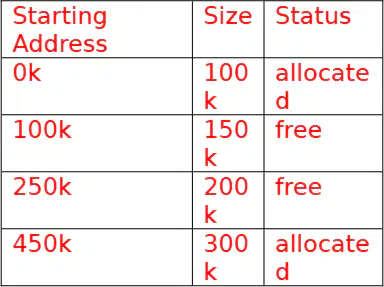
Given the following memory allocation status, which free block will First Fit choose for a process of 120 KB?
0k
100k
250k
450k
Why does dynamic linking improve memory utilization compared to static linking?
Because it preloads all library routines
Because it only loads library routines when they are actually used
Because it avoids using relocation registers
Because it fixes external fragmentation
You are designing a system that frequently runs large programs with multiple library calls. Which memory management technique would you prioritize?
Static linking and static loading
Dynamic linking and dynamic loading
Single-partition contiguous allocation
Worst-fit allocation only
If a system suffers from external fragmentation despite using contiguous memory allocation, the best approach to improve memory utilization is:
Increase physical RAM only
Use compaction or dynamic relocation
Avoid dynamic linking
Only use fixed partitions
What component of the CPU executes arithmetic and logical operations?
Control Unit
Arithmetic Logic Unit
Program Counter
Memory Address Register
Which register temporarily holds data being transferred to or from memory?
Accumulator
Memory Data Register
Instruction Register
Stack Pointer
Which bus carries the address of data between memory and CPU?
Data Bus
Control Bus
Address Bus
System Bus
What is the main function of the Control Unit in a CPU?
Perform logical operations
Direct the execution of instructions
Store data permanently
Manage cache memory
Which type of architecture stores instructions and data in the same memory?
Harvard
Von Neumann B
RISC
CISC
In Programmed I/O, how does the CPU interact with the I/O device?
CPU executes other instructions while I/O works
CPU waits for the device to complete data transfer
I/O device directly transfers data to memory
CPU and I/O share the bus alternately
Which I/O technique allows high-speed data transfer without CPU intervention?
Programmed I/O
Interrupt-driven I/O
Direct Memory Access
Cycle stealing
In interrupt handling, what is a disadvantage of daisy chaining?
Cannot handle multiple interrupts
Slower priority handling for devices farther from CPU
Requires extra hardware for each device
Devices are serviced in parallel
Which type of DMA transfer takes control of the bus for the entire block of data?
Cycle stealing
Burst mode
Programmed I/O
Interrupt-driven I/O
What is the role of the Program Counter (PC)?
Store intermediate results
Hold the address of the next instruction
Store memory contents temporarily
Control data transfer between CPU and I/O
Which register stores the currently fetched instruction to be decoded?
Instruction Register A
Memory Data Register
Stack Pointer
Accumulator
Which type of hazard in pipelining occurs due to resource conflicts?
Data hazard
Control hazard
Structural hazard
Instruction hazard
Which type of hazard occurs when a branch instruction causes uncertainty in the pipeline?
Structural hazard
Data hazard
Control hazard C
Execution hazard
In a pipelined processor, which technique reduces stalls caused by control hazards?
Branch prediction
Instruction pipelining
Cache prefetching
Register renaming
Which I/O interface method uses a flag to notify the CPU that data is ready?
Programmed I/O
Interrupt-driven I/O
DMA
Cycle stealing
Why is DMA preferred for high-speed I/O devices?
CPU manages all transfers directly
It reduces CPU involvement and speeds up data transfer
Transfers data one byte at a time only
It requires the CPU to wait for completion
A word in computer organization refers to:
The smallest unit of storage
A fixed-sized group of digits handled as a unit by the processor
A single bit
A group of four bits
How many bits are in a byte?
4
8
16
32
Which number system is based on powers of 10?
Binary
Octal
Decimal
Hexadecimal
Convert the binary number 101.01 to decimal:
5.25
5.5
6.25
6.5
Which is the correct decimal equivalent of binary 1011?
9
10
11
12
Which base is used in octal numbers?
2
8
10
16
Convert decimal 175 to octal:
257
275
527
572
Convert decimal fraction 0.625 to binary:
0.101
0.110
How many bits represent one hexadecimal digit?
2
3
4
8
Convert hexadecimal 3A9F to decimal:
14999
149991
159991
15999
Which code is Binary Coded Decimal (BCD)?
110101
0011 0010 1001
11100011
10101010
Why is Gray code useful?
To represent decimal digits
To reduce errors in communication
For binary arithmetic operations
To represent ASCII characters
Which ASCII code represents uppercase 'A'?
41 (hex)
61 (hex)
42 (hex)
62 (hex)
Convert binary 101011110110011 to octal:
53663
53763
35663
56363
Convert the same binary 101011110110011 to hexadecimal:
57B3
57C3
5AB3
5AC3
Why might computers use BCD instead of pure binary?
To save memory
To simplify decimal display for humans
To speed up binary calculations
To avoid Gray code errors

