
 Worksheets
Quarter 1 : 9 - Week Exam
Total questions: 28
Worksheet time: 28mins
Name
Class
Date
1.
Using what you have learned about Sumerian civilization, what can you infer about the advantages of Sumer’s location?
a)
Sumer was in the south; so Sumerian farmers enjoyed a longer growing season.
b)
Access to rivers and the Persian Gulf, plus the invention of the sailboat, may have provided faster transportation routes for trading.
c)
Because of its location, Sumer was protected from Asian enemies in the north and Arab enemies in the south.
d)
Limestone from the rivers was a rare resource that could be traded for wood.
2.
What accomplishment of the early Mesopotamian cultures resulted in a long-term solution to seasonal climate changes?
a)
supplying water to fields with dams and irrigation
b)
building retaining walls around the entire farming settlement
c)
settling further from the rivers to prevent damage to homes and fields
d)
growing a surplus of food and developing a way to store it to prevent famine
3.

Read the excerpt from the Code of Hammurabi. Which statement best describes the nature of the code?
a)
The punishment should fit the crime.
b)
The slightest infraction will incur severe punishment.
c)
The laws are simple and made to be broken.
d)
The code shows an improvement over Sumerian culture.
4.
What effect did Hammurabi's Code have on the further development of civilizations?
a)
They kept the city under strict rule.
b)
They showed other civilizations how not to function.
c)
They introduced the written law that would emerge elsewhere later in ancient history.
d)
They shaped emerging civilizations through the use of fear.
5.
Where did the first civilizations arise because of farming conditions?
a)
in the mountains
b)
near the sea
c)
in river valleys
d)
in the desert
6.
Which part of Babylon was known as one of the Seven Wonders of the Ancient World?
a)
Hanging Gardens
b)
king’s palace
c)
wall around the city
d)
irrigation system
7.
The few Sumerians who learned how to write often held high positions in society as what?
a)
artisans
b)
scribes
c)
heads of households
d)
merchants
8.
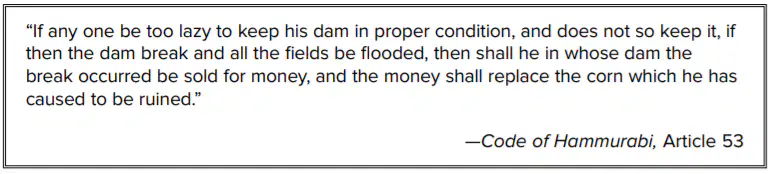
The code states that the punishment for allowing one’s dam to flood everyone's fields is to
a)
be sold into slavery.
b)
pay a fine to replace ruined crops.
c)
rebuild the dam.
d)
receive 60 lashes in the public square.
9.
A Sumerian temple to honor their chief god was called a
a)
scribe
b)
cradle
c)
Gilgamesh
d)
ziggurat
10.
Although most Sumerians were farmers, many made metal, cloth, and pottery because they were skilled
a)
artisans
b)
merchants
c)
slaves.
d)
priests
11.
According to the social structure, Sumerian artisans, merchants, farmers, and fishers made up this group.
a)
business class
b)
lower class
c)
middle class
d)
upper class
12.
What do tin and copper make?
a)
Gold
b)
Silver
c)
Cotin
d)
Bronze
13.
What were the two physical features that bordered Mesopotamia in Southwest Asia?
a)
Arabian Peninsula & Fertile Crescent
b)
Euphrates River & Tigris River
c)
Mediterranean Sea & Persian Gulf
d)
Taurus Mountains & Zagros Mountains
14.
How did irrigation lead to the growth of civilization in Mesopotamia?
a)
It stopped droughts from happening in the area.
b)
It made it easier to navigate along the rivers.
c)
It helped produce a surplus of food.
d)
It protected property and fields from flooding.
15.
A person who practiced polytheism in Mesopotamia would believe in which of the following gods?
a)
Anu
b)
Enlil
c)
Ishtar
d)
All of the above
16.
Why did the Sumerians originally use cuneiform?
a)
They used cuneiform to document different stories and poems.
b)
They used cuneiform to make currency and coins.
c)
They used cuneiform to keep business records.
d)
They used cuneiform to post signs around their cities.
17.
Many kings in Mesopotamia claimed that their authority over their people came from which source?
a)
gods
b)
nature
c)
priests
d)
scribes
18.
Why is Sargon considered an important figure in world history?
a)
He was the first leader to rule an empire.
b)
He was the first priest and created polytheism.
c)
He was the first sailor to travel around the entire Mediterranean Sea.
d)
He was the first superhero in Mesopotamian literature.
19.
Which of the following scenarios is the best example of a barter system?
a)
A person uses coins to buy food from a farmer.
b)
Two people bid against each other to buy glassware at an auction.
c)
One person trades lumber to another person for clothing.
d)
A person stores their money with a banker for safety and security.
20.
What do the following laws from Hammurabi's Code reveal about life in his empire?
(Law 196: If a man put out the eye of another man, his eye shall be put out.
Law 198: If he put out the eye of a freed man, or break the bone of a freed man, he shall pay one gold mina.
Law 199: If he put out the eye of a man's slave, or break the bone of a man's slave, he shall pay one-half of its value.)
a)
Someone charged with a crime would be harmed the same way as the victim.
b)
Hammurabi was very concerned about the safety of enslaved people.
c)
Everyone was protected equally under the laws in the Babylonian Empire.
d)
Consequences were unequal and based on the social class of the victim.
21.
What were the two rivers that bordered Mesopotamia?
a)
Mississippi and Missouri Rivers
b)
Nile and Blue Nile Rivers
c)
Yellow and Dang Rivers
d)
Tigris and Euphrates Rivers
22.
In larger Sumerian cities, the religious temples were pyramid-shaped brick towers known
a)
Edifice
b)
Monolith
c)
Ziggurats
d)
Cadre
23.
What was a City-State in Sumer?
a)
A small city size "baby" country that acted independently from all other cities, would fight other City-States for resources.
b)
Special towers built near the Tigris and Euphrates Rivers where ancient Mesopotamian astronomers practiced a secret form of water-based fortune-telling to predict the annual flooding
c)
A series of extremely popular, walled-off athletic stadiums built around 3000 BCE. They hosted annual, televised chariot races between rival teams
d)
Large, sprawling desert markets where traders came from all over to haggle fiercely over the price of exotic spices, especially cinnamon and paprika.
24.
What is the name of one of the oldest written stories in world history, which is about a superhuman king who fights demons for glory and wants to live forever?
a)
Gilgamesh
b)
Sargon
c)
Amorite
d)
Hammurabi
25.
Ur-Nammu created the world's first, what?
a)
Empire
b)
Law Code
c)
Irrigation Canals
d)
Written Language
26.
EXTRA CREDIT: Which of the following images shows an example of cuneiform?
a)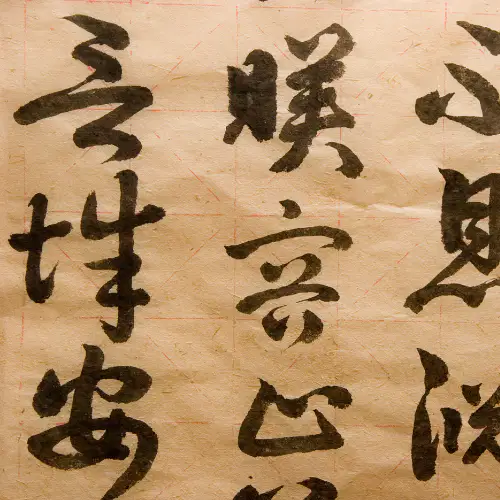
A
b)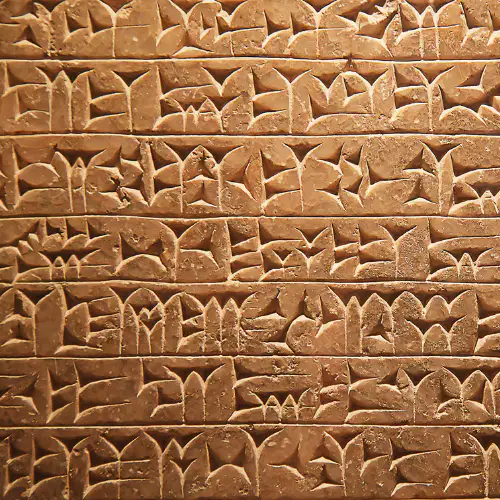
B
c)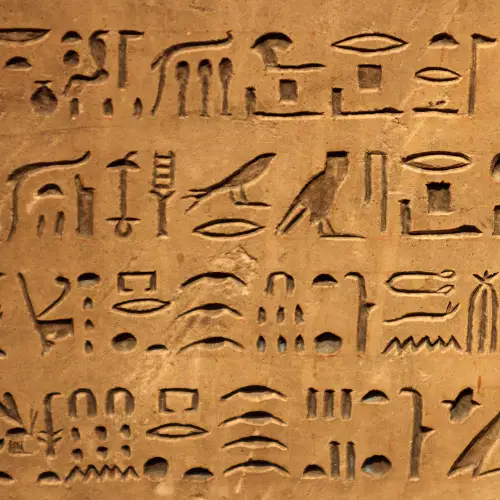
C
d)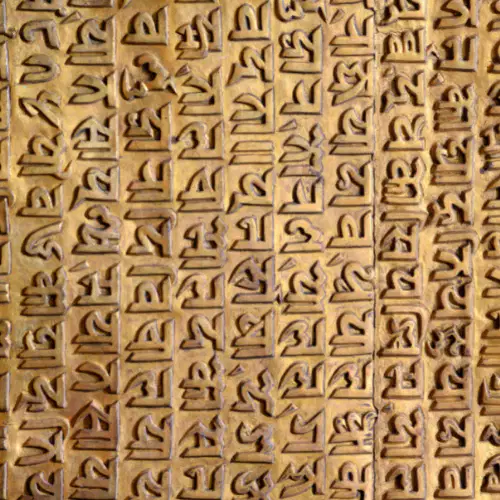
D
27.
EXTRA CREDIT: List the appearance of the civilizations around Mesopotamia in chronological order.
a)
Ur, Akkadian, Babylon
b)
Babylon, Ur, Akkadian,
c)
Akkadian, Babylon, Ur
d)
Babylon, Akkadian, Ur
e)
Ur, Babylon, Akkadian
28.
How many years apart are these two dates? 34BCE to 34CE
4 lines
100 %

