
 Worksheets
DFT-MOCK TEST-NEET PG/INICET-15-10-2025-STUDYWITHMAXEMO
Total questions: 20
Worksheet time: 15mins
A 48-year-old woman presents with a 4.5-cm mass in her right breast. On examination, the mass is fixed to the underlying pectoralis muscle. Several mobile, firm lymph nodes are palpable in the right axilla. A core biopsy confirms invasive ductal carcinoma, and a fine-needle aspirate of an axillary node is positive for malignancy. What is her minimum clinical stage?
IIIA
IIIC
IIB
I
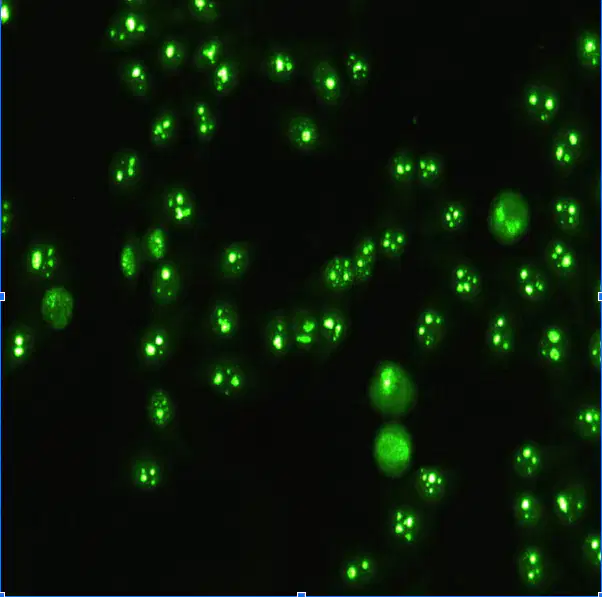
A 44-year-old lady presents to the clinic with shortening of the digits in her hands. She has a history of pallor of the extremities followed by pain and cyanosis on exposure to cold since her adolescence. Six months ago, she noticed puffiness of her fingers and face. An ANA test was positive with a Nucleolar pattern on immunofluorescence. What is the most likely diagnosis?
Diffuse systemic sclerosis
Limited systemic sclerosis
Systemic lupus erythematosus
Polyarteritis nodosa
A 28-year-old graduate student presents with a chronic history of fluctuating moods that he feels have been present since his late teens. He reports numerous, distinct periods of heightened energy, reduced need for sleep, and racing thoughts, followed by periods of low mood, anhedonia, and fatigue. These symptoms have never been severe enough to meet the criteria for a hypomanic or major depressive episode but have caused significant social distress. Which of the following is a mandatory criterion for establishing a diagnosis of cyclothymic disorder?
The symptomatic periods must be present for at least half the time over a minimum duration of two years.
The patient must have experienced at least one full hypomanic episode during the two-year period.
The patient must have a first-degree relative with a confirmed diagnosis of Bipolar I disorder.
The mood fluctuations must be directly attributable to a general medical condition, such as hypothyroidism.
A 29-year-old male with schizophrenia is being treated with a second-generation (atypical) antipsychotic. His physician explains that the medication's efficacy for both positive and negative symptoms is due to its dual action on two key neurotransmitter systems. In addition to its effect on dopamine D2 receptors, what is the principal antagonistic action that defines this class of medication?
5-HT2A antagonism
5-HT2C antagonism
Muscarinic M1 antagonism
Norepinephrine alpha-1 agonism
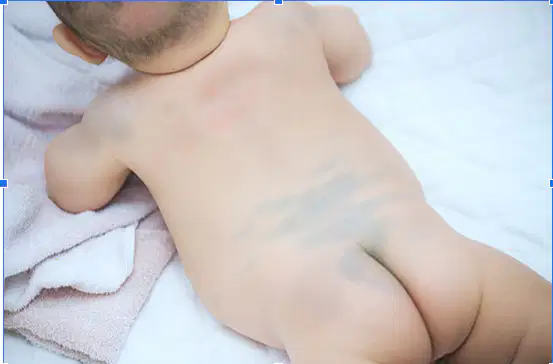
A neonate is brought to the hospital with a bluish pigment on the buttock, present since birth. The lesion is flat, non-tender, and has indistinct borders. What is the underlying embryological cause for this lesion?
Entrapment of melanocytes in the dermis due to arrested migration from the neural crest
Perinatal extravasation of deoxygenated blood into the deep dermal tissues
Fetal adrenal dysfunction leading to elevated levels of α-melanocyte-stimulating hormone
A genetic mutation causing premature apoptosis of all epidermal keratinocytes
In a widely reported criminal case from Kerala, a woman was accused of serially poisoning six family members over several years. The investigation revealed that the primary poison used was cyanide, often mixed into food or drink. This poison is rapidly fatal because it halts cellular respiration. Which component of the mitochondrial electron transport chain does cyanide directly inhibit?
Complex IV (Cytochrome c oxidase)
Complex I (NADH dehydrogenase)
Complex III (Cytochrome bc1 complex)
The citric acid cycle
A 22-year-old male presents to the emergency department after falling backward onto his outstretched, hyperextended left wrist. He complains of severe wrist pain and swelling. A lateral radiograph reveals that the lunate maintains its normal articulation with the distal radius, but the capitate and the rest of the carpus are displaced dorsally. Which statement accurately describes this injury pattern?
In a perilunate dislocation, the lunate remains aligned with the radius, while the capitate and distal carpal row dislocate, typically dorsally.
In a lunate dislocation, the lunate is displaced dorsally out of the lunate fossa of the radius, while the capitate remains aligned.
In a perilunate dislocation, both the lunate and the capitate dislocate together in a volar direction relative to the distal radius.
In a scaphoid fracture-dislocation, the radius is displaced dorsally, and the lunate spontaneously relocates in a volar direction.
A forensic pathologist is performing an autopsy on a deceased individual found in a locked, airtight room with an unlit gas stove turned on high. The deceased has cherry-red lividity, and toxicology confirms lethal levels of carboxyhemoglobin. No suicide note was found, and there were no signs of a struggle. The pathologist's official opinion is that the manner of death is suicide. The conclusion that the deceased intentionally turned on the gas is an example of what?
Circumstantial evidence
Direct evidence
Hearsay evidence
Evidence from a hostile witness
A 25-year-old G1P1 woman is being seen by a community health nurse on her fifth day after a normal vaginal delivery. When asked about her postpartum bleeding, she describes a moderate amount of pinkish-brown, watery discharge. What is the correct term for this expected physiological finding?
Lochia serosa
Lochia rubra
Lochia alba
Lochia purulenta
During a prolonged abdominal surgery under general anesthesia, the anesthesiologist observes a sudden and sustained increase in the patient's end-tidal CO2 (ETCO2) from 35 mmHg to 60 mmHg. This is accompanied by tachycardia, muscle rigidity, and a rapid rise in body temperature. Which of the following is the most likely cause of this sudden increase in ETCO2?
Malignant hyperthermia
Hypoventilation
Esophageal intubation
Circuit leak
A 55-year-old woman is diagnosed with primary hyperparathyroidism after lab tests reveal elevated serum calcium and parathyroid hormone (PTH) levels. To plan for a minimally invasive parathyroidectomy, a localization study is ordered. Which of the following is the best initial investigation to identify the hyperfunctioning parathyroid gland?
FDG-PET scan
Sestamibi Scan
Neck Ultrasound (USG)
4D-CT Scan
The following statements are true regarding dry age-related macular degeneration (ARMD) except:
Geographic atrophy is seen in later stages.
The optimal management is with antioxidants.
It is a more common variant of ARMD.
Choroidal new vessels are seen.
A 45-year-old musician complains of experiencing brief but intense episodes of vertigo and seeing the room spin whenever he is exposed to loud music during his concerts. This phenomenon of sound-induced dizziness and nystagmus is known as the Tullio phenomenon. This sign can be present in all of the following conditions EXCEPT:
Perilymph fistula
Meniere's Syndrome
Post fenestration surgery
Acoustic neuroma
A medical student is describing histology of an anaplastic carcinoma of thyroid, which of the following histological feature is not applicable for features of anaplasia in this patient?
Capsular Invasion
Nuclear Pleomorphism
Abnormal Mitosis
High Nucleo-Cytoplasmic ratio
A 66-year-old male presents with vivid visual hallucinations and memory loss. His family has noticed that his “internal clock” seems to be off because some days he will sleep all day and other days he is awake all day. His physical examination reveals mild rigidity in his upper extremities and slow finger taps. What is the likely diagnosis?
Alzheimer disease
Creutzfeldt-Jakob disease
Dementia of Lewy body
Corticobasal degeneration
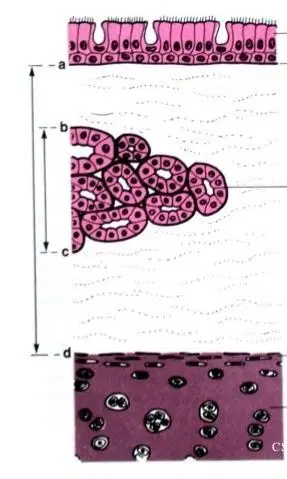
In the provided histological diagram of a bronchial wall, the ratio calculated by dividing the thickness of the mucous gland layer (distance b to c) by the thickness of the bronchial wall from the basement membrane to the cartilage (distance a to d) is known as the:
BODE index
Reid index
Mentzer index
Lung clearance index
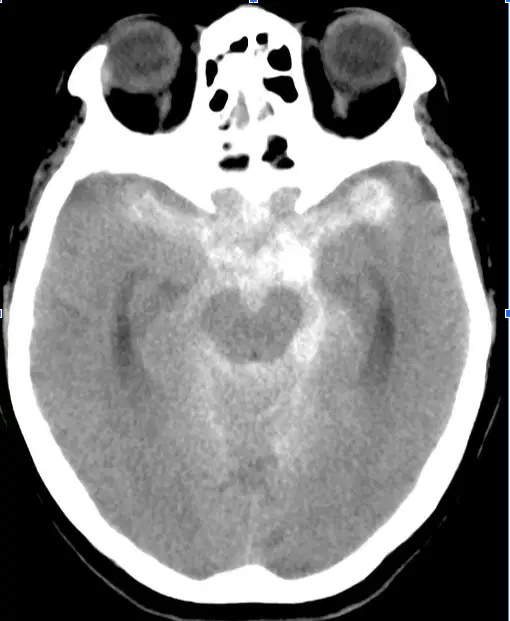
A 35-year-old female presents with a "thunderclap headache." What is the likely diagnosis based on the provided non-contrast CT scan of the head?
Subdural hematoma (SDH)
Subarachnoid hemorrhage (SAH)
Epidural hematoma (EDH)
Intraventricular hemorrhage (IVH)
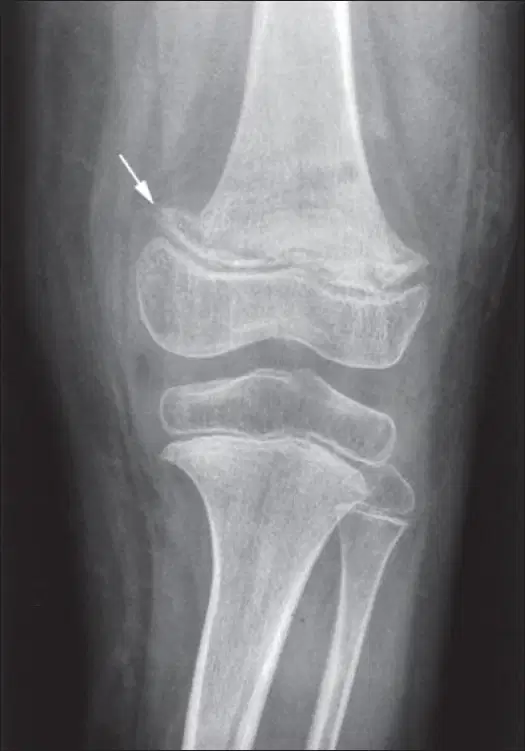
A child with a history of a highly restrictive diet presents with irritability and severe pain in their legs, refusing to stand. The pediatrician notes that the child's overall bone mineralization appears normal. Based on the provided X-ray of the child's knees, what is the most likely diagnosis?
Rickets
Scurvy
Metaphyseal Dysplasia
Diaphyseal Aclasia
A 48-year-old male with a history of chronic alcohol abuse is brought to the emergency department with confusion, ataxia, and nystagmus. On examination, he is disoriented to time and place and has difficulty with coordinated movements, such as the finger-to-nose test. Which of the following is the most appropriate initial treatment for this patient's suspected condition?
Intravenous glucose
Intravenous thiamine
Intravenous diazepam
Intravenous haloperidol
A 30-year-old woman presents to the emergency department on day 8 postpartum with a fever of 39°C and chills. She reports that her vaginal discharge, which had been lightening, has become heavier, darker, and foul-smelling. On examination, she has significant lower abdominal tenderness, and the uterine fundus is soft and exquisitely tender. What is the most likely diagnosis?
Postpartum endometritis
Retained products of con
Urinary tract infection
Normal uterine subinvolution

