
NEW
Font size
 Worksheets
Respiratory System Post Quiz
Total questions: 29
Worksheet time: 15mins
What is the main function of the respiratory system?
To supply the body with oxygen and dispose of carbon dioxide
To digest food and absorb nutrients
To pump blood throughout the body
To control body temperature
Which of the following is NOT one of the four processes of respiration?
Pulmonary Ventilation
External Respiration
Transport of respiratory gases
Digestion
List the four processes of respiration in the correct order.
Pulmonary Ventilation, External Respiration, Transport of respiratory gases, Internal respiration
External Respiration, Pulmonary Ventilation, Internal respiration, Transport of respiratory gases
Transport of respiratory gases, Pulmonary Ventilation, External Respiration, Internal respiration
Internal respiration, Pulmonary Ventilation, External Respiration, Transport of respiratory gases
Which of the following is a structural part of the respiratory system?
Upper respiratory system
Conducting zone
Respiratory zone
Circulatory system
The respiratory system can be divided into how many structural parts?
One
Two
Three
Four
Which of the following is NOT a part of the external nose?
Root (area between eyebrows)
Bridge
Dorsum nasi
Internal nose
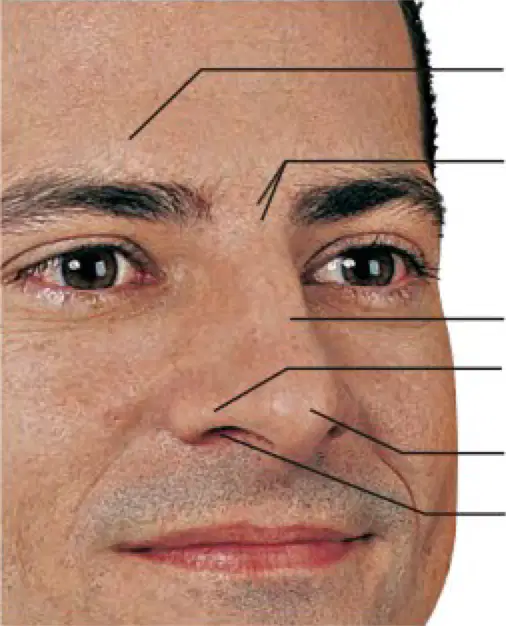
What is the apex of the nose?
The area between the eyebrows
The tip of the nose
The bridge of the nose
The nostrils
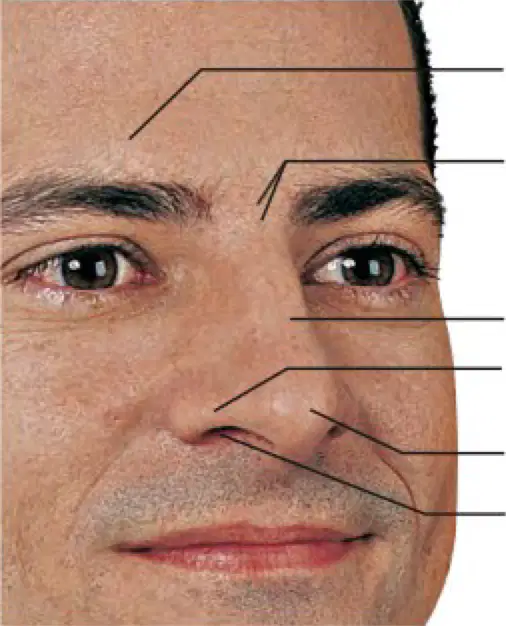
The external opening of the nose is called:
Dorsum nasi
Apex
Naris/nares
Bridge
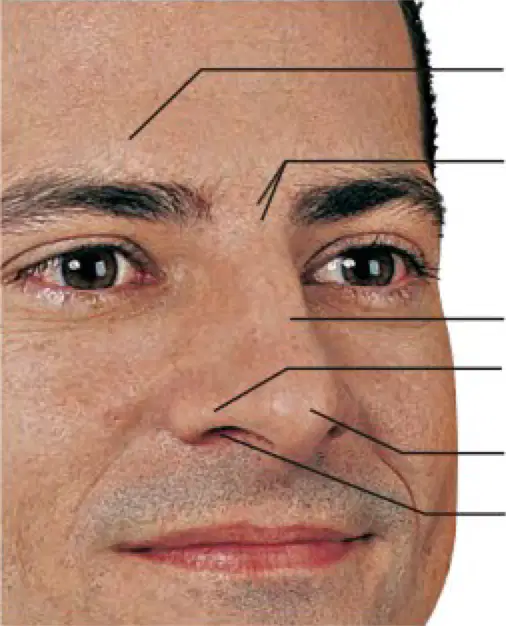
The external nose is structurally divided into which of the following main components?
The root, bridge, dorsum nasi, and apex
The septum and conchae
The maxilla and mandible
The frontal and temporal bones
What is the space within the internal nose called?
Nasal cavity
Oral cavity
Pharynx
Larynx
What divides the nasal cavity into two halves?
Nasal septum
Palate
Ethmoid bone
Sphenoid bone
Which bones form the roof of the nasal cavity?
Ethmoid and sphenoid bones
Palatine and maxillary bones
Frontal and occipital bones
Temporal and zygomatic bones
What is the pharynx commonly called?
Throat
Nose
Mouth
Windpipe
The pharynx is described as a funnel-shaped tube because:
Because it helps direct air and food to the correct passages, ensuring proper respiratory and digestive functions.
Because it is flat and does not play a role in directing air or food.
Because it is a solid structure that blocks air passage.
Because it only serves as a passage for blood.
The larynx lies in the midline of the neck anterior to which structure?
Esophagus
Heart
Lungs
Thyroid gland
What is the function of the vocal folds (true vocal cords)?
Vibrate to produce sounds as air rushes up from the lungs
Filter dust from inhaled air
Prevent food from entering the trachea
Absorb oxygen from the air
The structure of the Adam’s apple contributes to its function in the larynx by:
Its two fused plates of hyaline cartilage form the anterior wall of the larynx and give it a triangular shape, which helps protect the vocal folds and maintain an open airway.
Its fatty tissue provides insulation for the vocal cords.
Its muscle fibers contract to produce sound.
Its blood vessels supply oxygen to the larynx.
Which of the following best describes the path of the trachea?
Descends from the larynx through the neck and into the mediastinum
Ascends from the lungs to the pharynx
Runs horizontally across the chest
Connects the nasal cavity directly to the lungs
Which structure allows the diameter of the trachea to change subtly during inhalation and exhalation?
Trachealis muscle
Carina
Mucosa
Submucosa
At what point does the trachea end?
By dividing into the two main bronchi at the midthorax
By connecting to the esophagus
By merging with the larynx
By splitting into the alveoli
What is the function of the carina in the trachea?
Marks the point where the trachea branches into the two main bronchi
Allows the trachea to expand during swallowing
Produces mucus to trap dust particles
Contracts to help expel air forcefully
Passages smaller than 1 mm in diameter in the bronchial tree are called:
Bronchioles
Alveoli
Tracheoles
Capillaries
What is the name of the double-layered serous membrane that encloses and protects each lung?
Pleural membrane
Pericardial membrane
Synovial membrane
Mucous membrane
The lobes of the right lung are separated by which fissures, and how does this compare to the left lung?
Both lungs have lobes separated by the horizontal fissure.
The right lung's lobes are separated by both the oblique and horizontal fissures, while the left lung's lobes are separated only by the oblique fissure.
The left lung's lobes are separated by the cardiac notch, while the right lung's lobes are separated by the lingula.
The right lung's lobes are separated by the cardiac notch, while the left lung's lobes are separated by the horizontal fissure.
Which muscles contract during inspiration to initiate pulmonary ventilation?
Inspiratory muscles (diaphragm and external intercostals)
Abdominal muscles
Internal intercostals
Cardiac muscles
Air flows out of the lungs during expiration because:
Intrapulmonary pressure rises above atmospheric pressure due to decreased thoracic volume and passive recoil of the lungs.
Intrapulmonary pressure drops below atmospheric pressure.
The diaphragm contracts.
The rib cage expands.
Which respiratory volume is defined as the amount of air that can be expelled from the lungs after a normal tidal volume expiration?
Tidal volume (TV)
Inspiratory reserve volume (IRV)
Expiratory reserve volume (ERV)
Residual volume (RV)
Which of the following is NOT included in the list of respiratory capacities?
Inspiratory capacity
Functional residual capacity
Vital capacity
Expiratory reserve capacity
If a person’s inspiratory capacity (IC) is 3600 ml, which formula was used to calculate it?
IC = TV + IRV
IC = TV + ERV
IC = IRV + RV
IC = ERV + RV

