
NEW
Font size
 Worksheets
Quiz on Ampere's Law and Electromagnetic Induction
Total questions: 35
Worksheet time: 18mins
What is the SI unit of electric current?
Ampere (A)
Coulomb (C)
Volt (V)
Ohm (Ω)
What does a current of 1.0 A represent in terms of charge?
1.0 Coulomb per second
1.0 Coulomb per minute
1.0 Coulomb per hour
1.0 Coulomb per millisecond
What is the direction of the magnetic field around a current-carrying wire according to the right-hand thumb rule?
In the direction of the thumb
In the direction of the fingers
Opposite to the thumb
Perpendicular to the wire
What happens to the magnetic field strength when the number of coils in a solenoid is increased?
It decreases
It remains the same
It increases
It becomes zero
Who discovered the connection between the magnetic field and electric current?
Hans Christian Oersted
André-Marie Ampère
Michael Faraday
Nikola Tesla
What is the relationship known as that describes the strength of a magnetic field in relation to electric current?
Oersted's Law
Faraday's Law
Ampere's Law
Newton's Law
What did Oersted's experiment demonstrate?
Electricity can induce magnetism
Magnetism can induce electricity
The strength of electric current
The direction of electric current
What is electromagnetic induction?
Generating electricity from magnets
Inducing magnetism from electricity
Both A and B
None of the above
What is the effect of increasing the current in a coil on the magnetic field strength?
It decreases the strength
It has no effect
It increases the strength
It reverses the direction
What is the charge of an electron?
1.6 × 10^-19 C
-1.6 × 10^-19 C
1.9 × 10^-16C
-1.9 × 10^-16C
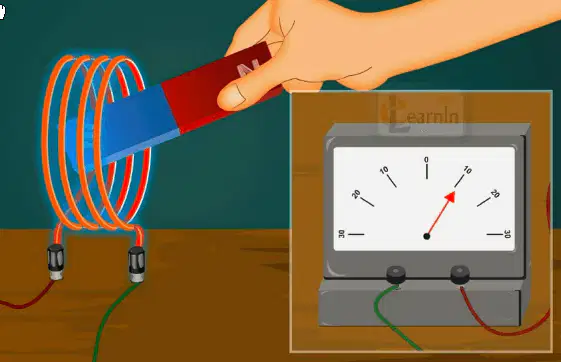
How could the experimenter increase the amount of electricity being induced by this experiment?
Increase the number of coils
Flip the magnet around
Decrease the number of coils
Nothing, the amount of electricity cannot be increased

The voltmeter is at 0 in this image. How would you manipulate the experiment to create electricity (measured in volts)?
Flip the magnet around so the North pole is facing out
Take the magnet out
Move the magnet back and forth
Add more coils around the paper cylinder
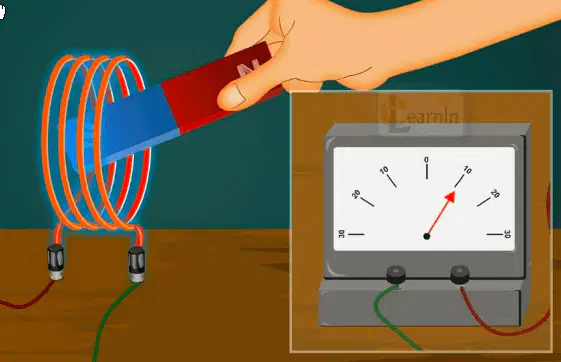
Electromagnetic induction is taking place in this experiment. How much electricity is being produced?
-10 Volts
100 Volts
10
-100
A magnet can move in a coil of wire to produce electricity in which system?
Transformer
Motor
Magnet
Generator
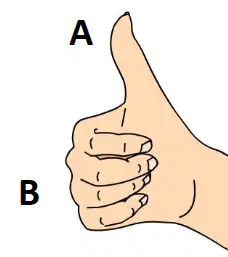
Using the right hand grip rule, A represents the direction of the
current
magnetic field
electric field
voltage
Using the right hand rule, B represents the direction of the
current
magnetic field
electric field
voltage
Which of the following statements best describes the Right Hand Rule in electromagnetism?
It is used to find the resistance in a circuit.
It is used to calculate the magnitude of the electric field.
It is used to determine the direction of the magnetic field around a current-carrying wire.
It is used to measure the voltage across a capacitor.
When using the Right Hand Rule for a current-carrying wire, what does the thumb represent?
The direction of the magnetic field
The direction of the electric current
The magnitude of the current
The resistance of the wire
In the context of the Right Hand Rule, what does the curl of the fingers represent when applied to a solenoid?
The direction of the electric current
The magnitude of the magnetic field
The resistance of the solenoid
The direction of the magnetic field inside the solenoid
How does the Right Hand Rule apply to electromagnetic induction?
The thumb points in the direction of the induced current, and the fingers curl in the direction of the magnetic field.
The thumb points in the direction of the force, and the fingers curl in the direction of the magnetic field.
The thumb points in the direction of the magnetic field, and the fingers curl in the direction of the induced current.
The thumb points in the direction of the magnetic field, and the fingers curl in the direction of the force.
Ampere's Law helps us
calculate the force produced by a straight conductor when a current is run through it
calculate the magnetic field produced by any shape conductor when a current is run through it
calculate the current produced by a straight conductor when a magnetic field is present
calculate the amount of resistance in a wire when current is passed through it
The magnetic field lines near a long straight wire carrying current are:
Straight lines
Spiral lines
Concentric rings
Radial lines
What is the unit of magnetic field?
ampere
kilowatt hour
watt
tesla
Moving charges, or an electric current, produces a magnetic field.
Gauss's Law
Ampere's Law
Ohm's Law
Law of Conservation of Magnetism

A wire carries a current, creating a magnetic field around itself as shown. The current in the wire is:
Directed to the right
Equal to the magnetic field
Directed to the left
In the same direction as the magnetic field
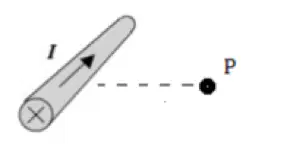
A straight wire carries a current inside the paper. What is the direction of the magnetic field at point P?
Points to the right
Clockwise
Points to the left
Counterclockwise
The scientists who greatly contributed to the development of electric motor and generator
Ampere and Hertz
Faraday and Maxwell
Oersted and Faraday
Gilbert and Oersted
Hans Christian Oersted was known for his ________ experiment
Induction ring
Generator
Television
Compass needle
In which direction does a compass points ?
Geographic North Pole
Geographic South Pole
Towards the Sun
Towards the core of the earth
In which direction does a compass points ?
Magnetic North Pole-Geographic South Pole
Magnetic North Pole-Geographic North Pole
Magnetic South Pole-Geographic North Pole
Magnetic South Pole-Geographic South Pole
What is the principle behind the operation of an electric motor?
Thermal expansion
Electromagnetic induction
Magnetic levitation
Electrolysis
Which scientist is known for formulating the law of electromagnetic induction?
James Clerk Maxwell
Michael Faraday
Albert Einstein
Thomas Edison
What happens to the direction of the magnetic field if the current direction is reversed?
It remains the same
It increases in strength
It reverses direction
It becomes zero
Which of the following devices uses electromagnetic induction to convert mechanical energy into electrical energy?
Capacitor
Battery
Resistor
Generator
What happens to the induced current when the speed of a moving magnet near a coil is increased?
It decreases
It remains the same
It increases
It becomes zero

