
 Worksheets
Biodiversity and Ecosystems Quiz
Total questions: 211
Worksheet time: 2hrs 25mins
Which of the following best describes biodiversity?
The variety of genes, species, and ecosystems
The number of abiotic factors in an environment
The amount of sunlight an ecosystem receives
The rate of photosynthesis in plants
What is the main basis for hierarchical biological classification?
Molecular sequences and similarity of physical features
The color of organisms
The speed at which organisms move
The size of organisms
Which of the following is NOT a type of relationship or interaction within or between species in ecosystems?
Photosynthesis
Predation
Competition
Parasitism
Which principle states that no two species can occupy the same niche in the same environment for an extended period of time?
Competitive exclusion principle
Law of conservation of energy
Principle of succession
Law of independent assortment
How can abiotic factors be used in the study of environments?
To describe and classify environments
To determine the genetic code of organisms
To measure the speed of animal movement
To calculate the age of fossils
Which of the following best explains the role of keystone species in an ecosystem?
Their loss has a greater impact than expected based on their abundance or biomass
They are always the most numerous species
They only affect abiotic factors
They are always at the top of the food chain
Why are food webs and biomass pyramids useful in ecosystem studies?
They represent energy transfer and biogeochemical cycling
They show the genetic makeup of populations
They measure the speed of ecological succession
They classify species by color
Which of the following is an example of a biotic component in an ecosystem?
A population of microorganisms
Sunlight
Water
Soil minerals
What is ecological succession?
Changes in the populations of species in a habitat over time
The immediate extinction of all species in an area
The process of photosynthesis in plants
The movement of water through the ecosystem
How can fire affect Australian ecosystems?
It is a dynamic factor with different effects on biodiversity
It always increases the number of species
It only affects abiotic factors
It has no impact on ecosystem structure
Which of the following is an example of an abiotic factor influencing an ecosystem?
Symbiotic relationships between fungi and trees
Competition for food between birds
Predation among animal species
Temperature changes affecting plant growth
What is the primary role of producers in an ecosystem?
To convert solar energy into chemical energy through photosynthesis
To decompose organic matter
To consume other organisms for energy
To regulate abiotic factors
Which process describes the gradual replacement of one community by another in an ecosystem?
Ecological succession
Speciation
Photosynthesis
Gene flow
Which of the following best describes the function of decomposers in an ecosystem?
They break down dead organic matter and recycle nutrients
They produce energy from sunlight
They compete for food with herbivores
They regulate the temperature of the environment
What is a trophic level in the context of a food web?
A position an organism occupies in a food chain based on its source of energy
The total number of species in an ecosystem
The rate at which plants grow in an environment
The amount of sunlight received by an ecosystem
Which factor is most likely to cause a decrease in biodiversity within an ecosystem?
Habitat destruction
Increase in producer populations
Stable climate conditions
Presence of multiple food webs
Which of the following organisms is considered a primary consumer in a food web?
A grasshopper feeding on plants
A tree producing oxygen
A mushroom decomposing leaves
A hawk hunting small birds
What is the main difference between biotic and abiotic components in an ecosystem?
Biotic components include sunlight and water
Biotic components are living, while abiotic components are non-living
Abiotic components reproduce, biotic do not
Biotic components are always producers, abiotic are always consumers
Which process is responsible for the transfer of energy from one trophic level to the next in a food chain?
Decomposition
Photosynthesis
Evaporation
Consumption
Which of the following is an example of a mutualistic relationship in an ecosystem?
Fungi decomposing dead matter
Birds competing for nesting sites
Wolves hunting deer
Bees pollinating flowers
What is the main consequence of removing a top predator from an ecosystem?
Stabilization of all populations
Decrease in sunlight availability
Increase in abiotic factors
Disruption of food web balance
Which abiotic factor is most likely to influence the distribution of plant species in a desert ecosystem?
Water availability
Predator presence
Symbiotic relationships
Number of herbivores
All of the carbon in existence is continually recycled in the carbon cycle.
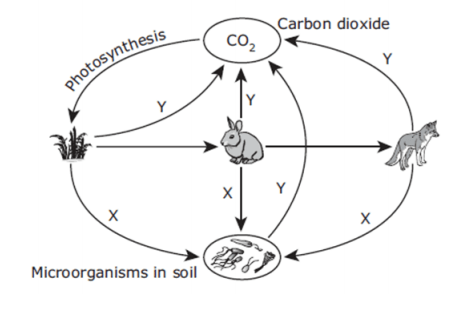
Y : Predation
Y : Decomposition
Y : Nitrogen Fixation
Y : Respiration
C6H12O6 is also known as glucose (sugar). Where is it found?
Plants
Animals
Both plants and animals
Neither plants or animals
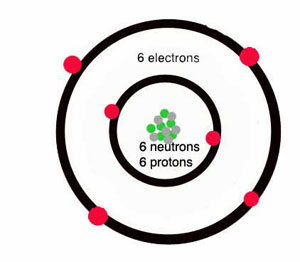
The circulation of the element Carbon among Earth's atmosphere, land, oceans, and organisms is called _____________.
the Carbon Cycle
the Oxygen Cycle
the Carbon dioxide Cycle
the Water Cycle
When animals eat plants, the carbon that the plant contains is absorbed by the animals.
True
False
How do animals get carbon?
By eating plants and or other animals.
They absorb it from the atmosphere.
From the ground
They do not get carbon from anywhere.
What are fossil fuels made from?
Plants and animals that are buried underground for millions of years.
They absorb it from the atmosphere.
Water
Wind
When humans EXHALE, we release __________________.
Oxygen
Carbon Dioxide
Nitrogen
Water
What is CO2?
Carbon Monoxide
Carbon Trioxide
Carbon Dioxide
Oxygen
Which of the following are fossil fuels?
Coal, water, oil
Oxygen, coal, oil
Coal, Oil, Natural Gas
None of the above
How is the carbon cycle similar to the water cycle?
Both involve liquid substances falling to the Earth from the atmosphere?
Neither process works at low temperature.
Both involve the transfer of substances between animals, plants, and the Earth.
Both involve the transfer of substances between the earth and outer space.


Organisms that need nitrogen to survive
only plants
only animals
only bacteria
all living organisms

Plants and animals cannot use nitrogen directly from the air.
True
False

After plants and animals contain nitrogen, what puts it back into atmosphere and soil?
decomposition
precipitation
condensation
bacteria


What happens when organisms die and decay?
Their bodies are lifted up
Their nitrogen returns to the soil
they keep their nitrogen
They stay on earth forever

_____ is the conversion of organic nitrogen into ammonia
Nitrogen Fixation
Ammonification
Denitrification
Assimilation
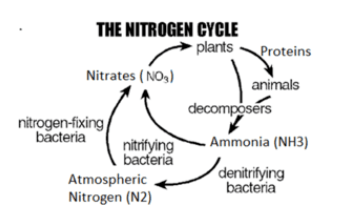
According to this diagram, plants use nitrogen to make _________________________
bacteria
animals
proteins
decomposers
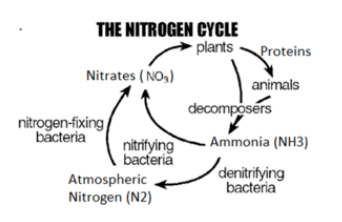
According to this diagram, animals get proteins from eating ________________________
decomposers
bacteria
plants
sunlight
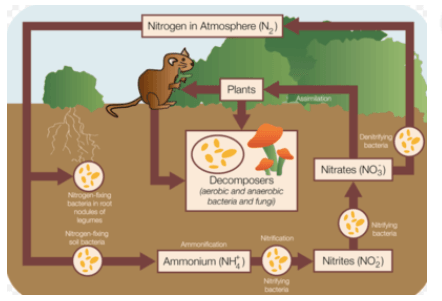
A correct path that nitrogen could take would be
air -> animals -> plants -> bacteria
animals -> air -> bacteria -> plants
bacteria -> air -> plants -> animals
air -> bacteria -> plants -> animals
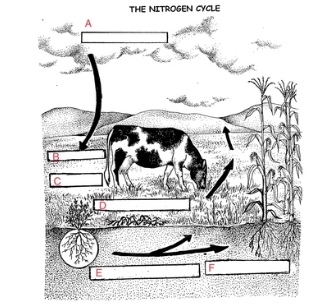
In the nitrogen cycle, what does label A in the diagram represent?
Gas
Clouds
Carbon dioxide in the atmosphere
Nitrogen in the atmosphere


why do animals and plants need nitrogen?
it helps to synthesize proteins
it helps to synthesize lipids
it helps to synthesize water
it helps to synthesize glucose

What is denitrification?
Conversation of nitrite back to nitrogen gas
Conversation of ammonia back to nitrogen gas

What % of the air is made of nitrogen?
21%
52%
61%
78%

Nitrates are poisonous to fish. What should you add more of to get rid of nitrates without having to change the water in your fish tank?
More fish
Nitrobacter bacteria
Nitrosomonas bacteria
Plants

What would happen to this nitrogen cycle if a virus killed all the bacteria?
Nitrogen would just keep on cycling
The cycle would stop
Plants would take over for the bacteria
Fish would grow more because there's no bacteria

What is the carrying capacity of the graph?
1000
8000
800
600
This may cause a population to increase
increase of food supply
removal of predators
removal of disease
all of these

If the carrying capacity of a predator decreases, what will happen to the carrying capacity of the prey?
Will Increase
Will Decrease
Will stay the same

The graph to the right shows the interaction of the wolf and moose populations on Isle Pekie. If the moose population continues to increase, the wolves' food supply will increase. What will most likely happen to the wolf population as a result?
It will decrease.
It will increase.
It will remain the same.
A scientist was studying a population of fish in a pond over a period of 10 years. He observed that
the population increased each year for 3 years, and then remained nearly constant for the rest of
the study. The best explanation for this observation is that the population had
stopped reproducing
reached carrying capacity
mutated into a different species
run out of food and all died
What are factors that affect carrying capacity?
Biotic only
Biotic and abiotic
Depends on the ecosystem
Abiotic only

What happens if a population grows past its carrying capacity?
The population keeps growing
The population starts to die off
The entire species will go extinct
The carrying capacity just increases

What type of growth is demonstrated in the graph?
Exponential
Carrying capacity
Linear
Negative
Logistic population growth can be described as
growth when resources are limited
a s-shaped curve
reaching carrying capacity
all of the above

Exponential Growth occurs when-
populations have plenty of food/space
home to keystone species
have few evasive species in a habitat
have little to no competition or predators

What point on the graph represents the carrying capacity?
A
B
C
D

Logistic growth displays a ____-shaped curve which indicates a population size capped at carrying capacity.
J
S
C
V


Select all description/s of an ecological niche from the following options.
A fox sleeps in a burrow
A bear helps clear lichen off rocks with it's feet when fishing in a stream
A monkey swings off branches to reach fruit
Two different species of bird exist in the same air space without interacting
Birds eat seeds, then disperse them further away

A species that plays a critical role in the health, maintenance, growth, or definition of an ecosystem.
keystone
invasive
engineer
predator

Two or more species that engage in mutually beneficial interactions.
mutualists
engineers
invasives
predators
Select the best definition for the term 'ecological niche'
The physical space where a species lives
A summation of the relationships and interactions a species has with other biotic and abiotic factors
A representation of what a species preys on, and what preys on it i.e. it's place in a food chain
When a species does a job or function that no other species carries out

Which of the following would be the most likely effect, if there were a sudden increase in the cricket population?
There would be a decrease in the small bird population.
There would be a decrease in the grass/flowers population.
There would be a decrease in the mice population.
There would be an increase in the grass/flowers population.
Removing a species from a food web typically results in...
Increased population of their prey
Increased population of their predators
Plant overgrowth
The whole system to collapse

A habitat is the same as an ecological niche
True
False

A keystone species fills a unique ecological niche and therefore carries unique functions in an ecosystem
True
False
Animals will adapt to fill a vacant ecological niche
True
False
Deforestation causes an increase in atmospheric carbon dioxide
true
false


Which CONTINENT is home to the Amazon rainforest?
South America
North America
Australia
Which atmospheric gas contributes to climate change?
carbon dioxide
oxygen
ozone
nitrogen
The area where a plant or animal lives
environment
location
habitat
home
When a habitat is destroyed, ____ (check all that are true)
Only organisms that can adapt quickly will survive
Only organisms that can move out of the area quickly will survive.
No plants or animals will survive.
Most plants will survive because their seeds are still in the ground.
Pollution can cause harm to the ________.
air
water
land
air, water and land
Climate change causes extreme weather conditions such as:
Flooding
Hurricanes
Heat Waves
All of the above

What is biodiversity?
Maintaining something at a stable level
All of the living and non-living things in an environment
All of the members of the same species in an area
All of the different types of living things
What is an endemic species?
Species that can be found anywhere
Animals that became endangered
Organisms that can only be found in restricted habitat
Plants that can undergo photosynthesis
Biodiversity is a priceless treasure and a legacy of nature which should
be preserved. Choose two importance of biodiversity.
Recreational places
To maintain the water level in the atmosphere
Medical
To classify organisms

What can be done by human to maintain and conserve biodiversity (2 answers) ?
Deforestation
Encourage sales of turtle eggs
Reforestation
Carry out breeding programs
True or False: Human beings are wiping out species much faster than nature creates them, causing what scientists call a "6th extinction"
true
false
Which applies to this environmental problem:
Shark fin soup is consumed by millions of people in South East Asia.
Habitat Loss
Invasive Species
Pollution
Population Growth
Over-exploitation
Which applies to this environmental problem:
The albatross are dying from eating plastic items that look like food.
Habitat Loss
Invasive Species
Pollution
Population Growth
Over-exploitation
Which applies to this environmental problem:
As more people are added to the Earth, more resources are required to meet their needs.
Habitat Loss
Invasive Species
Pollution
Population Growth
Over-exploitation
Which applies to this environmental problem:
The zebra mussel is outcompeting native species and causing damage in the Missouri River.
Habitat Loss
Invasive Species
Pollution
Population Growth
Over-exploitation
What is an invasive species?
An organism that is new to an environment that has positive effects on the environment.
An organism that is native to an environment that has negative effects on the environment.
An organism that is new to an environment that has negative effects on the environment.
An organism that is native to an environment that has positive effects on the environment.
The excessive use of species that have economic value is known as
pollution
habitat destruction
over - exploitation
climate change
Which of the following is NOT a way in which humans are destroying habitats?
Gathering rain water to use to water crops
Clearing out prairies to grow a single crop
Cutting trees to use as toilet paper
Building a shopping mall with a large parking lot
How is the current decline in biodiversity different from the previous mass extinctions that Earth has experienced?
It is happening much more slowly
This time it is not really happening
It is made worse by an asteroid hitting Earth
This is being caused by humans
Which applies to this environmental problem:
Humans produce an excessive amount of artificial light which can interfere with natural cycles of light/dark in an environment and can confuse animals.
Habitat Loss
Invasive Species
Pollution
Population Growth
Over-exploitation
Which applies to this environmental problem:
Invasive carp are fast-growing, aggressive, and adaptable fish that are outcompeting native fish species for food and habitat in much of the mid-section of the United States.
Habitat Loss
Invasive Species
Pollution
Population Growth
Over-exploitation
Biodiversity, aka biological diversity, usually refers to
the same species in a general location
the number of different species in a given area
the number of animal species in a given area
the number of plant species in a given area
What is eutrophication?
A process of nutrient enrichment in water bodies
A method of water purification
A geological phenomenon
A type of fish farming
What are the consequences of eutrophication?
Improved water clarity
Decreased plant growth
Increased fish population
Harmful algal blooms and dead zones
Environmental factors do affect genetic diversity
True
False
Sustainability is making sure that the planet and its resources can continue to provide life.
True
False
The variety of different types of genes in a species or population
Speciation
Genetic variation
Artificial selection
Evolution




The ecological role an organism performs in their specific environment is considered the organism's...
Habitat
Population
Biome
Niche

For animals, ______can include nesting space, shelter, types of food, and places to feed.
Thus, each species occupies a distinct (different) ____________.

This outcome of competition often leads to the extinction of one of the competing species
Character Displacement
Competitive Exclusion
Resource Partitioning
Brood Parasitism
No two species can occupy the same niche
Competitive Exclusion Principle
Limiting Exclusion Theory
Competitive Limiting Principle
Limiting Competitive Theory
The inevitable elimination from a habitat of one or two different species with identical needs for resources.
Tertiary Consumer
Organism
Secondary Consumer
Competitive Exclusion
More than one individual or population in an ecosystem that relies upon the same limited resource
Limited Resource
Competition
Dependent Interaction
Organism

Which conclusion is supported by the graphs given?
Competition benefited P. Aurelia
Competition only negatively affected P. caudatum
Competition negatively affected both species but negatively affected P. caudatum more

Which of the following can be inferred from the graph showing the populations of different species of Paramecia grown in individual cultures (no competition)?
P. aurelia outcompeted P. caudatum for the resources
The carrying capacity for P. aurelia is higher than the carrying capacity for P. caudatum
Both species of paramecia are competing for the exact same resource and being successful

Which of the following conclusions is supported by the graph showing the populations of 2 different species of paramecia grown together in a mixed culture?
Both species of paramecia are able to survive when mixed in culture
P. aurelia were able to get their needs met more easily than P. caudatum
Mixing both species of paramecia in one culture ends up giving the same results as if the two species are grown separately.
Two different species fighting for the same resources often enough will lead to what outcome?
Interspecific mating
Intraspecific competition
competitive exclusion
predation
When taken to a new habitat, non-native plants often threaten native plants of the new habitat. Why do they do this?
Non-native plants are able to mutate rapidly
Non-native plants cause native animals to relocate
Non-native plants are able to be used for medicine
Non-native plants compete with native plants for resources

What effect will an invasive species have on the carrying capacity of an ecosystem?
The carrying capacity will increase
The carrying capacity for everyone will decrease
The carrying capacity will only decrease for those in competition for same resource
The carrying capacity for all animals will stay the same

Kudzu has overgrown many parts of southern Missouri and native ground plants have disappeared from the area. This is an example of:
Parasitism between kudzu and the native plants
A predator prey relationship between ground plants and kudzu
Competition occurring between the native and invasive species
Commesalism occurring between the kudzo and native plants
What is the Competitive Exclusion Principle?
Two species can coexist in the same niche indefinitely
No two species can occupy the same niche indefinitely
Species can share resources equally
Species evolve to avoid competition
Which of the following is an example of competitive exclusion?
Two bird species sharing the same tree
One fish species outcompeting another for food
Plants growing in different soil types
Animals migrating to different areas
What happens when two species compete for the same resources according to the competitive exclusion principle?
They will both thrive
One will adapt to a new niche
One will be driven to extinction
They will share the resources
In an experiment, two species of bacteria are grown in the same culture. What is the likely outcome?
Both species will grow equally
One species will outcompete the other
They will form a symbiotic relationship
Both will die off
Which scenario best illustrates the concept of competitive exclusion?
Two species of birds feeding at different times
Two species of fish living in different parts of a lake
One species of plant outgrowing another in the same field
Animals using different types of shelters
How does competitive exclusion affect biodiversity?
Increases biodiversity by creating new niches
Decreases biodiversity by eliminating species
Has no effect on biodiversity
Promotes genetic diversity within species
What is a potential outcome of competitive exclusion in an ecosystem?
Increased resource availability
Decreased species diversity
Stable population sizes
Enhanced mutualistic relationships
Which of the following is NOT a result of competitive exclusion?
Resource partitioning
Species extinction
Niche differentiation
Symbiotic relationships
What role does competitive exclusion play in natural selection?
It accelerates natural selection by favoring the fittest species
It slows down natural selection by reducing competition
It has no impact on natural selection
It promotes genetic drift
In a forest ecosystem, two species of squirrels compete for the same food. What is a likely result?
Both species will increase in number
One species will migrate to a new area
One species will become extinct
Both species will adapt to new food sources
Which of the following best describes the outcome of competitive exclusion in a laboratory setting?
Coexistence of species
Dominance of one species over another
Equal growth of all species
Mutual benefit for all species
How can competitive exclusion lead to adaptive radiation?
By forcing species to evolve new traits
By reducing the number of available niches
By increasing competition among species
By stabilizing population sizes
What is the relationship between competitive exclusion and ecological niches?
Competitive exclusion creates new niches
It reduces the number of available niches
It has no effect on ecological niches
It allows species to share niches
Which of the following experiments would best demonstrate competitive exclusion?
Growing two plant species in separate pots
Observing predator-prey interactions
Cultivating two algae species in the same tank
Studying mutualistic relationships in a coral reef
Definition of an introduced species
an organism that is not native to a place where it is now living.
an organism that is native to a place that it is living.
an organism that you have met.
an organism that has been introduced to other organisms
Which of the following is not an introduced species species to Australia
Cane Toad
Rabbit
Koala
Rat
Which of the following is not a reason introduced species thrive in an area?
A lack of predator
Prior knowledge of the area.
Occupying a niche that is unoccupied
They can reproduce and grow rapidly.
One of the main reasons rabbits are able to thrive in Australia is that they can?
(a)
Introduced species can impact ecosystems by: (4 points)
List as many methods as you can, that are used to control introduced species
What is the main reason for the accumulation of harmful amounts of DDT in the carnivores?
DDT is water soluble and easily excreted from the body
DDT is not absorbed by living organisms
DDT is fat soluble and easily stored in living tissues
DDT is quickly degraded in the environment
What is the term used to describe the increase in concentration of DDT along a food chain?
Bioaccumulation
Biodegradation
Biomagnification
Persistent
What is the evolutionary advantage gained by insects with genetic mutations that made them resistant to DDT?
They became larger in size
They became more colorful
They were not killed by the pesticide
They reproduced at a faster rate
What is the drawback of DDT in terms of its impact on beneficial insects?
It indiscriminately killed beneficial insects along with pests
It only targeted pests and had no impact on beneficial insects
It made beneficial insects more resistant to other pesticides
It had no impact on the population of beneficial insects
What is the main reason for the restriction of DDT usage since 1972? (Select two answers)
Its negative ecological effects
Its ineffectiveness against pests
Its high cost
Its popularity among farmers
What was the main benefit of DDT in preventing millions of deaths from malaria?
Improving the healthcare infrastructure in affected areas
Increasing the resistance of humans to malaria
Significantly reducing the numbers of the mosquito population
Developing a vaccine for malaria
What is the main reason for the toxic concentration of DDT in organisms at the top of the food chain?
Bioaccumulation
Bioremediation
Biomagnification
Biodegradation
What is the term used to describe the process of random genetic mutations leading to insects becoming resistant to DDT?
Artificial selection
Selective breeding
Natural selection
Genetic engineering
What is the main reason for the ineffectiveness of DDT against insects over time?
The development of new and improved insecticides
The decrease in the use of DDT
The change in climate and environmental conditions
The increase in number of DDT-resistant insects
What was the main benefit of DDT in preventing millions of deaths from malaria?
Increasing the resistance of humans to malaria
Significantly reducing the numbers of the mosquito population
Developing a vaccine for malaria
Improving the healthcare infrastructure in affected areas
Algal bloom absorbs sunlight
TRUE
FALSE
Which of the following is NOT a source of nitrates and phosphates into a river?
Fertilizers
Animal waste
Wastewater
Burning fossil fuels
What can be a source of nitrates for eutrophication in rivers?
fertilisers
plastic bottles
paper
sewage
What is the very next thing that happens after fertilisers enter a river in eutrophication?
Fish die due to a lack of oxygen
Plants below the surface die due to a lack of sunlight
The number of aerobic bacteria increases
Fast growth of plants
In eutrophication, what directly causes the death of fish?
The plants use up oxygen in respiration
The fish are poisoned by high CO2 levels
Bacteria use up oxygen in respiration
The fish use up oxygen in respiration
In eutrophication, what does 'algal bloom' refer to?
The rapid increase in the number of bacteria
The rapid increase in the number of plants
The rapid decrease in the number of fish
The rapid increase in the amount of nitrates in the river
Eutrophication is defined as a change that occurs to an aquatic ecosystem. This change is mainly due to what?
Newly introduced fish
Depletion of the ozone layer
Increased nutrient concentration
Increase in atmospheric carbon dioxide.
Which is the correct order of changes that occur during eutrophication?
Aquatic plants cannot photosynthesize and die. Algal blooms blocks light from entering lower levels of a pond or lake. The fish and other aquatic organisms die. The bacteria decompose the algae, and they use up a lot of oxygen during this process. The algae die.
Algal blooms blocks light from entering lower levels of a pond or lake. Aquatic plants cannot photosynthesize and die. The algae die. The fish and other aquatic organisms die. The bacteria decompose the algae, and they use up a lot of oxygen during this process.
Algal blooms blocks light from entering lower levels of a pond or lake. Aquatic plants cannot photosynthesize and die. The algae die. The bacteria decompose the algae, and they use up a lot of oxygen during this process. The fish and other aquatic organisms die.
Aquatic plants cannot photosynthesize and die. Algal blooms blocks light from entering lower levels of a pond or lake. The bacteria decompose the algae, and they use up a lot of oxygen during this process. The algae die. The fish and other aquatic organisms die.
Nitrate and Sulphate are the nutrients that are washed into the water
TRUE
FALSE
Without the greenhouse effect, the average temperature on Earth would be...
zero degrees Celsius
above zero degrees Celsius
below zero degrees Celsius
beyond calculation
Which of these causes global warming?
An increase in greenhouse gases
The burning of fossil fuels
Deforestation
All of the above
Which of these is not a greenhouse gas?
Methane
Ozone
Oxygen
Carbon dioxide
What percentage of the incoming solar radiation is scattered or reflected back into space by the atmosphere and the Earth’s surface?
10
20
30
50
About what percentage of the solar radiation is absorbed by the land, water, and vegetation on the surface of the Earth?
10
30
50
70
What percentage of the Earth’s emitted infrared radiation goes directly into space?
10%
30%
50%
90%
Which greenhouse gases absorb infrared radiation?
Carbon dioxide, methane, and nitrous oxide
Oxygen, hydrogen, and nitrogen
Argon, ozone, and carbon monoxide
All atmospheric gases equally
What is the average global temperature of Earth with the natural greenhouse effect?
0°C (32°F)
15°C (59°F)
30°C (86°F)
-18°C (0°F)
What is the process called when greenhouse gases absorb infrared radiation and re-radiate it back to Earth?
The greenhouse effect
Photosynthesis
Condensation
Evaporation
What is the main consequence of an enhanced greenhouse effect caused by human activities?
A thicker ozone layer
An energy imbalance and global warming
Lower amounts of solar radiation reaching Earth
Decreased carbon dioxide concentrations
What is not a greenhouse gas?
N2
NO2
CO
CH4

The greenhouse effect is caused by human activities
True
False
The ozone layer in the stratosphere absorbs what portion of the radiation from the sun.
Visible light
UVB radiation
IR radiation
UVA radiation

