
 Worksheets
DP SEHS C.2.1 Motor learning processes (Part 2)
Total questions: 20
Worksheet time: 10mins

Which of the following best describes the difference between a skill and an ability?
A skill is something we learn; an ability is something we are born with.
A skill is something we are born with; an ability is something we learn.
Both skill and ability are things we learn.
Both skill and ability are things we are born with.
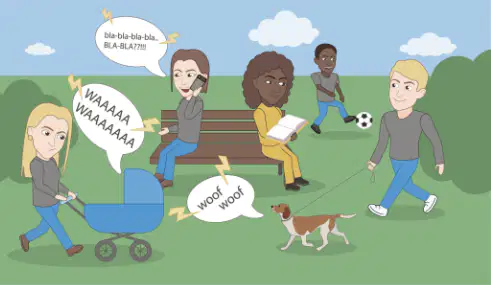
Which process is being demonstrated in the diagram showing people in a park with multiple distractions?
Selective attention
Motor coordination
Long-term memory
Physical endurance
According to Broadbent (1956), what happens to information that is not selected in the short-term memory (STM)?
It is filtered out
It is stored in long-term memory
It is immediately recalled
It is used for decision making
Compare the duration and capacity of sensory store, short-term memory, and long-term memory.
Sensory store: less than 1 second, 1 item; Short-term memory: 6-12 seconds, 7 items (+/-2); Long-term memory: indefinite, indefinite
Sensory store: indefinite, 7 items; Short-term memory: less than 1 second, 1 item; Long-term memory: 6-12 seconds, 7 items
Sensory store: 6-12 seconds, indefinite; Short-term memory: less than 1 second, 1 item; Long-term memory: 7 items, indefinite
Sensory store: 7 items, indefinite; Short-term memory: indefinite, 1 item; Long-term memory: less than 1 second, 6-12 seconds
Which approach to motor learning is described in the provided material?
Linear pedagogical approach
Cognitive behavioral approach
Constructivist approach
Holistic approach
What is the process called when people group numbers together to aid memory?
Chunking
Sorting
Repetition
Coding
Why does chunking help people remember more information than their typical STM capacity?
It reduces the number of bits to remember by grouping items
It increases the total memory capacity
It makes the information more interesting
It eliminates the need for repetition
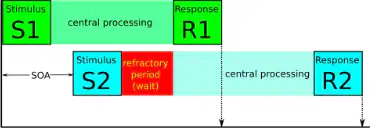
Who created an experiment to test reaction time to an initial stimulus (S1) and a second stimulus (S2)?
Welford
Pavlov
Skinner
Bandura
What is the typical range for simple reaction time when there are no choices?
170-200 ms
100-120 ms
250-300 ms
50-80 ms
If a task involves more stimuli and choices, what is the expected effect on response time?
Slower response
Faster response
No change in response
Unpredictable response
According to Fitts and Posner (1967), which of the following is NOT one of the three stages of learning?
Cognitive phase
Associative phase
Autonomous phase
Reflective phase
Which stage of learning comes after the associative phase in the linear pedagogical approach to motor learning?
Cognitive phase
Autonomous phase
Perceptual phase
Action phase

Which phase of learning is characterized by experience building knowledge, requiring much practice, and aiming to perfect skill and develop consistent coordinated movements?
Associative phase
Cognitive phase
Autonomous phase
Preparatory phase
What is the plateau effect in motor learning?
Learning is slow and never improves
Learning is quick at first, then stops completely
Learning is quick at first, followed by no improvement, then improvement resumes after a breakthrough
Learning is quick at first, then slows down gradually
Which activity best illustrates an executive motor programme?
Triple jump
Catching a football
Doing a flip
Hitting a tennis ball
Which type of control is too fast for feedback to alter movement?
Closed-loop control
Open-loop control
Feedback control
Delayed-loop control
According to Schmidt’s schema theory, what is a schema?
A set of generalized rules or rules that are generic to a group of movements
A specific movement pattern for each action
A memory of past experiences
A type of feedback mechanism
Schmidt believed we develop two types of memory movements. What are they?
Recall schemas and Recognition schemas
Short-term memory and Long-term memory
Procedural memory and Declarative memory
Implicit memory and Explicit memory
Which of the following best describes a recall schema according to Schmidt’s schema theory?
Memory with regard to the choice and initiation of action
Memory for the feel of a movement
Memory for the outcome of an action
Memory for the rules of a game
According to the material, what happens to schemas after they are recalled from long-term memory?
They are forgotten
They are stored in short-term memory and allow for a selection of a movement
They are used to create new rules
They are transferred to sensory memory

