
 Worksheets
AS_3.1 Monitoring and Control Systems
Total questions: 30
Worksheet time: 15mins
Which statement best distinguishes monitoring from control in computer systems?
Monitoring involves measuring and reporting data; control involves using data to influence devices.
Monitoring converts analogue signals to digital; control converts digital signals to analogue.
Monitoring uses actuators; control uses sensors.
Monitoring always requires feedback; control does not use feedback.
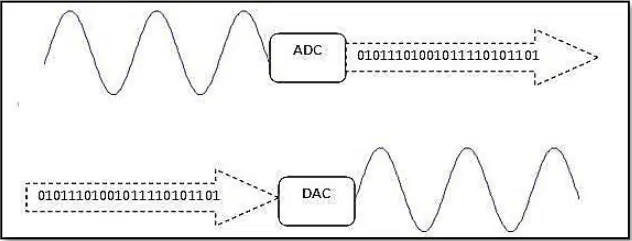
What is the primary reason an Analogue to Digital Converter (ADC) is used with sensors?
To amplify weak sensor signals
To convert continuously varying analogue readings into discrete digital values a computer can process
To store sensor readings in memory
To reduce electrical noise in sensor circuits
Which device is required when a computer sends signals to operate a motor or valve that expects analogue input?
Sensor
Transducer
Digital to Analogue Converter (DAC)
Analogue to Digital Converter (ADC)
Which statement correctly defines an actuator, according to the material?
A device that measures physical properties like temperature and pressure
A device that accepts a computer signal and produces a physical movement; also called an output transducer
A circuit that converts analogue signals to digital data
A component that stores discrete values for later control actions
Which of the following is an example of an actuator listed in the material?
Thermistor measuring temperature
Microphone converting sound to electricity
Lamp converting electricity to light
pH probe measuring acidity
Which sensor application pairing matches the table provided?
Magnetic field sensor: monitors river pollution levels
pH sensor: used in anti-lock braking systems
Magnetic field sensor: used in anti-lock braking systems in motor vehicles
pH sensor: detects movement in a motor
Which sensor type is most appropriate for measuring O2 and CO2 levels in a greenhouse?
Gas sensor
Pressure sensor
Light sensor
Thermocouple
A system needs to automatically switch on a car’s headlights when it gets dark. Which sensor category best fits this application?
Acoustic/sound
Infra-red/Motion
Light
Moisture/humidity
What is the primary output of a thermocouple as described?
Electrical resistance that changes with pressure
Electrical voltage that changes with temperature
Light intensity that varies with humidity
Sound frequency that changes with motion
Which statement best explains an advantage of using sensors in monitoring systems?
They require human interaction for accuracy.
Readings are generally more accurate than those taken by human operators.
They eliminate the need for calibration.
They never produce false readings.
A car’s rear bumper sensors become dirty and either fail to detect obstacles or give a continuous alarm. This situation illustrates which concept?
Benefit of automation
Faulty sensors giving bogus results
Thermocouple temperature drift
Light sensors controlling street lighting
Which description best matches a computerised monitoring system?
A system that requires manual checks at fixed intervals
A system designed to watch a state external to the computer and automatically detect when a property goes outside a desired range
A system that controls processes without using sensors
A system that records only instantaneous readings without considering time
Which component in a monitoring and control system physically carries out the control action?
Sensor
Actuator
Controller
Processor
Which statement best defines a closed-loop feedback control system?
A system that operates without any sensors
A system where feedback directly controls operation by comparing actual output with desired output
A system that only monitors but does not control actuators
A system that runs only when humans intervene
In a closed-loop feedback system, what role does a microprocessor primarily perform?
Actuator
Controller that compares actual output with desired output
Sensor that measures heat
Power supply for the process
Which is an advantage of using control systems mentioned in the material?
They eliminate the need for sensors
They can run only during working hours
Outputs are consistent and error free
They always require human supervision
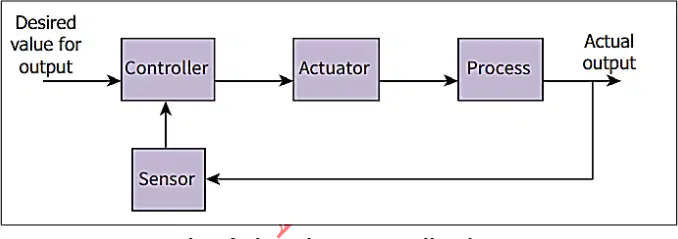
Refer to the feedback loop diagram: Sensor readings are compared with desired output, and the difference is sent to which component to adjust the process?
Actuator
Controller
Process
Power source
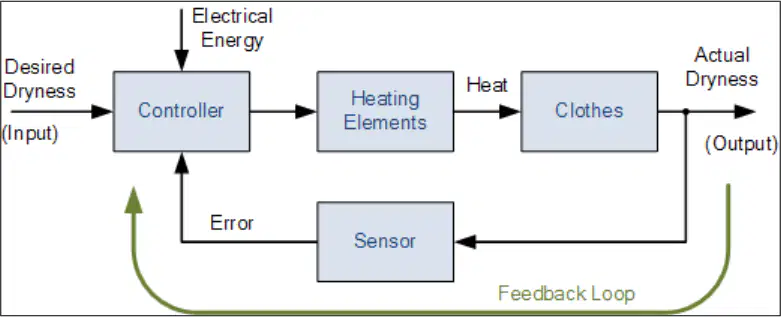
A clothes-drying control example shows a controller receiving desired dryness (input), driving heating elements (actuator), affecting clothes (process), and using a sensor to feed back actual dryness. What is the main importance of feedback in such a system?
To increase manual adjustments by operators
To ensure the output affects subsequent input so conditions are automatically adjusted
To reduce the need for a controller
To convert electrical energy directly into clothes dryness without measurement
Which of the following is an example of a monitoring application?
Turning street lights on at night and off during daylight
Controlling the environment in a greenhouse
Monitoring pollution levels in a river
Operating anti-lock brakes on a car when necessary
In the workflow of a monitoring and control system, what is the purpose of using an ADC?
To convert digital signals to analog for actuators
To convert analog sensor readings to digital so the computer can process them
To amplify sensor signals before comparison with a preset value
To store the preset value used for comparison
Which statement best distinguishes a monitoring system from a control system when data is outside the acceptable range?
Both send signals to actuators to change device states
Monitoring systems activate warnings but do not affect the process, while control systems send signals to actuators
Monitoring systems convert digital to analog signals, while control systems convert analog to digital
Monitoring systems adjust sensors, while control systems only display warnings
During patient monitoring in a hospital, which action is explicitly mentioned as part of the process?
Actuator turns a heater on or off near the patient
Computer samples the data at frequent intervals from sensors measuring temperature, heart rate, and breathing rate
Street lights are controlled based on patient activity
Traffic lights are synchronized with the patient's vital signs
In a control system, why might a Digital to Analog Converter (DAC) be required after the processor produces a digital signal?
Because sensors only accept digital inputs
Because actuators may require an analog signal
Because preset values are always analog
Because the microprocessor compares only analog values
In a burglar alarm system, which sensor detects the weight of a person coming through a window?
Infra-red sensor
Acoustic sensor
Pressure sensor
Light sensor
Magnetic field sensor
Street lighting control uses a light sensor whose analogue output is first sent to which component before the microprocessor?
DAC
ADC
Amplifier
Actuator
Relay
Which event triggers the microprocessor in an ABS to reduce braking pressure on a wheel?
When all wheels rotate at the same speed
When one wheel rotates too slowly indicating lock-up
When the car is accelerating
When the brake pedal is released
When headlights are turned on
In the burglar alarm workflow, what happens if incoming sensor data values are outside the acceptable preset range?
The system shuts down automatically
The microprocessor sends a signal to activate a siren or flashing light
Data is ignored until the next sampling cycle
The password is reset
Sensors are disconnected
For street lighting control, what condition causes the microprocessor to switch the lamp on?
Sensor data greater than preset value
Battery voltage below threshold
Sensor data less than preset value
Manual override engaged
ADC detects a fault
In an anti-lock braking system (ABS), sensors check the rotational speed of each wheel several times a second. What immediate action occurs if one wheel is rotating too quickly compared to the others?
Braking pressure to all wheels is reduced to zero
Braking pressure to that wheel is increased until it matches the others
The engine is turned off to stop acceleration
No change occurs; the system only logs the event
Which statement best distinguishes a monitoring system from a control system?
Monitoring systems include actuators and provide continuous feedback to change inputs
Monitoring systems do not control any process and do not involve actuators; control systems control a process and have output that affects input with continuous feedback
Both monitoring and control systems lack actuators and do not use feedback
Control systems only collect data while monitoring systems change the process using actuators

