
 Worksheets
DFT-SURGERY2D2-16-10-2025-MAXEMO
Total questions: 10
Worksheet time: 8mins
The "bell-clapper deformity" is the most common anatomical risk factor for intravaginal testicular torsion. This deformity, which allows the testis to rotate freely on the spermatic cord, is a direct result of which embryological anomaly?
An abnormally high attachment of the tunica vaginalis onto the spermatic cord, allowing it to completely encircle the testis.
Failure of the gubernaculum to descend and properly anchor the inferior pole of the testis to the scrotal floor.
A widely patent processus vaginalis, which leads to a communicating hydrocele and excessive testicular mobility.
Complete agenesis of the epididymis, leading to a disconnect between the testis and its scrotal attachments.
A 17-year-old, sexually active male presents with a 5-hour history of severe right scrotal pain, vomiting, and lower abdominal discomfort. On examination, the right testis is exquisitely tender, high-riding with a transverse lie, and the cremasteric reflex is absent. A urine dipstick reveals trace leukoesterase and 5-10 WBC/hpf. Despite the urinalysis finding, which of the following is the most critical and appropriate next step?
Immediate surgical exploration of the scrotum
Empiric treatment with ceftriaxone and doxycycline for presumed epididymitis
Urgent color Doppler ultrasound to confirm the diagnosis before any intervention
Abdominal and pelvic CT scan to rule out a retroperitoneal cause for the pain
A 35-year-old male presents to his urologist after noticing a painless, firm swelling in his right testicle. He denies any history of trauma. His medical history is significant for cryptorchidism (an undescended testis) as a child, which was surgically corrected. An ultrasound reveals a solid, homogenous, hypoechoic mass. Based on the patient's age and the high prevalence of this tumor type, what is the most likely diagnosis?
Seminoma
Yolk Sac Tumor
Choriocarcinoma
Leydig Cell Tumor
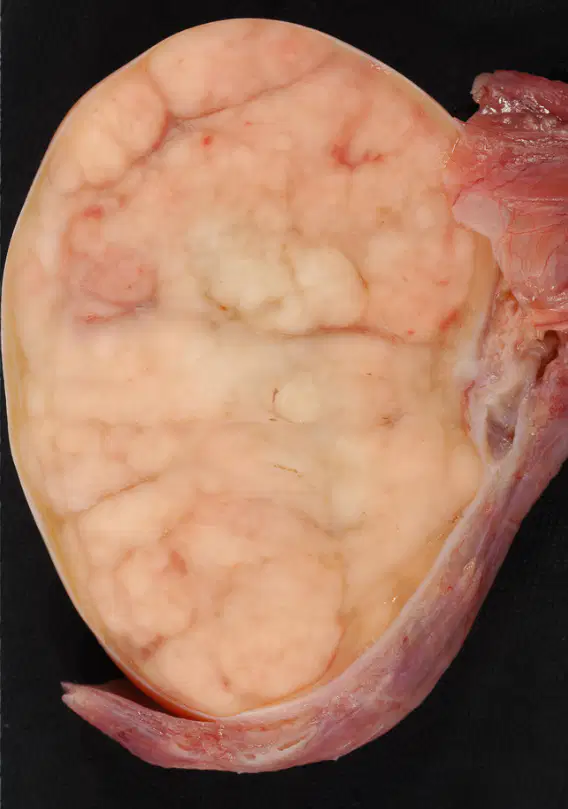
A pathologist examines a testicular tumor specimen. On gross examination, the cut surface reveals a solid, homogenous, tan-white, fleshy mass that bulges and appears to compress the surrounding normal testicular tissue. Based on the provided image and this description, which diagnosis is most likely?
Teratoma
Seminoma
Choriocarcinoma
Yolk Sac Tumor
A 24-year-old male presents for a fertility workup. An incidental, firm, 1.5-cm nodule is palpated in his right testis. Scrotal ultrasound confirms a solid, hypoechoic, intratesticular lesion. His serum AFP and β-hCG levels are within the normal range. The surgeon proceeds with an inguinal exploration. After delivering the testis and applying a non-crushing clamp to the spermatic cord, what is the most appropriate next step in management?
Perform an excisional biopsy of the lesion for intraoperative frozen section analysis
Proceed directly with a high inguinal radical orchiectomy
Close the incision and await results from serum tumor markers drawn post-operatively
Perform a trans-scrotal wedge resection for better cosmetic results
A 28-year-old male was diagnosed with a non-seminomatous germ cell tumor (NSGCT) with para-aortic lymph node metastases (Stage II). He completed three cycles of BEP chemotherapy, after which his serum tumor markers normalized. A follow-up CT scan reveals a single residual 2.5-cm retroperitoneal lymph node. What is the mandatory next step in management?
Proceed with a retroperitoneal lymph node dissection (RPLND)
A PET/CT scan to assess the viability of the residual mass
Observation with serial imaging and tumor markers
Radiation therapy to the residual para-aortic mass
A 19-year-old male complains of a dragging discomfort in his left scrotum. Examination reveals a palpable "bag of worms" superior to the left testis, consistent with a varicocele. As noted in the provided diagram, which physical examination finding is essential to confirm a primary, uncomplicated varicocele?
The mass decompresses and disappears when the patient is in the supine position.
The cremasteric reflex is absent on the affected side.
The mass is exquisitely tender to palpation.
The testis on the affected side is significantly enlarged.
A 45-year-old man is diagnosed with invasive ductal carcinoma of the breast. His family history is notable for a sister diagnosed with breast cancer at age 39 and a mother who died from ovarian cancer. This patient's clinical presentation and family history are most strongly suggestive of a mutation in which of the following genes?
BRCA2
BRCA1
CHEK2
TP53
A 62-year-old woman presents for her annual screening mammogram. She is asymptomatic. The radiologist identifies a new 1.5 cm spiculated mass with associated microcalcifications in the upper outer quadrant of her right breast. The final report assigns this finding a BI-RADS 5 category. What is the most appropriate next step in management?
Core needle biopsy of the mass
Proceed directly to lumpectomy and sentinel lymph node biopsy
Short-term follow-up mammogram in 6 months
Reassure the patient and recommend routine screening in one year
A 38-year-old male is diagnosed with primary hyperparathyroidism after presenting with recurrent kidney stones and being found to have elevated serum calcium and parathyroid hormone (PTH) levels. His family history is significant for his father having had a pituitary tumor and his sister having a pancreatic tumor. A surgeon is planning a neck exploration. Which of the following is the most likely underlying pathology?
Solitary parathyroid adenoma
Multi-gland parathyroid hyperplasia
Parathyroid carcinoma
Ectopic PTH-secreting tumor

