wayground logo

Free Printable Worksheets

Font size

S
M
L
XL
Worksheets

DNA Structure & Replication - Gen Bio

Total questions: 41

Worksheet time: 34mins
Name
Class
Date
1.
In nucleotides, the letters A, G, C and T represent
a)
phosphate groups
b)
deoxyribose sugars
c)
nitrogen bases
d)
ribose sugar
2.
In a nitrogen base pair, guanine always pairs with __.
a)
adenine
b)
cytosine
c)
thymine
d)
guanine
3.
In a nitrogen base pair, thymine always pairs with __.
a)
adenine
b)
cytosine
c)
thymine
d)
guanine
4.
In a nitrogen base pair, adenine always pairs with __.
a)
adenine
b)
cytosine
c)
thymine
d)
guanine
5.
In a nitrogen base pair, cytosine always pairs with __.
a)
adenine
b)
cytosine
c)
thymine
d)
guanine
6.
The structure of DNA is referred to as a ___ because it is a twisted ladder.
a)
Double-helix
b)
Chromosome
c)
Gene
7.
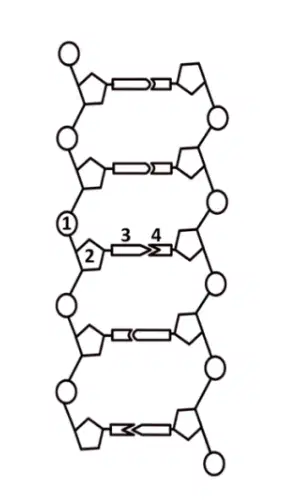
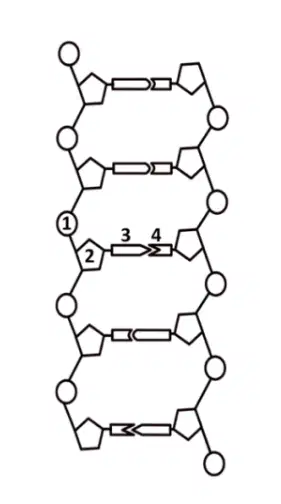
Use the diagram and your knowledge of biology to answer this question. Structures 3 and 4 are held together by?
a)
weak hydrogen bonds
b)
strong covalent bonds
8.
Use the diagram and your knowledge of biology to answer this question. How many nucleotides are present in the diagram below?
a)
5
b)
10
c)
15
d)
30
9.
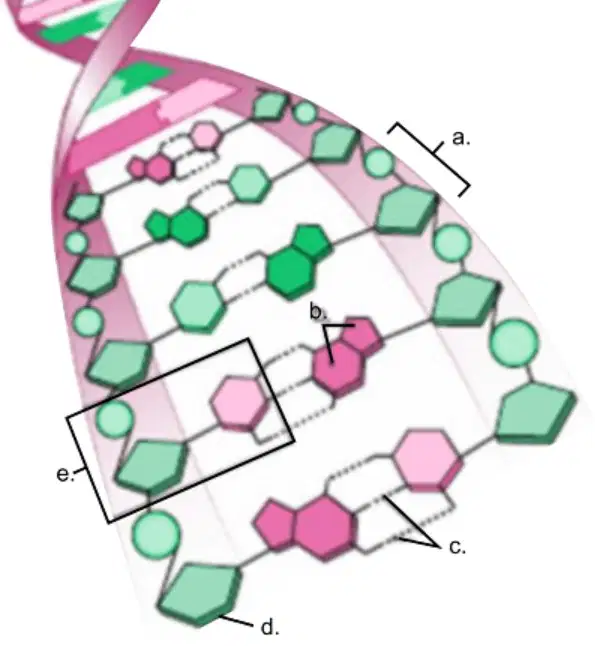
In the double helix model of DNA, the structure labeled "e" below is best described as a/an:
a)
nucleotide
b)
nitrogen base pair
c)
amino acid group
d)
codon
10.

In the double helix model of DNA, the structure labeled "c" below is best described as a/an:

a)
nucleotide
b)

hydrogen bonds

c)
amino acid group
d)
codon
11.

In the double helix model of DNA, the structure labeled "d" below is best described as a/an:

a)

deoxyribose sugar

b)

hydrogen bonds

c)
amino acid group
d)
codon
12.
If there are 10% adenines in a strand of DNA, then what percent thymines should be present?
a)
10%
b)
30%
c)
40%
d)
80%
13.
If there are 10% adenines in a strand of DNA, then what percent guanines should be present?
a)
10%
b)
30%
c)
40%
d)
80%
14.
What are the complementary base pairs for the following DNA strand? CGT AGC TTA
a)
CCA TCG AAT
b)
GCA TTG AAT
c)
GCA TCG AAT
d)
CGT AGC TTA
15.
Why does DNA replication occur?
a)
So our cells can divide and have an identical copy of the DNA in each cell
b)
So our cells can make proteins
16.

If there are 20% thymines in a DNA sequence, then what percent adenines should be present?

a)

10%

b)

20%

c)

30%

d)

80%

17.

If there are 20% thymines in a DNA sequence, then what percent cytosines should be present?

a)

10%

b)

20%

c)

30%

d)

80%

18.

Which of the following is a base pair?

a)

Adenine - Cytosine

b)

Cytosine - Thymine

c)

Deoxyribose - Cytosine

d)

Cytosine - Guanine

19.

Cytosine pairs with which base?

a)

Adenine

b)

Cytosine

c)

Guanine

d)

Thymine

20.

Adenine pairs with which base?

a)

Adenine

b)

Cytosine

c)

Guanine

d)

Thymine

21.
Question Image

Match the following DNA base pairs.

a)

Adenine pairs with

1.

Thymine

b)

Thymine pairs with

2.

Adenine

c)

Cytosine pairs with

3.

Guanine

d)

Guanine pairs with

4.

Cytosine

22.

A model of DNA is shown.

Which part of the DNA model is most directly associated with the coding of genetic information?
23.

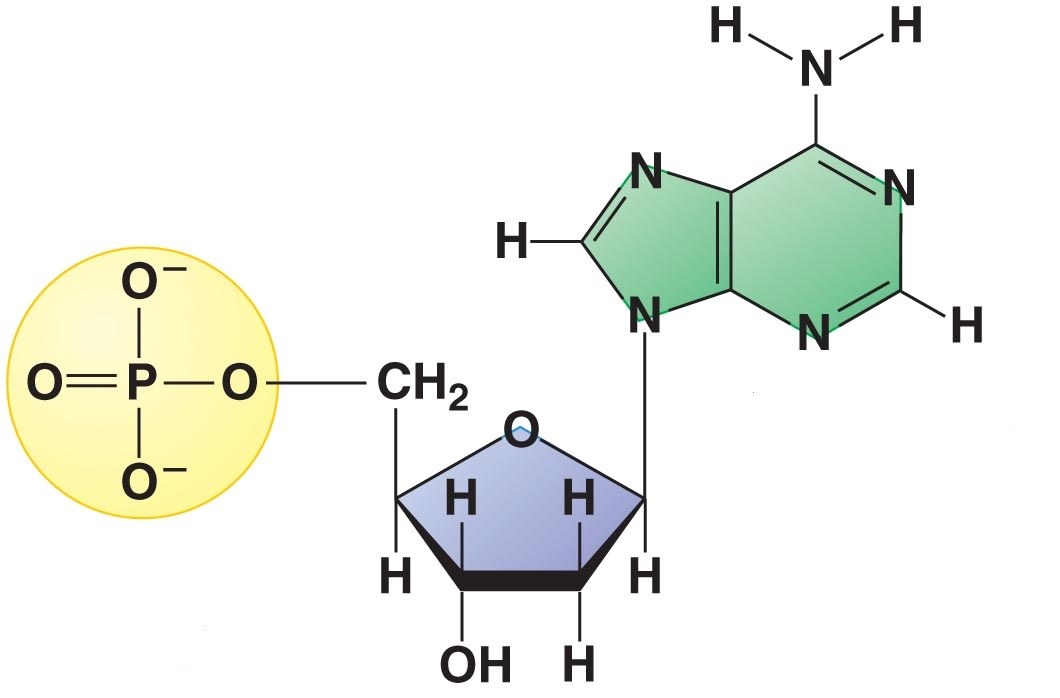
What is the name of the blue part of this image?

a)

phosphate group

b)

deoxyribose

c)

nitrogen base

24.

Chargaff's rules state that....

a)

The amount of A's always = the amount of C's and the amount of T's always = the amount of G's.

b)

The amount of A's always = the amount of A's and the amount of C's always = the amount of C's.

c)

The amount of A's always = the amount of G's and the amount of C's always = the amount of T's.

d)

The amount of A's always = the amount of T's and the amount of C's always = the amount of G's.

25.

What does the term semi-conservative mean?

a)

DNA consists of half an old strand and half a new strand and the code stays conserved.

b)

DNA consists of two old strands and the code stays conserved.

c)

DNA consists of two new strands and the code stays conserved.

d)

DNA consists of half an old strand and half a new strand and the code changes each time.

26.

Look at the image of DNA, what do the circles represent?

a)

Sugars

b)

Phosphate groups

c)

Nitrogen bases

d)

Covalent Bonds

27.

The enzyme that unwinds the DNA to prepare for replication is _.

a)
helicase
b)
replicase
c)
polymerase
28.

Which enzyme seals any gaps in the new DNA strands?

a)
Helicase
b)
Polymerase
c)
Ligase
29.
What are the yellow "beads" that DNA is coiled around?
a)
Centromeres
b)
Telomeres
c)
Histones
d)
Chromatin
30.

What is the function of DNA polymerase in DNA replication?

a)

Unwinds the DNA double helix

b)

Builds the new DNA strands

c)

Proofreads the newly synthesized DNA strands

31.
What are the three components of a nucleotide?
a)
sugar, hydrogen, nitrogen base
b)
sugar, oxygen, nitrogen base
c)

sugar, phosphate group, nitrogen base

d)

sugar, phosphate group, protein

32.

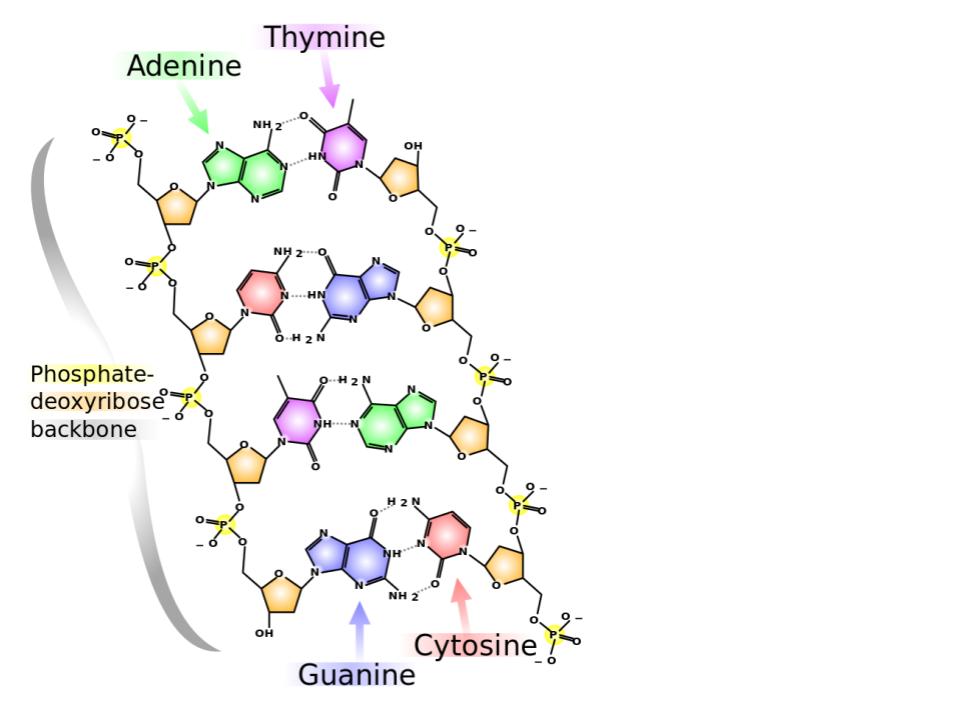
How many nucleotides are in this image?

a)

8

b)

2

c)

4

d)

24

33.

What is the complement to the DNA strand below:

5'-ATGCCAT-3'

a)

ATGCCAT

b)

TACGGTA

34.

If there are 5% adenines in a strand, then what percent thymines will there be?

a)

0%

b)

5%

c)

95%

d)

45%

35.
What are the 4 nitrogen bases?
a)
adenine, thymine, cytoplasm, and guanine
b)
adenine, thymine cytosine, and guanine
c)
adenine, thymine, cytosine, and gylcerol
d)
adenine, thymine, cytosine, and glucose
36.
Where is DNA located in eukaryotes?
a)
ribosome
b)
cytoplasm
c)
lysosomes
d)
nucleus
37.

What bases are considered Purines?

a)

Adenine and Guanine

b)

Cytosine and Guanine

c)

Cytosine and Adenine

38.

What bases are considered Pyrimidines?

a)

Adenine and Thymine

b)

Cytosine and Thymine

c)

Cytosine and Guanine

39.
What is the name of the sugar found in DNA?
a)
Deoxyribose
b)
Oxyclean
c)
Glucose
d)
Ribose
40.
Why is it important that when DNA is copied, it makes an exact copy?
a)
If not, then there will be different instructions passed on to the new cell
b)
It's not important
c)
It's not important because the cell will just figure it out
41.

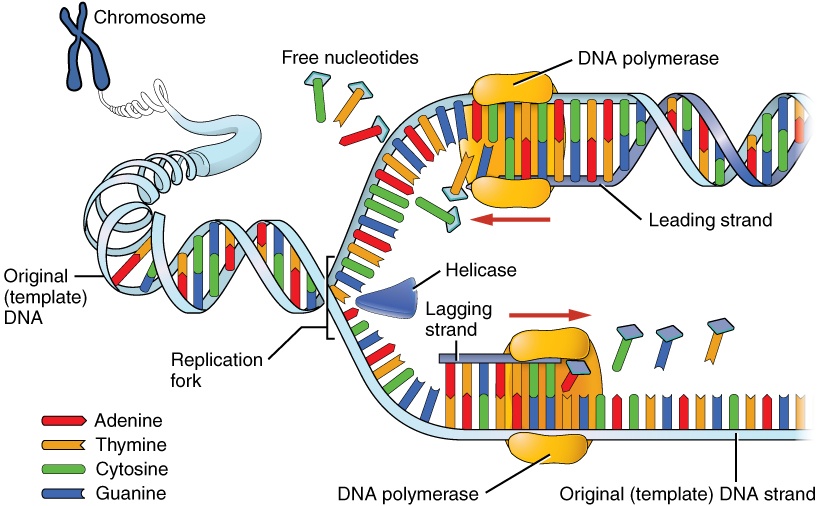
The picture below shows an enzyme unwinding and unzipping DNA.

​What is the name of this enzyme?

a)

Helicase

b)

Ligase

c)

DNA polyermase