
 Worksheets
Passive Transport Worksheet Questions (Grade 12)
Total questions: 38
Worksheet time: 19mins
Passive Transport — Cell transport that requires ______ cellular energy (ATP) to be used.
no
some
large amounts of
variable
Passive Transport — Molecules will move from a ______ concentration to a ______ concentration.
high; low
low; high
equal; higher
random; ordered
Three types of passive transport — Which of the following is one of the three types of passive transport?
Diffusion
Endocytosis
Exocytosis
Active transport
Cells need certain ______ to stay alive.
substances
organelles
impulses
pigments
Some substances must be ______ from the cell.
removed
manufactured
stored
imported
To get these substances in or out, they must pass through the ______ membrane.
plasma (cell)
nuclear
mitochondrial
Golgi
The movement of molecules from an area of high concentration to an area of low concentration describes this process.
passive transport
active transport
biology transport
wildcat transport
In passive transport, molecules will move ______ the concentration gradient.
down
up
against and require ATP to move up
randomly without a gradient
______ ______: difference in the concentration of a substance.
Concentration gradient
Selective permeability
Membrane potential
Activation energy
Diffusion — Some ______ molecules can ______ through the phospholipid bilayer.
small nonpolar; diffuse
large charged; pump
large polar; be endocytosed
ionic; be actively transported
Diffusion — ______ molecules cannot pass through the phospholipid bilayer.
large and/or charged
small nonpolar
nonpolar gases
hydrophobic
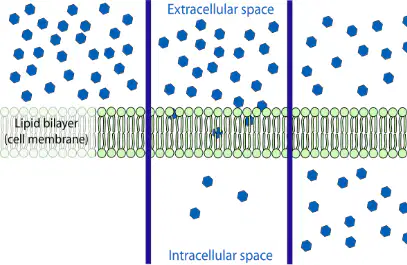
Diffusion — Since only small particles can pass through, we say that the plasma membrane is ______ ______.
selectively permeable
fully porous
electrically neutral
uniformly permeable
Examples of Diffusion — Which situation illustrates diffusion?
Lungs exchanging oxygen and carbon dioxide
Vesicles releasing enzymes via exocytosis
ATP-driven sodium–potassium pumping
DNA replication in the nucleus
Facilitated Diffusion — Uses a ______ protein.
carrier
motor
receptor tyrosine kinase
ribosomal
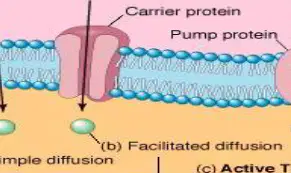
Facilitated Diffusion — Helps ______ molecules move from an area of high concentration to an area of low concentration.
larger or polar
small nonpolar
hydrophobic gas
lipid
Facilitated Diffusion — Human example = ______ (blood sugar).
glucose transport
glycogen synthesis
insulin secretion
fructose fermentation
Facilitated Diffusion — Uses hormone ______ to activate the carrier protein.
insulin
adrenaline
thyroxine
glucagon
Osmosis — When ______ moves through the phospholipid bilayer it’s called ______.
water; osmosis
sodium; diffusion
glucose; active transport
lipids; filtration
Osmosis is the ______ of water.
diffusion
creation
oxidation
filtration
Water will move from an area of ______ water concentration to an area of ______ water concentration.
high; low
low; high
equal; higher
zero; maximal
Solutions — ______ = a mixture of two or more substances.
Solution
Solvent
Solute
Suspension only
Solutions — The ______ is the liquid; for cells, this is the ______ (mostly water).
solvent; cytoplasm
solute; nucleus
solute; cytoskeleton
solvent; cell wall
Solutions — The ______ is the dissolved substance; in cells, this would be all of the ______, ______, proteins, and other molecules dissolved in the ______.
solute; salts; sugars; cytoplasm
solvent; lipids; gases; nucleus
solute; lipids; DNA; cell wall
solvent; hormones; pigments; vacuole
Three Types of Solutions: Choose all that are named in this worksheet.
Isotonic
Hypotonic
Hypertonic
Aqueous
Saturated
Isotonic Solution: Water moves in and out of the cell at the same rate. What phrase best completes this statement for both cells?
Dynamic equilibrium
Active transport
Bulk flow
Pinocytosis
In an isotonic solution, which description best fits the direction of water movement relative to the cell?
Enters and leaves at equal rates
Only enters the cell
Only leaves the cell
Does not move at all
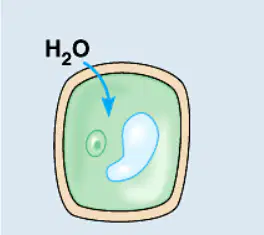
Hypotonic Solution: Water moves ______ the cell; the cell gets ______. Select the best completion.
into; larger (swollen)
into; smaller (shriveled)
out of; larger (swollen)
out of; smaller (shriveled)
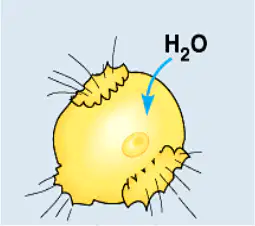
Hypotonic effect on animal cells: Which statement best matches the worksheet?
It is harmful for animal cells and may cause lysis (cell breaking).
It is beneficial for animal cells and increases turgor pressure.
It has no effect on animal cells.
It causes plasmolysis in animal cells.
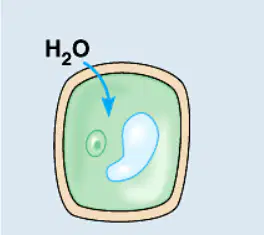
Hypotonic effect on plant cells: Which statement best matches the worksheet?
It is good for plant cells because turgor pressure makes the cell rigid.
It is bad for plant cells because it causes plasmolysis.
It causes crenation of plant cells.
It leaves plant cells flaccid with no pressure.
Hypertonic Solution: Water moves ______ the cell; the cell shrinks. Select the best completion.
out of
into
randomly within
both into and out of at equal rates
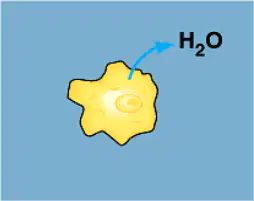
Hypertonic effect on animal cells: Which term best describes this condition for animal cells according to the worksheet?
Harmful; crenation (cells lose water and shrink)
Beneficial; turgid state
Neutral; no size change
Cytolysis (cells burst)
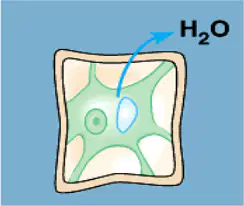
Hypertonic effect on plant cells: Which description best matches the worksheet?
Harmful; plasmolysis (cell loses rigid structure and shrinks)
Beneficial; increased turgor pressure
Neutral; cell remains normal size
Crenation of plant cells increases rigidity
Passive Transport Summary: All three processes (diffusion, facilitated diffusion, osmosis) are examples of what kind of transport?
Passive transport
Active transport
Bulk transport
Endocytosis
Passive Transport Summary: What energy requirement do these processes have?
No ATP is required
ATP is required continuously
GTP is required
They require energy only for large molecules
Passive Transport Summary: Molecules move from an area of ______ concentration to an area of ______ concentration.
higher; lower
lower; higher
equal; equal
random; organized
Which substance is moved by osmosis in this worksheet’s table of passive transport?
Water
Ions only
Large proteins
Lipids only
According to the worksheet’s table, which part of the membrane is primarily used in facilitated diffusion?
Transport proteins (channels or carriers)
Phospholipid tails only
Cholesterol molecules
Glycolipids
According to the worksheet’s table, simple diffusion mainly involves movement through which membrane component?
Phospholipid bilayer
Ribosomes
Cell wall pores
Mitochondrial cristae

