
 Worksheets
CMA Review 1
Total questions: 35
Worksheet time: 18mins
Which statement best describes how maps are used?
Maps always show complete and unbiased information
Maps only show physical features
Maps always show the same information
Maps can change or highlight information for specific purposes
Regional boundaries are best described as:
Permanent and unchanging
Always clearly defined with no overlap
Transitional and sometimes contested
Defined only by physical features
How does scarcity of natural resources affect human settlement patterns?
Scarce resources usually lead to lower population density
Scarcity has little effect on transportation networks
Resource scarcity often shapes trade routes and transportation networks
Areas with scarce resources develop faster than resource-rich regions
Which of the following is an unintended consequence of human interaction with the environment?
Building dams for power
Introducing invasive non-native species
Creating national parks
Setting up wildlife reserves
Which of the following best describes how physical characteristics define a region?
Patterns of language and religion
Climate, biomes, landforms, and bodies of water
Population density and fertility rates
Economic development and service activities
Why did European traders want direct access to Asian markets?
To form military alliances
To lower trade costs
To spread Christianity
To create permanent settlements
Which historical event involved the exchange of crops, animals, and diseases between the Americas and Europe?
establishment of the line of Demarcation
creation of the Hanseatic League
Columbian Exchange
Glorious Revolution
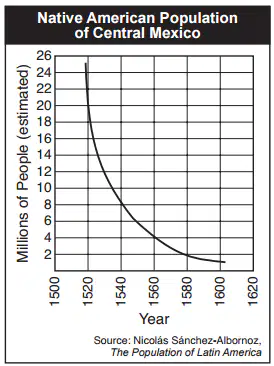
Which statement best explains the population decline shown in the graph?
Native beliefs included human sacrifice.
Tribal warfare occurred during this period.
Native traditions encouraged polygamy.
Europeans brought diseases to Latin America.
How did the Mughal Empire promote cohesion?
By enforcing strict religious uniformity
By separating religion from politics
By practicing limited religious tolerance
By granting complete religious freedom
Under the Qing Dynasty, China's territory was:
Reduced by half
Same as under the Ming Dynasty
Doubled through conquest and diplomacy
Limited to coastal regions
How did Russian and Qing Chinese policies toward Western influence differ by the late 18th century?
Russia rejected Western influence while China embraced it
Both Russia and China equally embraced Western goods and culture
Russia promoted Western goods and culture while China limited Western contact
Both Russia and China completely rejected Western goods and culture
What were two major effects of the Protestant and Catholic reformations in Europe?
Increased illiteracy and unified European states
Religious conflicts and decreased education
Religious conflicts and promotion of literacy
Peaceful transitions and decreased religious practice
What is Vodun?
A new religion unrelated to others
A mix of Catholicism and Amerindian practices
A Protestant movement in Europe
The original religion of South Asia before Sikhism

What does this diagram show about Spanish colonial society in the Americas?
The smallest group had the most power.
Africans and Native Americans had political power.
Peninsulares were the largest group.
Mestizos and mulattoes owned most land.
What was the political impact of the Atlantic Revolutions?
They delayed the formation of nation-states
They restricted political rights to the elite
They democratized political rights
They established absolute monarchies
Which historical event most influenced Simón Bolívar’s speech about establishing a government in Venezuela in 1819?
Treaty of Nanjing
The Cold War
The Enlightenment
Industrial Revolution
What problem does Montesquieu identify when legislative and executive powers are united?
Concentration of power
Lack of natural rights
Technological advancements
Direct democracy
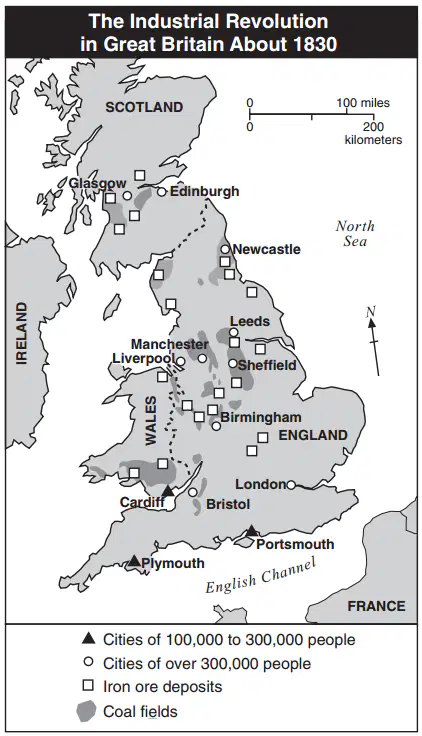
Which conclusion is best supported by the map?
England’s natural resources led to the growth of industrial cities.
In 1830, England had an unfavorable balance of trade.
Great Britain’s prosperity unified the people.
People emigrated from Great Britain because of pollution.
What was a main economic reason for New Imperialism in Africa and Asia?
To spread democratic ideals
To establish military bases
To get raw materials for industry
To create cultural exchange programs
What was a common result of violent uprisings against Western European imperialism?
Immediate independence
Tighter imperial control
Economic sanctions
Democratic governments
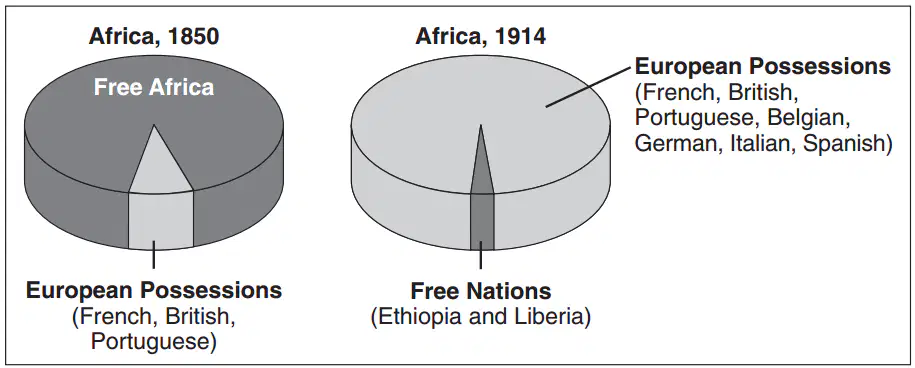
Which factor most likely led to the change shown in the chart?
European desire for resources and markets
African military advancements
European belief in racial equality
Start of World War I
How did World War I differ from earlier wars?
It was fought only in Europe
It used mainly cavalry and old tactics
It had more machines and higher casualties
It lasted less than a year

What event does the cartoon reference through the conflict between Austria-Hungary and Serbia?
The sinking of the Lusitania
The assassination of Archduke Franz Ferdinand
Germany’s invasion of Belgium
Russia’s withdrawal from the war
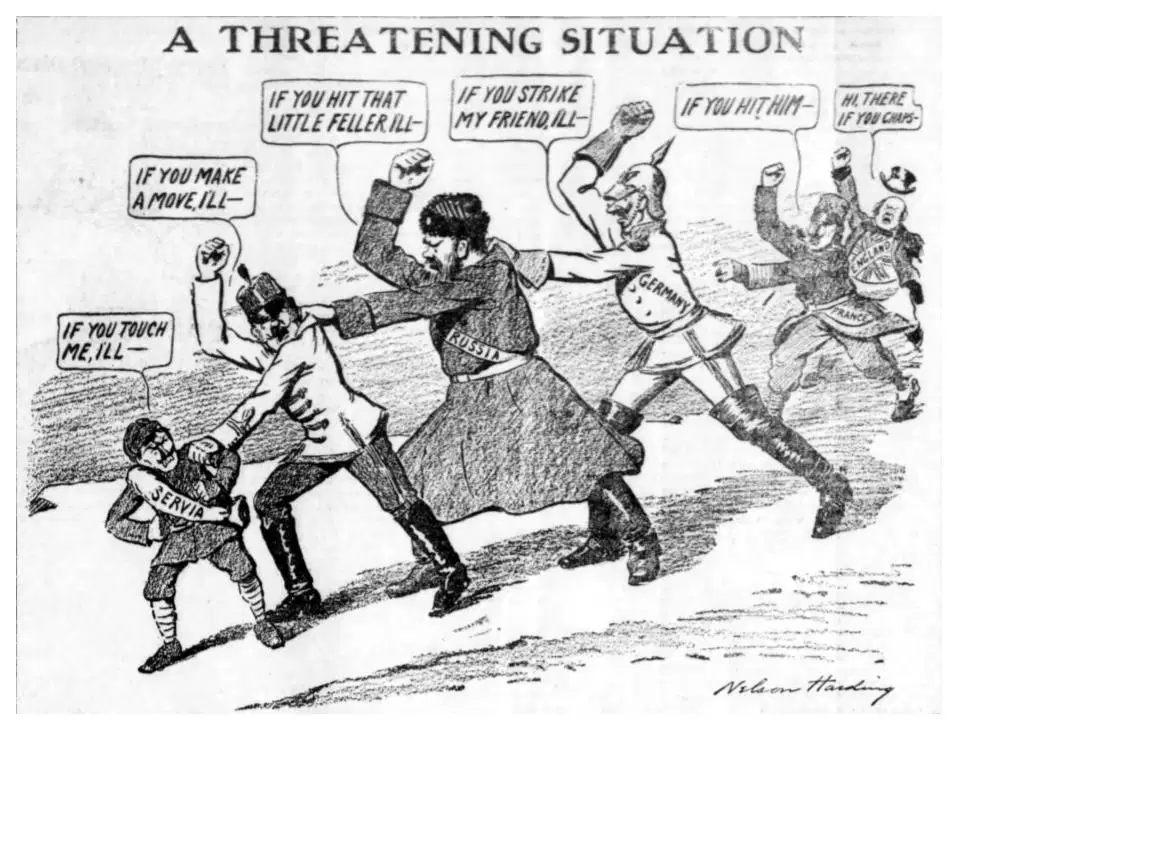
What message does the cartoon give about Europe before WWI?
Nations wanted to work together
Small conflicts could quickly involve major powers in war
Armies were not ready
The Balkans were not connected to world events
What economic system did the USSR establish after the Russian Revolution?
A free market economy
A mixed economy
A communist economy
A capitalist economy
What led to the rise of fascist states in Italy and Germany?
Strong democratic institutions and economic prosperity
Support from communist parties and labor unions
Decreased nationalism and international cooperation
Hostility toward the Treaty of Versailles and high unemployment
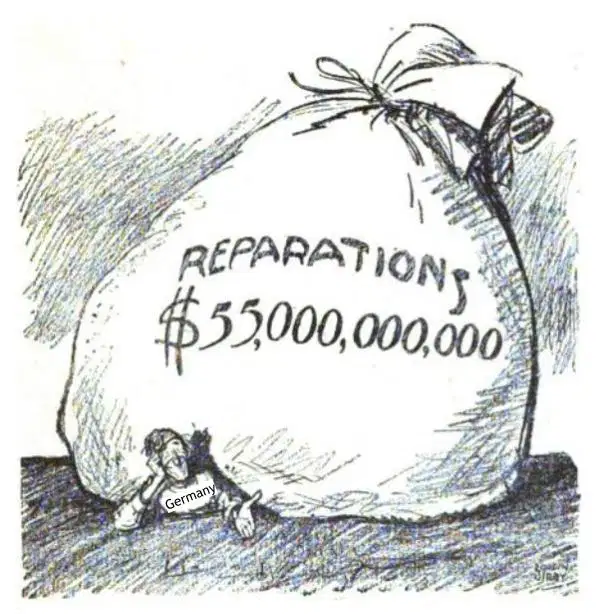
Which event caused Germany's economy to collapse even more, helping extremist groups gain support?
The Russian Revolution
The assassination of Archduke Franz Ferdinand
The Great Depression
The signing of the Non-Aggression Pact
How did World War II affect colonial territories?
Colonial powers became stronger
Colonial territories were mostly unchanged
The war led to independence movements in many colonies
All colonies became independent right after the war
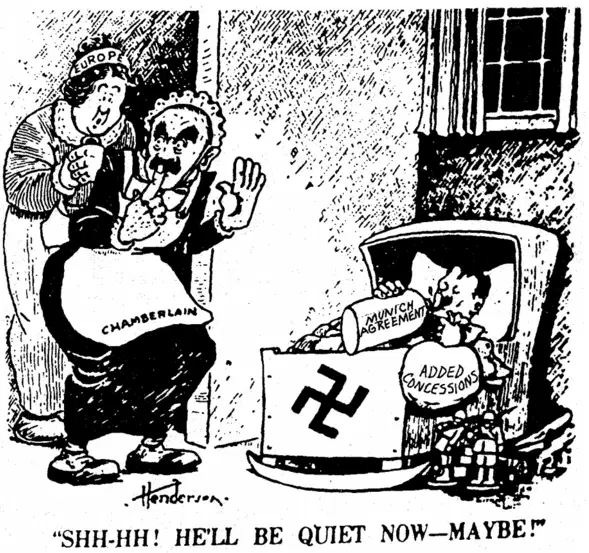
What led to distrust between the U.S. and USSR after World War II?
The development of military industrial complexes
The formation of the United Nations
Japan's surrender to Allied forces
The division of Africa into new nations
The main goal of the Cold War policy of 'containment' was to:
Expand Soviet influence
Stop the spread of communism
Promote nuclear disarmament
Create trade agreements

Which claim is best supported by these maps?
Egypt and Ethiopia are no longer part of Africa.
By 1980, most African countries were independent.
By 1950, most of Africa was controlled by Russia or the United States.
The Union of South Africa was renamed Namibia.
Which statement describes the relationship between manufacturing and globalization?
Manufacturing has disappeared from the global economy
Manufacturing is mainly in Western nations
Manufacturing has shifted to developing nations
Manufacturing is less important to global growth
What is a major environmental impact of increasing consumerism?
Less use of natural resources
More waste and pollution
No manufacturing in developing countries
Lower carbon emissions
How has globalization affected global income distribution?
It has eliminated poverty in most developing nations
It has created equal economic opportunities everywhere
It has increased income and social inequality worldwide
It has mainly benefited rural areas over cities

