
 Worksheets
Exploring Wave Properties and Interactions
Total questions: 33
Worksheet time: 34mins

The _______ of a wave is how many waves pass a given point every second.
Frequency
Wavelength
Amplitude
What is the highest point of a wave called?
Trough
Crest
Amplitude
Frequency
Which term describes the distance between two consecutive crests of a wave?
Amplitude
Wavelength
Frequency
Reflection
What is the name for the lowest point of a wave?
Crest
Trough
Amplitude
Refraction

Where is the rest position
Top of Line
Bottom of line
Middle
End
Which property of a wave measures how tall the wave is from its rest position?
Wavelength
Amplitude
Frequency
Diffraction
What does frequency measure in a wave?
The height of the wave
The number of waves passing a point per second
The distance between crests
The bending of waves

The image represents what type of wave interaction
Refraction
Diffraction
Reflection
Constructive interference
What is it called when a wave bounces off a surface?
Refraction
Reflection
Absorption
Diffraction
Which wave interaction occurs when a wave bends as it passes from one medium to another?
Reflection
Refraction
Absorption
Diffraction
What happens when a wave is taken in by a material and not reflected or transmitted?
Reflection
Refraction
Absorption
Diffraction
What is the term for the spreading out of waves as they pass through an opening or around a barrier?
Reflection
Refraction
Absorption
Diffraction
Which of the following best describes amplitude?
The number of waves per second
The maximum distance a wave moves from its rest position
The distance between two troughs
The bending of waves

Which of the following is an example of wave reflection?
A straw looking bent in a glass of water
An echo in a canyon
Sunlight warming your skin
A rainbow forming after rain
Which situation is an example of refraction in daily life?
Hearing your voice echo in a tunnel
Seeing a pencil look bent in a glass of water
Feeling the warmth of the sun
Hearing a sound around a corner
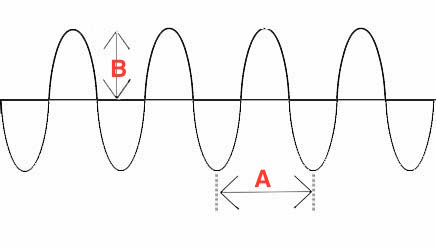
What property of this wave is represented by the letter "A"
amplitude
crest
trough
wavelength
If the wavelength of a wave increases but the speed stays the same, what happens to the frequency?
It increases
It decreases
It stays the same
It disappears
Which of the following best explains why you can hear someone talking around a corner?
Reflection
Refraction
Absorption
Diffraction
If a wave is absorbed by a material, what happens to the energy of the wave?
It is reflected back
It passes through unchanged
It is taken in by the material
It increases in frequency
Which of the following is NOT a property of a wave?
Amplitude
Wavelength
Frequency
Gravity
A student notices that when a wave passes from air into water, its speed changes and the wave bends. What is this an example of?
Reflection
Refraction
Absorption
Diffraction
You shine a flashlight at a mirror and the light bounces back. Which wave interaction is this, and why does it happen?
Absorption, because the mirror takes in the light
Diffraction, because the light spreads out
Reflection, because the light bounces off the surface
Refraction, because the light bends

A sound wave travels from air into water. What happens to its speed and direction, and what is this process called?
Speed stays the same, direction changes, reflection
Speed increases, direction bends, refraction
Speed decreases, direction stays the same, absorption
Speed increases, direction stays the same, diffraction

The picture to the left shows which wave behavior?
absorption
reflection
diffraction
refraction
If you want to design a room to reduce echoes, which wave interaction should you focus on and why?
Reflection, to increase bouncing of sound
Absorption, to take in sound energy
Refraction, to bend sound waves
Diffraction, to spread sound waves
A student observes that when a wave passes through a narrow opening, it spreads out on the other side. What is this called and why does it happen?
Reflection, because the wave bounces back
Refraction, because the wave bends
Diffraction, because the wave spreads out after passing through an opening
Absorption, because the wave is taken in
A student notices that when sunlight passes through a window and hits a carpet, the carpet feels warm. Which wave interaction is responsible, and what happens to the energy?
Reflection, energy bounces off
Refraction, energy bends
Absorption, energy is taken in by the carpet
Diffraction, energy spreads out

Wave __________ shows a steady frequency but changing amplitude.
R
T
S


