
 Worksheets
Matter Test
Total questions: 28
Worksheet time: 14mins
Name
Class
Date
1.
Which of the following describes matter?
a)
Matter is anything that takes up space and has mass.
b)
Matter is energy.
c)
Matter is anything we can and cannot see.
d)
Matter can only be found in liquid, solid, or gas states.
2.
The classification of matter that is made up of identical particles is known as...
a)
Substances
b)
Mixtures
3.
___________________ mixtures are mixtures that are uniform throughout.
a)
Homogeneous
b)
Heterogeneous
c)
Element
d)
Compounds
4.

Which diagram shows a mixture?
a)
A
b)
B
c)
C
5.
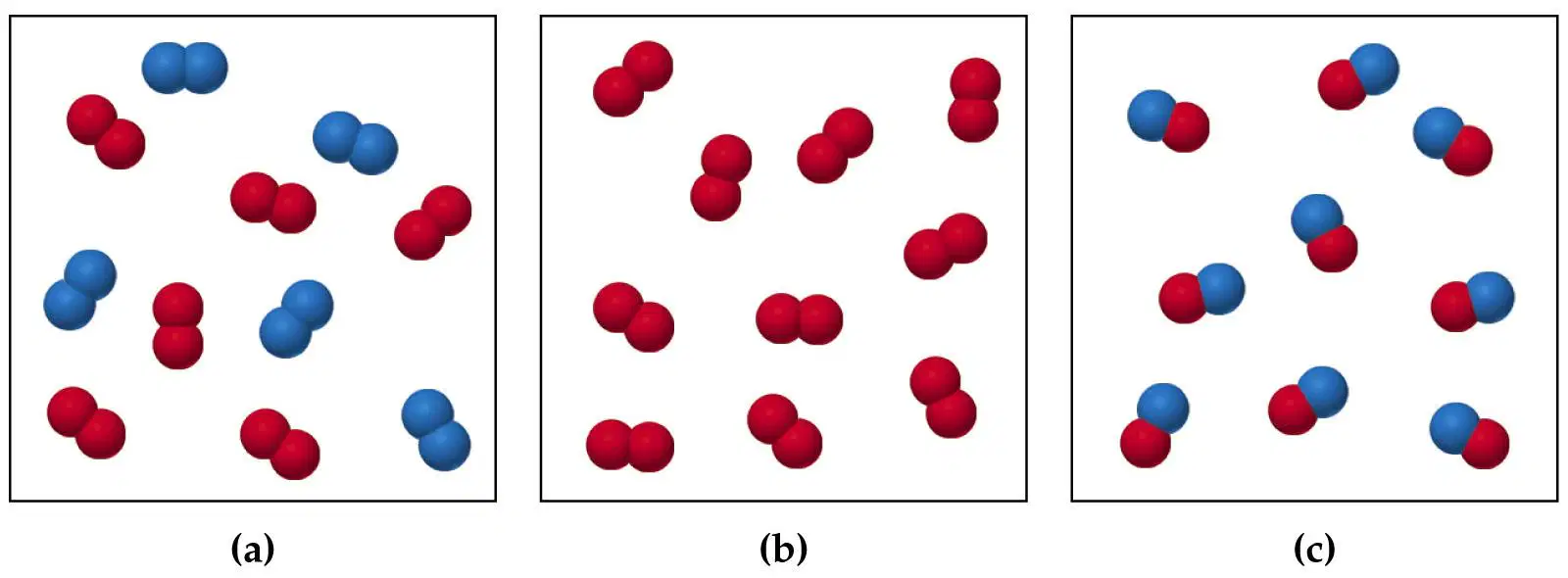
Which diagram shows a compound?
a)
A
b)
B
c)
C
6.
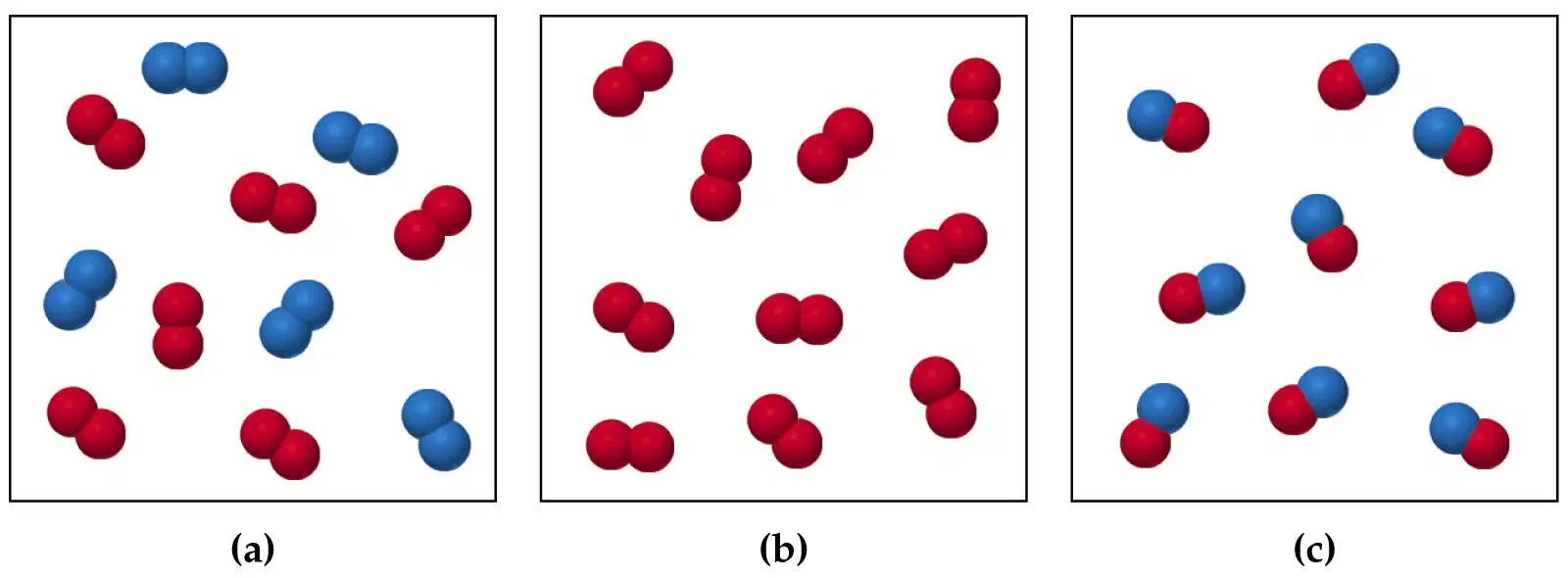
Which diagram shows an element?
a)
A
b)
B
c)
C
7.
Which process describes when enough energy is added to transform a liquid to a gas?
a)
Condensation
b)
Vaporization
c)
Sublimation
8.
Which process describes when enough energy is removed to transform a gas to a solid?
a)
Vaporization
b)
Sublimation
c)
Deposition
9.
Particles in this state of matter are described as having a fixed shape and fixed volume. The particles are vibrating.
a)
Solid
b)
Liquid
c)
Gas
10.
Which of the following states of matter has particle movement that can be described as flowing or sliding past eachother?
a)
Solid
b)
Liquid
c)
Gas
11.
The form of matter with the highest amount of kinetic energy is...
a)
Solid
b)
Liquid
c)
Gas
12.
Which of the following is the correct order of the average states of matter from highest to lowest density?
a)
Solids, Gases, Liquids
b)
Solids, Liquids, Gases
c)
Gases, Liquids, Solids
d)
Gases, Solids, Liquids
13.
Which of the following statements is NOT true about particle motion?
a)
Particles in all states of matter are constantly moving.
b)
Heating a substance can cause a substance to change state.
c)
The way particles move changes when the substance's thermal energy changes.
d)
Particles in all states of matter are arranged close together.
14.
Which of the following does NOT happen when a liquid is heated?
a)
The substance vaporizes and becomes a gas.
b)
The particles gain thermal energy.
c)
The mass of each particle increases.
15.
Which of the following is considered a chemical change?
a)
breaking a ceramic plate
b)
burning a birthday candle
c)
chopping wood
d)
ice melting in a cooler
16.
Which of the following is considered a chemical change?
a)
a slice of banana turning brown
b)
dew appearing on grass in the morning
c)
ice cubes melting in soda
d)
sewing an apron
17.
Which of the following is a physical property?
a)
flammability
b)
combustability
c)
density
d)
reactivity
18.
Which of the following is a physical property?
a)
combustability
b)
oxidation
c)
mass
d)
toxicity
19.
Which of the following is a chemical property?
a)
odor/smell
b)
mass
c)
density
d)
flammability
20.
Which of the following is a chemical property?
a)
oxidation
b)
boiling point
c)
melting point
d)
mass
21.
A physical property will change the substance's identity if it is measured or observed.
a)
True
b)
False
22.
A chemical property can ONLY be observed by changing the identity of a substance.
a)
True
b)
False
23.
Water (H2O) is an example of what?
a)
An elementary substance (an element)
b)
A compound
c)
A mixture
24.
When classifying matter, a saltwater solution could also be called...
a)
An element
b)
A compound
c)
A homogenous mixture
25.
Which of the following statements is NOT true?
a)
Particles in a liquid state of matter have less energy than particles in a gaseous state.
b)
Particles in a solid state of matter have less energy than particles in a liquid state.
c)
Particles in a gaseous state of matter have less energy than particles in a solid state.
26.
When two or more substances are physically combined, the result is a.....
a)
compound
b)
mixture
27.
When two or more elements are chemically combined, the result is a.....
a)
compound
b)
mixture
28.
In which state of matter are particles farthest apart from each other?
a)
Gases
b)
Liquids
c)
Solids
100 %

