
 Worksheets
DFT-EMREECARDIO🫀17-10-2025-STUDYWITHMAXEMO
Total questions: 10
Worksheet time: 8mins
An older man with a known history of chronic atrial fibrillation presents to the clinic in Abu Dhabi complaining of frequent episodes of lightheadedness and palpitations over the past month. He has not been on any cardiac medications for over one year. On examination, he is alert with no signs of acute distress. His blood pressure is 115/75 mmHg, and his heart rate is 125 beats per minute and irregularly irregular. An electrocardiogram confirms atrial fibrillation with a rapid ventricular response. There are no clinical signs of acute heart failure. What is the most appropriate initial medication to manage his symptoms?
Digoxin
Warfarin
Metoprolol
Amiodarone
Lisinopril
A 4 year old girl is brought to the ED by her parents for being “unrousable.” O/E, she is pale with cool extremities. BP 65/40 mmHg, HR 230/min, RR 35/min, Temp 37.1°C. Capillary refill is 4 seconds. GCS is 9. A bedside cardiac monitor displays a narrow-complex tachycardia. IV access has just been established. What is the most appropriate immediate management?
Administer vagal maneuvers
Administer IV adenosine
Perform synchronized cardioversion
Administer IV amiodarone
Secure airway with endotracheal intubation
A female patient presents to the Emergency department of Emirates hospital Jumeirah c/o sudden-onset palpitations & dizziness x1hr. She denies chest pain or syncope. O/E, she is anxious but alert. BP 115/75 mmHg, HR 160/min, RR 18/min, SpO2 99% on RA. Cardiac monitor shows a regular, narrow-complex tachycardia. A 12-lead ECG confirms SVT with no visible P waves. Carotid sinus massage was performed without effect. What is the most appropriate next pharmacologic intervention?
IV Adenosine
IV Metoprolol
IV Amiodarone
IV Verapamil
IV Procainamide
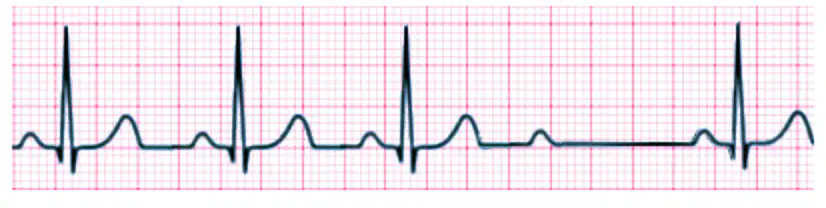
A 68 Y/O M with a Hx of HTN and CAD presents for a routine check-up. He reports feeling occasional dizziness over the past month but denies syncope or chest pain. O/E, his HR is 65/min and irregular. An in-office ECG is performed, and a representative rhythm strip is shown. What is the most accurate interpretation of this rhythm strip?
First-degree AV block
Mobitz Type I AV block (Wenckebach)
Mobitz Type II AV block
Third-degree (complete) AV block
Sinus pause
A patient with known HTN is evaluated for recurrent dizziness and one episode of syncope. A 12-lead ECG demonstrates a left bundle branch block and first-degree AV block (PR interval 340 ms). The patient is currently asymptomatic with a heart rate of 60/min. What is the most appropriate definitive management for this patient?
Implantation of a permanent pacemaker
IV Atropine and observation
Holter monitoring for 48 hours
Electrophysiology (EP) study
Discontinue all AV-nodal blocking agents
A patient presents with acute cardiogenic pulmonary edema, characterized by severe respiratory distress, bibasilar crackles, and a BP of 170/100 mmHg. An ECG shows sinus tachycardia but no acute ischemic changes. The patient is placed in an upright position and given supplemental oxygen. What is the most appropriate initial medication to administer to this patient?
Intravenous labetalol
Intravenous normal saline
Intravenous furosemide
Intravenous digoxin
Intravenous morphine
A patient with a known history of severe COPD presents with new-onset bilateral pedal edema and exertional dyspnea. O/E, the JVP is elevated. Auscultation of the lungs reveals diminished breath sounds but no crackles. What is the most likely diagnosis?
Cor pulmonale
Acute myocardial infarction
Decompensated left-sided heart failure
Constrictive pericarditis
Cirrhosis of the liver
A patient with heart failure is on a stable dose of digoxin. Furosemide is initiated to manage volume overload. Several weeks later, the patient develops bradycardia and nausea, and lab tests confirm digoxin toxicity despite no change in the digoxin dose or renal function. What is the primary mechanism responsible for the increased risk of digoxin toxicity in this patient?
Furosemide-induced hypokalemia
Decreased renal clearance of digoxin
Displacement of digoxin from plasma protein binding sites
Inhibition of hepatic CYP450 metabolism
Increased gastrointestinal absorption of digoxin
A patient with long-standing, untreated dyslipidemia is being counseled on the pathogenesis of coronary artery disease. The physician explains how certain lipids cross the arterial endothelium and accumulate in the vessel wall, initiating an inflammatory cascade. The subendothelial accumulation and subsequent oxidation of which of the following lipoproteins is the key initiating event in the formation of an atherosclerotic plaque?
Chylomicrons
High-density lipoprotein (HDL)
Very-low-density lipoprotein (VLDL)
Low-density lipoprotein (LDL)
Lipoprotein(a) [Lp(a)]
A patient is hospitalized following a recent myocardial infarction. Several days after the event, the patient suddenly develops severe dyspnea. O/E, tachycardia and bibasilar crackles are noted. Auscultation reveals a new, loud holosystolic murmur at the cardiac apex. Which investigation is most critical for identifying the cause of this patient's acute deterioration?
Echocardiography
12-lead ECG
Coronary Angiography
Serial Troponin measurement
Chest X-ray

