
Font size
 Worksheets
Chap 5 M&B
Total questions: 131
Worksheet time: 1hrs 8mins
Pieces of property that serve as a store of value are called
wealth
units of account
liabilities
borrowings
Of the four factors that influence asset demand, which factor will cause the demand for all assets to increase when it increases, everything else held constant?
wealth
expected returns
risk
liquidity
If wealth increases, the demand for stocks ______ and that of long-term bonds ______, everything else held constant.
increases; increases
increases; decreases
decreases; decreases
decreases; increases
Everything else held constant, a decrease in wealth
increases the demand for stocks.
increases the demand for bonds.
reduces the demand for silver.
increases the demand for gold.
An increase in an asset’s expected return relative to that of an alternative asset, holding everything else constant, ______ the quantity demanded of the asset.
increases
decreases
has no effect on
erases
Everything else held constant, if the expected return on ABC stock rises from 5 to 10 percent and the expected return on CBS stock is unchanged, then the expected return of holding CBS stock ______ relative to ABC stock and the demand for CBS stock ______.
rises; rises
rises; falls
falls; rises
falls; falls
Everything else held constant, if the expected return on U.S. Treasury bonds falls from 10 to 5 percent and the expected return on GE stock rises from 7 to 8 percent, then the expected return of holding GE stock ______ relative to U.S. Treasury bonds and the demand for GE stock ______.
rises; rises
rises; falls
falls; rises
falls; falls
If housing prices are expected to increase, then, other things equal, the demand for houses will ______ and that of Treasury bills will ______.
increase; increase
increase; decrease
decrease; decrease
decrease; increase
If stock prices are expected to drop dramatically, then, other things equal, the demand for stocks will ______ and that of Treasury bills will ______.
increase; increase
increase; decrease
decrease; decrease
decrease; increase
Everything else held constant, if the expected return on RST stock declines from 12 to 9 percent and the expected return on XYZ stock declines from 8 to 7 percent, then the expected return of holding RST stock ______ relative to XYZ stock and demand for XYZ stock ______.
rises; rises
rises; falls
falls; rises
falls; falls
Everything else held constant, if the expected return on U.S. Treasury bonds falls from 8 to 7 percent and the expected return on corporate bonds falls from 10 to 8 percent, then the expected return of corporate bonds ______ relative to U.S. Treasury bonds and the demand for corporate bonds ______.
rises; rises
rises; falls
falls; rises
falls; falls
An increase in the expected rate of inflation will ______ the expected return on bonds relative to that on ______ assets, everything else held constant.
reduce; financial
reduce; real
raise; financial
raise; real
If fluctuations in interest rates become smaller, then, other things equal, the demand for stocks ______ and the demand for long-term bonds ______.
increases; increases
increases; decreases
decreases; decreases
decreases; increases
If the price of gold becomes less volatile, then, other things equal, the demand for stocks will ______ and the demand for antiques will ______.
increase; increase
increase; decrease
decrease; decrease
decrease; increase
If brokerage commissions on bond sales decrease, then, other things equal, the demand for bonds will ______ and the demand for real estate will ______.
increase; increase
increase; decrease
decrease; decrease
decrease; increase
If gold becomes acceptable as a medium of exchange, the demand for gold will ______ and the demand for bonds will ______, everything else held constant.
decrease; decrease
decrease; increase
increase; increase
increase; decrease
The demand for Picasso paintings rises (holding everything else equal) when
stocks become easier to sell.
people expect a boom in real estate prices.
Treasury securities become riskier.
people expect gold prices to rise.
The demand for silver decreases, other things equal, when
the gold market is expected to boom.
the market for silver becomes more liquid.
wealth grows rapidly.
interest rates are expected to rise.
You would be less willing to purchase U.S. Treasury bonds, other things equal, if
you inherit $1 million from your Uncle Harry.
you expect interest rates to fall.
gold becomes more liquid.
stock prices are expected to fall.
You would be more willing to buy AT&T bonds (holding everything else constant) if
the brokerage commissions on bond sales become cheaper.
interest rates are expected to rise.
your wealth has decreased.
you expect diamonds to appreciate in value.
The demand for gold increases, other things equal, when
the market for silver becomes more liquid.
interest rates are expected to rise.
interest rates are expected to fall.
real estate prices are expected to increase.
In the bond market, the bond demanders are the ______ and the bond suppliers are the ______.
lenders; borrowers
lenders; advancers
borrowers; lenders
borrowers; advancers
The demand curve for bonds has the usual downward slope, indicating that at ______ prices of the bond, everything else equal, the ______ is higher.
higher; demand
higher; quantity demanded
lower; demand
lower; quantity demanded
The supply curve for bonds has the usual upward slope, indicating that as the price ______, ceteris paribus, the ______ increases.
falls; supply
falls; quantity supplied
rises; supply
rises; quantity supplied
In the bond market, the market equilibrium shows the market-clearing ______ and market-clearing ______.
price; deposit
interest rate; deposit
price; interest rate
interest rate; premium
When the price of a bond is above the equilibrium price, there is an excess ______ bonds and price will ______.
demand for; rise
demand for; fall
supply of; fall
supply of; rise
When the price of a bond is ______ the equilibrium price, there is an excess demand for bonds and price will ______.
above; rise
above; fall
below; fall
below; rise
When the interest rate on a bond is above the equilibrium interest rate, in the bond market there is excess ______ and the interest rate will ______.
demand; rise
demand; fall
supply; fall
supply; rise
When the interest rate on a bond is ______ the equilibrium interest rate, in the bond market there is excess ______ and the interest rate will ______.
above; demand; rise
above; demand; fall
below; supply; fall
above; supply; rise
A situation in which the quantity of bonds supplied exceeds the quantity of bonds demanded is called a condition of excess supply; because people want to sell ______ bonds than others want to buy, the price of bonds will ______.
fewer; fall
fewer; rise
more; fall
more; rise
If the price of bonds is set ______ the equilibrium price, the quantity of bonds demanded exceeds the quantity of bonds supplied, a condition called excess ______.
above; demand
above; supply
below; demand
below; supply
A movement along the bond demand or supply curve occurs when ______ changes.
bond price
income
wealth
expected return
When the price of a bond decreases, all else equal, the bond demand curve ______.
shifts right
shifts left
does not shift
inverts
During business cycle expansions when income and wealth are rising, the demand for bonds _______ and the demand curve shifts to the ______, everything else held constant.
falls; right
falls; left
rises; right
rises; left
Everything else held constant, when households save less, wealth and the demand for bonds _______, and the bond demand curve shifts _______.
increase; right
increase; left
decrease; right
decrease; left
Everything else held constant, if interest rates are expected to fall in the future, the demand for long-term bonds today _______ and the demand curve shifts to the _______.
rises; right
rises; left
falls; right
falls; left
Holding the expected return on bonds constant, an increase in the expected return on common stocks would _______ the demand for bonds, shifting the demand curve to the _______.
decrease; left
decrease; right
increase; left
increase; right
Everything else held constant, an increase in expected inflation, lowers the expected return on _______ compared to _______ assets.
bonds; financial
bonds; real
physical; financial
physical; real
Everything else held constant, an increase in the riskiness of bonds relative to alternative assets causes the demand for bonds to _______ and the demand curve to shift to the _______.
rise; right
rise; left
fall; right
fall; left
Everything else held constant, when stock prices become less volatile, the demand curve for bonds shifts to the _______ and the interest rate _______.
right; rises
right; falls
left; falls
left; rises
Everything else held constant, when stock prices become _______ volatile, the demand curve for bonds shifts to the _______ and the interest rate _______.
more; right; rises
more; right; falls
less; left; falls
less; left; does not change
Everything else held constant, an increase in the liquidity of bonds results in a _______ in demand for bonds and the demand curve shifts to the _______.
rise; right
rise; left
fall; right
fall; left
Everything else held constant, when bonds become less widely traded, and as a consequence the market becomes less liquid, the demand curve for bonds shifts to the _______ and the interest rate _______.
right; rises
right; falls
left; falls
left; rises
The reduction of brokerage commissions for trading common stocks that occurred in 1975 caused the demand for bonds to _______ and the demand curve to shift to the _______.
fall; left
fall; right
rise; right
rise; left
Factors that decrease the demand for bonds include
an increase in the volatility of stock prices.
a decrease in the expected returns on stocks.
a decrease in the inflation rate.
a decrease in the riskiness of stocks.
During a recession, the supply of bonds _______ and the supply curve shifts to the ______, everything else held constant.
increases; left
increases; right
decreases; left
decreases; right
In a business cycle expansion, the _______ of bonds increases and the _______ curve shifts to the _______, as business investments are expected to be more profitable.
supply; supply; right
supply; supply; left
demand; demand; right
demand; demand; left
When the expected inflation rate increases, the real cost of borrowing _______ and bond supply _______, everything else held constant.
increases; increases
increases; decreases
decreases; increases
decreases; decreases
An increase in the expected inflation rate causes the supply of bonds to _______ and the supply curve to shift to the _______, everything else held constant.
increase; left
increase; right
decrease; left
decrease; right
Higher government deficits _______ the supply of bonds and shift the supply curve to the _______, everything else held constant.
increase; left
increase; right
decrease; left
decrease; right
Factors that can cause the supply curve for bonds to shift to the right include
an expansion in overall economic activity.
a decrease in expected inflation.
a decrease in government deficits.
a business cycle recession.
When the inflation rate is expected to increase, the _______ for bonds falls, while the _______ curve shifts to the right, everything else held constant.
demand; demand
demand; supply
supply; demand
supply; supply
When the expected inflation rate increases, the demand for bonds _______, the supply of bonds _______, and the interest rate _______, everything else held constant.
increases; increases; rises
decreases; decreases; falls
increases; decreases; falls
decreases; increases; rises
Everything else held constant, when the inflation rate is expected to rise, interest rates will _______; this result has been termed the _______.
fall; Keynes effect
fall; Fisher effect
rise; Keynes effect
rise; Fisher effect
The economist Irving Fisher, after whom the Fisher effect is named, explained why interest rates _______ as the expected rate of inflation _______, everything else held constant.
rise; increases
rise; stabilizes
fall; stabilizes
fall; increases
Everything else held constant, during a business cycle expansion, the supply of bonds shifts to the _______, as businesses perceive more profitable investment opportunities, while the demand for bonds shifts to the _______ as a result of the increase in wealth generated by the economic expansion.
right; left
right; right
left; left
left; right
When the economy slips into a recession, normally the demand for bonds _______, the supply of bonds _______, and the interest rate _______, everything else held constant.
increases; increases; rises
decreases; decreases; falls
increases; decreases; falls
decreases; increases; rises
When an economy grows out of a recession, normally the demand for bonds _______ and the supply of bonds _______, everything else held constant.
increases; increases
increases; decreases
decreases; decreases
decreases; increases
Deflation causes the demand for bonds to ______, the supply of bonds to ______, and bond prices to ______, everything else held constant.
increase; increase; increase
increase; decrease; increase
decrease; increase; increase
decrease; decrease; increase
In the 1990s Japan had the lowest interest rates in the world due to a combination of
inflation and recession.
deflation and expansion.
inflation and expansion.
deflation and recession.
When the interest rate changes,
the demand curve for bonds shifts to the right.
the demand curve for bonds shifts to the left.
the supply curve for bonds shifts to the right.
it is because either the demand or the supply curve has shifted.
The interest rate falls when either the demand for bonds ______ or the supply of bonds ______.
increases; increases
increases; decreases
decreases; decreases
decreases; increases
When the government has a surplus, as occurred in the late 1990s, the ______ curve of bonds shifts to the ______, everything else held constant.
supply; right
supply; left
demand; right
demand; left
A decrease in the brokerage commissions in the housing market from 6% to 5% of the sales price will shift the ______ curve for bonds to the ______, everything else held constant.
demand; right
demand; left
supply; right
supply; left
When rare coin prices become volatile, the ______ curve for bonds shifts to the ______, everything else held constant.
demand; right
demand; left
supply; right
supply; left
If people expect real estate prices to increase significantly, the ______ curve for bonds will shift to the ______, everything else held constant.
demand; right
demand; left
supply; left
supply; right
Everything else held constant, when prices in the art market become more uncertain,
the demand curve for bonds shifts to the left and the interest rate rises.
the demand curve for bonds shifts to the left and the interest rate falls.
the demand curve for bonds shifts to the right and the interest rate falls.
the supply curve for bonds shifts to the right and the interest rate falls.
Everything else held constant, when real estate prices are expected to decrease
the demand curve for bonds shifts to the left and the interest rate rises.
the demand curve for bonds shifts to the left and the interest rate falls.
the demand curve for bonds shifts to the right and the interest rate falls.
the supply curve for bonds shifts to the right and the interest rate falls.
Everything else held constant, when the government has higher budget deficits
the demand curve for bonds shifts to the left and the interest rate rises.
the demand curve for bonds shifts to the left and the interest rate falls.
the supply curve for bonds shifts to the right and the interest rate falls.
the supply curve for bonds shifts to the right and the interest rate rises.
If stock prices are expected to climb next year, everything else held constant, the ______ curve for bonds shifts ______ and the interest rate ______.
demand; left; rises
demand; right; rises
demand; left; falls
supply; left; rises
If prices in the bond market become more volatile, everything else held constant, the demand curve for bonds shifts ______ and interest rates ______.
left; rise
left; fall
right; rise
right; fall
If brokerage commissions on stocks fall, everything else held constant, the demand for bonds ______, the price of bonds ______ and the interest rate ______.
decreases; decreases; increases
decreases; decreases; decreases
increases; decreases; increases
increases; increases; increases
If the expected return on bonds increases, all else equal, the demand for bonds increases, the price of bonds ______, and the interest rate ______.
increases; decreases
increases; increases
decreases; decreases
decreases; increases
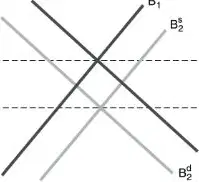
Refer to the figure showing bond market supply and demand with curves labeled B^s_1, B^s_2, B^d_1, B^d_2 and prices P_1 and P_2. In the figure above, a factor that could cause the supply of bonds to shift to the right is:
a decrease in government budget deficits.
a decrease in expected inflation.
a recession.
a business cycle expansion.
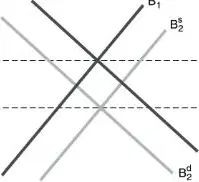
Refer to the same figure. In the figure above, a factor that could cause the demand for bonds to decrease (shift to the left) is:
an increase in the expected return on bonds relative to other assets.
a decrease in the expected return on bonds relative to other assets.
an increase in wealth.
a reduction in the riskiness of bonds relative to other assets.
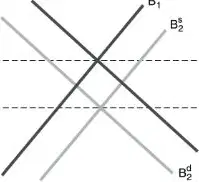
Refer to the same figure. In the figure above, the price of bonds would fall from P_1 to P_2
inflation is expected to increase in the future.
interest rates are expected to fall in the future.
the expected return on bonds relative to other assets is expected to increase in the future.
the riskiness of bonds falls relative to other assets.
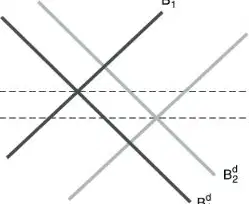
Refer to the figure showing bond market supply and demand with curves labeled B^s_1, B^s_2, B^d_1, B^d_2 and prices P_1 and P_2. In the figure above, a factor that could cause the supply of bonds to increase (shift to the right) is:
a decrease in government budget deficits.
a decrease in expected inflation.
expectations of more profitable investment opportunities.
a business cycle recession.
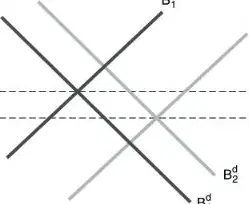
Refer to the same figure. In the figure above, a factor that could cause the demand for bonds to shift to the right is:
an increase in the riskiness of bonds relative to other assets.
an increase in the expected rate of inflation.
expectations of lower interest rates in the future.
a decrease in wealth.
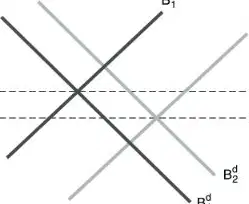
Refer to the same figure. In the figure above, the price of bonds would fall from P_2 to P_1 if
there is a business cycle recession.
there is a business cycle expansion.
inflation is expected to increase in the future.
inflation is expected to decrease in the future.
What is the impact on interest rates when the Federal Reserve decreases the money supply by selling bonds to the public?
In Keynes's liquidity preference framework, individuals are assumed to hold their wealth in two forms:
real assets and financial assets.
stocks and bonds.
money and bonds.
money and gold.
In Keynes's liquidity preference framework,
the demand for bonds must equal the supply of money.
the demand for money must equal the supply of bonds.
an excess demand of bonds implies an excess demand for money.
an excess supply of bonds implies an excess demand for money.
In Keynes's liquidity preference framework, if there is excess demand for money, there is
excess demand for bonds.
equilibrium in the bond market.
excess supply of bonds.
too much money.
The bond supply and demand framework is easier to use when analyzing the effects of changes in ______ while the liquidity preference framework provides a simpler analysis of the effects from changes in income, the price level, and the supply of ______.
expected inflation; bonds
expected inflation; money
government budget deficits; bonds
government budget deficits; money
Keynes assumed that money has ______ rate of return.
a positive
a negative
a zero
an increasing
In his Liquidity Preference Framework, Keynes assumed that money has a zero rate of return; thus,
when interest rates rise, the expected return on money falls relative to the expected return on bonds, causing the demand for money to fall.
when interest rates rise, the expected return on money falls relative to the expected return on bonds, causing the demand for money to rise.
when interest rates fall, the expected return on money falls relative to the expected return on bonds, causing the demand for money to fall.
when interest rates fall, the expected return on money falls relative to the expected return on bonds, causing the demand for money to rise.
In Keynes's liquidity preference framework, as the expected return on bonds increases (holding everything else unchanged), the expected return on money ______, causing the demand for ______ to fall.
falls; bonds
falls; money
rises; bonds
rises; money
The opportunity cost of holding money is
the level of income.
the price level.
the interest rate.
the discount rate.
An increase in the interest rate
increases the demand for money.
increases the quantity of money demanded.
decreases the demand for money.
decreases the quantity of money demanded.
If there is an excess supply of money
individuals sell bonds, causing the interest rate to rise.
individuals sell bonds, causing the interest rate to fall.
individuals buy bonds, causing interest rates to fall.
individuals buy bonds, causing interest rates to rise.
When the interest rate is above the equilibrium interest rate, there is an excess ______ money and the interest rate will ______.
demand for; rise
demand for; fall
supply of; fall
supply of; rise
In the market for money, an interest rate below equilibrium results in an excess ______ money and the interest rate will ______.
demand for; rise
demand for; fall
supply of; fall
supply of; rise
In the Keynesian liquidity preference framework, an increase in the interest rate causes the demand curve for money to ______, everything else held constant.
shift right
shift left
stay where it is
invert
A lower level of income causes the demand for money to ______ and the interest rate to ______, everything else held constant.
decrease; decrease
decrease; increase
increase; decrease
increase; increase
When real income _______, the demand curve for money shifts to the _______ and the interest rate _______, everything else held constant.
falls; right; rises
rises; right; rises
falls; left; rises
rises; left; rises
A business cycle expansion increases income, causing money demand to _______ and interest rates to _______, everything else held constant.
increase; increase
increase; decrease
decrease; decrease
decrease; increase
In the Keynesian liquidity preference framework, a rise in the price level causes the demand for money to _______ and the demand curve to shift to the _______, everything else held constant.
increase; left
increase; right
decrease; left
decrease; right
When the price level _______, the demand curve for money shifts to the _______ and the interest rate _______, everything else held constant.
falls; left; falls
rises; right; falls
falls; left; rises
rises; right; rises
A rise in the price level causes the demand for money to _______ and the interest rate to _______, everything else held constant.
decrease; decrease
decrease; increase
increase; decrease
increase; increase
When the price level falls, the _______ curve for nominal money _______ and interest rates _______, everything else held constant.
demand; decreases; fall
demand; increases; rise
supply; increases; rise
supply; decreases; fall
A decline in the expected inflation rate causes the demand for money to _______ and the demand curve to shift to the _______, everything else held constant.
decrease; right
decrease; left
increase; right
increase; left
When the Fed decreases the money stock, the money supply curve shifts to the _______ and the interest rate _______, everything else held constant.
right; rises
right; falls
left; falls
left; rises
When the Fed _______ the money stock, the money supply curve shifts to the _______ and the interest rate _______, everything else held constant.
decreases; right; rises
increases; right; falls
decreases; left; falls
increases; left; rises
_______ in the money supply creates excess _______ money, causing interest rates to _______, everything else held constant.
A decrease; demand for; rise
An increase; demand for; fall
An increase; supply of; rise
A decrease; supply of; fall
______ in the money supply creates excess demand for ______, causing interest rates to ______, everything else held constant.
An increase; money; rise
An increase; bonds; fall
A decrease; bonds; rise
A decrease; money; fall
When the price level falls, the ______ curve for nominal money ______, and interest rates ______, everything else held constant.
demand; decreases; fall
demand; increases; rise
supply; increases; rise
supply; decreases; fall
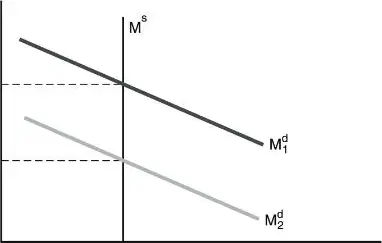
Refer to the figure: Interest Rate vs. Quantity of Money, showing money demand shifting from M1d to M2d with vertical money supply Ms and interest rates falling from i1 to i2 . In the figure above, one factor not responsible for the decline in the demand for money is
a decline the price level.
a decline in income.
an increase in income.
a decline in the expected inflation rate.
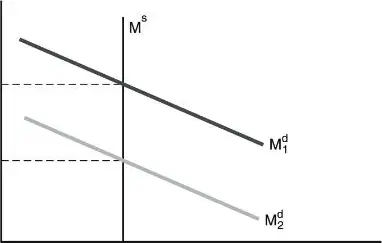
Refer to the figure: Interest Rate vs. Quantity of Money, showing money demand shifting from M1d to M2d with vertical money supply Ms and interest rates falling from i1 to i2 . In the figure above, the decrease in the interest rate from i1 to i2 can be explained by
a decrease in money growth.
a decline in the expected price level.
an increase in income.
an increase in the expected price level.
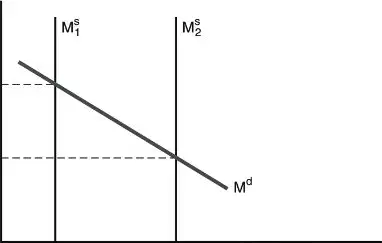
Refer to the figure: Interest Rate vs. Quantity of Money, showing vertical money supplies M1s and M2s with downward-sloping money demand Md and interest rates from i1 to i2 . In the figure above, the factor responsible for the decline in the interest rate is
a decline the price level.
a decline in income.
an increase in the money supply.
a decline in the expected inflation rate.
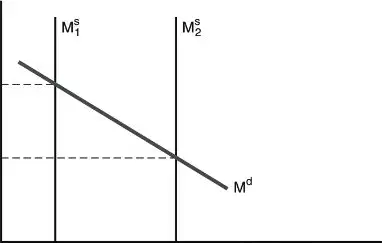
Refer to the figure: Interest Rate vs. Quantity of Money, showing vertical money supplies M1s and M2s with downward-sloping money demand Md and interest rates from i1 to i2 . In the figure above, the decrease in the interest rate from i1 to i2 can be explained by
a decrease in money growth.
an increase in money growth.
a decline in the expected price level.
an increase in income.
Milton Friedman called the response of lower interest rates resulting from an increase in the money supply the ______ effect.
liquidity
price level
expected-inflation
income
Of the four effects on interest rates from an increase in the money supply, the initial effect is, generally, the
income effect.
liquidity effect.
price level effect.
expected inflation effect.
In the liquidity preference framework, a one-time increase in the money supply results in a price level effect. The maximum impact of the price level effect on interest rates occurs
at the moment the price level hits its peak (stops rising) because both the price level and expected inflation effects are at work.
immediately after the price level begins to rise, because both the price level and expected inflation effects are at work.
at the moment the expected inflation rate hits its peak.
at the moment the inflation rate hits it peak.
Of the four effects on interest rates from an increase in the money supply, the one that works in the opposite direction of the other three is the
liquidity effect.
income effect.
price level effect.
expected inflation effect.
It is possible that when the money supply rises, interest rates may ______ if the ______ effect is more than offset by changes in income, the price level, and expected inflation.
fall; liquidity
fall; risk
rise; liquidity
rise; risk
When the growth rate of the money supply increases, interest rates end up being permanently lower if
the liquidity effect is larger than the other effects.
there is fast adjustment of expected inflation.
there is slow adjustment of expected inflation.
the expected inflation effect is larger than the liquidity effect.
When the growth rate of the money supply is increased, interest rates will fall immediately if the liquidity effect is ______ than the other money supply effects and there is ______ adjustment of expected inflation.
larger; fast
larger; slow
smaller; slow
smaller; fast
If the Fed wants to permanently lower interest rates, then it should raise the rate of money growth if
there is fast adjustment of expected inflation.
there is slow adjustment of expected inflation.
the liquidity effect is smaller than the expected inflation effect.
the liquidity effect is larger than the other effects.
If the liquidity effect is smaller than the other effects, and the adjustment to expected inflation is slow, then the
interest rate will fall.
interest rate will rise.
interest rate will initially fall but eventually climb above the initial level in response to an increase in money growth.
interest rate will initially rise but eventually fall below the initial level in response to an increase in money growth.
If the liquidity effect is smaller than the other effects, and the adjustment to expected inflation is immediate, then the
interest rate will fall.
interest rate will rise.
interest rate will fall immediately below the initial level when the money supply grows.
interest rate will rise immediately above the initial level when the money supply grows.
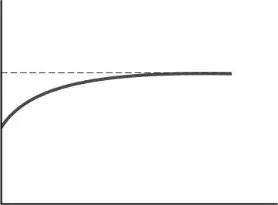
Refer to the figure showing interest rate over time with an immediate rise from i1 toward i2 after time 0. From the figure, one can conclude that the
liquidity effect is smaller than the expected inflation effect and interest rates adjust quickly to changes in expected inflation.
liquidity effect is larger than the expected inflation effect and interest rates adjust quickly to changes in expected inflation.
liquidity effect is larger than the expected inflation effect and interest rates adjust slowly to changes in expected inflation.
liquidity effect is smaller than the expected inflation effect and interest rates adjust slowly to changes in expected inflation.
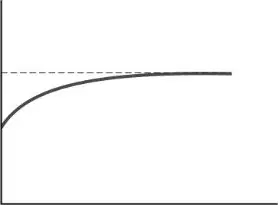
Refer to the same figure showing interest rate over time with an immediate rise from i1 toward i2 after time 0. From the figure, one can conclude that the
Fisher effect is dominated by the liquidity effect and interest rates adjust slowly to changes in expected inflation.
liquidity effect is dominated by the Fisher effect and interest rates adjust slowly to changes in expected inflation.
liquidity effect is dominated by the Fisher effect and interest rates adjust quickly to changes in expected inflation.
Fisher effect is smaller than the expected inflation effect and interest rates adjust quickly to changes in expected inflation.
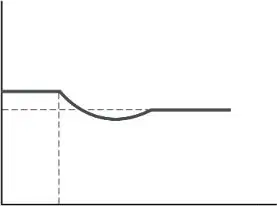
The figure shows interest rate over time with an initial level i1 above i2 and a drop at T0 followed by a gradual rise toward i2 below i1. From the figure, one can conclude that the
liquidity effect is smaller than the expected inflation effect and interest rates adjust quickly to changes in expected inflation.
liquidity effect is larger than the expected inflation effect and interest rates adjust quickly to changes in expected inflation.
liquidity effect is larger than the expected inflation effect and interest rates adjust slowly to changes in expected inflation.
liquidity effect is smaller than the expected inflation effect and interest rates adjust slowly to changes in expected inflation.
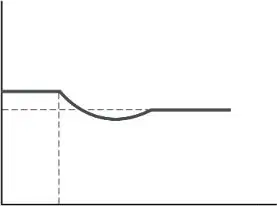
Refer to the same figure with i1 above i2 and a drop at T0 followed by a gradual rise toward i2. From the figure, one can conclude that the
Fisher effect is dominated by the liquidity effect and interest rates adjust slowly to changes in expected inflation.
liquidity effect is dominated by the Fisher effect and interest rates adjust slowly to changes in expected inflation.
liquidity effect is dominated by the Fisher effect and interest rates adjust quickly to changes in expected inflation.
Fisher effect is smaller than the expected inflation effect and interest rates adjust quickly to changes in expected inflation.
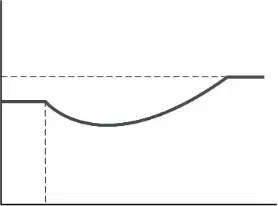
The figure shows interest rate over time with an initial dip after T0 from i1, then a rise above i2 by the end. From the figure, one can conclude that the
liquidity effect is smaller than the expected inflation effect and interest rates adjust quickly to changes in expected inflation.
liquidity effect is larger than the expected inflation effect and interest rates adjust quickly to changes in expected inflation.
liquidity effect is larger than the expected inflation effect and interest rates adjust slowly to changes in expected inflation.
liquidity effect is smaller than the expected inflation effect and interest rates adjust slowly to changes in expected inflation.
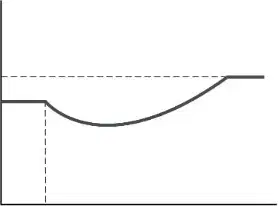
Refer to the same figure with an initial dip after T0 from i1 and a rise above i2 by the end. From the figure, one can conclude that the
Fisher effect is dominated by the liquidity effect and interest rates adjust slowly to changes in expected inflation.
liquidity effect is dominated by the Fisher effect and interest rates adjust slowly to changes in expected inflation.
liquidity effect is dominated by the Fisher effect and interest rates adjust quickly to changes in expected inflation.
Fisher effect is smaller than the expected inflation effect and interest rates adjust quickly to changes in expected inflation.
Interest rates increased continuously during the 1970s. The most likely explanation is
banking failures that reduced the money supply.
a rise in the level of income.
the repeated bouts of recession and expansion.
increasing expected rates of inflation.
The riskiness of an asset is measured by
the magnitude of its return.
the absolute value of any change in the asset’s price.
the standard deviation of its return.
risk is impossible to measure.
Holding many risky assets and thus reducing the overall risk an investor faces is called
diversification.
foolishness.
risk acceptance.
capitalization.
The ______ the returns on two securities move together, the ______ benefit there is from diversification.
less; more
less; less
more; more
more; greater
A higher ______ means that an asset’s return is more sensitive to changes in the value of the market portfolio.
alpha
beta
CAPM
APT

