
 Worksheets
The Whytboard Analytical Chemstry
Total questions: 13
Worksheet time: 10mins

Good luck on your Whytboard quiz in Analytical Chemistry! You’ve mastered the fundamentals, so stay calm and trust your calculations. Every precise conversion counts, from mass to molar mass; each step brings you closer to the answer. You’ve got the reaction ready, the mindset balanced, and the confidence to mole the competition. Go ahead and crush it, you’re analytically unstoppable!
LET'S GO !
PADAYON !
A student needs to determine the concentration of an unknown acid solution using a standardized base. Which analytical approach is most appropriate for this task?
Qualitative spot test
Titrimetric (volumetric) analysis
Chromatographic separation
Gravimetric analysis
Which branch of analytical chemistry deals with how much of a substance is present?
Qualitative analysis
Quantitative analysis
Instrumental analysis
Bioanalytical analysis
A student repeated a titration (TV: 24.31 mL) four times and obtained the following volumes: 24.32 mL, 24.30 mL, 24.33 mL, and 24.31 mL. These results are best described as
accurate but imprecise
both accurate and precise
precise but inaccurate
neither accurate nor precise
The difference between the measured value and the true value is called
relative error
absolute error
standard deviation
relative standard deviation
Which of the following is an example of a systematic (determinate) error?
Slight variations in how different analysts read the meniscus.
A buret is not properly rinsed, leaving a small amount of water.
Fluctuations in the power supply affecting a digital balance.
Random noise in an electronic signal.
Which of the following numbers has three significant figures?
0.0025
0.250
250
2.5 × 10³
In analytical chemistry, “accuracy” is mainly related to
how closely repeated measurements agree with each other
how close a measured value is to the true value
the number of significant figures in the result
the range of the data set
Chromatography can be used both qualitatively to identify compounds and quantitatively. to determine results.
Stirring a solution does not affect the rate at which the solute dissolves.
Gravimetric analysis determines the amount of analyte in a sample by measuring a mass change.
pH = 4.0. Calculate [H⁺].
10 raised to -14 M
10 raised to −10 M
10 raised to -4 M
10 raised to 4 M
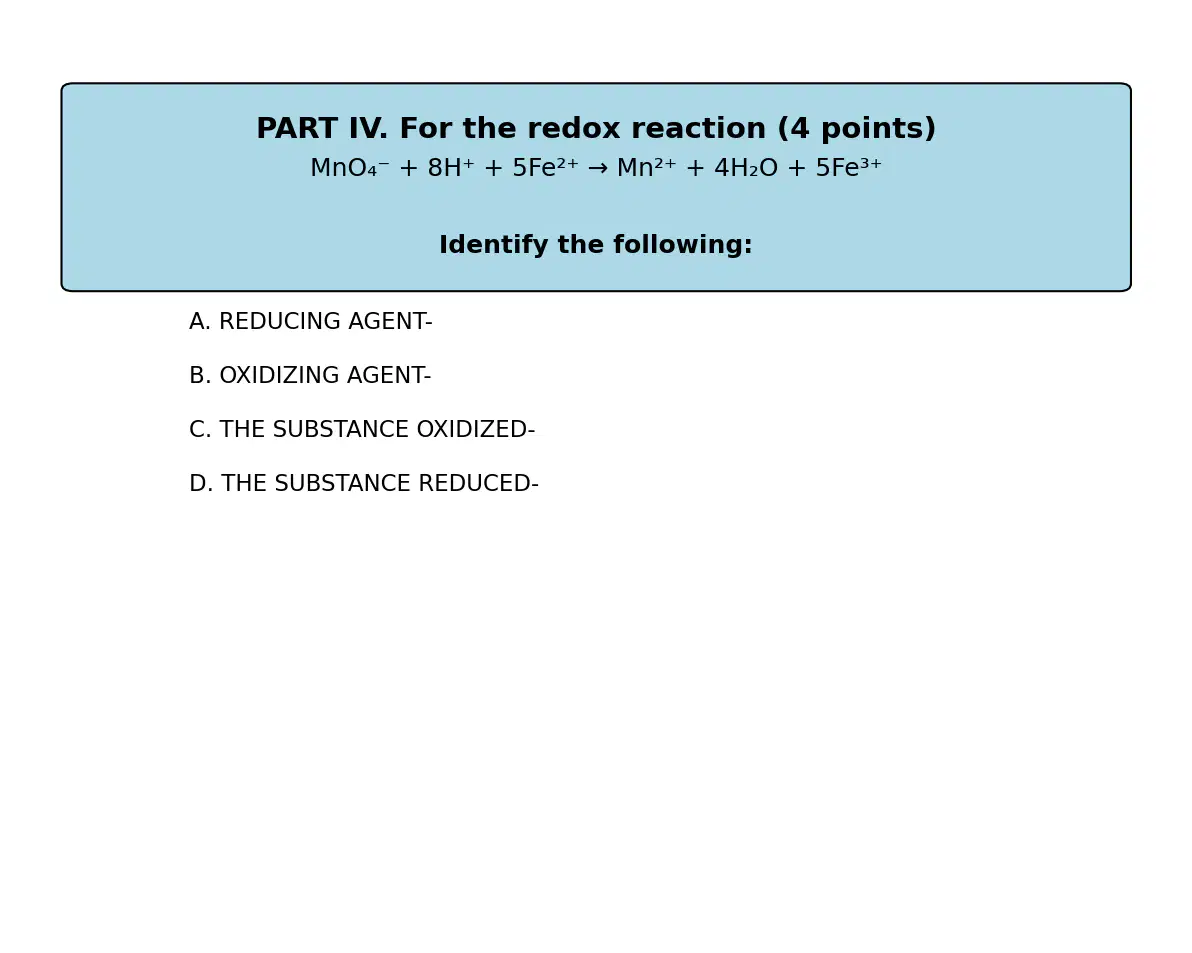
A. Reducing agent: Fe²⁺
B. Oxidizing agent: MnO₄⁻
C. The substance oxidized: Fe²⁺
D. The substance reduced: MnO₄⁻
A. Reducing agent: Fe²⁺
B. Oxidizing agent: MnO₄⁻
C. The substance oxidized: Fe²⁺
D. The substance reduced: MnO₄⁻
A. Reducing agent: MnO₄⁻
B. Oxidizing agent: Fe²⁺
C. The substance oxidized: MnO₄⁻
D. The substance reduced: Fe²⁺
A. Reducing agent: Fe²⁺
B. Oxidizing agent: MnO₄⁻
C. The substance oxidized: MnO₄⁻
D. The substance reduced: Fe²⁺

