
Font size
 Worksheets
Soil Classification Systems Quiz
Total questions: 99
Worksheet time: 50mins
What are soil classification systems based on?
Particle-size distribution and consistency limits
Color and texture of soil
Chemical composition of soil
Soil temperature and moisture content
What are the two major categories of soil classification systems?
Textural classification and engineering behavior classification
Chemical classification and biological classification
Physical classification and chemical classification
Organic classification and inorganic classification
Which classification system is based on the particle-size distribution of sand, silt, and clay-size fractions?
Textural classification
Unified classification system
AASHTO classification system
Chemical classification
What does the engineering behavior classification of soil take into consideration?
Particle-size distribution and plasticity
Soil color and texture
Soil temperature and moisture content
Organic and inorganic content
What is the aim of a soil classification system?
To establish conditions for useful comparisons between different soils
To determine the color of the soil
To measure the temperature of the soil
To identify the chemical composition of the soil
What is the purpose of wet sieving in soil classification?
To separate fine grains from coarse grains
To measure soil temperature
To determine soil color
To analyze chemical composition
What is dry sieve analysis used for?
To analyze particles coarser than 75 microns
To measure soil temperature
To determine soil moisture content
To separate organic and inorganic particles
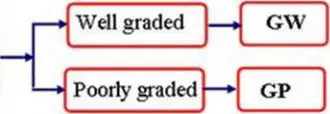
What does the term "GW" represent in soil classification systems?
Poorly graded gravel
Well graded gravel
High plasticity clay
Low plasticity silt
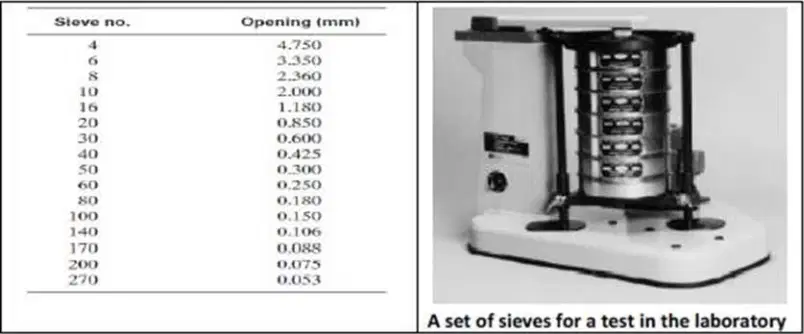
What is the sieve opening size for sieve number 40 in the U.S. Standard sieve sizes?
0.425 mm
0.850 mm
0.320 mm
0.250 mm
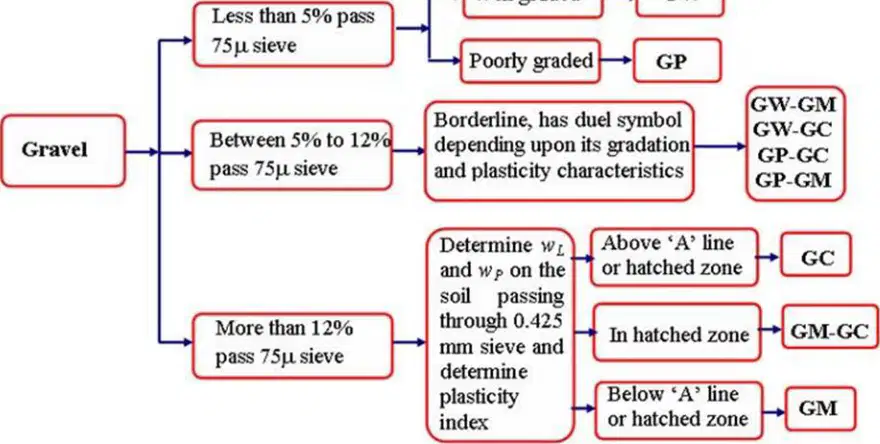
If less than 5% of soil passes through a 75µ sieve, how is the soil classified?
Poorly graded gravel (GP)
Well graded gravel (GW)
Borderline gravel (GW-GM)
High plasticity clay (CH)
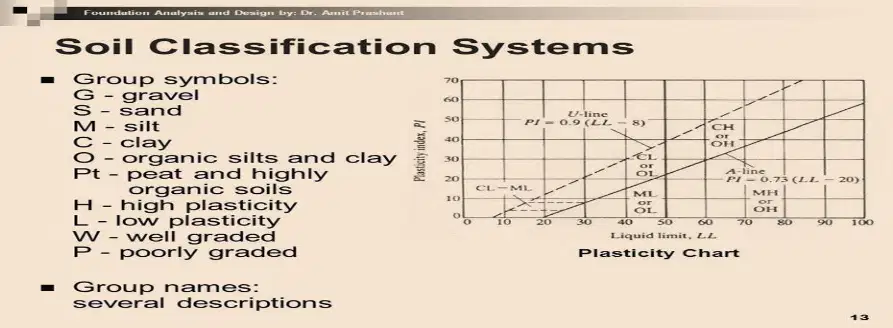
What does the symbol "M" represent in soil classification systems?
Sand
Silt
Clay
Gravel
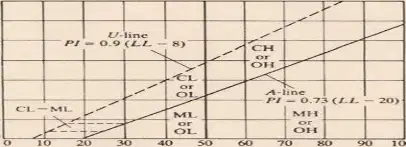
What is the plasticity index (PI) used for in soil classification systems?
To determine the liquid limit of soil
To classify soil based on its plasticity characteristics
To measure the organic content of soil
To identify the sieve size of soil particles
What principle is hydrometer (sedimentation) analysis based on?
Filtration of soil particles
Sedimentation of soil grains in water
Evaporation of water from soil
Absorption of water by soil particles
According to the text, what assumption is made about soil particles in hydrometer analysis?
All soil particles are cubes
All soil particles are spheres
All soil particles are irregular shapes
All soil particles are cylindrical
What does soil texture refer to in the context of textural classification?
Soil color
Soil weight
Surface appearance of soil
Soil temperature
Which categories are used in textural classification of soil based on particle size?
Sand, gravel, clay, and silt
Sand, gravel, clay, and rocks
Sand, gravel, clay, and pebbles
Sand, gravel, clay, and mud
What is the No. 10 sieve used for in textural classification?
To measure soil color
To determine the fraction of soil passing through 2 mm diameter
To measure soil temperature
To classify soil based on weight
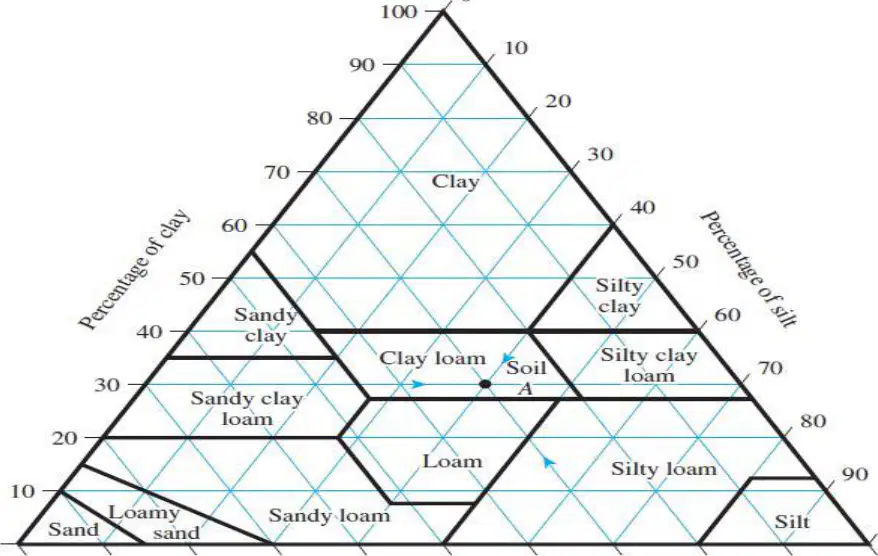
What is the textural classification of soil A with a particle-size distribution of 30% sand, 40% silt, and 30% clay?
Sandy clay loam
Clay loam
Silty clay loam
Loamy sand
If soil B has a particle-size distribution of 20% gravel, 10% sand, 30% silt, and 40% clay, what is the modified percentage of sand size?
10%
12.5%
15%
20%
Based on the modified percentages of soil B, what is its textural classification?
Sandy clay loam
Silty clay loam
Gravelly clay
Loamy sand
What is the percentage of clay size in soil B after modification?
40%
45%
50%
55%
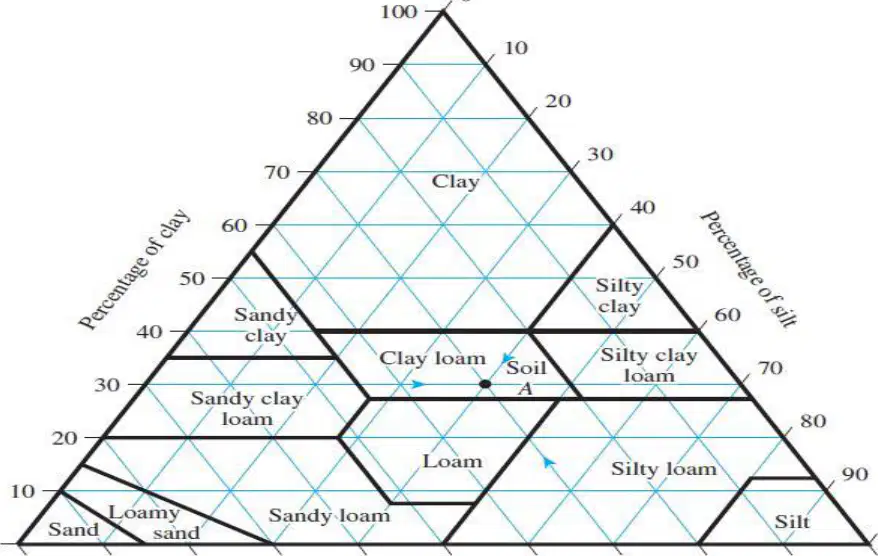
What is the purpose of the triangular classification diagram shown in Figure 4.1?
To determine the color of soil
To classify soil based on particle-size distribution
To measure soil temperature
To calculate soil density
What is the formula to calculate the modified percentage of sand in a soil sample?
Modified % Sand = (% Sand / % Gravel) x 100%
Modified % Sand = (% Sand / (100 - % Gravel)) x 100%
Modified % Sand = (% Sand x % Gravel) / 100%
Modified % Sand = (% Sand + % Gravel) x 100%
Which soil type is classified as "Gravelly clay loam" according to the USDA textural classification system?
Soil A
Soil B
Soil C
Soil D
Why is the word "gravelly" added to the classification of soils A, B, and D?
Because of the high percentage of sand present in each soil
Because of the high percentage of silt present in each soil
Because of the large percentage of gravel present in each soil
Because of the high percentage of clay present in each soil
What is the modified percentage of clay in soil sample C?
55%
45.5%
30%
25.6%
Which soil type has the highest modified percentage of silt?
Soil A
Soil B
Soil C
Soil D
Which classification system is mostly used by state and county highway departments?
Unified Soil Classification System (USCS)
American Association of State Highway and Transportation Officials (AASHTO) classification system
International Soil Classification System (ISCS)
Soil Texture Classification System (STCS)
What does the Unified Soil Classification System (USCS) primarily consider for soil classification?
Soil color and texture
Particle-size distribution and Atterberg limits
Soil density and moisture content
Organic matter content
What is the grain size of soil classified as "No. 4" in the Unified Soil Classification System (USCS)?
0.075 mm
4.75 mm
19 mm
0.425 mm
In the plasticity chart, what does "LL > 50" indicate?
Low plasticity
High plasticity
Medium plasticity
No plasticity
What symbol is used for silt below the A-line in the plasticity chart?
C
S
M
L
What symbol is used for clay above the A-line in the plasticity chart?
C
S
M
L
What is the basis for categorizing soils into Granular Materials and Silt-Clay Materials in the AASHTO classification system?
The percentage passing No. 10 sieve
The percentage passing No. 40 sieve
The percentage passing No. 200 sieve
The percentage passing No. 100 sieve
Which groups in the AASHTO classification system are classified as Granular Materials?
A-4, A-5, A-6, A-7
A-1, A-2, A-3
A-7-5, A-7-6
A-2, A-4, A-6
What is the plasticity index for soils classified under group A-1 in the AASHTO classification system?
6 max
10 max
11 min
41 min
What is the general rating as subgrade for soils classified under group A-1 in the AASHTO classification system?
Fair to Poor
Excellent to Good
Poor to Fair
Good to Excellent
What is the liquid limit for soils classified under group A-2 in the AASHTO classification system?
40 max
41 min
10 max
N.P.
Which groups in the AASHTO classification system are classified as Silt-Clay Materials?
A-1, A-2, A-3
A-4, A-5, A-6, A-7
A-7-5, A-7-6
A-2, A-4, A-6
What is the grain size classification for gravel according to the given system?
Fraction passing the No. 10 (2-mm) U.S. sieve and retained on the No. 200 (0.075-mm) U.S. sieve
Fraction passing the 75-mm sieve and retained on the No. 10 (2-mm) U.S. sieve
Fraction passing the No. 200 U.S. sieve
Fraction passing the No. 10 (2-mm) U.S. sieve
What is the plasticity index threshold for soil to be classified as silty?
5 or less
15 or less
10 or less
20 or less
What is the plasticity index threshold for soil to be classified as clayey?
11 or more
10 or more
15 or more
20 or more
What size is considered for cobbles and boulders in the classification system?
Larger than 50 mm
Larger than 75 mm
Larger than 100 mm
Larger than 25 mm
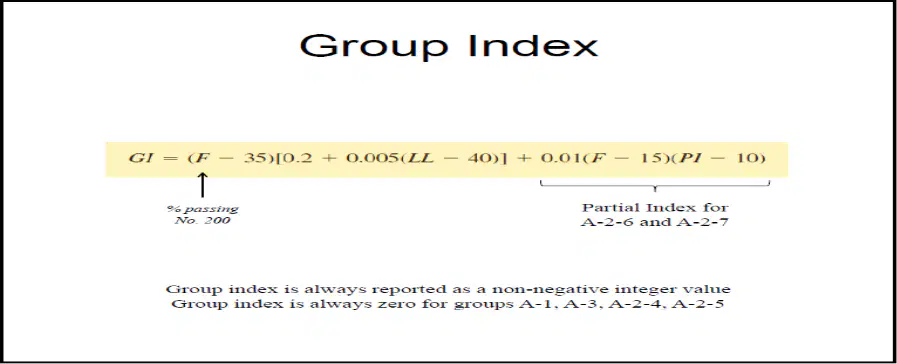
What does the Group Index (GI) evaluate in soils?
The color of the soil.
The quality of soil as a highway subgrade material.
The mineral composition of the soil.
The moisture content of the soil.
What happens when the Group Index (GI) is calculated as a negative value?
GI is reported as a negative number.
GI is reported as zero.
GI is rounded to the nearest integer.
GI is ignored in calculations.
How is the Group Index (GI) reported when it is calculated as a decimal value?
It is reported as a fraction.
It is rounded to the nearest integer.
It is reported as a negative value.
It is ignored in calculations.
What is the Group Index (GI) for soils belonging to groups A-1-a, A-1-b, A-2-4, A-2-5, and A-3?
GI is always 0.
GI is calculated using Equation (4.1).
GI is calculated using Equation (4.2).
GI is always 10.
For A-2-6 and A-2-7 subgroups, which part of Equation (4.1) is used to calculate the Group Index (GI)?
Both terms of Equation (4.1).
Only the first term of Equation (4.1).
Only the second term of Equation (4.1).
Neither term of Equation (4.1).
What is the formula for calculating the Group Index (GI) for A-2-6 and A-2-7 subgroups?
GI = 0.01(F200 – 15)(PI – 10).
GI = (F200 – 35)[0.2 + 0.005(LL – 40)] + 0.01(F200 – 15)(PI – 10).
GI = 0.005(LL – 40)(PI – 10).
GI = (F200 – 15)(LL – 40).
What does a group index of 0 indicate about the subgrade material under average conditions of good drainage and thorough compaction processes?
Very poor subgrade material
Good subgrade material
Average subgrade material
Excellent subgrade material
What is the group index of a subgrade material that is considered "very poor"?
0
10
20 or greater
5
What type of pavement system includes a sub-base course and is made of asphalt cement?
Rigid pavement system
Flexible pavement system
Concrete pavement system
Subgrade pavement system
According to the AASHTO system, what is the classification of a soil with 20% passing the No. 200 sieve, a liquid limit of 25, and a plastic limit of 20?
A-1-b(0)
A-7-6
A-2-4
A-3
What is the classification of a silty-clay material with 95% passing the No. 200 sieve, a liquid limit of 60, and a plasticity index of 40 according to the AASHTO system?
A-1-b(0)
A-7-6
A-2-4
A-3
Which of the following are possible group names for gravelly soils?
GW, GP, GM, GC
SW, SP, SM, SC
MH, ML
CH, CL
Who developed the Unified Soil Classification System (USCS) and for what purpose?
Arthur Casagrande for agricultural purposes
Arthur Casagrande for wartime airfield construction
Arthur Casagrande for urban planning
Arthur Casagrande for mining operations
Which of the following are major symbols used in the Unified Soil Classification System (USCS)?
G, S, M, C, O, Pt
GW, GP, GM, GC
SW, SP, SM, SC
CH, CL, OH, OL
What does the modifier "H" represent in the Unified Soil Classification System (USCS)?
High plasticity (for silt, clay, and organic soils)
Poorly graded (for gravel and sand)
Well graded (for gravel and sand)
Low plasticity (for silt, clay, and organic soils)
Which of the following are possible group names for sandy soils?
GW, GP, GM, GC
SW, SP, SM, SC
MH, ML
CH, CL
What are the possible group names for organic soils in the Unified Soil Classification System (USCS)?
OH and OL
CH and CL
GW and GP
MH and ML
What does the symbol "S" represent in the Unified Soil Classification System (USCS)?
Silt
Sand
Clay
Organic
Which of the following is an example of a classified group name in the Unified Soil Classification System (USCS)?
GP for poorly graded gravel
SW for poorly graded sand
CH for low-plasticity clay
SM for high-plasticity sand
What does the modifier "L" represent in the Unified Soil Classification System (USCS)?
High plasticity (for silt, clay, and organic soils)
Poorly graded (for gravel and sand)
Well graded (for gravel and sand)
Low plasticity (for silt, clay, and organic soils)
Which of the following are possible group names for silty soils?
GW, GP, GM, GC
SW, SP, SM, SC
MH, ML
CH, CL
What does the symbol "C" represent in the Unified Soil Classification System (USCS)?
Clay
Sand
Silt
Organic
What are the possible group names for clayey soils in the Unified Soil Classification System (USCS)?
OH and OL
CH and CL
GW and GP
MH and ML
What does the symbol "O" represent in the Unified Soil Classification System (USCS)?
Organic
Sand
Silt
Clay
What does the symbol "Pt" represent in the Unified Soil Classification System (USCS)?
Peat
Plasticity
Poorly graded
Gravel
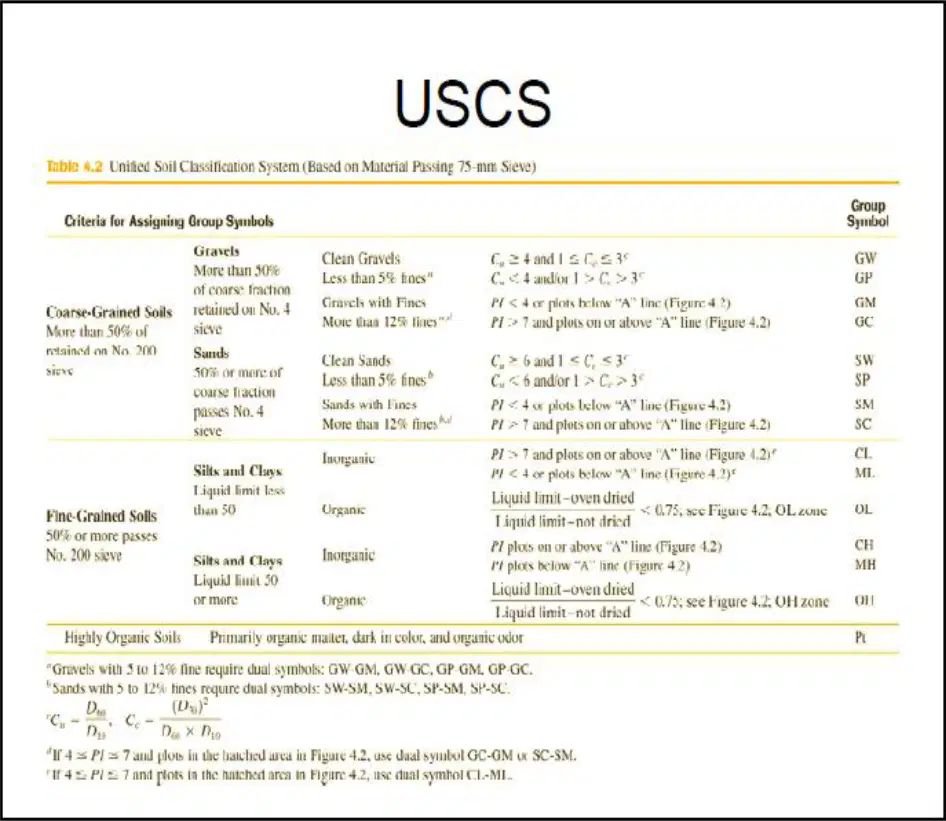
What does "Pt" stand for in the Unified Soil Classification System (USCS)?
Peat soils
Gravel soils
Sand soils
Clay soils
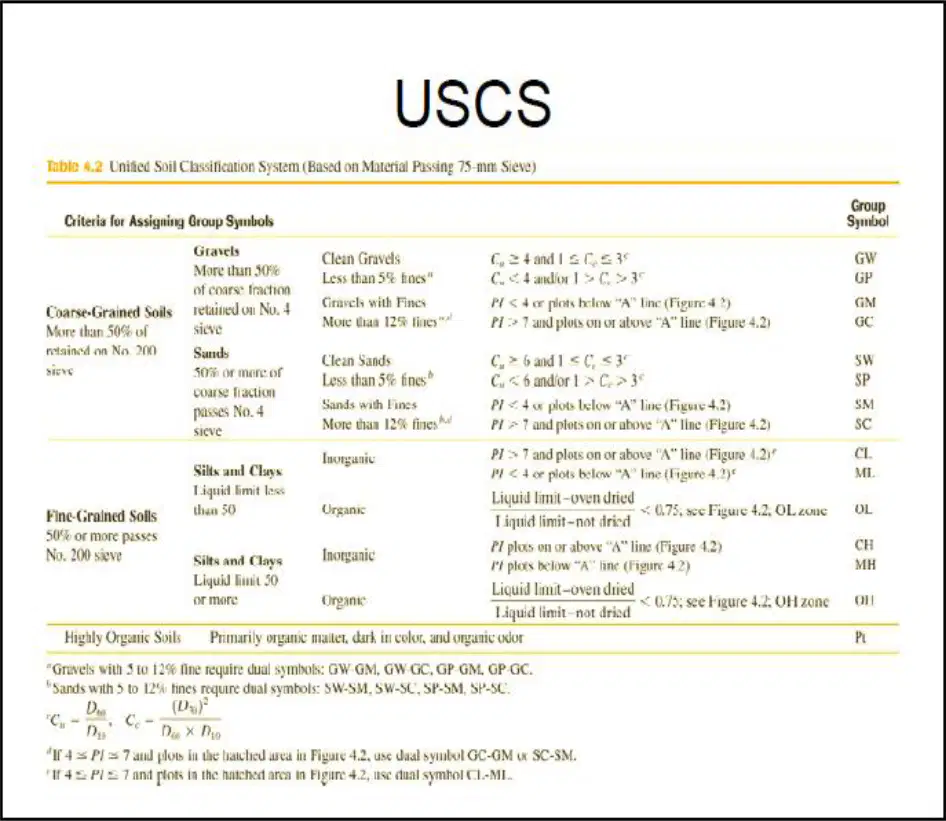
What does the dual naming "GW-GM" represent in the USCS?
Well-graded sand with silt
Silty clayey gravel
Well-graded gravel with silt
Poorly graded gravel

Which group symbol is used for clean sands with less than 5% fines in the USCS?
SW
SP
SM
GC

What is the group symbol for silty clayey gravel in the USCS?
GW-GM
GC-GM
SW-SM
GP-GC
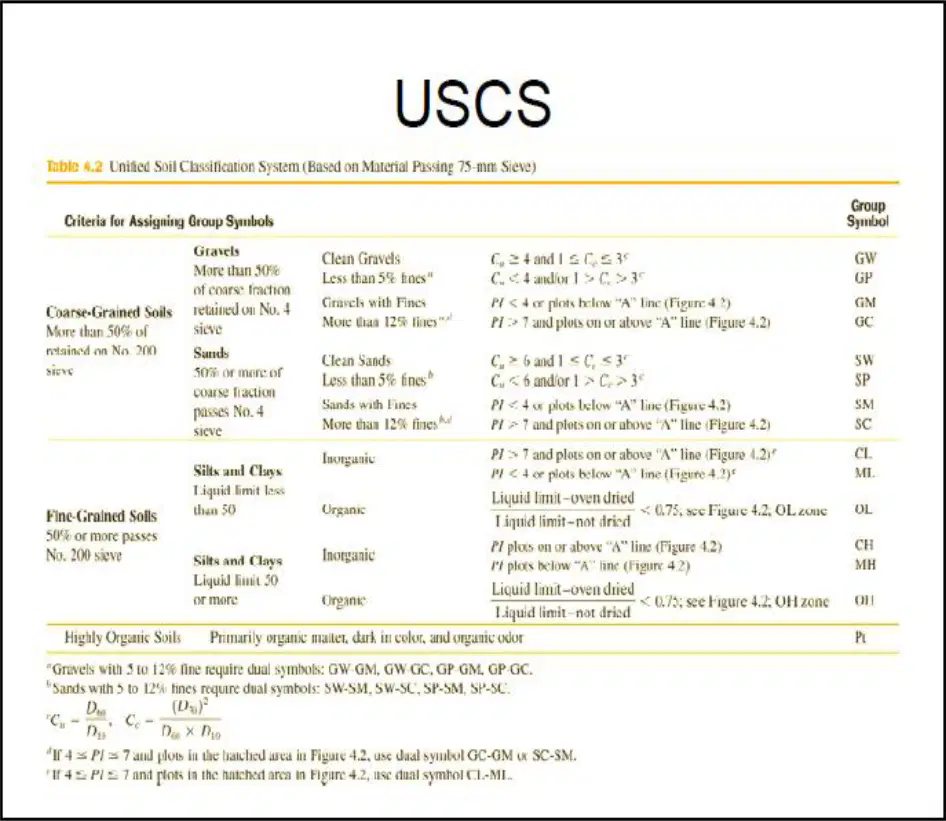
What does the dual naming "SW-SM" represent in the USCS?
Well-graded sand with silt
Silty clayey gravel
Well-graded gravel with silt
Poorly graded sand
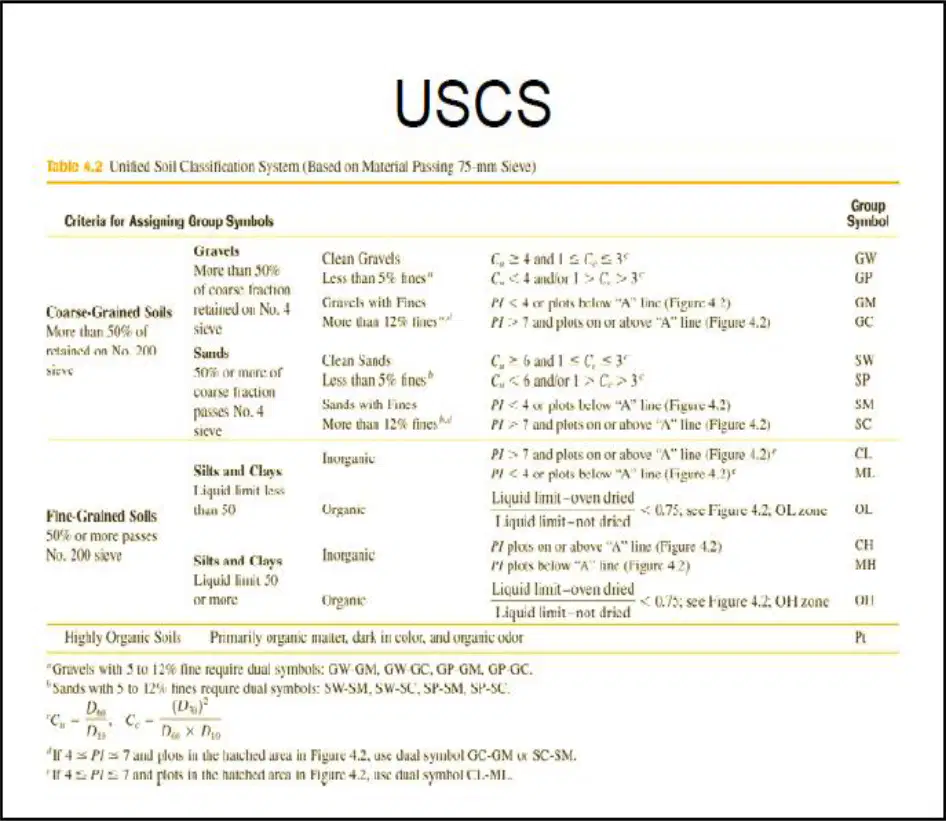
Which type of soil is primarily organic matter, dark in color, and has unique odor according to the USCS?
Silty clayey gravel
Peat soils
Well-graded sand with silt
Clean sands
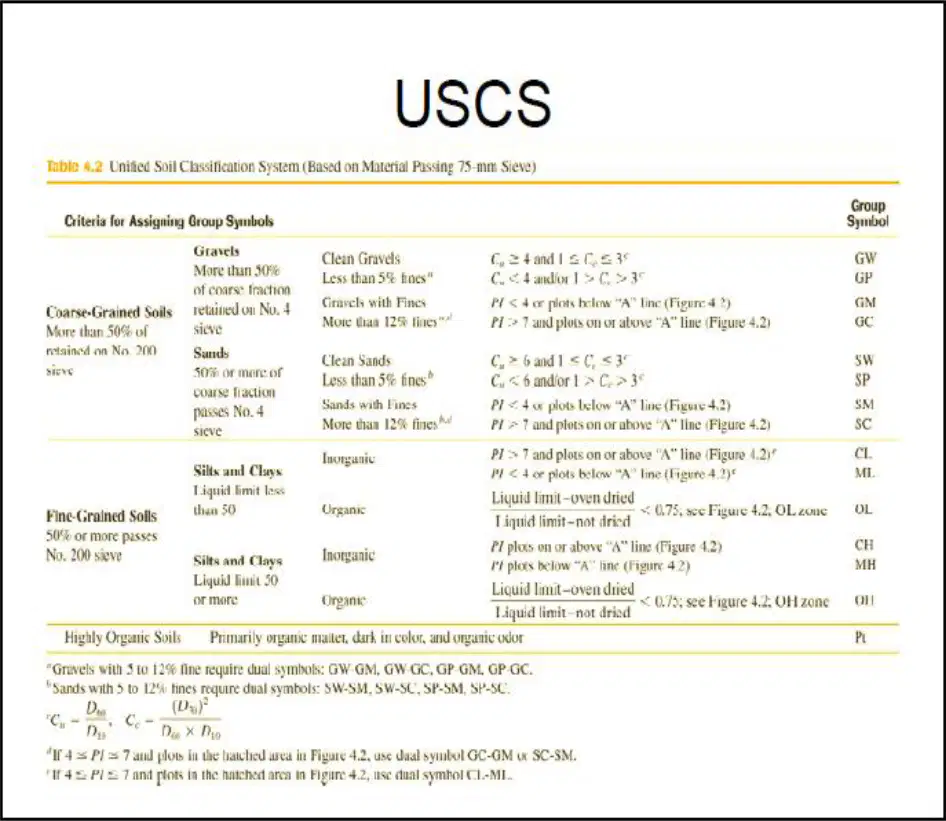
What is the group symbol for inorganic silts and clays with a liquid limit less than 50 in the USCS?
CL
ML
CH
OL
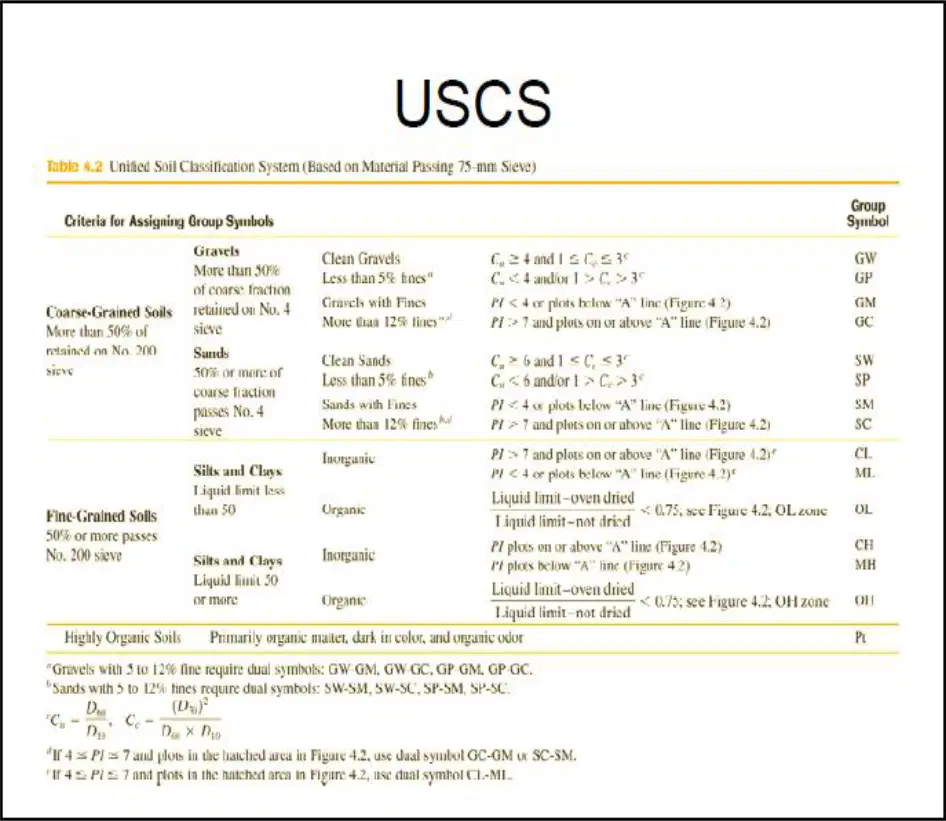
What is the group symbol for inorganic silts and clays with a liquid limit greater than 50 in the USCS?
CL
ML
CH
OL
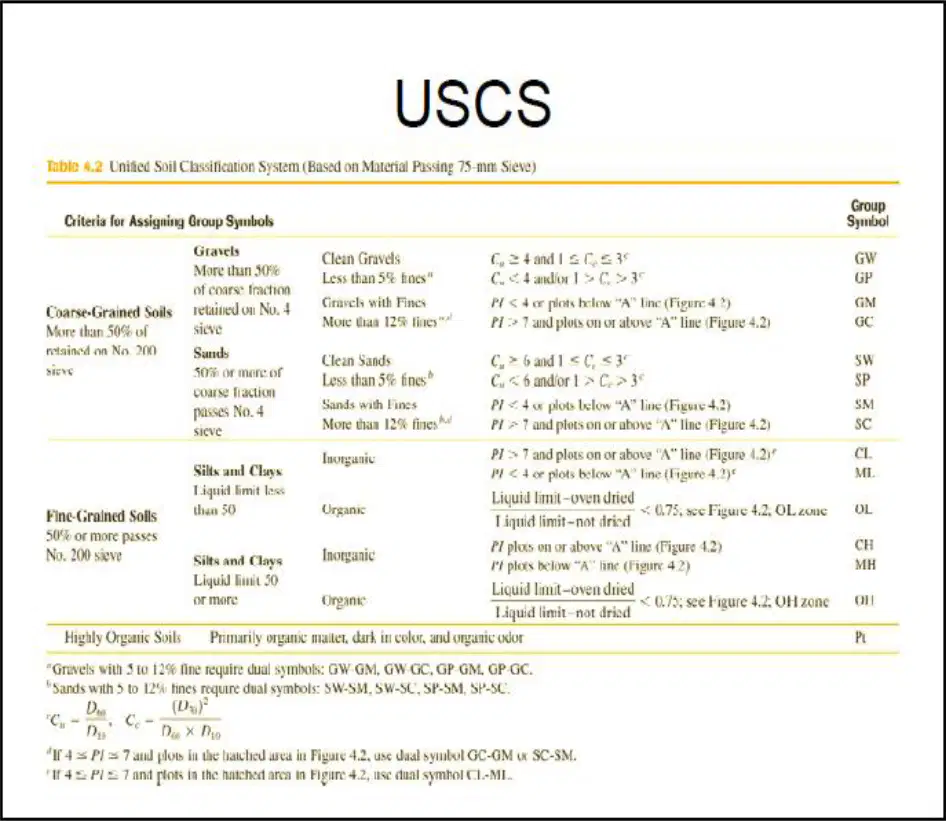
What is the group symbol for clean gravels with less than 5% fines in the USCS?
GW
GP
GC
GM

What does the group symbol "OL" represent in the USCS?
Organic silts and clays with liquid limit less than 50
Organic silts and clays with liquid limit greater than 50
Inorganic silts and clays with liquid limit less than 50
Inorganic silts and clays with liquid limit greater than 50
What does the USCS system use to classify soils?
LL, PL, PI, and soil gradation information
Grain size distribution curve only
Soil color and texture
Soil density and porosity
What is the grain size range for sand according to the USCS system?
d ≥ 4.75 mm
4.75 mm > d > 0.075 mm
d ≤ 0.075 mm
d ≥ 10 mm
What does F200 represent in the USCS system?
Percentage retained on No. 200 sieve
Percentage finer than No. 200 sieve
Percentage retained on No. 4 sieve
Percentage finer than No. 4 sieve
How is the coefficient of uniformity (Cu) calculated?
Cu = (D30/D10)
Cu = (D60/D10)
Cu = (D10/D60)
Cu = (D60/D30)
What is the formula for the coefficient of gradation (Cg)?
Cg = (D30/D60)
Cg = (D60 × D10)/D30
Cg = (D30²)/(D60 × D10)
Cg = (D10 × D60)/D30
Which soil types are categorized as fine in the USCS system?
Sand and gravel
Clay and silt
Sand and silt
Gravel and clay
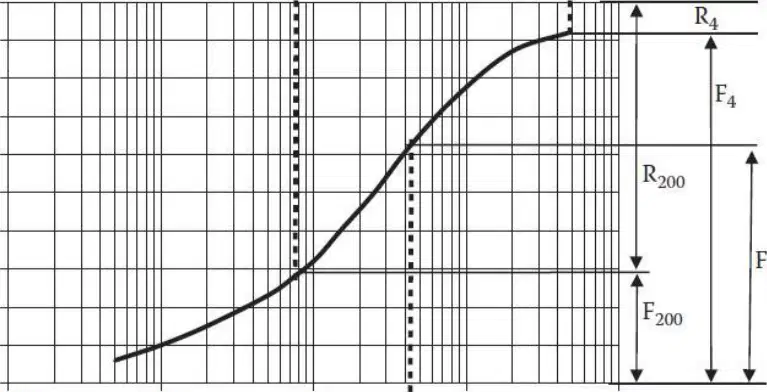
What does the No. 200 sieve (0.075 mm) primarily separate in soil classification?
Sand and gravel
Fine particles (clay & silt) and sand
Gravel and fine particles
Sand and coarse particles
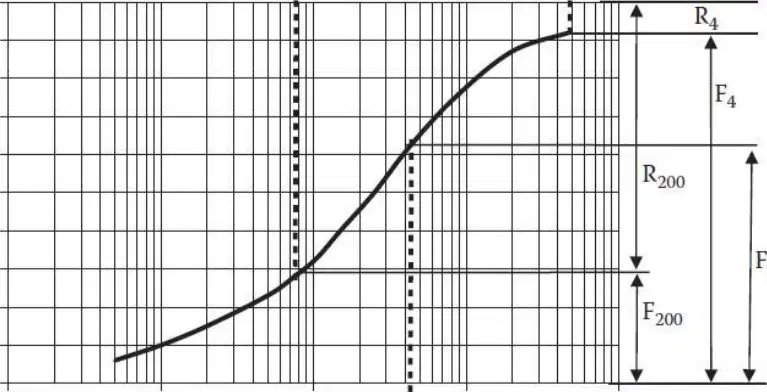
What is the significance of the No. 40 sieve (0.425 mm) in soil classification?
Separates sand and gravel
Separates fine particles and sand
Separates coarse particles and gravel
Separates fine particles and gravel
In the Unified Soil Classification System (USCS), what does the abbreviation "GW" stand for?
Well-graded gravel
Poorly graded gravel
Well-graded sand
Poorly graded sand
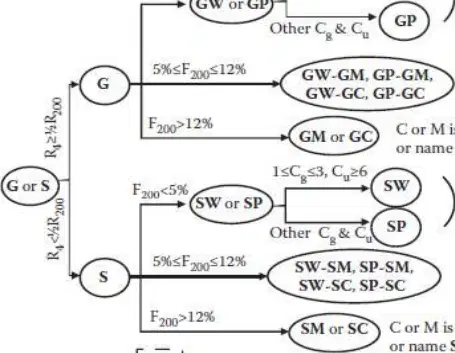
According to the USCS flow chart, what is the percentage of sand required to classify soil as GW or GP with sand?
% sand ≥ 10%
% sand ≥ 15%
% sand ≥ 20%
% sand ≥ 25%
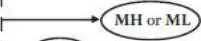
What does the abbreviation "CL" represent in the USCS flow chart?
Low plasticity clay
High plasticity clay
Low plasticity silt
High plasticity silt
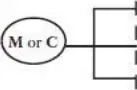
In the USCS flow chart, what is the criterion for identifying "Pt" (peat)?
Based on grain size distribution
Identified by color, odor, spongy feel, and fibrous texture
Based on plasticity chart
Based on percentage of sand and gravel
What is the classification of soil if F200 < 50% and gravel and sand content is more than 50%?
G or S
M or C
O or Pt
GW or GP
If F200 > 12%, what are the possible classifications for the soil?
GW, GP, SW, SP
GM, GC, SM, SC
GW-GM, GW-GC, GP-GM
SW-SC, SP-SM, SP-SC
What is the condition for naming gravel as W in the final step for gravel and sand classification?
Cu ≥ 6 and 1 ≤ Cg ≤ 3
Cu ≥ 4 and 1 ≤ Cg ≤ 3
Cu ≥ 5 and 1 ≤ Cg ≤ 4
Cu ≥ 3 and 1 ≤ Cg ≤ 2
What is the classification of soil if F200 ≥ 50%?
GW or GP
SW or SP
M or C (or possibly O or Pt)
GM or GC
What chart is used to classify soil as M or C?
Grain size distribution chart
Plasticity chart
Soil density chart
Permeability chart
What values are used in the plasticity chart to classify soil type?
Cu and Cg values
LL and PL values
F200 and R200 values
GW and GP values
What are the possible classifications for soil based on the plasticity chart?
GW, GP, SW, SP
GM, GC, SM, SC
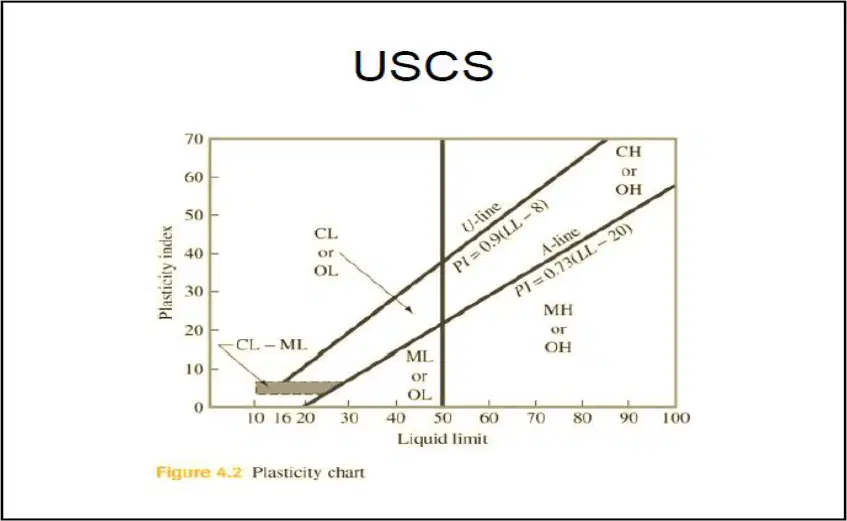
CH, CL, MH, ML, or CL-ML
SW-SC, SP-SM, SP-SC
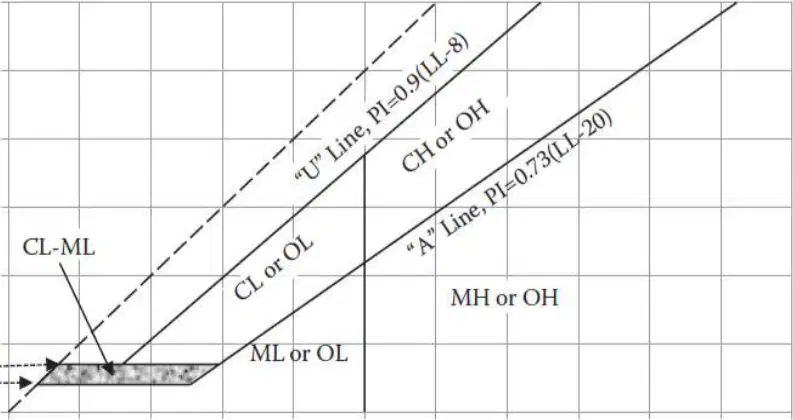
What is the boundary liquid limit (LL) that separates high-plastic soils from low-plastic soils on the plasticity chart?
LL = 30
LL = 40
LL = 50
LL = 60
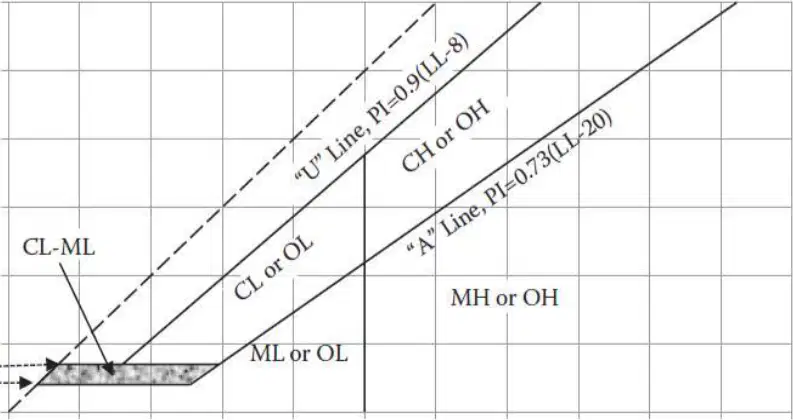
Which subgroup names are used for gravel soils with fine contents between 5% and 12% according to the plasticity chart?
GW-GM, GW-GC, GP-GM, GP-GC
SW-SM, SW-SC, SP-SM, SP-SC
CL-ML, ML-OL, CH-OH
MH-OH, CL-OL, SP-SC

