
 Worksheets
GRADE 7- 2nd Quarter (RUQA)
Total questions: 33
Worksheet time: 28mins


For numbers 1–5, refer to the illustration and description of a compound microscope showing labeled parts A to I. A compound microscope has an ocular lens and objective lens, a head, base, arm, stage, focusing knobs, and an illumination system.

Based on the diagram and description, if you are a lab scientist observing a water sample, after you are done, what is the safest and most correct way to put the microscope away?
Turn off the light, leave the high-power objective in place, and carry it by the eyepiece.
Leave the light on for the next user, lower the stage, and carry it by the stage.
Turn off the light, lower the stage, wrap the cord loosely around the base, and carry it with one hand.
Turn off the light, rotate the lowest power objective into place, lower the stage, and carry it with two hands

You are focusing on a specimen and see a blurry image. Which part of the microscope (from the illustration) should you use first to make the image sharper without risking damage?
Eyepiece
Arm
Coarse Focus Knob
Light Source

The following are the labeled parts of the microscope paired with its function correctly, EXCEPT.
Label A: where the viewer looks the magnified image of the specimen
Label D: it collects and focuses the light from the mirror to the specimen
Label F: where the mounted slide is placed
Label G: it reflects light from an external light source

Looking at the illustration, which part holds the slides in place and allows light to pass through the specimen from below?
Eyepiece
Arm
Stage
Light Source
During a class activity, your friend forgets to lower the stage before storing the microscope. Why is this a problem?
The light stays on longer
It saves space in the cabinet
It makes the microscope lighter
The lenses might touch and scratch each other

Can the microscope still be in function if you remove the part labeled with G?
Yes, because this part is not necessary for the microscope thus removing it is a must.
Yes, because the light will automatically reflect towards the objective lens even without this part.
No, because this part plays a role in reflecting the light source towards the specimen.
No, because there will be no surface for the specimen to be placed if we remove this part.
You are observing onion cells in a lab experiment. What technique should you use first to see the cells clearly?
Use high power lens right away
Shake the slide vigorously
Turn off the light completely
Add a drop of water and cover with a slip
In a team discussion, identify the cell part that acts like a boss controlling activities. What is it?
Cell membrane
Nucleus
Cytoplasm
Mitochondria
Imagine sketching what you see under the microscope. Which part looks like a jelly filling inside the cell?
Nucleus
Chloroplasts
Cytoplasm
Cell membrane
During observation, you notice green dots in plant cells. What are these and their function?
Mitochondria, make energy
Nucleus, store water
Chloroplasts, make food from sunlight
Cytoplasm, protect the cell
Why do we start with the low power lens when observing cells?
To use less light
To make the image darker
To count more cells at once
To find the sample easily and avoid breaking the slide
Unicellular organisms consist of just one cell and the entire organism's functions are performed by that cell only. One type of unicellular organism is bacteria and they are capable of living and reproducing independently. On the other hand, multicellular organisms such as humans have numerous cells collaborating to do various jobs, which enables these organisms to construct elaborate structures and develop intricate functions.

Think about tiny living things in pond water. What makes bacteria unicellular?
It grows into a big animal
It needs other organisms to survive
It has many cells working together
It is made of one cell that does everything
In a class debate, compare humans to amoeba. Why is a human multicellular?
It has one big cell
It lives in water only
It is made of many cells forming tissues and organs
It reproduces faster and increases its mass and dimension.
Imagine of designing a poster, give an example of a unicellular organism.
Dog
Tree
Yeast
Fish
What advantage do multicellular organisms like plants have over unicellular ones?
They don't need food
They are always smaller
They can only do one job
They have specialized cells for different tasks
You are tasked with comparing the structures of plants and animal cells using a microscope. Which approach would most effectively facilitate this comparison?
Observing only one type of cell at a time
Focusing solely on the nucleus of each cell
Using a prepared slide of each cell type side by side
Sketching the cells from memory after viewing them

For number 16-20, refer to the statement about plant and animal cells based on their organelles.
You are comparing slides of cheek and leaf cells. What organelle is only in plant cells for making food?
Nucleus
Mitochondria
Chloroplasts
Cytoplasm
In a group activity, identify why plant cells are stiff and box-shaped.
They have a cell wall
They have more mitochondria
They lack a membrane
They are smaller
Animal cells don't have chloroplasts. What does this mean for how they get energy?
They make food from sunlight
They store water better
They eat other things for energy
They divide faster
What organelle is bigger in plant cells to store water?
Nucleus
Vacuole
Mitochondria
Cell membrane
Both plant and animal cells have mitochondria. What is their common function?
Make food
Control the cell
Produce energy
Provide shape
For number 21-25, refer to the illustration and description given below.

Imagine your skin healing after a scratch. Which cell division helps with this repair?
Meiosis
Mitosis
Fertilization
Photosynthesis
In a class presentation where you explain mitosis. How many daughter cells does it produce?
One
Two identical
Four different
None
Think about growing taller. Why does your body use mitosis?
To make sex cells
To reduce cell number
For growth and adding more cells
For energy production
Meiosis is different from mitosis because meiosis
is for daily growth.
happens only in plants.
produces four cells with half chromosomes.
makes identical cells for repair and production.
Which cell division used by a plant root that grows longer?
Meiosis for seeds
Mitosis for new cells
Both equally
Neither

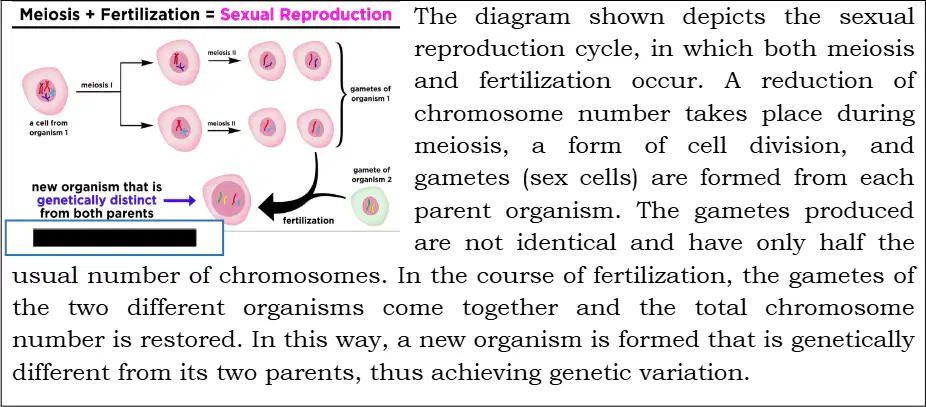
For number 27-30, refer to the illustration and description given below. The diagram shown depicts the sexual reproduction cycle, in which both meiosis and fertilization occur.

You are telling a story about family traits. How does a child get eye color from both mom and dad?
From food eaten
By growing alone
Through mitosis, meiosis, reproduction, and fertilization
By meiosis making sex cells and fertilization joining them
What happens to the cell during fertilization?
One cell divides into two
Cells repair damage
Sperm and egg join together
Energy is made
Why does meiosis halve the genetic information in sex cells?
So offspring get half from each parent
For faster growth and reproduction
To make identical copies
To remove traits

In a diagram showing genetic passing, where do the offspring get the genes?
One parent only
The environment
Both parents
Other siblings
A puppy looks different from both of its parents, having a mix of their traits like fur color and ear shape. Which two processes are most directly responsible for this?
Mitosis and repair
Meiosis in parents and fertilization
Asexual division
Cell eating

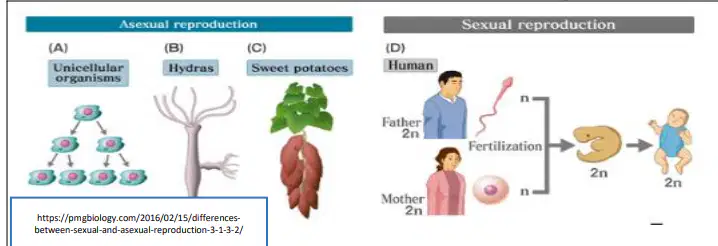
Refer to the illustration comparing asexual and sexual reproduction (unicellular organisms, hydras, sweet potatoes vs. human parents and fertilization). A farmer grows a field of bananas from the shoots of one single, very tasty banana plant. Why are all the bananas in the field genetically identical?
Because the process involved two parents.
Because the process was sexual reproduction.
Because the process was asexual reproduction.
Because the bananas decided to look the same.
Looking at the illustration, which statement is TRUE about sexual reproduction?
It requires two parents
It requires only one parent
It is how bacteria reproduce.
The offspring are always identical to the parent
A starfish regrows from a piece and therefore this is asexual reproduction
because offspring vary a lot
because it needs fertilization
because two parents mix genes and produce
because one parent makes identical offspring
In a group discussion: How does sexual reproduction produce offspring?
Always grow faster
Look exactly like one of the parents
Are similar but not identical to parents
Have no traits from both mother and father
Bacteria will split into two. What kind of reproduction is it?
Sexual reproduction, it needs meiosis
Asexual reproduction, two parents involved
Asexual reproduction, one parent and offspring is identical
Bacteria Type of reproduction, it produces variety of offspring

Refer to the illustration of Levels of Organization in Biology (atom to biosphere). You are an ecologist studying a coral reef. You start by observing a single, individual fish. What is the next level of organization you would study, according to the diagram?
Organ System
Population
Community
Biosphere
Your heart is made of muscle tissue, nerve tissue, and connective tissue working together. Based on the illustration, your heart is best described as a/an:
Cell
Tissue
Organ
Organ System
All the interacting populations (of fish, coral, algae, etc.) in a coral reef make up a/an:
Population
Community
Ecosystem
Biosphere
The stomach, small intestine, and large intestine work together as part of the:
Digestive Tissue
Digestive Organ
Digestive System
Organism

Referring to the given illustration, the highest level of organization, which includes all the ecosystems on Earth is
Community
Ecosystem
Biosphere
Population
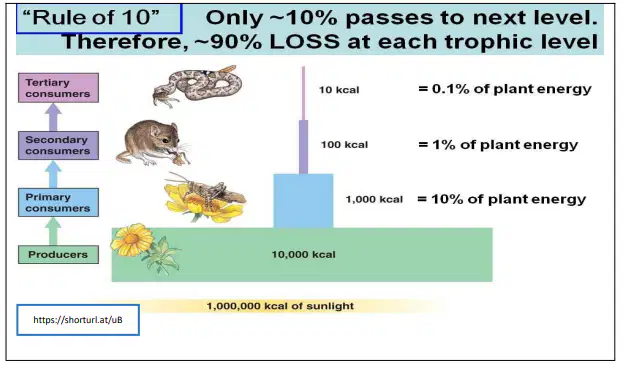
Rule of 10: Only ~10% passes to next level. Therefore, ~90% loss at each trophic level. According to the illustration given, which organism has the most energy available to it?
Snake
Rabbit
Bee
Grass

The illustration given shows that a snake has much less energy than the grass. What is the main reason for this energy loss as you move up the pyramid?
Decomposers take all the energy
Energy is destroyed by consumers
Producers create less energy than consumers
Energy is used by each organism for its own life processes

Based on the illustration, what is the role of the sunflower?
Producer
Secondary Consumer
Decomposer
Primary Consumer
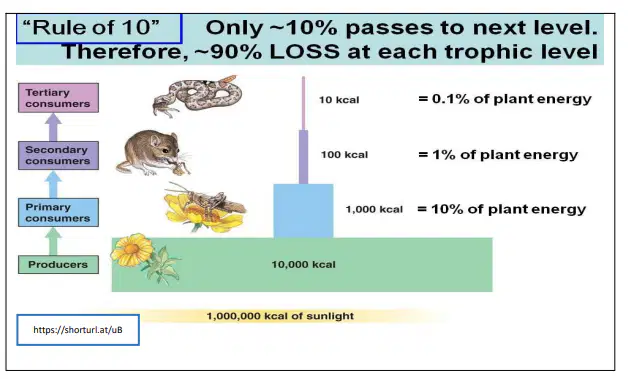
If a harmful pesticide entered this ecosystem, which organism in the pyramid would likely have the highest concentration of the toxin in its body?
Sunflower
Snake
Rabbit
Bee

What would most likely happen to the snake population if the rabbit population decreased drastically?
It would increase.
It would stay the same.
It would decrease.
It would become producers.

Which of the following correctly describes the flow of energy in the pyramid?
Snake -> Rabbit -> Bee -> Sunflower
Sunflower -> Bee -> Rabbit -> Snake
Snake -> Grass -> Hawk -> Frog
It flows equally to all levels.

If the grass has 10,000 units of energy, approximately how many units would be available to the Bee (primary consumers)?
10,000 units
1,000 units
100 units
10 units
What is the original source of energy for almost all food pyramids on Earth?
Water
The Sun
Soil
Consumers

Which organism from the given illustration is a herbivore?
Snake
Rabbit
Bee
Sunflower
Why are there typically fewer top predators in an ecosystem than producers?
Because they are harder to find.
Because they are less important.
Because they reproduce more slowly.
Because there is not enough energy to support a large number of them after it flows up the pyramid.

