wayground logo

Free Printable Worksheets

Font size

S
M
L
XL
Worksheets

ESB -U2Q1: Earth's Layers Pulse Check - 2025

Total questions: 30

Worksheet time: 23mins
Name
Class
Date
1.
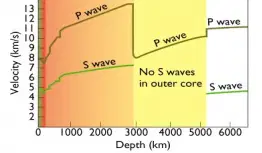
What is the independent variable on the graph below?
a)
Velocity (km/s)
b)
Seismic waves
c)
Depth (km)
2.
Early Earth (proto-Earth) was a _____ planet.
a)
differentiated
b)
heterogeneous
c)
homogeneous
d)
layered
3.
Heavy (dense) elements were separated from lighter (less dense) elements within early Earth during a phenomenon known as _____.
a)
the Cambrian Explosion
b)
Primary Endosymbiosis
c)
the Great Oxidation Event
d)
the Iron Catastrophe
e)
Plate Tectonics
4.
Most of the water on Earth's surface originated from _____.
a)
Earth's interior
b)
comets
c)
an icy ring system
d)
dinosaur tears
5.
True/False: Earth's first crust was formed when a magma ocean solidified into rock.
a)
True
b)
False
6.
Based on chemical composition, Earth has _____ layers.
a)
2
b)
3
c)
4
d)
5
7.
Identify the least dense layer of Earth:
a)
asthenosphere
b)
inner core
c)
lithosphere
d)
lower mantle
e)
outer core
8.
Identify the hottest layer of Earth:
a)
asthenosphere
b)
inner core
c)
lithosphere
d)
lower mantle
e)
outer core
9.
Identify the layer that consists of molten rock:
a)
asthenosphere
b)
inner core
c)
lithosphere
d)
lower mantle
e)
outer core
10.
Which of the following statements is true?
a)
Continental crust is much thicker and less dense than oceanic crust
b)
Continental crust is much thicker and more dense than oceanic crust
c)
Oceanic crust is much thicker and more dense than continental crust
d)
Oceanic crust is much thicker and less dense than oceanic crust
11.
NOT among the evidence that supports a differentiated (layered) Earth is _____.
a)
convection currents in the mantle
b)
Earth's average density
c)
Earth's magnetic field
d)
meteorites
e)
seismic waves
12.
_____ cannot travel straight through Earth's interior indicating the presence of a liquid inside Earth.
a)
L-waves
b)
P-waves
c)
S-waves
d)
Surface waves
13.
Earth is closest to the Sun during the month of _____.
a)
April
b)
January
c)
July
d)
September
14.
What percentage of Earth's surface is land?
a)
29%
b)
50%
c)
71%
d)
most of Earth's surface is land
15.
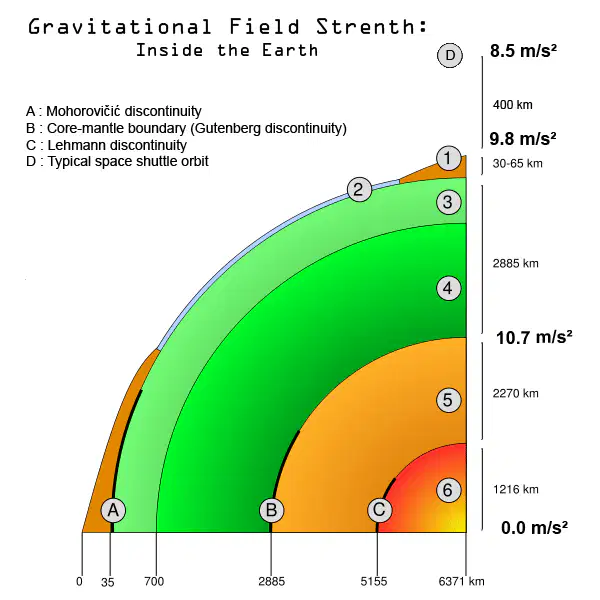
Use the illustration below to answer the question. Which layer is the least dense?
a)
1/2
b)
3
c)
4
d)
5
e)
6
16.
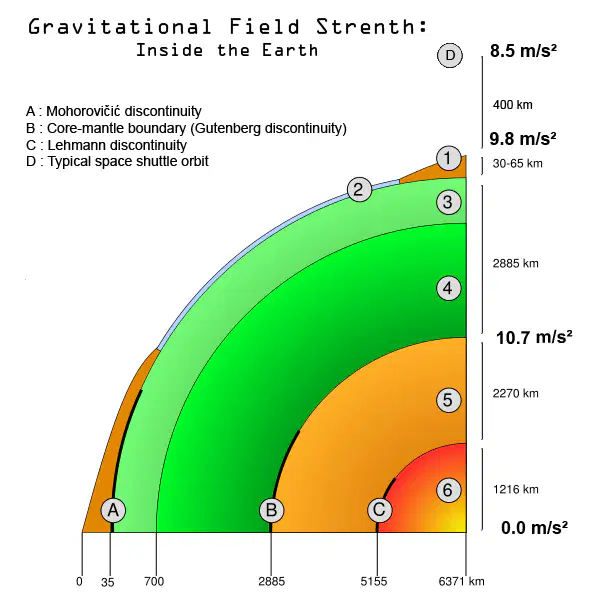
Use the illustration below to answer the question. Which layer absorbs S-waves?
a)
1/2
b)
3
c)
4
d)
5
e)
6
17.
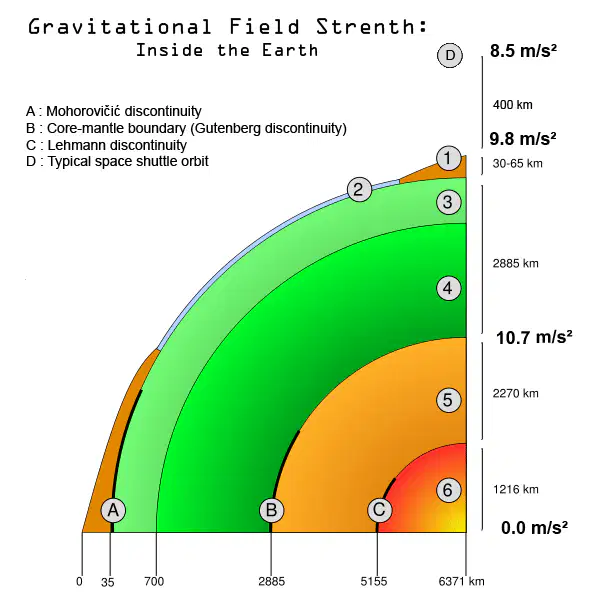
Use the illustration below to answer the question. Which layer is the asthenosphere?
a)
1/2
b)
3
c)
4
d)
5
e)
6
18.

The process by which a homogeneous (uniform) Earth separated into layers of differing density, with heavier materials sinking to the center, is known as:

a)

Accretion

b)

Differentiation

c)

Volcanic Outgassing

d)

Nebular Theory

19.

The "Iron Catastrophe" describes the time when molten iron sank to form Earth's core. The primary cause of this event was:

a)

The slow cooling of the Earth over billions of years.

b)

The planet's temperature reaching iron's melting point due to bombardment, allowing liquid iron to sink by gravity.

c)

Tidal forces from the early Moon pulling the liquid core into place.

d)

The initial accretion of planetesimals containing only iron.

20.

Which two sources are primarily responsible for the water that formed Earth's oceans?

a)

Water vapor released by volcanic outgassing and bombardment by comets

b)

Water captured from an icy ring system around the early Earth

c)

Gravitational capture of atmospheric gases from space

d)

Photosynthesis by early bacteria

21.

The outermost mechanical layer of Earth, which is rigid and broken into large pieces called tectonic plates, is the:

a)

Asthenosphere

b)

Mesosphere

c)

Lithosphere

d)

Outer Core

22.

The Asthenosphere is described as plastic because:

a)

The rock within it flows slowly due to immense heat and pressure.

b)

It is composed primarily of silicon, oxygen, and aluminum.

c)

It is the boundary between the crust and the mantle.

d)

It is a transitional zone where S-waves are absorbed.

23.
Which earth layer is #2?
a)
Crust
b)
Mantle
c)
Outer core
d)
Inner core
24.
Identify each layer - #16.
a)
Crust
b)
Mantle
c)
Lithosphere
d)
Asthenosphere
25.
Identify each layer - #17.
a)
Crust
b)
Mantle
c)
Lithosphere
d)
Asthenosphere
26.
Pressure ______________________ as you go deeper into the Earth
a)
increases
b)
decreases 
c)
goes up or down depending on the layer
d)
stays the same
27.
Temperature _____________________ as you go deeper into the earth.
a)
increases
b)
decreases
c)
goes up and down depending on the layer
d)
stays the same
28.

Earth's average density is 5.54 g/cm³. Given that the crust has a density of 2.2-3.4 g/cm³, this information implies that:

a)

The oceans must be denser than the crust.

b)

The Mantle must have a lower density than the crust.

c)

Material deep inside Earth (the core) must have a density much greater than 5.54 g/cm³

d)

The Mesosphere is the layer that generates the magnetic field.

29.

Earth's magnetosphere is created and sustained by the:

a)

Extreme heat from the Inner Core.

b)

Interactions and churning flow of liquid iron and nickel in the Outer Core (Dynamo Theory).

c)

Convection currents in the Asthenosphere.

d)

Gravitational pull of the Moon on the Inner Core.

30.

How can we describe an oblate spheroid?

a)

Equatorial Diameter is shorter than the Polar Diameter

b)

Polar Diameter is shorter than the Equatorial Diameter

c)

Polar and Equatorial Diameter are equal