
 Worksheets
DFT-EMREE-PULMONOLOGY--20-10-2025
Total questions: 10
Worksheet time: 8mins
A 55-year-old with a 30-pack-year smoking history presents with progressive dyspnea. The patient reports a daily productive cough with a tablespoon of sputum for the past two years, along with intermittent wheezing. Spirometry reveals an FEV1 of 2.3 L and an FVC of 3.6 L. After administration of a short-acting bronchodilator, the FEV1 is 2.4 L and the FVC is 3.7 L. What is the most likely diagnosis?
Asthma
Chronic Obstructive Pulmonary Disease (COPD)
Bronchiectasis
Idiopathic Pulmonary Fibrosis
Congestive Heart Failure
A 20 year old with known exercise-induced asthma is on a maintenance regimen of beclomethasone 400 mcg BID and a salbutamol inhaler as needed. The patient reports being woken by cough and wheeze 2-3 times per week, requiring salbutamol for relief. Daytime symptoms are also limiting physical activity. What is the most appropriate next step in this patient's management?
Increase beclomethasone dose to 800 mcg BID
Add a long-acting beta-agonist (LABA)
Add a leukotriene receptor antagonist (LTRA)
Start a short course of oral prednisolone
Switch beclomethasone to sodium cromoglycate
A patient with a history of very severe, long-standing COPD (FEV1 < 30% of predicted) presents with progressive dyspnea on minimal exertion. The patient is already on maximal medical therapy, including multiple inhalers and oral theophylline. On examination, the patient is afebrile and has a resting oxygen saturation of 87% on room air. Which of the following is the most critical management step to improve this patient's long-term survival?
Referral for lung volume reduction surgery
Trial of nocturnal non-invasive ventilation
Initiation of pulmonary rehabilitation
Assessment for long-term oxygen therapy (LTOT)
Addition of roflumilast to the current regimen
A patient is brought to the ED after a severe chest trauma. The patient is in severe respiratory distress, agitated, and hypotensive (BP 80/50 mmHg). O/E: Neck veins are distended, trachea is deviated to the right, and there is a complete absence of breath sounds over the left hemithorax. What is the most appropriate immediate action?
Obtain a stat portable chest X-ray
Administer high-flow oxygen and reassess
Insert a needle into the left 2nd ICS, midclavicular line
Prepare for immediate endotracheal intubation
Insert a chest tube into the left 5th ICS, midaxillary line
A patient is diagnosed with Eosinophilic Granulomatosis with Polyangiitis (EGPA) after presenting with sinusitis, lung problems, and skin rashes. Which laboratory finding is essential for this diagnosis?
High neutrophil count
Positive Antinuclear Antibody (ANA)
Marked eosinophilia
Low platelet count
A 68 Y/O presents with 2 years of progressive dyspnea & a dry cough. O/E: Digital clubbing & bibasilar 'Velcro-like' crackles are present. What is the most likely Dx?
COPD
Congestive Heart Failure
Sarcoidosis
Idiopathic Pulmonary Fibrosis (IPF)
A young adult develops high fever, cough, and confusion after staying in a communal lodging. A chest X-ray confirms pneumonia. Several atypical organisms are considered. Which of the following associated findings would most strongly suggest Legionella pneumophila over other causes?
A positive cold agglutinin test
Hyponatremia
Bullous myringitis on otoscopy
A dry, non-productive cough
A patient with a history of a seizure disorder is diagnosed with a lung abscess in the superior segment of the right lower lobe, a location consistent with an aspiration event. The patient is admitted for initiation of intravenous antibiotic therapy. Which of the following antibiotic regimens provides the most appropriate empiric coverage for this patient?
Azithromycin
Vancomycin
Ceftriaxone
Ampicillin-sulbactam
Ciprofloxacin
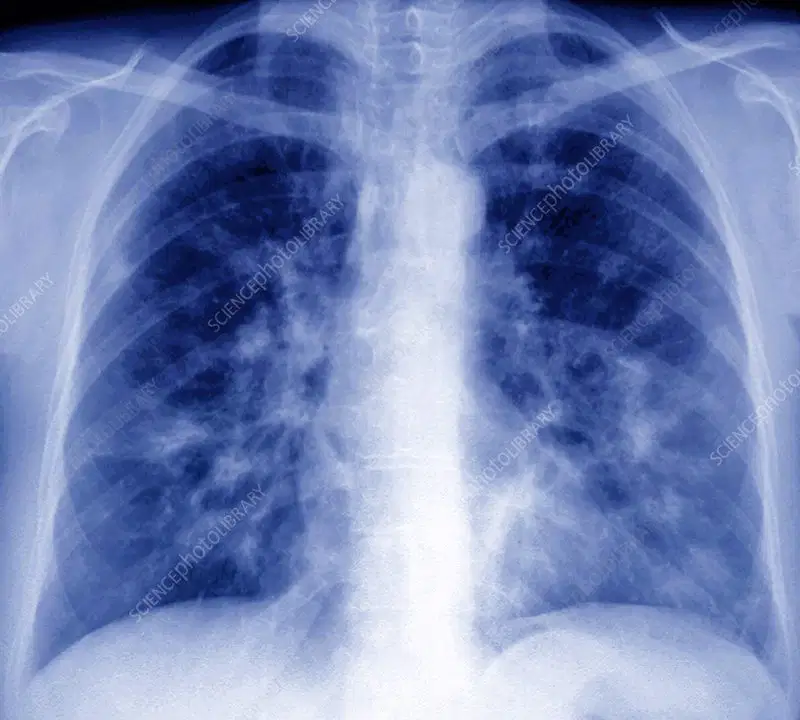
A 42 Y/O M, a pet shop owner specializing in exotic birds, presents with a 1-week Hx of high swinging fevers, severe headache, and a dry cough. O/E: T 39.2°C, appears toxic. A few faint, rose-colored macules are noted on the abdomen. The provided chest X-ray shows diffuse bilateral patchy infiltrates. Based on the history and radiological findings, what is the most likely causative organism?
Chlamydia psittaci
Coxiella burnetii
Salmonella typhi
Mycoplasma pneumoniae
Francisella tularensis
A patient with a known allergy to grass pollen is exposed to a high concentration of the allergen. Within minutes, the patient develops intense nasal itching, paroxysmal sneezing, and profuse clear rhinorrhea.This immediate allergic response is primarily triggered by the cross-linking of IgE antibodies on the surface of which cell type?
Eosinophils
T-lymphocytes
Mast cells
Neutrophils
Macrophages

