
 Worksheets
Math 1 & 2 Test
Total questions: 70
Worksheet time: 12hrs 40mins
Choose the correct property that states: For all real numbers x, y, and z, x + (y + z) = (x + y) + z.
Commutative Law of Addition
Additive Inverse
Associative Law of Addition
Distributive Law
Additive Law of Addition
What equations are of the form ax2 + bx + c = 0, where a ≠ 0?
linear
standard
exponential
quadratic
rational
In which quadrant is the angle 265*?
I
II
III
IV
cannot be determined
Solve 1/15 (x+4) = 2/7
2/7
1
- 4/35
30/7
3
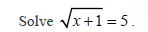
x = -1
x = 1
x = 0
x = 24
no solutions exist
Solve the inequality 5(x-2) > 5
x > -26
x < 6
x > 3
all real numbers
no solutions exist
What type of number is an expression of the form a + bi, where a and b are real numbers?
rational
irrational
simple
cmplex
imaginary
The conjugate of a + bi is ________.
−a + bi
2a + 2bi
a − bi
a +/− bi
−a − bi
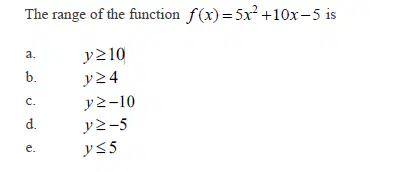
A
B
C
D
E
Which of the following is NOT a property of the graph of the function y = x^2?
The graph has a minimum at x = 0.
The graph is symmetric.
The function is decreasing on the negative side of the x-axis
The function is increasing on the positive side of the x-axis.
The graph is asymmetric

A
B
C
D
E
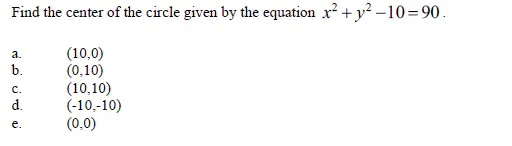
A
B
C
D
E

A
B
C
D
E
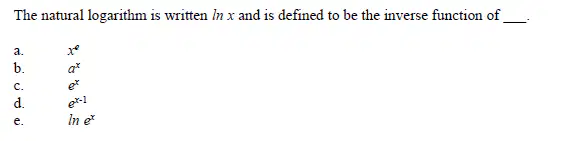
A
B
C
D
E
A rational equation is an equation that involves only ____________ or rational expressions.
linear equations
polynomials
functions
relations
numerators
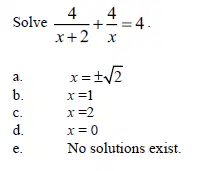
A
B
C
D
E

A
B
C
D
E
The goal of ___________ geometry is to describe geometric objects, such as lines and circles, algebraically
through equations (and sometimes through inequalities).
computational
coordinate
differential
projective
systemic
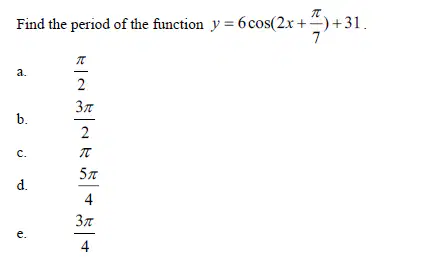
A
B
C
D
E
The equation y = mx + d is called the ____________ form of a line.
slope-distance
point-slope
standard
slope-diameter
slope-intercept
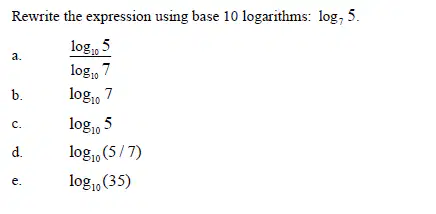
A
B
C
D
E
In a right triangle ABC, which of the following is the correct relation with right angle C?
cosA = c/b sinA
cosB = b/c sinA
sinA = c/a cosB
tanA = b/a = cotB
cotA = b/a = tanB
Find the midpoint between the points (5, -2) and (15, 6).
(0, 0)
(1, 2)
(1, 2)
(2, 2)
(10, 2)

A
B
C
D
E
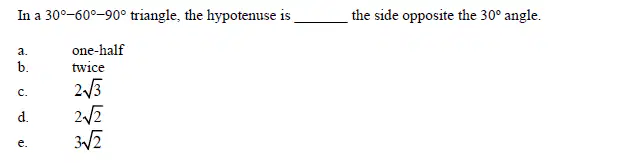
A
B
C
D
E

A
B
C
D
E

A
B
C
D
E

A
B
C
D
E
A
B
C
D
E

A
B
C
D
E

A
B
C
D
E
A
B
C
D
E
A
B
C
D
E

A
B
C
D
E
A
B
C
D
E
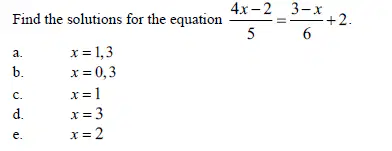
A
B
C
D
E

A
B
C
D
E
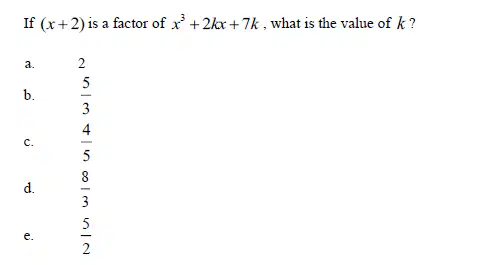
A
B
C
D
E

The first equation has two real solutions; the second equation has no real solution.
The first equation has no real solution; the second equation has one real solution.
The first equation has two real solutions; the second equation has one real solution.
The first equation has one real solution; the second equation has two real solutions.
The first equation has one real solution; the second equation has no real solution.
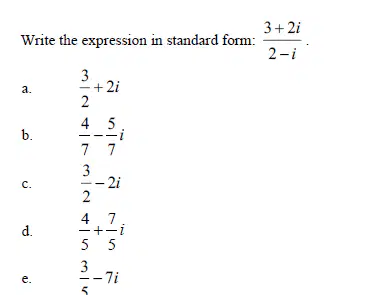
A
B
C
D
E
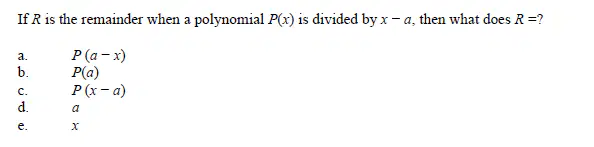
A
B
C
D
E

A
B
C
D
E
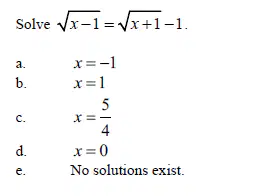
A
B
C
D
E

A
B
C
D
E
If the discriminant in a quadratic equation is −1, why are there no real solutions?
A discriminant of −1 means squaring a negative number
The square root of a negative number can never be negative.
A discriminant of −1 equals an irrational number.
There is no real number x for which x2 = −1.
Squaring of a negative number can equal a negative.
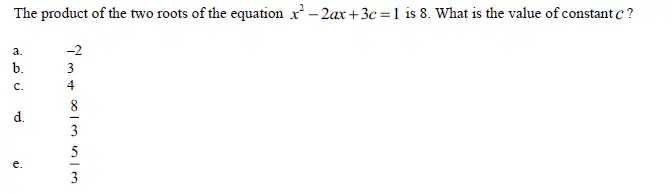
A
B
C
D
E
What is the difference between the domain and range of the function h(x) = x^2?
The domain is the set of all non-zero numbers; the range is the set of all real numbers.
The domain is the set of all real numbers; the range is the set of all non-negative numbers
The domain is the set of all non-negative numbers; the range is the set of all real numbers.
The domain is the set of all non-irrational numbers; the range is the set of all real numbers.
The domain is the set of all non-negative numbers; the range is the set of all non-irrational numbers.
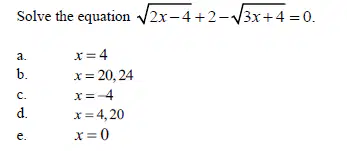
A
B
C
D
E
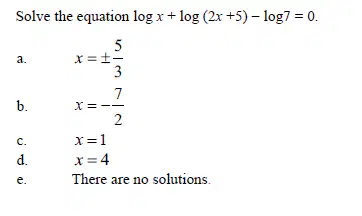
A
B
C
D
E
A
B
C
D
E
Why is the graph of y = log2/ 3 x symmetric to the graph of y = (2/3)^x?
The two functions are the converse of one another.
The two functions are the inverse of one another.
The two functions are proportional to one another.
The two functions have identical outputs.
The two functions have the same inputs and outputs.
Why is the number e irrational?
It cannot be expressed as a repeating decimal.
It has a non-infinite decimal representation.
It cannot be expressed as a non-perfect square.
It cannot be expressed as a non-terminating decimal.
none of the above

7
8
9
10
11
The function f(x) = (4x + 2)^2
is an odd function
is an even function
is both an even and an odd function
is neither an even nor an odd function
cannot be classified in the given form

symmetric with respect to the x-axis
symmetric with respect to the y-axis
symmetric with respect to the origin
symmetric with respect to both the x-axis and the y-axis
without symmetry
A
B
C
D
E
A
B
C
D
E
What is the maximum value for y = −4sin(x−
-2
2
4
6
10
What is the difference in the calculated value between the basic identities tanα ⋅ cotα and sin^2α + cos^2α?
0
1
2
1/2
-1
Which of the following sum and difference identities is correct?
cos(α − β) = cosα cosβ + sinα sinβ
sin(α − β) = sinα cosβ − cosα sinβ
cos(α + β) = cosα cosβ − sinα sinβ
none of the above
a, b, and c are all correct
A
B
C
D
E
A
B
C
D
E
What is the difference in periods for the graphs of cosine and sine trigonometric functions, compared to the graphs
for tangent and cotangent functions?
For cosine and sine functions, the period is 180°; for tangent and cotangent functions, the period is 360°.
For cosine and sine functions, the period is 720°; for tangent and cotangent functions, the period is 360°.
For cosine and sine functions, the period is 90°; for tangent and cotangent functions, the period is 180°.
For cosine and sine functions, the period is 360°; for tangent and cotangent functions, the period is
180°.
For cosine and sine functions, the period is 180°; for tangent and cotangent functions, the period is 90°.
Arcsin 1/2 = 30° because ____________.
cos 30° = 1/2
sec 30° = 1/2
tan 30° = 1/2
sin 30° = 1/2
csc 30° = 1/2
A
B
C
D
E

A
B
C
D
E

A
B
C
D
E
A
B
C
D
E
By the definition of cosine, cos(90° −α) is equal to ___________.
csc α
cot α
sec α
tan α
sin α
What is 1/sin α often denoted by?
csc α
cot α
sec α
tan α
cos α

