
 Worksheets
Classical Civilizations Ancient Greece & Rome: Riley 2025
Total questions: 42
Worksheet time: 21mins
Name
Class
Date
1.
What is a revolution?
a)
A war
b)
A fight between to countries
c)
A dramatic and wide-reaching change in the way something works or is organized or in people's ideas about it
d)
An extensive group of states or countries under a single supreme authority
2.
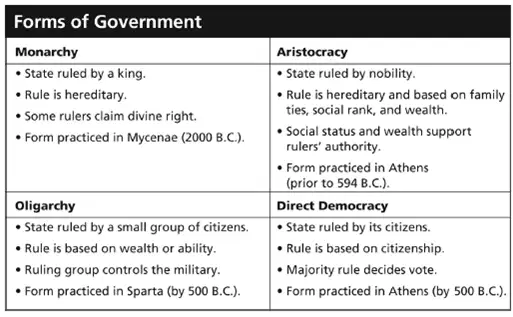
Based on the chart below, which form of Government involves the state being ruled by a single individual who often inherits his position?
a)
monarchy
b)
aristocracy
c)
direct democracy
d)
oligarchy
3.
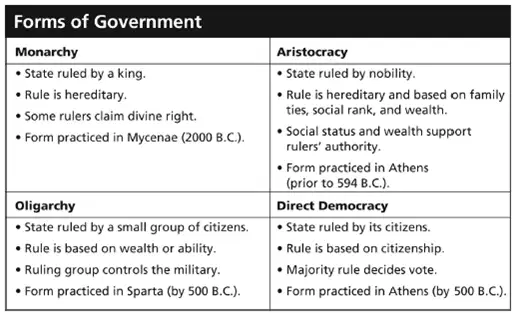
Based on what you see in the chart below, how would someone from Athens describe Sparta after visiting it?
a)
"The Spartans are very strict. The military dominates Spartan society."
b)
"It's interesting how both the rich and the poor can be rulers in Sparta."
c)
"This society has so many personal freedoms, unlike in Athens."
d)
"Sparta is exactly like Athens."
4.
What effect did the geography of Greece have on it's early development?
a)
Greece had a lot of natural resources, so they never traded with other nations.
b)
Being located on the Mediterranean Sea limited cultural diffusion.
c)
75% of Greece was covered by mountains, which led to independent city-states (called polis)
d)
It's locations limited the colonization of Greece.
5.
Which of the following did Sparta and Athens have in common?
a)
Both favored Democracy
b)
Both were dominated by their military
c)
Both were Greek city-states
d)
They both fought on the same side in the Peloponnesian Wars
6.
In a comparison between the Greek city-states of Sparta and Athens, Sparta placed more importance with?
a)
equality and voting rights
b)
art and culture
c)
education
d)
the military
7.
Who was the Persian king who led his massive forces in an invasion of Greece, only to be held off by the Spartans?
a)
Darius
b)
Cyrus
c)
Alexander
d)
Xerxes
8.
Which statement describes a Direct Democracy?
a)
The government controls the action of the people
b)
Citizens participate in government decisions by voting
c)
The military leaders create laws
d)
Religious leaders control the government
9.
Why is Ancient Greece considered important to Western Civilization?
a)
Greek culture influenced today's democracy, architecture, and entertainment
b)
Athens defeated Sparta in the Peloponnesian Wars
c)
The Greeks borrowed ideas from Rome and improved on them
d)
The Greeks invented the world's first monotheistic religion
10.
Which of the following is NOT a Greek achievement?
a)
Mathematics such as the formula for pi
b)
Philosophy, such as the work of Socrates, Plato, and Aristotle
c)
Medicine, such as the Hippocratic Oath
d)
Government, such as using Confucius as the basis for the exam system
11.
What were two regions conquered by Alexander the Great?
a)
Egypt and Persia
b)
China and Egypt
c)
Persia and China
d)
Macedonia and Germany
12.
Who conquered all of Greece after the Peloponnesian Wars?
a)
Alexander the Great
b)
King Xerxes of Persia
c)
King Darius of Persia
d)
King Phillip II of Macedonia
13.
After Alexander the Great died, what became his legacy?
a)
Hellenistic Culture, and an emphasis on Cultural Diffusion
b)
Alexandria was second only to Sparta as a military power
c)
The Greeks destroyed all of Egyptian culture
d)
The Nile River dried up and all of Egypt went through a tremendous drought
14.
As a young man, Alexander the Great was tutored by this great Greek philosopher and taught to appreciate Greek culture:
a)
Aristotle
b)
Augustus Ceasar
c)
King Phillip II
d)
Pythagorus
15.
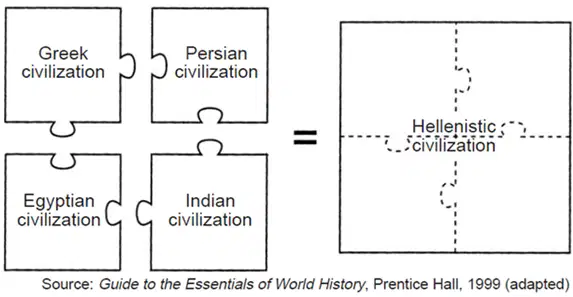
Based on this image, Hellenism was a result of?
a)
military strength
b)
combining cultural ideas (cultural diffusion)
c)
isolation of Egypt, Idia, Persia, and Greece
d)
urbanization
16.
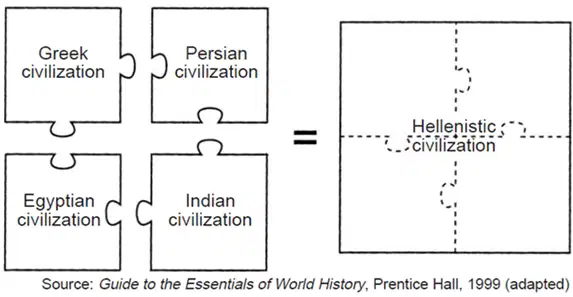
Based on this image below, what is "Hellenism?
a)
Separation of cultures to prevent the mixing of ideas
b)
The study of Greek culture
c)
The spread and blending of Greek culture with other cultures
d)
A nation along the Mediterranean Sea
17.
Which great leader is most closely associated with the spread of Hellenistic civilization?
a)
Augustus Ceasar
b)
Alexander the Great
c)
Julius Ceasar
d)
King Phillip II of Macedonia
18.
Greek cities had an agora, a massive marketplace that was the center of trade and government. What was the equivalent to the agora in Roman cities?
a)
acropolis
b)
palace
c)
coliseum
d)
forum
19.
As a result of 207 years of Pax Romana, the Roman Empire
a)
went through constant wars with their neighbors
b)
experienced peace, increased wealth, and a "golden age"
c)
survived invaions by Germanic tribes
d)
shrank in size and wealth
20.
Hammurabi's Code and Rome's Twelve Tables were important to their societies because they created?
a)
religions
b)
economic systems
c)
governments
d)
rules and laws
21.

Based on the map below, how did geography influence the development of Ancient Rome?
a)
The rivers north of the Italian Peninsula provided sources of fresh drinking water
b)
The desert climates limited farming
c)
Rome's central location on the Mediterranean Sea helped it create a huge empire
d)
Rome's location near the Atlantic Ocean led to frequent invasions
22.
Who did Rome defeat in the Punic Wars?
a)
Persia
b)
Greece
c)
Egypt
d)
Carthage
23.
During the time of the Roman Republic, the power to elect leaders belonged to the?
a)
king
b)
senators
c)
citizens
d)
centurions
24.
Which Civilization is associated with the Republican form of Government, and excellent road system, and uses of arches and domes in it's buildings?
a)
Roman
b)
Egyptian
c)
Greek
d)
Persian
25.
Why was Julius Caesar assassinated?
a)
Many Senators thought he had to much power
b)
He angered the poor when he raised taxes
c)
His soldiers betrayed him when he did not pay them enough
d)
Many Romans thought they would be better off with a king
26.
Who was the FIRST Emperor of the ROMAN EMPIRE?
a)
Caligula
b)
Augustus Caesar
c)
Julius Caesar
d)
Marcus Aurelius
27.
For how long did Roman Emperors rule?
a)
for life
b)
until they lost the Mandate of Heaven
c)
four years
d)
ten years
28.
What did the 41 year long reign of AUGUSTUS CAESAR begin?
a)
Punic Wars
b)
Roman Civil Wars
c)
Pax Romana
d)
Middle Ages
29.
The Romans borrowed much of their culture from the Greeks. Which of the following does NOT show influence by the Greeks on the Romans?
a)
Greek Christianity influenced Roman Judaism
b)
Greek gods influenced Roman gods
c)
Greek language and writing influenced Latin
d)
Greek architecture influenced Roman architecture
30.
Which of the following statements is TRUE about Julius Caesar?
a)
He became powerful and popular with his many military victories
b)
He created the Roman Senate
c)
He was named Rome's first Emperor
d)
He spread Greek culture as he conquered Egypt and Persia
31.
Before Emperor Constantine, Roman emperors opposed Christianity because Christians_____?
a)
rebelled against Roman rule in Judea
b)
gave their lions indigestion
c)
invaded and looted Rome
d)
Refused to worship the Roman gods
32.
A similarity between Judaism and Christianity is the both religions____?
a)
use the Bible as their holy book
b)
believe that Jesus was the Messiah
c)
are monotheistic and believe in the same God
d)
obey the Pope as their spiritual leader
33.
Which of the following was NOT a reason Christianity spread throughout the Roman Empire?
a)
Buddha sent his missionaries to spread the religion
b)
Rome's excellent road system enabled the spread of ideas
c)
Christianity appealed to all people; men and women, rich and poor
d)
Jesus promised eternal life in Heaven
34.
Why was Ancient Rome considered to be important to Western Civilization?
a)
The Romans had new innovations, such as the world's very first writing system
b)
The Roman's developed the world's first monotheistic religion
c)
The Romans dominated Asia after winning the Punic Wars
d)
The Romans' culture influenced modern government, law, and engineering
35.
Which of these was NOT a Roman achievement?
a)
aqueduct system and roads
b)
philosophy of Socrates, Plato, and Aristotle
c)
arches and domes in buildings
d)
Latin, which developed the Romance languages
36.
Which of these was NOT a Roman achievement?
a)
great structures like the Pantheon and coliseum
b)
an accurate 365-day calendar
c)
a fair system of law and justice
d)
using the first standardized coins in the world
37.
Which of these is NOT a reason for the decline of the Roman Empire?
a)
the invasions of the Germanic tribes
b)
economic problems such as a disruption of trade
c)
the Romans improved on Greek innovations
d)
the military grew ineffective because of por leadership
38.
Which group of people was most responsible for the FALL OF THE ROMAN EMPIRE in 476 CE?
a)
armies of Carthage
b)
the rebelling Jews of Judea
c)
the Macedonians
d)
the Germanic tribes
39.
During the period of Rome's decline, Emperor Diocletian attempted to reform the Roman Empire by____?
a)
trying to eliminate Christianity by persecuting Christians
b)
dividing the Empire in two halves in order to make controlling it easier
c)
creating a new Senate to give power back to the people
d)
hiring foreign mercenaries to serve in the Roman Army
40.
Which of the following best describes the BYZANTINE EMPIRE after the fall of the Western Roman Empire?
a)
their empire survived and prospered for another thousand years
b)
it slipped into the Middle Ages, an era of little cultural achievement
c)
Attila the Hun ruled it as part of his "barbarian empire"
d)
the Pope controlled it completely
41.

Which of the following shows events in the correct chronological order?
a)
III, II, IV, I
b)
II, III, I, IV
c)
III, IV, II, I
d)
I, II, III, IV
42.
What is one reason for the Fall of the Western Roman Empire? Make sure to state one example for that reason using a good sentence structure and proper thesis statement formatting.
(a)
100 %

