
 Worksheets
Page 1
Total questions: 11
Worksheet time: 6mins
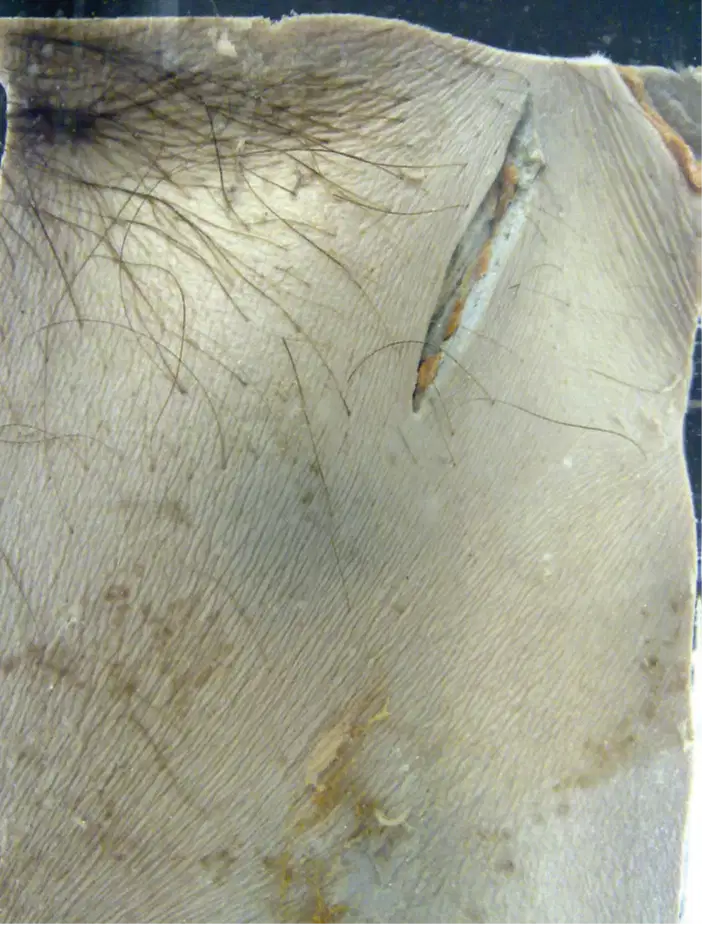
The museum specimen presented represents:
All of the above
Incised wound
Incised wound in the area of the navel
Vulnus scissum regio umbilicalis
During apparent death, if the doctor does not notice any signs of life or death in the patient, what is necessary to do?
Declare biological death
Initiate resuscitation until signs of vital functions or death appear
Wait for spontaneous recovery
Perform an emergency autopsy
Which phenomenon describes the post-mortem accumulation and movement of blood within the internal organs due to gravity, potentially mimicking a fresh myocardial infarction in the posterior wall of the left ventricle?
Embolism
Hypostasis (post-mortem lividity)
Hemorrhagic shock
Coagulative necrosis
Which formula is considered the most accurate (around 95%) for estimating the time elapsed since death using body temperature?
Newton's law of cooling
Henßge's formula
Wolff's rule
Fick's law
What ecological factors contribute to desiccation (drying of the body) after circulation ceases?
Only high altitude
Only exposure to radiation
Airflow, heat, and evaporation
Low lighting conditions
What is usually found inside the skin blisters (bulla) that form during decomposition?
Sterile saline solution
Purulent pus
Dirty and smelly cloudy liquid
Coagulated blood
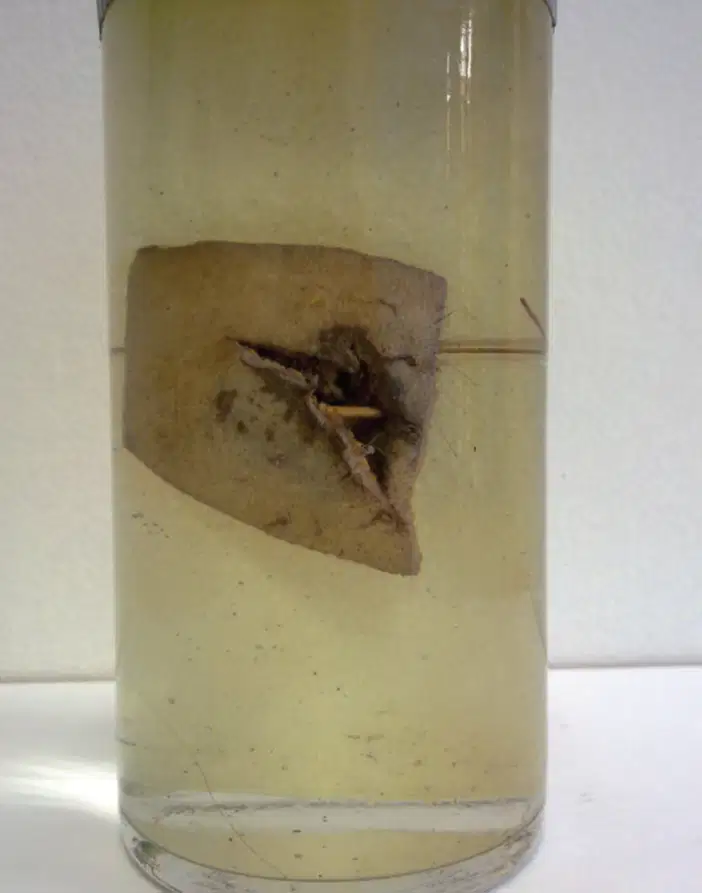
Correct name of the museum specimen:
Vulnus caesum
Vulnus lacerum
Vulnus lacerocontusum
Vulnus contusum
Which of the following is not listed as a cutaneous manifestation of putrefaction?
Peeling of the epidermis in mottled fragments (skin shedding)
Swelling of the lips, tongue, eyeballs, and genitals (cadaveric emphysema)
Rupture of the abdominal wall
Development of rigor mortis
Which of the following causes of death is associated with accelerated decomposition?
Death due to dehydration
Death due to sepsis, peritonitis, and other inflammatory disorders
Death due to hypothermia
Death due to drowning
How does the color of the crust change in deeper scratches that reach the capillary layer of the skin?
Remains yellow
Changes from dark brown to black
Turns light red
Becomes transparent
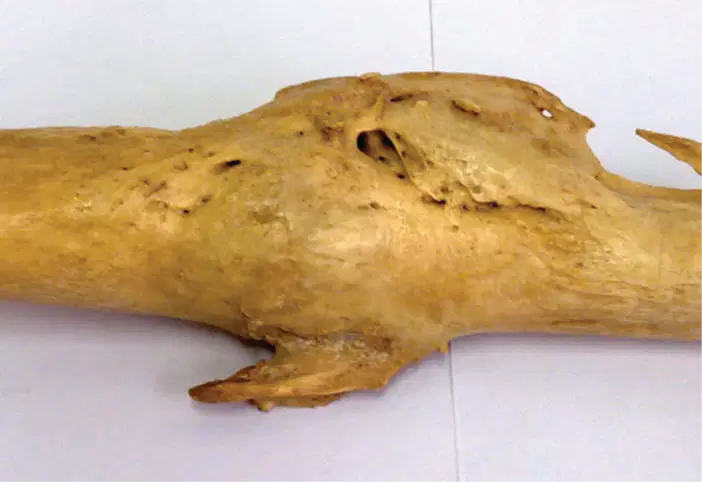
Correct name of the museum preparation:
Vulnus explosivum
Fractura impressiva femoris
Status post fracturam femoris lat. sin.
Subluxatio femoris lat. sin.

