
 Worksheets
Population, Sampling, and Sample
Total questions: 40
Worksheet time: 34mins

In the diagram showing a large group labeled Population, an arrow labeled Sampling points to a smaller group labeled Sample. What does the arrow represent in statistical studies?
Choosing a few representative members from the entire group
Counting every member of the entire group
Eliminating outliers after data collection
Predicting future trends without data
Which statement best describes the relationship among Population, Sampling, and Sample as illustrated?
A sample becomes the population through sampling
Sampling selects a subset (sample) from the larger population
Population is a subset of the sample chosen by sampling
Sampling increases the size of the population
Which two main categories are presented under types of purposive sampling?
Random and Systematic
Probability and Non-probability
Stratified and Cluster
Quota and Snowball

Refer to the side-by-side dot grids comparing sampling approaches. Which grid most likely represents probability sampling?
The grid where selected dots are dispersed across the frame
The grid where selected dots form a concentrated cross-shaped cluster
Both grids represent probability sampling equally
Neither grid represents probability sampling
Which of the following is NOT listed as a type of probability sampling in the material?
Simple Random Sampling
Stratified Sampling
Systematic Sampling
Cluster Sampling
Convenience Sampling
Choose the technique that groups the population into strata before sampling.
Stratified Sampling
Systematic Sampling
Cluster Sampling
Which statement best describes simple random sampling?
Selecting elements based on prior knowledge of the population
Ensuring every element has an equal chance of being selected
Choosing only elements that are easiest to reach
Dividing the population into groups before sampling
When is simple random sampling most appropriate to use?
When detailed prior information about the target population is available
When the population is already divided into strata
When there is no prior information about the target population
When the sample must include specific subgroups

Which statement best describes stratified sampling in social research?
Selecting a single random sample from the entire population without grouping
Dividing a population into homogeneous subgroups (strata) based on similarity and then randomly selecting elements from each stratum
Choosing only the most accessible participants
Creating subgroups after sampling is complete
Based on the visual example with three labeled strata, which action demonstrates stratified sampling?
Randomly choosing five items from the entire set without considering groups
Selecting one item at random from Stratum 1, one from Stratum 2, and one from Stratum 3
Picking only items from Stratum 2 because it has many members
Grouping items after sampling is done

Which statement best defines cluster sampling as described?
A few individuals are chosen at random from the whole population.
The entire population is divided into clusters, clusters are randomly selected, and all elements within chosen clusters are used.
Groups are formed by convenience and every tenth person is sampled.
The population is stratified and proportional samples are taken from each stratum.

In cluster sampling, clusters can be identified using which types of details?
Income bracket and education only
Random numbers only
Age, sex, location, etc.
Political affiliation only
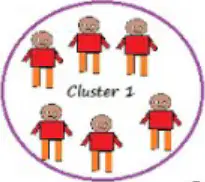
Single-stage cluster sampling is best described as:
Randomly selecting some clusters and then sampling all elements within those clusters.
Randomly selecting individuals from all clusters.
Choosing clusters based on convenience, then sampling some individuals.
Selecting one cluster deterministically and sampling a few elements.
Two-stage cluster sampling differs from single-stage cluster sampling because it:
Uses non-random selection at both stages.
Randomly selects clusters, then randomly selects elements within those clusters.
Selects all clusters and then samples all elements.
Randomly selects elements first and clusters second.
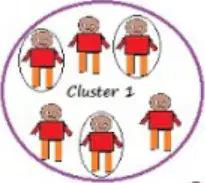
Which scenario best illustrates two-stage cluster sampling?
A city is divided into neighborhoods; five neighborhoods are randomly chosen; every household in those neighborhoods is surveyed.
A city is divided into neighborhoods; five neighborhoods are randomly chosen; within those neighborhoods, households are randomly selected for a survey.
A researcher lists all city residents and randomly selects 500 people.
Volunteers from several neighborhoods are asked to participate.
Which statement best defines multi-stage sampling in social research?
Selecting a sample using only simple random sampling
Choosing participants in one step from the entire population
Combining one or more sampling methods across successive stages
Using convenience sampling within a single neighborhood
Identify the key characteristic of multi-stage sampling.
It relies on a single method applied once.
It combines methods and can proceed through multiple stages.
It always produces a census of the whole population.
It excludes any probabilistic techniques.
Which of the following is NOT listed as a type of non-probability sampling?
Convenience Sampling
Purposive Sampling
Quota Sampling
Random Stratified Sampling
Snowball/Referral Sampling
Which sampling type in the list specifically includes an alternate name separated by a slash?
Convenience Sampling
Purposive Sampling
Quota Sampling
Snowball/Referral Sampling
Which statement best defines convenience sampling in social research?
Selecting participants randomly from a full population list
Choosing samples based on their availability to the researcher
Ensuring every subgroup is proportionally represented
Recruiting only volunteers through formal advertisements
Which statement best defines purposive sampling in research?
Selecting elements randomly from the entire population to avoid bias
Selecting elements based on the intention or specific purpose of the study
Selecting every nth element from a list to ensure systematic coverage
Selecting participants who volunteer first to speed up data collection
In purposive sampling, which elements from the population are chosen?
Elements that are easiest to access
Elements that suit the best for the purpose of the study
Elements selected by lottery to ensure fairness
Elements representing every subgroup equally by quota
Which statement best describes quota sampling?
Selecting participants purely at random from the population
Choosing a sample so that the proportions of key characteristics match those in the population based on pre-set standards
Including only volunteers who respond first to a survey
Using a single characteristic to define the entire sample
In quota sampling, what guides when you stop selecting elements?
When the total sample size reaches 1,000
When exact proportions for specified categories are obtained or sufficient data in different categories is collected
When every member of the population has been contacted once
When the researcher runs out of time
In social research, which sampling technique is most appropriate when the target population is completely unknown and rare?
Simple random sampling
Snowball or referral sampling
Systematic sampling
Stratified sampling
In snowball (referral) sampling, what is the role of the first selected participant?
To randomly assign groups to treatments
To recommend other individuals who fit the sample description
To calculate the sample size mathematically
To ensure equal representation across strata
Why is the technique called “snowball” sampling?
Because it is conducted in cold regions
Because the sample size increases progressively like a rolling snowball
Because participants remain anonymous like snowflakes
Because it requires white paper forms
Which of the following best describes systematic sampling?
Selecting every nth individual from a list after a random start
Choosing participants based on their availability
Randomly selecting clusters and sampling all individuals within
Sampling only those who volunteer for the study
What is the main advantage of using stratified sampling over simple random sampling?
It ensures that all subgroups are represented in the sample
It is easier to implement
It requires less time to conduct
It eliminates the need for randomization
Which of the following best describes convenience sampling?
Randomly selecting clusters and sampling all individuals within
Choosing participants based on their random selection
Sampling individuals who are easiest to reach
Ensuring equal representation from all subgroups
A researcher writes the names of all Grade 12 students on slips of paper, puts them in a box, and draws 50 names to participate in a survey.
Cluster
Random
Stratified
Purposive
A study on teaching strategies selects three entire sections of Grade 11 TVL students from a school and surveys all the students in those chosen sections.
Random
Cluster
Convenience
Quota
To represent different academic tracks, a researcher divides students into groups — Academic, TVL, and Sports — and randomly selects 20 students from each track.
Random
Stratified
Cluster
Quota
A researcher studying peer influence among student leaders asks the president of a club to recommend another active leader, who then refers another, and so on until the desired number is reached
Purposive
Convenience
Snowball
Cluster
For a study on honor students’ study habits, the researcher specifically selects top-performing students based on their GPA.
Random
Purposive
Stratified
Quota
A marketing researcher surveys the first 30 customers entering a mall because they are the easiest to reach.
Quota
Purposive
Convenience
Cluster
A researcher wants to ensure representation from each gender, so she divides the population into males and females, then randomly selects 25 from each group.
Cluster
Stratified
Random
Quota
A researcher wants to ensure representation from each gender, so she divides the population into males and females, then randomly selects 25 from each group.
Cluster
Stratified
Random
Quota
A political surveyor needs 100 respondents — 60 male and 40 female — so he stops collecting responses once those numbers are met.
Random
Convenience
Quota
Purposive
A sociology researcher studying LGBTQ+ teachers starts with a few known respondents and asks each to refer others who meet the same criteria.
Purposive
Convenience
Cluster
Snowball

