
Font size
 Worksheets
Chapter 11: Building Mechatronic Systems Introduction
Total questions: 127
Worksheet time: 1hrs 4mins
Which statement best defines mechatronics as introduced in Chapter 11?
A field combining mechanical systems with manual control methods
An integration of mechanical, electronic, and computational components to build automated systems
A purely software-focused approach to robotics
An electrical engineering specialization limited to power distribution
According to the chapter outcomes, which component is explicitly listed as part of mechatronic systems?
Microcontrollers
Hydraulic turbines
Optical fiber networks
Biochemical sensors only
Which learning outcome focuses on handling data from a motion-measurement device?
Designing automated control devices
Using sensors to address accessibility issues
Data logging values from an accelerometer
Coding devices with a general-purpose language
Which pair of terms both relate to orientation or movement as highlighted in the key terms?
pitch and yaw
PWM and microprocessor
ultrasonic and PIR sensor
solenoid and end effector
According to the passage, what are artificial limbs (prostheses) primarily used for?
To enhance athletic performance in healthy individuals
To replace a missing body part lost due to trauma, disease, or congenital defect
To improve cosmetic appearance only
To reduce pain without restoring movement
Which advantage of mechatronic prosthetics over traditional designs is highlighted in the passage?
They are heavier and more durable
They are lighter, smaller, better-controlled, more lifelike, and more affordable
They eliminate the need for any power sources
They require no integration with the nervous system
What future improvement in prosthetics is suggested by researchers working on brain–machine interfaces?
Prosthetics that change color based on mood
Devices controlled directly by the user's thoughts, closely replicating normal movement and functionality
Limbs that operate only through manual switches
Prosthetics that function without any sensors
Which statement best defines mechatronics?
The study of purely mechanical machines without electronics
An engineering approach that combines mechanical, electronic and software engineering to build computer-controlled devices responsive to their environment
A branch of biology focused on human–computer interaction
Only the design of robots for industrial use
Which of the following is NOT given as a familiar example of mechatronic devices?
Robots
Drones
Washing machines
Escalators that only speed up when shoppers step on a first step
Mechatronics is highlighted as making important contributions to which broader technology movement?
Virtual Reality (VR)
Internet of Things (IoT)
Quantum Computing
Blockchain
According to the material, why is mechatronics increasingly important for society?
It reduces the need for any programming knowledge
Environmental pressures and resource availability demand more efficient use of energy and resources, which mechatronic systems help achieve
It eliminates all mechanical components in devices
It is only useful for entertainment products
Which list contains typical industrial functions performed by modern mechatronic systems?
Sewing, cooking and cleaning
Welding and spray-painting; assembly operations; palletising and material handling; dispensing operations; laboratory applications; 3D printing
Web design and email filtering
Data entry, taxation and accounting
Identify the three main components that together form a mechatronic system.
Sensors, actuators and a microcontroller
Batteries, gears and displays
Motors, cameras and speakers
Cables, screws and frames
In a mechatronic system, what do sensors primarily do?
Provide mechanical power to move parts
Measure their environment and send data to the device’s microcontroller
Display messages to users
Store long-term data
Which statement best describes an actuator and an effector in mechatronic systems?
An actuator is the part that senses, and the effector is the part that computes
An actuator is a mechanical component that performs action, while the effector is the part of the device being controlled by actuators
Both terms refer exclusively to software modules
An effector is always a sensor
Which description correctly characterises microcontrollers in mechatronic systems?
Large desktop computers with extensive memory
Small dedicated computers on a single board that receive and process data, interact with components like accelerometers, infrared sensors, motors, pumps and valves
Purely mechanical devices without any computing capability
Devices used only in aerospace engineering
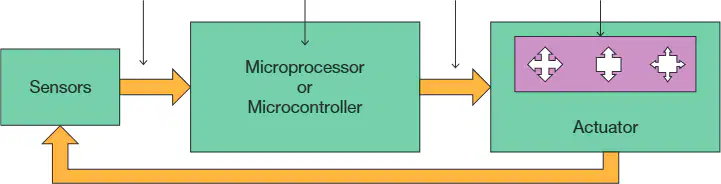
Refer to the block diagram of a mechatronic system. What is the correct signal flow sequence?
Actuator → Microcontroller → Sensor
Sensor (sensing signal) → Microprocessor/Microcontroller (control code) → Actuator (command signal) → Mechanical components
Microcontroller → Mechanical components → Sensor → Actuator
Mechanical components → Actuator → Sensor → Microcontroller
Which of the following are named examples of microcontroller boards used in prototyping mechatronic devices?
Raspberry Pi and Jetson Nano
micro:bit and Arduino
PIC and FPGA
BeagleBone and NUC
Which statement best defines sensors in mechatronic systems?
Devices that generate mechanical power to drive actuators
Input devices that collect real-world data (e.g., temperature, light, movement) and send it to a central processing unit
Programs that compute outputs based on user commands
Output devices that convert electrical energy into motion
Active sensors require _______ between the sensor and another device, whereas passive sensors require _______ to operate.
no interaction; a power source
physical interaction; a change in the environment
a battery; signal amplification
visual data; sound waves
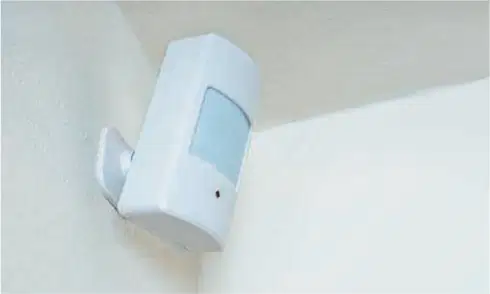
Which sensor type is commonly used in security systems to detect intruders by sensing body heat and movement?
Ultrasonic sensor
Passive infrared detector (PIR)
Chemical sensor
Temperature sensor
In a home security system that uses a light beam across a passageway, what triggers the alarm sequence?
The beam intensifies when someone approaches
The beam is momentarily blocked as someone walks between the light source and the sensor, causing a drop in light levels
The sensor detects an increase in ambient temperature
The control box automatically runs a timed alarm every hour
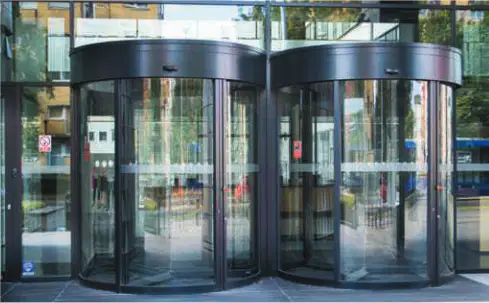
Automatic doors typically use sensors placed at the head of the door. These sensors are usually _______ and may be _______.
active; magnetic
passive; ultrasonic or infrared
digital; optical
analogue; temperature
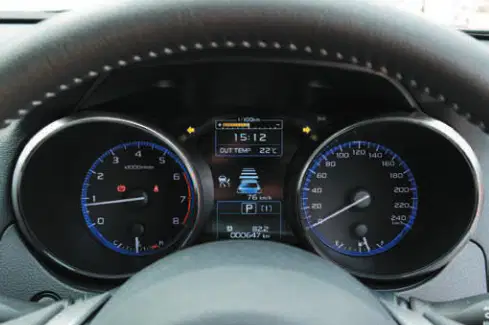
Late-model cars use sensors to support peak efficiency. Which set lists common measurements these sensors provide?
Fuel level, rain intensity, tyre pressure, engine temperature, speed, lane proximity, obstacle proximity, battery condition
Ambient light, classroom noise, internet speed
CPU temperature, fan speed, motherboard voltage
Soil moisture, plant growth rate, sunlight exposure
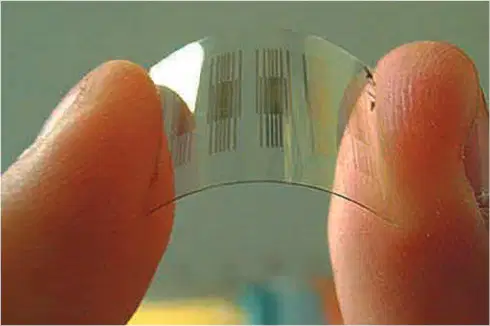
Which statement about nanosensors is most accurate according to the material?
Nanosensors are large mechanical devices designed for industrial lifting
They are tiny sensors that can detect extremely small amounts of viruses, bacteria and fungi, and can measure chemicals and biological agents in air
They only function in automotive systems to monitor tyre pressure
They are unable to operate inside the human body
Which phone sensor primarily measures acceleration along the X, Y, and Z axes?
Gyroscope
Accelerometer
Magnetometer
Barometer
In mobile devices, which sensor measures angular velocity (rotation rates) rather than linear acceleration?
Accelerometer
Barometer
Gyroscope
Proximity
Which app allows students to create an untitled experiment, select multiple phone sensors, and export recordings in .csv format for spreadsheet analysis?
Sensors Toolbox
Arduino Science Journal
Google Sheets
Compass
According to the Skill Builder, which two sensors are suggested to examine together to understand compass behavior while ignoring gravity?
Barometer and ambient light
Gyroscope and proximity
Magnetometer and accelerometer
Front camera and NFC
Which statement best describes the role of the magnetometer in a phone?
Measures sound intensity in decibels
Detects magnetic field to provide compass heading
Measures barometric pressure to estimate altitude
Detects linear acceleration only
Which output unit is shown for the barometer in the screenshot?
m/s
Pa
hPa
µT
Identify the correct pairing of sensor and a typical use in a mobile phone.
Proximity sensor — detects device altitude
Touch fingerprint — measures ambient brightness
Accelerometer — detects motion for screen orientation
NFC — measures temperature
Which step is required to review and export a recording in Arduino Science Journal after moving the phone?
Click 'Review' at the top, then use the three dots to Save to files as .csv
Open Google Sheets and import directly from the app
Tap 'Share' in Sensors Toolbox to export CSV
Enable NFC to archive the experiment
Which statement best describes the primary role of an accelerometer in mechatronics?
It measures rotational speed of motors directly.
It measures acceleration along the x, y, and z axes.
It measures temperature changes in electronic components.
It measures electrical resistance of sensors.
Which application relies on accelerometers working with gyroscopes to keep devices oriented correctly?
Detecting earthquakes
Keeping robots upright and drones horizontal
Measuring rocket lift-off temperatures
Counting steps in a fitness tracker
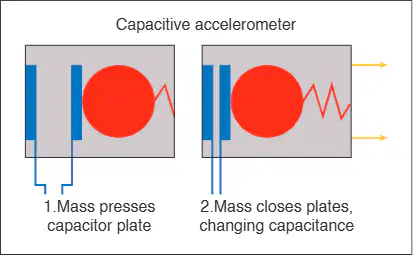
In a capacitive MEMS accelerometer, what physical change allows acceleration to be measured?
The plates heat up, changing resistance.
The mass compresses a spring, changing inductance.
The distance between capacitive plates changes, altering capacitance.
A magnet moves within a coil, inducing current.
Using Pythagoras’ theorem, what is the formula for overall acceleration magnitude when only x and y accelerations are considered (device lying flat)?
a = x + y
a = x × y
a = √(x² + y²)
a = (x + y)²
When including all three axes, which formula gives the total overall acceleration magnitude?
a = x + y + z
a = √(x² + y² + z²)
a = (x + y + z)²
a = x² + y² + z²
Which statement about a micro:bit accelerometer is correct when the device is dropped and in free fall?
It measures maximum acceleration equal to 8g.
It measures zero because it is not experiencing any forces.
It only measures acceleration along the z axis.
It only measures tilt (pitch, roll, yaw).
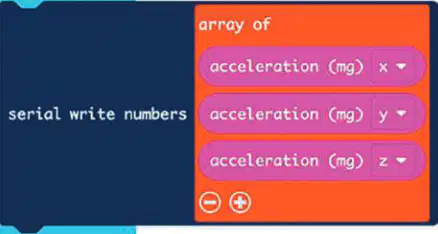
In MakeCode, which action lets you observe how tilting affects acceleration values along x, y, and z on the micro:bit simulator?
Run a program with ‘serial write numbers’ and use ‘Show Data Simulator’
Press the reset button on the micro:bit
Enable temperature sensing in the Advanced library
Use the compass calibration feature
When the micro:bit board is flat, which axis shows a non-zero acceleration and why?
x axis, due to horizontal friction
y axis, due to wind resistance
z axis, due to downward gravitational force of 1 g
All axes show zero because there is no movement
Which MakeCode component converts live accelerometer readings into an array for logging?
‘show number’ block
‘serial write numbers’ instruction block (Advanced library)
‘on start’ block
‘show leds’ block
What file format is used to export the live acceleration data for graphing in spreadsheets like Google Sheets or Excel?
.txt
.csv
.json
.xlsx
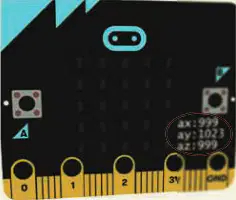
Which statement best describes the line graphs in the MakeCode interface when tilting the simulator?
They show constant values for all axes regardless of tilt.
They display live acceleration data for x, y, and z axes in different colors.
They only display temperature changes.
They require a physical micro:bit to function.
After downloading code to a physical micro:bit, which new button allows viewing data streamed from the device rather than the simulator?
Show LEDs
Show Data Device
Show Compass
Show Temperature
When preparing a spreadsheet graph from logged data, which action helps improve the line graph’s quality?
Delete rows containing unrepresentative data
Convert the file to .docx
Randomize the order of rows
Replace all negative values with zero
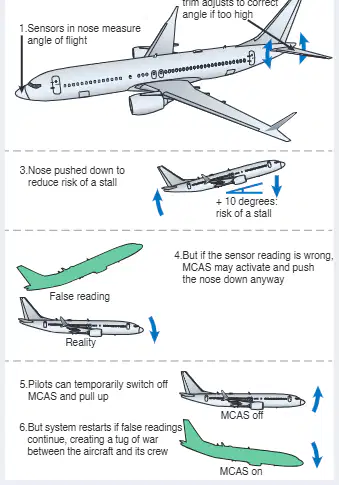
In the Boeing 737 Max case study, what condition does MCAS attempt to correct when detected?
Incorrect fuel mixture
High angle of flight risking a stall
Engine overheating
Landing gear deployment
What led to the repeated nose-down commands in the 737 Max accident scenario?
A single sensor correctly detected a high angle of attack
Two sensors gave conflicting readings, and the system chose the worst-case scenario repeatedly
Pilots engaged manual trim to level the plane
The autopilot was disengaged and no sensors were active
In the tilt sensor simulation graph, the left sensor shows a rapid increase in angle of attack while the right sensor remains near 0°. What is the most likely issue illustrated by the graph?
Both sensors are functioning identically
Sensors began giving conflicting readings
Aircraft was level throughout
Pilot disabled the system immediately
Which coding environment is used to first simulate the Boeing tilt sensor and measure pitch before building the movement alarm?
Scratch
MakeCode's Block editor
Arduino IDE
MATLAB
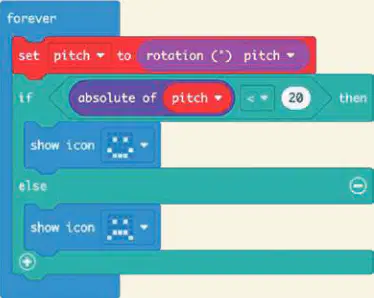
In the Blockly program, why is the 'forever' loop placed at the start?
To run the code once
To repeatedly measure the accelerometer
To disable the accelerometer
To reset the micro:bit after 2 seconds
In the pitch test Blockly program, the 'absolute' function is applied to the pitch value. What is its purpose?
It converts degrees to radians
It averages positive and negative values
It removes negative signs, treating all values as positive
It rounds to the nearest integer
According to the Blockly skill steps, what action triggers the pitch warning during simulator testing?
Tilting along any axis
Only tilting along the x axis (pitch)
Pressing button A
Shaking the board
Which manual validation step is recommended to assess the accelerometer’s measurement of pitch accuracy?
Compare to GPS altitude
Use a protractor to tilt exactly 10 degrees and compare two line graphs
Measure magnetic heading
Time a free fall
In the questions for the pitch test, why is inequality (if pitch < 20) preferred over equality (if pitch = 20)?
Equality is easier to evaluate on micro:bit
Inequality captures a threshold range instead of a single exact value
Equality avoids false positives
Inequality slows the loop
Which micro:bit Python feature is used to detect turning the board over to reset the alarm?
accelerometer.was_gesture('face down')
button_b.was_pressed()
display.scroll
sleep(2000)
In the Python movement alarm, what event arms the system?
Pressing button A
Pressing button B
Shaking the board
Holding the micro:bit face down
What is compared to detect movement after arming in the Python program?
Current pitch vs. 20 degrees
Current acceleration strength vs. static strength minus 100
x-axis tilt vs. y-axis tilt
Button A presses vs. button B presses
Which function provides the time in milliseconds since the board was powered on, enabling elapsed-time calculation for the alarm?
time_since_start()
running_time()
millis()
now()
Identify and correct the logic error described in the movement alarm test steps.
The program never arms; add button A handler
The accelerometer if statement keeps updating 'end' repeatedly; trigger it only once and add a display 'NO' to show permanent trigger
The display never clears; remove display.clear()
Button B cannot be read; replace with button_a
In the fall detection case study, which populations beyond seniors are mentioned as benefiting from accelerometer-based fall detection?
Only pilots
Mountaineers, construction workers, window washers, painters, roofers
Infants only
Marathon runners
According to the case study, why is timely fall detection critical for older adults?
Falls rarely cause injury
Early assistance prevents password loss
Hip fractures can be fatal; one-third die within a year, and many are hospitalized annually
It improves Wi‑Fi signal strength
Refer to the accelerometer graph labeled “WALKING DOWNSTAIRS.” Which statement best describes the overall behavior of the X-, Y-, and Z-axis signals during steady walking?
Large spikes on all axes indicating impacts
Moderate oscillations around near-constant means without extreme spikes
Flat lines at zero on all axes
Rapid drift to ±1024 on one axis
In the “SITTING DOWN” accelerometer graph, which feature indicates the brief moment of impact when the person contacts the chair?
A long flat line at zero on all axes
A short, sharp spike in the overall acceleration (vector sum)
A gradual increase on the Z-axis over many samples
Alternating peaks on the X-axis only
When the person is lying on their side after the fall, which axis shows +g according to the diagram of the fall detector orientation?
X-axis
Y-axis
Z-axis
Vector sum only
Which sequence correctly orders the four key features visible in the fall accelerometer graph?
Initial status → impact → motionless → weightlessness
Weightlessness → impact → motionless → changed orientation after fall
Impact → weightlessness → motionless → initial status
Motionless → weightlessness → impact → initial status
Design consideration: A fall detector should trigger an alert when which combination of features is detected?
Continuous oscillations on all axes for several seconds
Weightlessness followed by a brief large spike and then prolonged motionless state
A slow, steady increase on the X-axis only
Random small fluctuations around zero
According to the graphs and captions, which observation distinguishes sitting down from a fall?
Sitting down shows repeated spikes and long motionless periods
Sitting down shows a single impact-like spike without extended motionless and without post-fall orientation change
Sitting down shows axis values fixed at ±1024
Sitting down produces identical patterns to walking downstairs
Which statement best defines data logging in mechatronic systems?
Recording sensor data over time using electronic devices
Encrypting user passwords for secure access
Rendering 3D graphics from accelerometer inputs
Streaming video from a camera to a computer
Identify two example applications of data logging mentioned in the material.
Weather stations and road traffic
Video editing and game development
Virtual reality headsets and drones
Voice recognition and chatbot training
What role can a micro:bit play in the Skill Builder activity?
A data logger to record sensor readings such as movement and button presses
A dedicated graphics processor for 3D simulation
A wireless router to share internet access
A thermal printer for hard-copy graphs
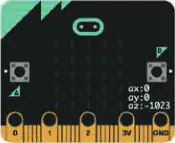
In the fall detection Skill Builder, what is examined when running the simulator and showing data?
Live data feed and graph while moving the mouse over the simulated micro:bit
Battery temperature under high load
Network throughput of the micro:bit Wi‑Fi module
Compiled code size compared to memory limits
In a Python data logging loop for a micro:bit, which labels are set for the log to record accelerations?
'temp', 'light', 'sound'
'x', 'y', 'z'
'lat', 'long', 'alt'
'vx', 'vy', 'vz'
When holding down button A during the logging program, what is displayed and recorded?
Image.NO and temperature readings
Image.YES and x, y, z accelerations
A scrolling text message and button presses
Image.HEART and compass headings
To ensure the latest data file is captured after re-running the experiment, what must you do with the micro:bit according to the instructions?
Reset the Python interpreter
Unplug the micro:bit and plug it back in again
Clear the device’s flash memory
Press buttons A and B together
What file format is suggested for exporting the live data graph so it can be opened in a spreadsheet?
.txt
.json
.csv
.xml
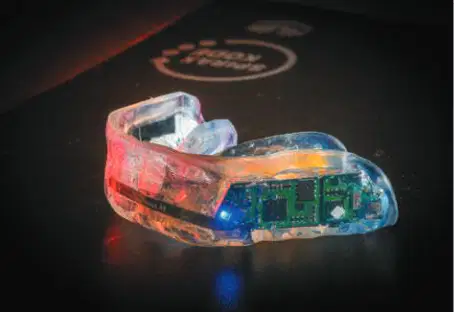
In the sports brain injury case study, what device is embedded in the high-tech mouthguard to help analyze impacts?
Gyroscopes
Accelerometers
Pressure sensors
Thermistors
Why are mouthguards fitted to the maxilla (fixed upper jaw) for measuring acceleration in sports?
It improves wireless connectivity
It keeps sensors away from saliva
It makes the sensors’ readings similar to being attached to the skull
It avoids interference from breathing
Which statement best explains why rotational accelerations can be more dangerous than direct linear ones in head impacts?
They produce less motion and therefore less damage.
They can twist the brain inside the skull, damaging connective tissues and disrupting essential functions.
They only occur during falls and are rare in sports.
They are easier to measure, so more injuries are detected.
In the skill builder experiment, why might the micro:bit need to be held vertically when testing rotational acceleration with only pitch and roll available?
Vertical orientation reduces sensor noise.
It aligns the axes that are available for measuring twisting impact.
It prevents overheating during logging.
Vertical holding increases battery efficiency.
A smartphone’s proximity sensor near the top of the screen helps by emitting infrared light and detecting reflections. What is its purpose according to the material?
To brighten the screen when near your face.
To turn off the display when the phone is near your ear and prevent accidental button presses.
To enable GPS when you hold the phone upright.
To measure the phone’s battery level.
Which scenario best describes a common industrial use of proximity sensors as stated in the material?
Detecting ambient temperature changes in the factory.
Sensing when a manufactured object is aligned at a certain position to perform an operation, such as filling a bottle or placing components.
Monitoring employee attendance via RFID cards.
Measuring humidity near conveyor belts.

Which distance sensor type is specifically noted for enabling 3D representations of distant objects through algorithms?
Infrared
Ultrasonic
RADAR
LiDAR

The image of an autonomous vehicle labels several systems used for sensing and navigation. Which labeled technology specifically measures distance using laser pulses?
Vision
LiDAR
GPS
RADAR
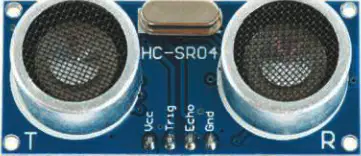
According to the material on using ultrasonic sensors with micro:bits, why might a separate 5V power supply be needed for the HC-SR04?
The micro:bit only supports analog inputs
Ultrasonic sensors require higher voltage than the micro:bit’s 3.3V
The HC-SR04 needs Wi‑Fi connectivity
LiDAR modules cannot be powered by batteries
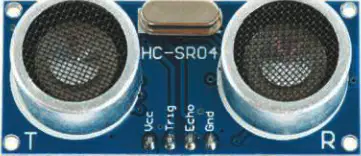
Which sensor type in the examples detects distance using sound waves and is commonly used by hobbyists and prototyping?
Infrared sensor
Proximity inductive sensor
Ultrasonic sensor (HC-SR04)
LiDAR unit
Which statement best describes how an ultrasonic distance sensor measures distance?
It uses infrared light to detect the color of nearby objects.
It sends high-frequency sound waves that reflect off objects and measures the time for the echo to return.
It measures changes in ambient temperature to estimate distance.
It relies on magnetic fields to determine proximity.
In a typical ultrasonic sensor, which pin initiates the measurement by sending a pulse?
Echo pin
Trigger (TRIG) pin
Ground (GND) pin
VCC pin
At room temperature, the speed of sound used in the distance calculation is approximately:
20 kHz
34300 cm/s
175 microseconds
5V
Why is the time measured for distance divided by 2 in the ultrasonic distance formula?
To correct for sensor latency.
Because the sound travels to the object and back.
To convert seconds to microseconds.
To account for the 5V power requirement.
The HC-SR04 ultrasonic sensor requires which supply voltage to operate properly?
3V from the micro:bit alone
1.5V from a single AAA
5V (VCC)
9V battery
When powering the HC-SR04 with a 4.5V battery pack, what wiring change is recommended to ensure a common ground?
Connect micro:bit 3V to sensor VCC and leave GND unconnected.
Move the + red wire from micro:bit 3V to the battery’s positive terminal and join the micro:bit GND to the battery’s negative terminal.
Connect TRIG and ECHO directly to the battery.
Disconnect the battery negative from GND.
In the provided MicroPython code, which function measures the duration of the echo pulse in microseconds?
sleep(100)
display.scroll()
time_pulse_us(echo, 1)
write_digital(1)
Given the code dist = (echo_time / 2) * 34300, what units are used for echo_time and dist respectively?
echo_time in seconds; dist in centimeters
echo_time in microseconds; dist in meters
echo_time in milliseconds; dist in inches
echo_time in seconds; dist in meters
If an ultrasonic pulse’s round-trip time is 175 microseconds, what is the corresponding one-way distance in centimeters using the provided relationship?
0.0343 cm
3 cm
58.3 cm
343 cm
Which factor can cause incorrect distance readings when using an ultrasonic sensor?
Using high-frequency sound waves
Placing the sensor so echoes reflect away from the receiver or using soft surfaces that absorb sound
Using a micro:bit for control
Having a breadboard connected
What is the primary role of an actuator in a mechatronic system?
To process digital data
To convert commands into physical actions as output devices
To store electrical energy
To measure environmental variables
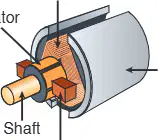
Which statement best describes how DC motors produce rotation?
A servo closes a feedback loop using a potentiometer
Opposing magnetic fields act on a rotor coil causing it to spin
Pistons pump gas into a chamber until full
A solenoid pulls a magnetised rod linearly
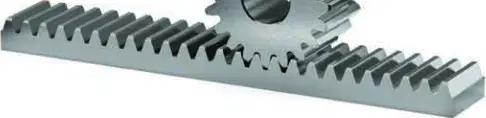
Select the most common action performed by actuators, which can be converted to linear motion using slider-crank or rack-and-pinion mechanisms.
Translation
Oscillation
Rotation
Vibration
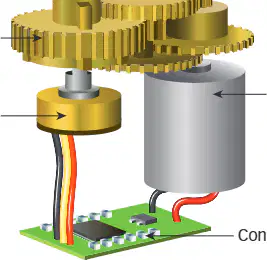
Which feature differentiates a hobby servo motor from a standard DC motor in typical mechatronics applications?
It rotates freely at a constant speed
Its position is controlled by feedback and it holds at a set angle
It uses hydraulic fluid instead of electricity
It requires no electrical power
Why might a hobby servo ‘tremble’ or ‘stutter’ during operation?
Because the motor lacks a commutator
Due to insufficient voltage causing the closed-loop system to continually adjust to match the set position
Because the pump chamber is overfilled
Because step pulses are too large
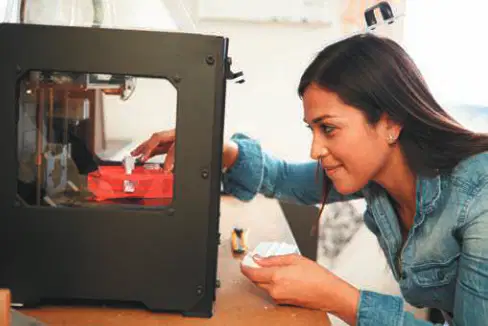
Which actuator is most suitable for precise incremental movements such as those required in 3D printing?
DC motor
Servo motor
Stepper motor
Solenoid
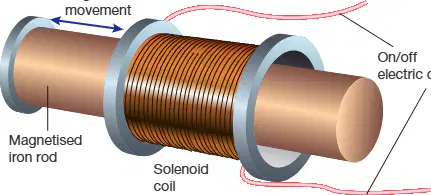
Which statement correctly describes a solenoid’s principle of operation?
A magnetised iron rod is moved by a magnetic field produced by a tightly wound coil when current flows
A rotor spins due to brushes and a commutator
A piston compresses air to move a chamber
A feedback potentiometer sets rotational speed
What is the primary function of a relay in a control system?
To convert digital pulses to analogue voltage directly
To act as a switch to control a larger mechanical or electrical load using a small control signal
To provide closed-loop position control
To pump gas into a chamber
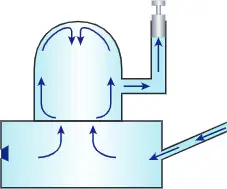
Pumps used in mechatronics are often hydraulic or pneumatic. What causes their mechanical action?
Magnetised rods
Stepper pulses
Forces created by moving liquids or gases into piston chambers
Feedback from potentiometers
Microcontroller boards use pulse wave modulation (PWM) primarily to achieve what outcome when controlling devices like DC motors and LEDs?
Generate continuous analogue voltage directly
Switch full voltage on and off rapidly to emulate analogue control
Provide hydraulic pressure
Convert AC to DC
Refer to the PWM diagram showing pulses repeating every 20 ms. Which pulse width most closely corresponds to a servo position of 0 degrees?
1 ms (0.5 ms)
1.5 ms
2 ms (2.5 ms)
20 ms
In the PWM-to-servo illustration, which pulse width is associated with approximately 90 degrees of servo rotation?
1 ms (0.5 ms)
1.5 ms
2 ms (2.5 ms)
Continuous DC signal
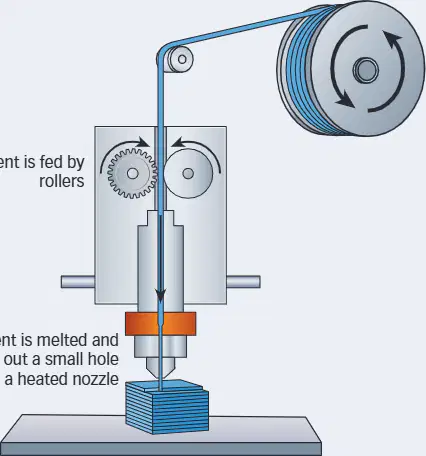
According to the FDM 3D printer schematic, what is the correct sequence of components the filament passes through from spool to printed layer?
Heated nozzle → rollers → print bed
Rollers → heated nozzle → print head lays layers
Print head → filament spool → heated nozzle
Print bed → rollers → filament spool

The case study describes the origin of Fused Deposition Modelling (FDM). Which inventor and event best describe its beginning?
Hideo Kodama experimenting with lasers for resin curing
Scott Crump attempting to make a toy frog for his daughter in 1988
Chuck Hull patenting stereolithography for industrial prototypes
Adrian Bowyer launching RepRap to make self-replicating printers
Identify three common actuators used in mechatronic systems.
Servo motor, DC motor, stepper motor
Resistor, capacitor, diode
Microcontroller, sensor, display
Battery, USB cable, breadboard
What is the typical inspiration for most actuators in engineering design?
Biological systems and human movement
Random chance discoveries
Economic policies
Astronomical observations
Outline the difference between a servo and a DC motor.
A servo includes position feedback and control; a DC motor generally spins freely when powered
A servo is powered by AC; a DC motor is powered by DC
A servo is only used in vehicles; a DC motor is only used in toys
A servo cannot be controlled by microcontrollers; a DC motor can
Briefly outline the difference between the internal mechanisms of a servo and a stepper motor.
Servos use a DC motor with gears and a feedback potentiometer; stepper motors use multiple coils to step to discrete positions
Servos use permanent magnets only; stepper motors use hydraulic actuators
Servos use gears with no feedback; stepper motors use brushes
Servos are linear actuators; stepper motors are pneumatic actuators
How does PWM use digital pulses to drive analogue devices?
By varying pulse width to change average power delivered to a device
By converting digital pulses to AC frequency directly
By storing pulses in a capacitor without changing duty cycle
By randomising pulse timing
In desktop 3D printers, which material and technology are most commonly used according to the passage about FDM?
Plastic filament and FDM technology
Liquid resin and stereolithography
Metal powder and sintering
Paper and lamination
In the mini weather station Skill Builder, what role does the micro:bit's radio feature play?
Transmits data for graphing wind speed and temperature over time
Controls the motor speed directly without sensors
Converts DC to AC for the generator
Acts as a power supply for the DC motor
How can a DC motor be used as a generator in the weather station build?
Spin the motor in reverse using airflow on attached fan blades to produce a small current
Connect the motor to an AC outlet to back-drive current
Heat the motor casing to induce thermoelectric voltage
Use PWM to stop the motor and capture residual charge
When measuring the generated voltage with a micro:bit, which pins are connected to the DC motor output wires?
GND pin and an analogue read pin
5V pin and a digital output pin
USB data+ and data− pins
I2C SCL and SDA pins
In Option 1: Building a fan, what is the first construction step using an A4 plastic document wallet?
Tear along the welded seam, open flat, form a square, then make 4 diagonal cuts 30 mm from the centre
Drill a 2 mm hole and fix the axle of the DC motor
Punch a hole in each blade and one in the centre
Fold the tips of each blade toward the centre
During fan construction, what is the purpose of rubber grommets or an elastic band?
To secure the blades and provide a hub in the centre
To insulate the motor wires
To measure temperature
To convert AC to DC
Select the correct sequence for preparing blade holes before fixing the motor axle.
Punch holes in each blade and centre; push grommets/band; fold blade tips; secure with a second grommet/band
Fold blade tips; drill 2 mm hole; attach motor; punch centre
Attach motor axle first; then create blade holes
Skip holes and tape blades directly
In the visual coding workflow for the weather station, what must you do first using MakeCode’s Block code editor to prepare two micro:bits for communication?
Download the temperature sensor driver
Set radio power to 0
Download two programs—one for the sender and one for the receiver—via USB
Attach both micro:bits to a single DC motor
When connecting the DC motor to the micro:bit during device build, which pin should one terminal of the motor connect to, with the other terminal going to GND?
P1
P0
P2
3V
In the visual code, which graph on the sender micro:bit indicates increasing readings when the fan spins faster?
Line graph
Pie chart
Bar graph
Scatter plot
Which instruction helps avoid incorrect readings when wiring the DC motor to the micro:bit?
Connect both motor terminals to 3V
Swap P0 and P1 randomly
Ensure one terminal goes to P0 and the other to GND using crocodile clips
Disable radio on both boards
In the sender’s Python code for data collection, which function reads the analog value from pin0?
pin0.read_digital()
pin0.write_analog()
pin0.read_analog()
display.scroll()

