
 Worksheets
Unit 2 Test Review
Total questions: 25
Worksheet time: 13mins
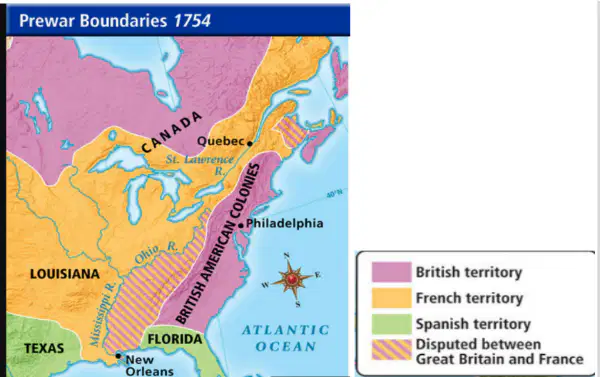
Use the map the answer the question.
Based on the map and map key above, what is the most likely explanation for the disputed land between Great Britain and France?
Both countries wanted the disputed land due to the lack of Native American tribes living there.
Both countries wanted the disputed land due to its abundance of wildlife and unique vegetation .
Both countries wanted the disputed land due to the discovery of precious metals like gold and silver.
Both countries wanted the disputed land due to its proximity to the Mississippi and Ohio Rivers.
“We hold these truths to be self-evident, that all men are created equal, that they are endowed by their Creator with certain unalienable Rights, that among these are Life, Liberty and the pursuit of Happiness.--That to secure these rights, Governments are instituted among Men, deriving their just powers from the consent of the governed.”
The excerpt above comes from the Declaration of Independence. Based on the excerpt, what did the writers of the Declaration of Independence believe about the purpose of government?
The purpose of the government is to provide people with equal opportunities.
The purpose of the government is to require that all people follow the laws.
The purpose of the government is to protect its people from foreign threats.
The purpose of the government is to ensure that people have certain rights.
The pamphlet, Common Sense, written by Thomas Paine in 1775, greatly encouraged support for which of the following?
Colonial resistance to Native American tribes.
Colonial assistance to French fleets.
Colonial assistance to British wars
Colonial resistance to British rule.
Why did the Proclamation of 1763 upset the colonists?
It upset the colonists because they wanted British military assistance against Native American tribes.
It upset the colonists because they did not want to pay taxes on everyday items like tea and stamps.
It upset the colonists because they wanted the French to suffer more for starting the French and Indian War.
It upset the colonists because they wanted to expand into the land gained from the French and Indian War.
“The Provincial Deputies of North Carolina having resolved not to drink any more tea, nor wear any more British cloth, & many ladies of this Province have determined to give a memorable proof of their patriotism, and have accordingly entered into the following honourable and spirited association.
The text above comes from a document written by colonial participants in the Edenton Tea Party. What form of protest are these colonists promoting?
A sit-in
A hunger strike
A boycott
A freedom march
Why was the Battle of Saratoga considered the turning point of the American Revolution?
The defeat of the British army led to an economic and military alliance with France.
The alliance of the Iroquois nations with the Patriots took place after this battle.
The announcement of the Declaration of Independence took place after this battle.
The battle forced the British to leave Canada and the territory east of the Mississippi.
The state of nature has a law of nature to govern it, which obliges every one: and reason ... teaches all mankind, ... that being all equal and independent, no one ought to harm another in his life, health, liberty, or possessions ...
—excerpt from Second Treatise, John Locke
Which of these political ideals from the Declaration of Independence is BEST supported by the excerpt?
All men are needed to create equality.
All men should follow the laws of nature and reason.
All men should have the right to life and liberty.
All men are responsible to change governments.
Why was the French and Indian War an indirect cause of the American Revolution?
Britain imposed taxes in the colonies to pay off war debt.
Native Americans created obstacles for Britain’s acquired land.
Britain imposed alliances with Native American chiefs.
Native Americans created an alliance against Great Britain.
What was the meaning behind the colonists’ slogan "No taxation, without representation!"?
Colonists thought the king should be replaced with the militia.
Colonists believed that every man should think for himself.
Colonists did not agree with the taxes, but were going to accept them.
Colonists thought it was unfair they had no representation in Parliament.
What is the significance of the Halifax Resolves?
It was the first call for political redistricting in the colonies.
It was the first call for independence from Great Britain.
It was the first call for congressional representation.
It was the first call for an alliance with Great Britain.
A Declaration of Rights made by the Representatives of the Freemen of the State of North Carolina.
Section I. That all political power is vested in and derived from the People only.
Section II. That the people of this State ought to have the sole and exclusive Right of regulating the internal Government and Police thereof.
Source: N.C. Constitution, Declaration of Rights, 1776
Which democratic ideal summarizes this excerpt from North Carolina’s original constitution?
Rule of law
federalism
Separation of powers
popular sovereignty
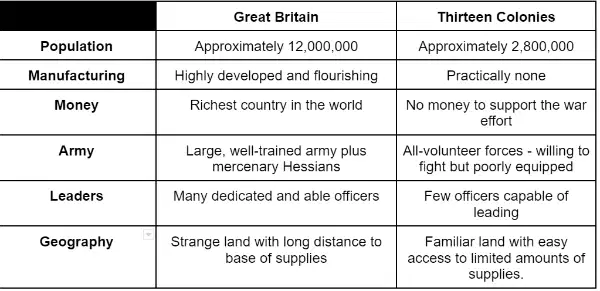
Which conclusion about the American Revolutionary War is most clearly supported by information in the chart?
The thirteen colonies had more advantages than disadvantages upon entering the war.
England did not believe that the thirteen colonies were worth the expense of a war.
The thirteen colonies had few, but important advantages in the war with England.
England had few advantages in a war with her American colonies.
Let the Daughters of Liberty, nobly arise,
And Tho’we’ve no voice, but a negative here,
The use of the Taxables, let us forebear [resist]...
Stand firmly resolved and bid
[Prime Minister] Grenville to see
That rather than Freedom,
We’ll part with our Tea.
According to the text, what action is women called upon to take?
To support the French and Indian War.
To refuse the quartering of British troops.
To boycott taxed goods imposed on colonists.
To attend the First Continental Congress.
What effect of the Quartering Act made the colonists upset at the Redcoat troops?
The King declared that he had all authority over the American colonists.
The King was collecting an extra quarter in tax from each colonist.
Soldiers could beat patriots or hang them in the streets for treason.
Soldiers could enter the homes of colonists to live without permission.
“Governments are instituted among men, deriving their just powers from the consent of the governed. That whenever any form of government becomes destructive to these ends, it is the right of the people to alter or to abolish it, and to institute new government… The history of the present King of Great Britain is a history of repeated injuries and usurpations, all having in direct object the establishment of an absolute tyranny over these states.”
-Declaration of Independence
Which statement justifies the colonists declaring their right to self-govern as stated in the excerpt above?
We hold these truths to be self-evident that all men are created equal.
The Declaration of Independence stated that the colonists were "injured" by the British King.
The Declaration of Independence was presented on July 4, 1776 which declared the colonists’ free.
The Declaration of Independence stated that the British king has ruled the colony in an oppressive way
What democratic ideals expressed in the Declaration of Independence influence our government today?
Natural rights such as the divine right of purpose and authority.
Natural rights such as the right to change forms of our government.
Natural rights such as life, liberty and the pursuit of happiness.
Natural rights such as the right to bear arms against a government.
“... participation in the Revolution, however, was not limited to supporting the American cause, and either voluntarily or under duress thousands also fought for the British. Enslaved blacks made their own assessment of the conflict and supported the side that offered the best opportunity…
What can you infer about the participation of enslaved Blacks during the American Revolution?
Enslaved Blacks gave their loyalty to the side their slaveholders supported.
Enslaved Blacks gave their loyalty to the side that created the conflict with the colonies.
Enslaved Blacks gave their loyalty to side that offered the prospect for freedom.
Enslaved Blacks gave their loyalty to the side that promised to keep them nothing.
Which of the following best describes the conditions of the colonial soldier at the beginning of the Revolutionary War?
Untrained, but better equipped than the British.
Well trained, but without supplies.
Untrained and poorly equipped.
Professionally trained and prepared.
Which of the following events officially marked the end of the American Revolution?
Paris Peace Talks, 1783
Battle of Yorktown
Battle of Saratoga
Treaty of Paris, 1783
Olive Branch Petition, July 5, 1775
“Your Majesty’s Ministers, persevering in their measures, and proceeding to open hostilities for enforcing them, have compelled us to arm in our own defence, and have engaged us in a controversy so peculiarly abhorrent to the affections of your still faithful Colonists, that when we consider whom we must oppose in this contest…what may be the consequences, our own particular misfortunes are accounted by us only as parts of our distress.
We therefore beseech your Majesty, that your royal authority and influence may be graciously interposed to procure us relief from our afflicting fears and jealousies…and to settle peace through every part of our Dominions, with all humility submitting to your Majesty’s wise consideration… in the mean time, measures may be taken for preventing the further destruction of the lives of your Majesty’s subjects; and that such statutes as more immediately distress any of your Majesty’s Colonies, may be repealed.…”
What inference can you make about the text above?
The colonists were asking for immediate removal of all British soldiers from the continent.
The colonists were still loyal to the king, while asking for relief from the various acts.
The colonists were ready to pay off the debt incurred from the French and Indian War.
The colonists were no longer faithful to the King and wanted immediate independence.
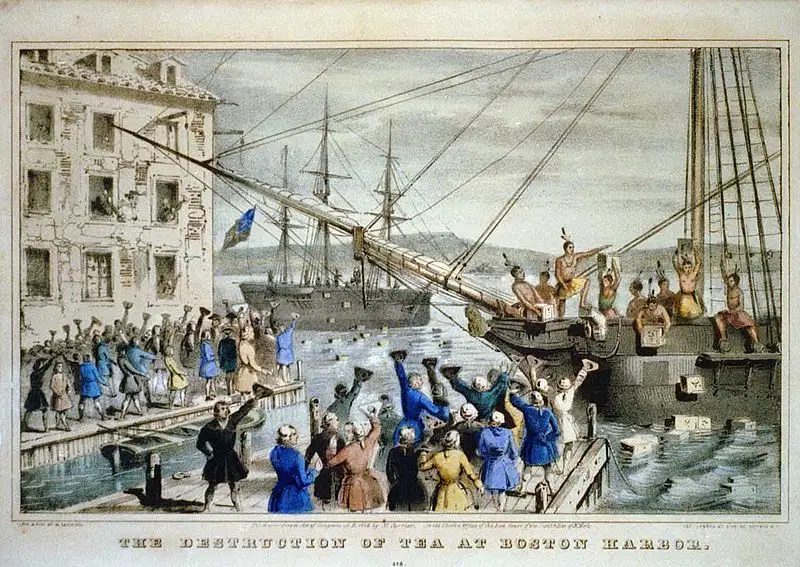
What was the immediate response by the British to the event shown above?
Passage of the Proclamation of 1763.
Passage of the Coercive (Intolerable) Acts.
Passage of the Declaratory Act.
Passage of the Salutary Neglect Act.
What were some ways the American Colonists responded to the British acts?
By dutifully following the acts, praising the king and paying their taxes.
By openly trading with other countries in defiance of Great Britain.
By boycotting, smuggling goods, and sending letters in protest to the King.
By migrating west of the Mississippi to begin a new, independent country.
Boston Port Act (One of Intolerable Acts)
..."AN ACT to discontinue, in such manner, and for or such time as are therein mentioned, the landing and discharging, lading or shipping, of goods, wares, and merchandise, at the town, and within the harbour, of Boston, in the province of Massachuset's Bay, in North America..."
How was the Boston Port Act intended to punish the colonists?
Boston depended on trade west of the Mississippi.
Boston depended on immigration through the harbor.
Boston depended on fishing in the harbor.
Boston depended on trade for their economy.
Which of the following best explains why the colonists organized the First Continental Congress in 1774?
To draft the United States Constitution.
To form an alliance with France against Britain.
To respond to the Intolerable Acts and seek a peaceful solution with Britain.
To declare independence from Great Britain immediately.
What was one major effect of the Stamp Act on colonial society?
It encouraged colonists to support British rule.
It led to widespread protests and the formation of groups like the Sons of Liberty.
It resulted in immediate independence for the colonies.
It increased trade between the colonies and Britain.

