
 Worksheets
Australian First Aid Manual Introduction
Total questions: 92
Worksheet time: 46mins

According to the DRSABCD action plan, what should you do first if there is a danger to yourself, others, or the patient?
Immediately start CPR
Remove the danger if safe to do so, or remove the patient from danger
Check breathing for 10 seconds
Apply an AED

During the 'Breathing?' step, which action indicates you are correctly checking for normal breathing?
Count pulse for 10 seconds
Tilt the head forward and look for chest rise for 5 seconds
Look, listen and feel for 10 seconds after tilting the patient's head back
Begin defibrillation immediately without assessment
A conscious adult has visible food in their mouth obstructing the airway. Based on the Airway guidance, what is the correct sequence of actions?
Apply an AED, then roll into recovery position
Start CPR, then remove all dentures
Turn the patient into the recovery position, tilt the head back with the mouth slightly downwards, and remove visible objects with your fingers (only remove dentures if loose or broken)
Blindly sweep fingers in the mouth while the patient lies face up

Which step is correct when opening the airway for an adult or child over 1 year?
Place your hand high on the patient’s forehead and tilt the head backwards while lifting the chin.
Apply pressure on the soft tissues of the neck to open the airway.
Keep the head in a neutral position and avoid opening the mouth.
Turn the patient into the recovery position immediately without checking airway.

For an infant (under 1 year), which action should NOT be performed when attempting to open the airway?
Place the infant flat on their back.
Support the lower jaw at the point of the chin with the mouth open.
Apply pressure on the soft tissues of the neck.
Keep the infant’s head in a neutral position.
After ensuring the airway is open, how long should you take to check for normal breathing by looking, listening, and feeling?
More than 30 seconds
Exactly 15 seconds
No more than 10 seconds (2–3 breaths)
About 1 minute
If the patient is not breathing, what is the correct immediate sequence according to the guidance?
Start CPR, then call Triple Zero (000).
Call Triple Zero (000). If alone, place the patient in the recovery position with their airway open and clear, then call for an ambulance and start CPR.
Turn the patient onto their back and wait for medical aid.
Continue checking breathing without calling for help.

Which statement about CPR from the guidance is accurate?
CPR is only given if the patient is conscious and breathing slowly.
Compressions should be given at about 2 per second, aiming for 5 sets of 30 compressions and 2 breaths in about 2 minutes.
Any attempt at resuscitation is discouraged unless trained.
The method of chest compressions and rescue breaths is identical for infants and adults.
In emergency first aid, an AED should be used if the patient is unresponsive and not breathing normally. Which action should you take before using the AED according to the notes?
Wait for the patient to regain consciousness
Ensure Triple Zero (000) has been called for an ambulance
Give the patient water
Remove the patient's shoes
When preparing a patient for AED pad placement, which step is part of the “What to do” list?
Apply the pads first, then expose the chest
Expose the patient’s chest and wipe it dry if damp
Begin CPR only after the AED is attached
Remove all clothing regardless of pad placement
According to the guidance for children and infants, which statement is correct?
Children over 8 years are managed differently from adults
Standard adult pads must never be used on children
Prefer an AED with paediatric capability and pads for ages 1–8 years
Infants under 1 year cannot be defibrillated
For an adult or child over 8 years, where should the first AED pad be placed?
Centre of the chest
Patient’s right chest wall, below the collarbone
Patient’s left chest wall, below the left nipple
Between the shoulder blades
On a child under 8 years or an infant, which pairing correctly describes pad placement?
First pad on right chest; second pad on left chest
First pad centre of chest; second pad centre of back between shoulder blades
First pad below collarbone; second pad below left nipple
Pads should touch each other on the chest
During AED use, what must happen while the device analyses and delivers a shock?
Everyone should continue touching the patient
The rescuer should leave the room
No-one should touch the patient; stop CPR and move slightly away
Remove the pads to reduce contact
Which sequence step is included in placing an adult or child over 1 year into the recovery position?
Roll the patient toward you while keeping both legs straight
Place the patient’s nearest arm across their chest and roll them away onto their side
Lift both legs to the chest then roll onto their stomach
Turn the patient’s head downwards and close the airway
For an infant under 1 year, how is the recovery position performed?
Lie the infant face up with head tilted back
Lie the infant face down on your forearm and support the head with your hand
Place the infant on their side with a bent knee
Sit the infant upright and support the chin
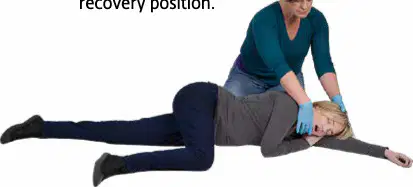
When preparing to place an unconscious adult or child (over 1 year) into the recovery position, which arm should be extended directly out from the body?
The nearest arm
The far arm
Both arms
Neither arm

Which action helps keep an adult or child in the recovery position from rolling onto their face?
Straighten both legs
Flex the far leg at the knee
Keep the bent knee touching the ground
Place both hands under the chin

For an infant (under 1 year), what is the correct recovery position?
On their back with head tilted back
Face down on your forearm, supporting the head with your hand
On their side with knee bent
Sitting upright with chin lifted

During the roll into the recovery position for an adult/child, what must you carefully support the entire time?
Hips
Head and neck
Feet
Lower back
Which step is part of opening the airway for an unconscious adult or child before placing in recovery position?
Place their hand under their chin to prevent tilting and keep airway open
Tie a blanket around the torso
Raise both legs above heart level
Deliver five back blows

In a choking adult or child over 1 year, what is the first recommended action?
Begin CPR immediately
Give five chest thrusts
Encourage the patient to relax and cough
Call an ambulance before doing anything

Where should back blows be delivered during choking management for an adult or child?
Between the shoulder blades using the heel of one hand
On the lower back using two hands
On the neck with fingertips
On the upper chest with knuckles

After five back blows fail to clear the obstruction, what is the next step for a choking adult or child?
Perform abdominal thrusts
Give up to five chest thrusts on the lower half of the sternum
Place the patient in recovery position
Stop and wait for medical aid

If the choking blockage has not cleared after five chest thrusts, what should you do until medical aid arrives?
Alternate five back blows with five chest thrusts
Switch to CPR compressions only
Give continuous back blows without pausing
Administer water to help swallow

Which sign indicates severe shock and suggests the patient is very sick?
Pale face and cool skin
Nausea and anxiety
Blue lips, face, earlobes, or fingernails
Muscle weakness only
When assessing a patient’s breathing during an asthma emergency, which sign indicates severe difficulty and the need for urgent help?
Persistent cough with short sentences
Increasingly soft to loud wheeze
Unable to speak normally with severe shortness of breath
Minor difficulty breathing
During an asthma emergency, what is the recommended action if the patient still cannot breathe normally after the initial 4 puffs and 4 minutes?
Give one more puff and wait 10 minutes
Call Triple Zero (000) for an ambulance and state it is an asthma attack
Allow the patient to walk around for fresh air
Stop giving medication and wait for symptoms to settle
What is the correct initial positioning for a patient experiencing an asthma attack who is conscious?
Lay them flat on their back
Help them to sit down in a comfortable position
Place them in the recovery position
Have them stand and lean forward
Which sequence correctly describes giving reliever medication using a puffer for asthma?
Take 2 puffs at once, wait 1 minute, repeat until 6 puffs
Shake inhaler, take 1 puff, take four breaths; repeat until 4 puffs are given
Take 1 puff every 10 minutes, no spacer needed
Shake inhaler, give 4 puffs at once, then call emergency
Which symptom differentiates an asthma emergency from a mild to moderate attack?
Watery eyes
Persistent cough
Blue lips, face, earlobes, or fingernails
Can walk and speak in short sentences
In a patient with known asthma who suddenly has breathing difficulty due to a food allergy, what medication should be given first?
Asthma reliever puffer
Adrenaline via autoinjector
Antihistamine tablets
Oral steroids
For a mild to moderate allergic reaction, which action is appropriate after reassuring the patient?
Let the patient stand and walk to improve circulation
Remove or move away from the allergen and give prescribed medications
Apply heat to the sting or bite site
Stop checking the patient’s breathing and pulse
What is the recommended action sequence when an asthma patient with an adrenaline autoinjector has sudden breathing difficulty?
Give asthma reliever first, then adrenaline, and allow the patient to walk
Help the patient to sit, use adrenaline autoinjector first, call Triple Zero (000), follow the anaphylaxis action plan
Lay the patient flat, avoid medication, wait for ambulance
Give antihistamines, then encourage deep breaths
When performing adult CPR, what is the recommended compression depth?
About 2 cm
About 5–6 cm
More than 7 cm
Exactly 3 cm
For adult and child CPR, what compression rate should you maintain?
60 compressions per minute
80–100 compressions per minute
100–120 compressions per minute
140 compressions per minute
Where should you place your hands for adult chest compressions?
On the lower half of the sternum, center of the chest
Over the left nipple
On the upper sternum near the clavicles
Two fingers below the ribcage
During adult CPR, what is the proper compression-to-ventilation ratio when providing rescue breaths with no advanced airway?
15:2
30:2
10:1
5:1
How should chest recoil be handled during compressions for adult CPR?
Keep slight pressure on the chest to maintain contact
Allow full recoil after each compression
Lift hands fully off the chest between compressions
Press faster to minimize recoil
For infant chest compressions when a single rescuer is present, which technique is recommended?
Two-hand sternum technique
One-hand compressions over the sternum
Two-thumb encircling hands technique
Heel-of-hand over lower ribs
What is the correct compression depth for infants during CPR?
About one-third the chest depth (approximately 4 cm)
Exactly 6 cm
Two inches
Half the chest depth
For infants, where should you deliver chest compressions?
Over the left side of the chest
Just below the nipple line on the sternum
Midway between sternum and ribs
Over the upper sternum
When giving rescue breaths to an adult, how long should each breath be delivered?
1 second, enough to make the chest rise
3 seconds, slow inflation
Half a second, quick puff
Continuous breathing for 5 seconds
How should you position the airway for adult rescue breaths?
Neutral head position with no tilt
Head tilt–chin lift to open the airway
Jaw thrust only for all cases
Place patient in recovery position
For infant rescue breaths, how should you seal the airway with your mouth?
Seal over the mouth only
Seal over the nose only
Seal over the mouth and nose together
Use a pocket mask only
What is the recommended compression-to-ventilation ratio when performing CPR on infants and children with a single rescuer and no advanced airway?
15:2
30:2
20:2
5:1
When performing CPR on an adult, what is the recommended rate of chest compressions per minute?
60–80 compressions per minute
80–100 compressions per minute
100–120 compressions per minute
120–140 compressions per minute
A bystander finds a patient who is breathing but unconscious. What is the first action they should take?
Begin CPR immediately
Turn the patient into the recovery position
Apply an AED
Give two rescue breaths
During adult CPR, how many compressions and breaths make up one full cycle that should be repeated to reach about 5 sets in 2 minutes?
15 compressions and 2 breaths
30 compressions and 2 breaths
50 compressions and 1 breath
30 compressions and 5 breaths
What should a first aider do if the patient stops breathing while in the recovery position?
Leave the patient as they are and call for help
Roll the patient onto their back and start CPR
Apply a pressure–immobilisation bandage
Wait for medical personnel to arrive
Which statement best describes the difference in CPR methods across age groups according to the material?
The method is the same for all ages
Children (1–8 years) and adults use one method; infants (less than 1 year) use a different method
Adults and infants use one method; children use a different method
Only infants require rescue breaths
Which action helps avoid interruptions to chest compressions during CPR?
Checking the pulse every 15 seconds
Ensuring airway assessments take at least 30 seconds
Planning to achieve 5 sets of 30 compressions and 2 breaths in about 2 minutes
Pausing compressions while calling emergency services
In the context of emergency first aid for snake bite, which type of bandage is preferred for pressure–immobilisation?
Soft crepe bandage
Elasticised roller bandage
Gauze wrap
Self-adhesive tape
When applying the second elasticised roller bandage for a snake bite, where should you start?
At the bite site
Just above the fingers or toes of the bitten limb
At the knee or elbow
Below the ankle or wrist
After bandaging a limb for snake bite, what additional step should be taken to immobilise the limb?
Apply ice packs
Use splints with figure-of-eight bandaging at the feet and ankles
Massage the limb to improve circulation
Loosen the bandage to allow movement
A patient who has suffered a blow to the head becomes unconscious but is breathing. Which immediate steps should be taken?
Begin CPR and then call an ambulance
Place the patient in the recovery position, support the head/neck, and call Triple Zero (000)
Apply an AED and deliver a shock
Give them water and keep them walking
Which statement best defines shock in first aid context?
A condition where the body’s organs and tissues do not receive adequate blood flow and oxygen
A temporary fainting episode caused by low blood sugar
A minor allergic reaction limited to skin redness
A state of elevated blood pressure due to stress
Which is considered a life-threatening condition requiring immediate management for shock?
Normal breathing with mild dizziness
Persistent chest pain and signs of poor perfusion
Slight headache after exercise
Minor cut with controlled bleeding
Which of the following is an initial symptom of shock?
Warm, flushed skin
Slow, bounding pulse
Pale, cool, clammy skin
High temperature and sweating from exercise
Which severe symptom indicates shock is worsening and requires urgent intervention?
Mild thirst
Sudden improvement in energy
Confusion or decreased responsiveness
Slight increase in appetite
What is the FIRST step a first aider should take when managing a patient suspected of shock?
Provide water immediately
Lay the patient down and elevate the legs if no trauma is suspected
Check for danger, send for help, and assess airway, breathing, and circulation
Apply an ice pack to the chest
For a conscious patient showing early signs of shock, which action is most appropriate?
Encourage rapid standing to improve circulation
Keep the patient warm and reassure them while monitoring breathing and pulse
Give strong coffee to raise blood pressure
Begin chest compressions immediately
Which statement about breathing in shock management is correct?
If breathing is absent, provide oxygen only
If breathing is absent or inadequate, begin CPR and be prepared to use oxygen delivery equipment if trained
Avoid touching the airway to prevent distress
Only deliver breaths if the patient requests oxygen
During shock management, what should be done regarding external bleeding?
Ignore bleeding until the patient becomes unconscious
Apply direct pressure to control bleeding promptly
Use cold water to rinse the wound before pressure
Wait for medical personnel before any action
Which observation best differentiates early shock from severe shock?
Early shock presents with pale, cool skin; severe shock may include confusion and weak or rapid pulse
Early shock includes confusion; severe shock shows normal mental status
Severe shock shows improved skin color and temperature
Early shock includes strong, slow pulse; severe shock includes strong, regular pulse
Why is keeping a patient warm important in shock management?
Warmth prevents infection at wound sites
It reduces metabolic rate to conserve energy
It helps prevent further heat loss, supporting circulation and oxygen delivery to tissues
It encourages sweating to eliminate toxins
Which initial action is recommended when an adult or child shows signs of severe choking but can still cough or speak?
Begin CPR immediately
Encourage them to continue coughing and monitor closely
Deliver back blows right away
Give water to help clear the airway
For a responsive adult with a complete airway obstruction, which sequence most accurately describes the first-aid procedure?
Call emergency services, start CPR, then deliver back blows
Deliver up to 5 back blows between the shoulder blades, then up to 5 chest thrusts if needed
Place the person in recovery position and wait
Administer an inhaler and reassess
When assisting a choking infant who is responsive, what is the correct body positioning before giving back blows?
Supine on a firm surface with head higher than chest
Sitting upright in caregiver’s lap
Face-down along forearm with head lower than chest, supporting the jaw
Standing while being gently shaken
Where should back blows be targeted during choking first aid?
Lower back, near the hips
Between the shoulder blades
Directly on the throat
On the abdomen
Which statement best distinguishes chest thrusts for infants from abdominal thrusts in adults/children?
Both use the same hand placement on the upper abdomen
Infant chest thrusts are delivered on the sternum; adults/children use abdominal thrusts above the navel
Infants receive abdominal thrusts while adults receive chest thrusts
Neither technique involves compressions
During choking first aid, when should you call for emergency medical help?
Only after the object is expelled
Immediately if the person cannot breathe, cough, or speak, or if they become unresponsive
Only if the first set of back blows fails
Never if the person is an infant
A choking adult becomes unresponsive while you are performing back blows and chest thrusts. What is the next best action?
Place in recovery position and wait
Start CPR with chest compressions, and look for an object in the mouth before giving breaths
Attempt more forceful back blows
Give abdominal thrusts while the person is lying down
Which principle explains why the infant’s head should be lower than the chest during back blows?
It keeps the airway closed to prevent aspiration
Gravity helps dislodge the object from the airway
It protects the spine from movement
It reduces the need for chest thrusts
After delivering 5 back blows to a choking adult with complete obstruction and no improvement, what is the appropriate follow-up?
Switch to up to 5 chest thrusts and repeat the cycle as needed
Give water and encourage deep breaths
Stop and wait for EMS
Perform abdominal thrusts only while seated
What indicator suggests it is time to transition from choking first aid to CPR?
The person expels the object
The person reports mild discomfort
The person becomes unresponsive and is not breathing normally
EMS arrives
Which symptom is most characteristic of an asthma attack and signals the need to consider a reliever inhaler if available?
Chest pain with no breathing changes
Wheeze with obvious difficulty in breathing
High fever and chills
Severe nosebleed
What is the primary purpose of an asthma reliever medication (puffer) during an attack?
Reduce body temperature
Open the airways to ease breathing
Increase blood sugar
Sedate the patient
During a mild to moderate allergic reaction from an insect sting, which action is most appropriate if the person has their usual medication?
Avoid all medication and wait for symptoms to pass
Administer their prescribed reliever or antihistamine as directed
Give them any available painkiller
Apply an ice pack only and do nothing else
Which sequence best reflects first aid priorities for a person with severe breathing difficulty from asthma or an allergic reaction?
Provide food, keep them walking, and monitor later
Follow DRSABCD, call emergency services, help them into a comfortable position, loosen tight clothing, and consider reliever medication if available
Give water, wait 30 minutes, then reassess
Drive them to a clinic yourself before calling for help
In the context of asthma management, when should emergency services be called?
Only if the patient asks
If breathing difficulty is obvious or worsening despite initial management
After 24 hours if symptoms persist
Never; asthma is not an emergency
A student with a known insect allergy is stung and develops itching and local swelling but can breathe normally. What is the best immediate management?
Treat as cardiac arrest immediately
Encourage rest, monitor, and assist with their usual allergy medication as directed
Force the student to run to increase circulation
Give them someone else’s prescription medication
Which sign differentiates a mild allergic reaction from a potentially life-threatening situation requiring urgent escalation?
Localized itching only
Development of breathing difficulties or wheeze
Mild redness at the sting site
Brief sneezing
Why is it important to have rapid access to reliever medication for asthma during physical activity sessions?
To prevent dehydration
Because prompt bronchodilation can quickly improve airflow and reduce distress
To increase heart rate for performance
To treat muscle cramps
Which immediate first aid action is recommended at the first signs of anaphylaxis?
Give water and monitor for 30 minutes
Administer an adrenaline auto-injector (e.g., EpiPen/Anapen) immediately
Apply cold compresses to the affected area
Have the person lie flat and avoid medication
Which of the following is a common warning sign or symptom of anaphylaxis?
Gradual onset of mild headache only
Localised redness without swelling
Difficulty breathing and swelling of the face or throat
Increased energy and alertness
Adrenaline auto-injectors like EpiPen or Anapen are primarily used to:
Reduce fever during allergic reactions
Reverse life-threatening airway and circulation problems in anaphylaxis
Treat mild skin rashes
Prevent future allergies
After administering an adrenaline auto-injector for anaphylaxis, what is the next best step?
Do nothing further and wait for recovery
Give food and drink immediately
Call emergency services and continue to monitor breathing and circulation
Start chest compressions regardless of breathing
Where should an adrenaline auto-injector generally be administered?
Into the buttock muscle
Into the outer mid-thigh, through clothing if necessary
Into the upper arm deltoid only, after removing clothing
Under the tongue
Which scenario best indicates the need to use a second adrenaline auto-injector?
Symptoms resolve completely within 5 minutes
No improvement or deterioration after the first dose and emergency help is delayed
Mild local itch without breathing issues
Patient requests another dose for reassurance
Which statement best explains why adrenaline is the first-line treatment for anaphylaxis?
It lowers blood sugar, preventing shock
It constricts blood vessels and relaxes airway muscles, improving breathing and blood pressure
It sedates the patient to reduce anxiety
It increases digestive activity to counter allergens
During monitoring after an auto-injector is used, which action is most appropriate if the person becomes unresponsive and is not breathing normally?
Place them in a chair and keep talking
Begin CPR and follow DRSABCD while awaiting emergency services
Give another food item to raise blood sugar
Leave them alone to rest

