
NEW
Font size
 Worksheets
LE Chapter 2 Review: Ecology
Total questions: 20
Worksheet time: 10mins
What would cause organisms to compete with one another?
Sharing the same niche; example two carnivores
Different habitats; example two herbivores
Abundant resources; example two omnivores
Diverse diets; example two scavengers
True/False: Nitrogen is NOT needed for protein production.
TRUE! Nitrogen is not needed for protein production.
FALSE! Nitrogen is needed for protein production.
Nitrogen is only needed in small amounts for protein production.
Nitrogen is needed for carbohydrate production, not protein.
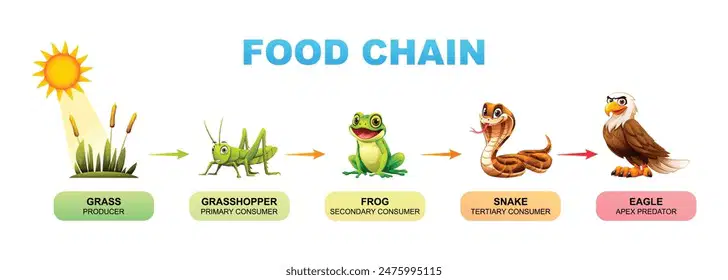
Look at this food chain.
Grass > Deer > Coyote > Bear.
Where on the food chain is there the most energy?
The producer (grass)
The primary consumer (deer)
The secondary consumer (coyote)
The tertiary consumer (bear)
Commensalism (+/0)
When one organism benefits and the other is UNharmed
When both organisms benefit from the relationship
When one organism is harmed and the other is unaffected
When both organisms are harmed in the relationship
How can you tell mushrooms cannot produce their own food?
They lack chlorophyll (green pigment)
They can photosynthesize like plants
They grow in bright, sunny places
They have roots that absorb nutrients from the soil
How do food chains and food pyramids differ from one another?
Pyramids show where the most energy, biomass and number of organisms, while food chains only show the flow of energy.
Food chains represent the number of organisms, while pyramids represent energy flow.
Pyramids are linear, while food chains are hierarchical.
Food chains are more complex than food pyramids.
Is phosphorus needed for DNA and ATP production?
Yes, it is essential for both DNA and ATP production.
No, it is not needed for DNA but needed for ATP production.
Yes, but only for DNA production.
No, neither DNA nor ATP requires phosphorus.
How does the energy flow in a food chain or food web?
From consumers to producers
From producers to consumers
From decomposers to producers
From herbivores to carnivores
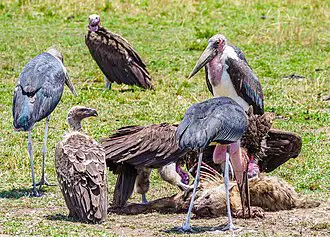
What type of organism feeds on roadkill?
Predator
Herbivore
Scavenger
Decomposer
Which organisms recycle top carnivores back to the soil into the form of nutrients for plants?
Bacteria and Fungi
Insects
Mammals
Birds
Facts regarding the water cycle:
The amount of water on earth always stays the SAME
Water is created and destroyed in the cycle
Plants absorb water from the atmosphere
The water cycle has no impact on weather patterns
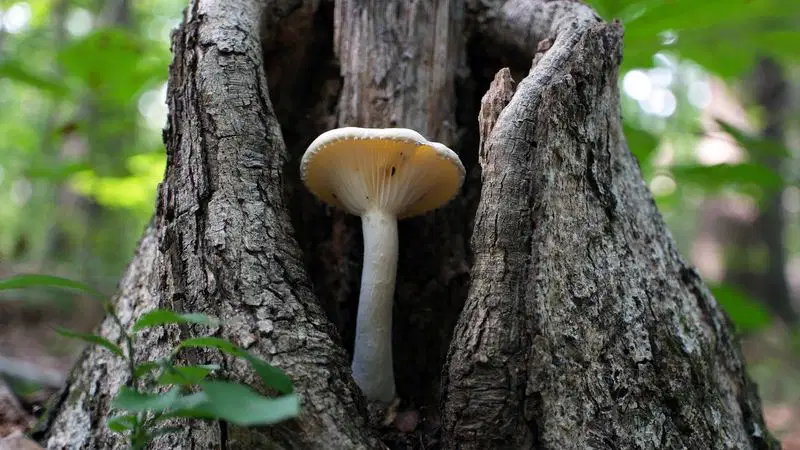
Why can a mushroom manufacture their own food?
they lack the green pigment, chlorophyll needed for photosynthesis
they grow in damp, shady areas and don't receive a lot of sunlight that would be needed for photosynthesis
they have a unique ability to absorb nutrients from the air
they can perform photosynthesis like plants
Look at this food chain.
Grass > Deer > Coyote > Bear.
What is the bear known as on this food chain?
First order carnivore and second order consumer
Second order carnivore and third order consumer
Primary producer and first order consumer
Third order herbivore and fourth order consumer
Why is sunlight important?
It is the main source of energy for life on earth.
It helps in the formation of clouds.
It is essential for the growth of plants only at night.
It has no significant impact on the environment.
How do ecosystems differ from communities?
Ecosystems include abiotic factors, communities do not.
Communities are larger than ecosystems.
Ecosystems are only made up of plants and animals.
Communities include both biotic and abiotic factors.
What does the prefix "eco" mean?
House
Environment
Economy
Ecosystem
What are the "steps" in a food chain called?
Trophic levels
Energy levels
Nutrient cycles
Food webs
2 Facts regarding the carbon cycle:
Combustion produces carbon dioxide which may affect climate change
Photosynthesis absorbs carbon dioxide and releases oxygen
Carbon dioxide is not affected by human activities
The carbon cycle has no impact on climate change
What is ecology?
The study of how organisms interact with each other AND their environment.
The study of animal behavior in isolation.
The study of geological formations and their impact on climate.
The study of human societies and their cultural practices.
Look at this food chain.
Grass > Deer > Coyote > Bear.
If the grass has 100% energy, how much energy will the coyote get?
10%
5%
1%
0.5%

