
 Worksheets
Motors and Generators Worksheet
Total questions: 19
Worksheet time: 10mins
What is the function of brushes in an electric motor?
To provide electrical contact to the rotating commutator
To generate magnetic fields
To cool the motor
To support the shaft
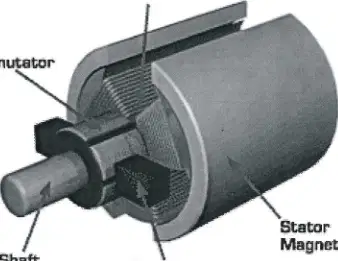
In the diagram of a motor, which part is responsible for reversing the direction of current in the rotor coils?
Commutator
Shaft
Stator Magnets
Brushes
Which two components are essential in both motors and generators?
Magnetic field and coil of wire (armature)
Battery and resistor
Light bulb and switch
Solar panel and capacitor
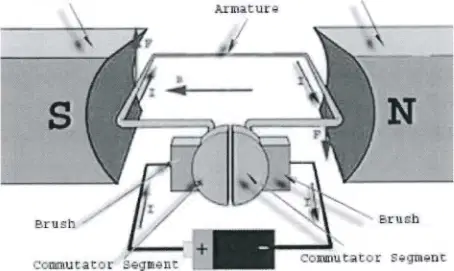
What is the name of the coil of wire present in both motors and generators as shown in the diagram?
Armature
Rotor
Stator
Inductor
Which equation correctly represents the supply voltage for a DC electric motor?
V = E + IaRa
V = E - IaRa
V = IaRa - E
V = E × IaRa
In a self excited series-wound DC generator, if the armature resistance (Ra) is 1.2 ohms, the field winding resistance (Rf) is 0.3 ohms, and the armature current (Ia) is 8A, what is the total resistance (Rt) in the circuit?
1.5 ohms
0.9 ohms
2.4 ohms
8.0 ohms
A self excited series-wound DC generator produces an EMF of 220V and supplies a current of 8A. If the total resistance in the circuit is 1.5 ohms, what is the terminal voltage?
208V
220V
232V
12V
What is the formula for the terminal voltage (V) of a self-excited shunt-wound DC generator?
V = E - IaRa
V = E + IaRa
V = IaRa - E
V = E × IaRa
Which of the following is a typical application of a self-excited shunt-wound DC generator?
Used to charge batteries as it can be made to give constant output voltage
Used to power electric trains
Used for welding applications
Used in step-up transformers
What happens to the speed of a series-wound DC motor as the load increases?
The speed decreases.
The speed increases.
The speed remains constant.
The speed fluctuates randomly.
In which applications are series-wound DC motors most suitable?
Where high starting torque is required and variations in speed are possible, such as trains and sewing machines.
Where constant speed is required, such as clocks.
Where low starting torque is needed, such as fans.
Where no variation in speed is allowed, such as elevators.
Why are permanent magnet motors commonly used in applications like computer cooling fans?
Because they are used where not much power is needed.
Because they provide high starting torque.
Because they are suitable for heavy load applications.
Because they have variable speed control.
Why are shunt-wound DC motors preferred for applications like fans and lathes?
Because they maintain a constant speed under varying loads.
Because they provide high starting torque.
Because they are the cheapest motors available.
Because they are suitable for intermittent operation.
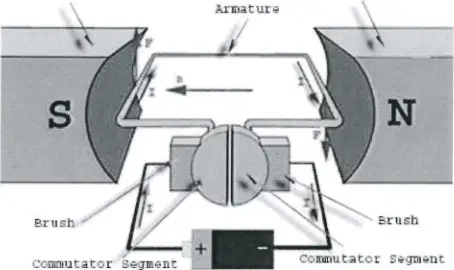
Which part of the DC motor generates the back emf?
The battery
The armature (rotating coil)
The commutator
The brushes
In a shunt wound motor, what is the result of adding a resistor in series with the armature?
The motor speeds up
The motor slows down
The motor reverses direction
The motor stops
Why does reducing the field current in a shunt wound DC motor cause it to speed up?
It increases the back EMF, reducing armature current
It reduces the back EMF, increasing armature current and driving torque
It increases the resistance in the armature circuit
It decreases the supply voltage to the motor
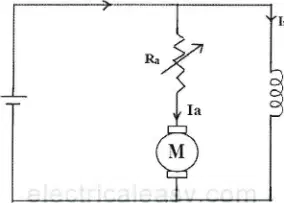
What is the effect of adding a resistor in series with the armature in a shunt wound motor?
The motor speeds up
The motor slows down
The field current increases
The field current decreases
What is the effect on the motor speed when the current in the field coil is decreased in a series wound motor?
The motor slows down
The motor stops
The motor speeds up
The motor reverses direction
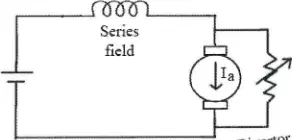
In the context of the diagrams shown, what happens to the armature current in diagram (b) when a diverter is added?
The current increases
The current remains the same
The current decreases
The current reverses

