
NEW
Font size
 Worksheets
Digital repositories and discoverability: Definitions & typology
Total questions: 12
Worksheet time: 12mins
Which historical origin is linked to the concept of the digital repository discussed in the section?
Museum cataloguing in the 1950s
Computer software development and software repositories
Library circulation systems of the 1970s
Web search engines of the late 1990s
Which feature most directly supports long-term accessibility and persistence of digital content in repositories?
Advertising integrations to drive traffic
Use of open-source technologies for asset management and, in some cases, digital preservation and curation
Proprietary media players for content streaming
Gamification features for user engagement
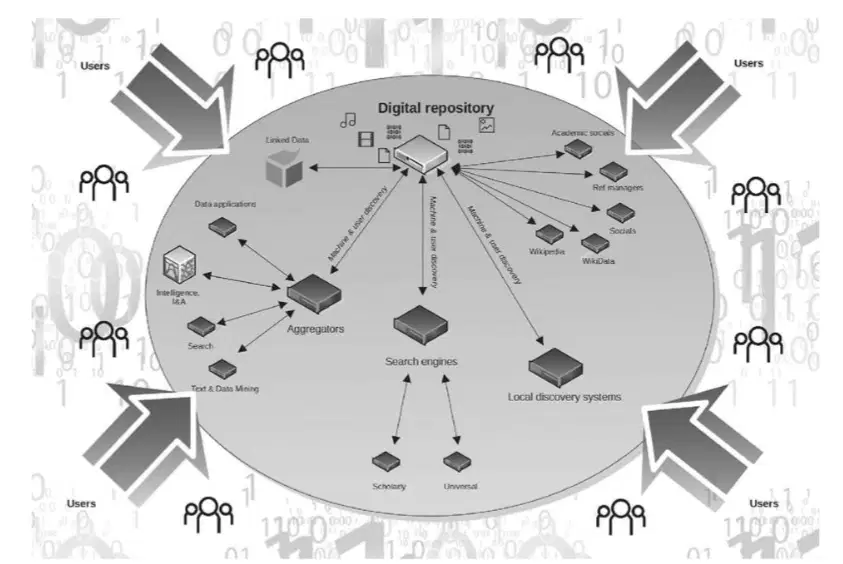
According to the conceptual diagram of users’ routes to repository content, which route represents users accessing the repository directly, often for known-item queries?
Aggregators
Local discovery systems
Native
Search engines
A university wants its repository items to appear in the library’s catalog interface and in Google results. Which combination of discovery routes and practices is most appropriate?
Rely solely on native search within the repository and disable external indexing
Integrate with local discovery systems (e.g., Primo or AtoM) and optimize for search engines via SEO and standards compliance
Use only aggregators and forbid metadata harvesting
Publish items as linked data but block all third-party search tools
Which statement best defines institutional repositories (IRs) in the context of scholarly communication?
Commercial platforms that sell access to research outputs
Digital repositories established by institutions to manage and disseminate their created digital content
Personal websites used by researchers to share preprints
National databases that index all scholarly publications worldwide
IRs primarily support open scholarly communication by focusing on which types of content?
Proprietary datasets and software binaries
OA academic research articles, conference papers, and research theses
Patent applications and corporate trade secrets
Audio-visual entertainment media
Preprints are best characterized as which of the following?
Final, peer-reviewed versions of research articles published in journals
Open research papers that have not yet undergone peer review and act as a precursor to a journal article
Government reports archived by national repositories
Datasets optimized for machine readability following FAIR principles
Which combination aligns with FAIR expectations for data repositories as described?
Findability, Accessibility, Interoperability, Reusability
Fidelity, Accuracy, Integrity, Reliability
Flexibility, Adaptability, Integration, Replicability
Feasibility, Affordability, Inclusivity, Resilience
Trusted Digital Repositories (TDRs) prioritize which main function?
Rapid publication of research outputs for immediate dissemination
Long-term, reliable access to managed digital resources, often under GLAMR or national memory institutions
Crowdsourced curation of learning objects for classroom reuse
Aggregation of metadata from distributed repositories via OAI-PMH
Which of the following correctly distinguishes machine-aggregated from user-aggregated repositories?
Machine-aggregated repositories rely on users to submit content, while user-aggregated ones harvest via protocols like OAI-PMH
Both machine- and user-aggregated repositories depend exclusively on manual deposit by institutional librarians
Machine-aggregated repositories harvest metadata and content using technical protocols (e.g., OAI-PMH, ResourceSync), whereas user-aggregated ones build aggregation through user deposits
User-aggregated repositories always focus on a single institution, while machine-aggregated ones are limited to one subject area
Typical governance for some repository types ensures transparency and openness through which approach?
Strict organizational control
Community governance
Automated algorithmic oversight
Private corporate ownership
What primarily distinguishes a 'subject-based' repository from an 'institutional' repository?
It requires CoreTrustSeal certification for all deposited content
It only accepts preprints that have not undergone peer review
It focuses on specific discipline rather than a specific organization
It always managed by a commercial publisher

