
 Worksheets
ART APPRECIATION - LONG QUIZ
Total questions: 93
Worksheet time: 31mins
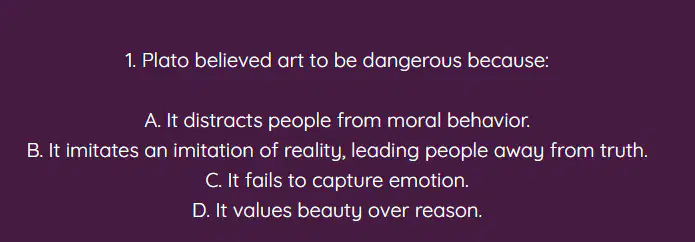
(a)
2. Aristotle’s view of art differs from Plato’s mainly because Aristotle:
A. Saw art as moral deception.
B. Believed art should be purely decorative.
C. Considered art emotionally and educationally beneficial.
D. Denied that art has any purpose.
(a)
3. Kant’s “free play of the mind” suggests that art:
A. Should serve religion.
B. Should be enjoyed for beauty alone.
C. Should be detached from utility.
D. Both A&B.
E. Both B&C
(a)
4. When an artwork expresses feelings that cannot be put into words, it shows art as:
A. Communication beyond language.
B. Purely decorative design.
C. Historical documentation.
D. Philosophical abstraction.
(a)
5. “The Great Wave off Kanagawa” was cited to illustrate that art:
A. Is personal and detached from society.
B. Is a mirror of culture and history.
C. Has no cultural impact.
D. Must always portray human figures.
(a)
6. Which of the following best explains art’s educational function?
A. It appeals to the senses for pleasure.
B. It provokes inquiry into human thought, history, or ethics.
C. It imitates reality without reflection.
D. It promotes political propaganda.
(a)
7. The Communicative Function of art implies that:
A. Art unites people through shared meaning beyond words.
B. Art is only valuable when realistic.
C. Artists must explain their works verbally.
D. Communication in art is always literal.
(a)
8. Why is The Two Fridas considered an artwork of personal expression?
A. It copies a famous photograph.
B. It visually explores the artist’s inner identity and pain.
C. It depicts national history.
D. It demonstrates mathematical proportion.
(a)
9. The ritualistic function of art is most visible when:
A. An artwork is used in ceremonies to strengthen spiritual bonds.
B. A painting depicts gods are depicted realistically.
C. Art provides social commentary.
D. Art records religious data.
(a)
10. Which statement summarizes Kant’s aesthetic philosophy?
A. Beauty is a rational concept.
B. Artistic judgment depends on universal moral truth.
C. Art appreciation is an independent, subjective experience of beauty.
D. Art’s purpose is moral education.
(a)
11. If a film helps viewers confront grief and find emotional release, it exemplifies whose idea of art?
A. Aristotel'
B. Arestotel's
C. Aristotle’s
D. Arestotle's
(a)
12. Compare Plato’s and Kant’s philosophies. Which statement captures their difference?
A. Both value art for truth.
B. Plato links art to illusion; Kant links it to beauty and creativity.
C. Kant rejects art’s emotional impact; Plato praises it.
D. Plato values art as moral therapy; Kant values art as emotional growth driver
(a)
13. Which statement most accurately describes the importance of art appreciation to human development?
A. It deepens empathy, critical thinking, and aesthetic sensitivity.
B. It trains artists to copy styles.
C. It promotes passive viewing.
D. It isolates beauty from morality.
(a)
14. Which of the following best sums up art’s social role?
A. To provoke reflection and foster unity through shared experience.
B. To remain exclusive to elites.
C. To maintain traditional techniques.
D. To isolate emotion from thought.
(a)
15. How does Guernica represent the merging of political and ethical reflection?
A. It imitates a photograph through artistic form.
B. It celebrates conquest through artistic form.
C. It visualizes moral outrage through artistic form.
D. It avoids social meaning through artistic form.
(a)
16. When an artist deliberately leaves tool marks visible to emphasize human labor, the analysis belongs primarily to the:
A. Contextual plane
B. Evaluative plane
C. Semiotic plane
D. Iconic plane
(a)
17. Which statement best illustrates autonomy in both artist and critic?
A. Both are free from external control yet still accountable to their own informed values.
B. Both must follow classical principles of harmony.
C. Both avoid moral interpretation to remain objective.
D. Both depend on institutional approval.
(a)
18. When the critic observes how figures are placed to create balance or dominance, the focus is on the (a) . A. Contextual plane B. Evaluative plane C. Semiotic plane D. Iconic plane
19. The semiotic plane treats the artist’s technical process as (a) . A. A system of signs carrying meaning B. An isolated manual skill C. A moral intention D. A cultural outcome only
20. When a viewer studies how an upright format emphasizes strength, this is analysis on the (a) . A. Semiotic plane B. Contextual plane C. Evaluative plane D. Iconic plane
21. A critic linking the artist’s class or culture to the subject matter applies the (a) . A. Semiotic plane B. Evaluative plane C. Contextual plane D. Iconic plane
22. Evaluative criticism becomes weak when it (a) . A. Includes ethical thought B. Ignores coherence between form and value C. Uses all planes together D. Examines unity of design
23. During analysis, a student notes how the orientation and stance of a figure affect the painting’s mood. This is part of:
A. Style of Figuration
B. Positioning
C. Relationship between Figures
D. Cropping of the Figure
(a)
24. When an artist’s personal struggles are visible in their work, such as Van Gogh’s turbulent emotions in The Starry Night, which contextual dimension is being explored?
A. Historical Context
B. Cultural Context
C. Social Context
D. Biographical Context
(a)
25. Comparing how Leonardo da Vinci’s Mona Lisa looks directly at the viewer versus Vermeer’s Girl Reading a Letter avoids eye contact helps us interpret the:
A. Format of the Work
B. Viewer-Subject Relationship
C. Texture of the Surface
D. Historical Context
(a)
26. In the evaluative plane, what distinguishes a mature critic?
A. The ability to memorize historical data
B. Having technical mastery equal to the artist
C. Developing clear values through experience and reflection
D. Applying fixed European standards
(a)
27. When analyzing The Scream by Edvard Munch, a student focuses on how distortion of form conveys emotion. This represents which type of figuration?
A. Classical Figuration
B. Realist Figuration
C. Expressionist Figuration
D. Impressionist Figuration
(a)
28. A student says that the iconic plane focuses on materials and tools. Why is this statement inaccurate?
A. It confuses the iconic with the contextual plane.
B. Materials belong to the semiotic plane, while the iconic deals with imagery.
C. Tools and pigments belong to evaluative analysis.
D. Both iconic and semiotic planes are identical in scope.
(a)
29. The way multiple figures in Raphael’s The School of Athens are arranged to interact and overlap demonstrates an understanding of:
A. Cropping and Isolation
B. Relationship Between Figures
C. Balance and Rhythm
D. Format and Size
(a)
30. If an artist uses bright hues and bold contrasts to convey joy, which property of color is being emphasized?
A. Value
B. Hue
C. Texture
D. Intensity
(a)
31. A critic compares the political themes in Picasso’s Guernica to the events of the Spanish Civil War. Which plane of art analysis is being applied?
A. Iconic Plane
B. Evaluative Plane
C. Contextual Plane
D. Semiotic Plane
(a)
32. If you were to design an art program fostering empathy and creativity, which aspect of human development is your focus?
A. Emotional intelligence
B. Aesthetic sensitivity
C. Cognitive skill
D. Moral awareness
(a)
33. The philosophical importance of the cultural function is that it:
A. Preserves identity and connects generations.
B. Focuses only on entertainment.
C. Rejects heritage.
D. Excludes innovation.
(a)
34. Which division of art allows integration of all others through technology?
A. Literary
B. Performing
C. Visual
D. Digital
(a)
35. “Art as imitation” and “Art as expression” differ because the latter:
A. Values reproduction
B. Prioritizes emotional authenticity over likeness
C. Rejects meaning
D. Focuses on proportion
(a)
36. What is the philosophical importance of art’s social function?
A. It reinforces political propaganda.
B. It teaches science.
C. It fosters unity and shared understanding.
D. It isolates individual artists.
(a)
37. Which statement best synthesizes the lesson’s view of art and society?
A. Art is a passive reflection of history.
B. Art is fixed and unchanging.
C. Art remains isolated from human development.
D. Art interacts with culture, shaping and being shaped by it.
(a)
38. Which of the following pairs correctly links artwork and philosophical function?
A. Mona Lisa – Epistemology
B. Totem Poles – Ontology
C. The Scream – Political
D. Guernica – Aesthetic
(a)
39. In evaluating an artist’s use of watercolor to depict soft emotions, what evaluative question is most relevant?
A. Does the background reflect cultural tradition?
B. Does the artist follow the canon of proportions?
C. Was the chosen medium appropriate for the message?
D. Are the colors realistic?
(a)
40. If a student describes how an artist’s texture and tool marks signify process and authenticity, what kind of semiotic interpretation is being made?
A. Technical Skill Assessment
B. Analysis of Intentional Marks
C. Evaluation of Ideological Meaning
D. Social Context Critique
(a)
41. Why is it insufficient to evaluate art only by technical form, according to the evaluative plane?
A. Form has no relevance to meaning.
B. Technical form and value content must both be considered.
C. Only historical background defines value.
D. Form should always dominate content in evaluation.
(a)
42. When evaluating whether a sculptor’s chosen marble best conveys fragility, the analysis focuses on:
A. Choice of Medium and Technique
B. Contextual Background
C. Historical Context
D. Style of Figuration
(a)
43. The tactile surface of Meret Oppenheim’s Object invites the viewer to imagine its feel. This reflects which element of art?
A. Value
B. Space
C. Line
D. Texture
(a)
44. The critic interprets how Mona Lisa’s smile engages the viewer psychologically. Which plane focuses on this interaction?
A. Semiotic Plane
B. Contextual Plane
C. Iconic Plane
D. Evaluative Plane
(a)
45. What best describes how “intensity” functions within color theory?
A. It measures the boldness or dullness of a hue.
B. It defines a color’s lightness or darkness.
C. It determines the tactile quality of a pigment.
D. It describes the composition’s proportion.
(a)
46. In analyzing The Third of May 1808, a student focuses on Goya’s dramatic light to highlight emotion and tension. Which principle is dominant?
A. Emphasis
B. Pattern
C. Rhythm
D. Unity
(a)
47. If a critic discusses how viewers’ moral perspectives influence their appreciation of art, this belongs to:
A. Iconic Plane
B. Evaluative Plane
C. Contextual Plane
D. Semiotic Plane
(a)
48. A circular artwork that produces a sense of completeness demonstrates the role of:
A. Viewer Engagement
B. Iconic Subject
C. Cropping Technique
D. Format of the Work
(a)
49. The artist’s deliberate asymmetry in composition to create visual interest demonstrates which principle?
A. Variety
B. Balance
C. Pattern
D. Movement
(a)
50. When art provokes debate about gender and justice, it demonstrates:
A. Ritualistic expression
B. Political and ethical critique
C. Aesthetic autonomy
D. Ontological questioning
(a)
51. In the context of human development, Heneral Luna helps audiences develop:
A. Technical painting skills
B. Logical reasoning
C. Empathy and patriotism
D. Spatial awareness
(a)
52. Which philosopher’s ideas would most support abstract digital art?
A. Plato
B. Kant
C. Aristotle
D. None
(a)
53. The educational function of art philosophically emphasizes:
A. Visual pleasure over moral development.
B. Engagement with ideas and reflection on human experience.
C. Skill mastery alone.
D. Cultural isolation.
(a)
54. A monument honoring heroes fulfills both the ______ and ______ functions of art.
A. Social – epistemological
B. Political – ritualistic
C. Cultural – aesthetic
D. Utilitarian – moral
(a)
55. The Third of May 1808 encourages reflection on human suffering and justice. This shows that art can:
A. Entertain audiences only.
B. Serve as a tool for ethical reasoning.
C. Depict abstract beauty alone.
D. Reject moral questions.
(a)
56. A sculpture showing a perfectly symmetrical human body inspired by Greek ideals represents:
A. Classical Figuration
B. Expressionist Figuration
C. Realist Figuration
D. Impressionist Figuration
(a)
57. If a viewer evaluates whether rhythm and harmony fit the artwork’s intent rather than absolute rules, they practice:
A. Contextual Analysis
B. Fixed Standard Assessment
C. Formalist Criticism
D. Relative Evaluation of Organization
(a)
58. The decision to use carving instead of modeling belongs to:
A. Figuration
B. Format
C. Technique
D. Iconic Plane
(a)
59. A painting depicts a subject looking away from the viewer, creating a sense of detachment. This conveys:
A. Power Hierarchy
B. Direct Engagement
C. Indirect Address
D. Cropped Framing
(a)
60. An artist places several overlapping figures to suggest crowding and motion. This shows understanding of:
A. Space and Depth
B. Proportion and Balance
C. Format and Size
D. Value and Light
(a)
61. A painting’s grainy brush texture that reflects the artist’s raw emotion would be analyzed under:
A. Semiotic Plane
B. Evaluative Plane
C. Contextual Plane
D. Iconic Plane
(a)
62. An artist’s autonomy and the critic’s independence in interpretation both highlight:
A. Shared Iconic Meaning
B. Dependence on Historical Context
C. Mutual Freedom in Evaluative Judgment
D. Technical Unity of Style
(a)
63. When an artist paints everyday workers as noble and dignified, it shows:
A. Realist Figuration
B. Classical Idealism
C. Expressionist Emotion
D. Impressionist Technique
(a)
64. The iconic sign in art differs from fixed conventional signs because it:
A. Avoids conveying meaning
B. Follows standardized meanings like traffic symbols
C. Is purely decorative
D. Has nuanced, context-specific meanings
(a)
65. The critic identifies how religious beliefs shape symbolism in a Renaissance painting. This uses:
A. Iconic Plane
B. Semiotic Plane
C. Contextual Plane
D. Evaluative Plane
(a)
66. The viewer feels dominance when the subject in a portrait looks down at them. This reflects:
A. Decentered Composition
B. Power and Hierarchy
C. Relationship between Figures
D. Cropping
(a)
67. The illusion of distance created by overlapping objects belongs to:
A. Line
B. Balance
C. Space
D. Form
(a)
68. When an artist positions multiple figures equally, suggesting equality among them, what relationship is shown?
A. Peer Relationship
B. Dominance
C. Isolation
D. Juxtaposition
(a)
69. When a subject in a painting gazes directly at the viewer, the effect often creates
a. Frontal Figuration
b. Intimacy and confrontation
c. Central Composition
d. Isolated Relationship
(a)
70. Evaluating The Musicians by Botero for its exaggerated forms focuses on:
A. Principle of Emphasis
B. Principle of Variety
C. Principle of Unity
D. Principle of Pattern
(a)
71. The presence of deliberate imperfections to convey authenticity shows the role of:
A. Intentional Marks
B. Format of the Work
C. Medium and Technique
D. Relative Evaluation
(a)
72. Plato’s theory of imitation contrasts with Aristotle’s view because Plato saw imitation as ______, while Aristotle saw it as ______.
A. Spiritual – decorative
B. Deceptive – educational
C. Emotional – illusory
D. Physical – metaphysical
(a)
73. A political cartoon that challenges corruption demonstrates art’s:
A. Ritualistic purpose
B. Social and political commentary
C. Aesthetic goal
D. Communicative symbolism
(a)
74. Which of the following most clearly represents the epistemological function of art?
A. A painting that records daily life and human behavior.
B. A building that blends beauty and purpose.
C. A ritual mask used in ceremonies.
D. A mural about political resistance.
(a)
75. A performance that narrates indigenous myths through dance demonstrates:
A. Visual art
B. Digital art
C. Performing art
D. Literary art
(a)
76. Which function of art builds bridges between individuals through shared interpretation?
A. Political
B. Social
C. Practical
D. Ritualistic
(a)
77. In Aristotle’s view, a tragedy’s value lies in its power to:
A. Represent perfect forms
B. Convey political reform
C. Entertain the masses
D. Produce emotional cleansing and reflection
(a)
78. A viewer connects an artist’s chaotic brushwork with the trauma of war. This type of interpretation uses which planes?
A. Semiotic and Contextual
B. Evaluative and Iconic
C. Contextual and Formal
D. Semiotic and Evaluative
(a)
79. Why is contextual analysis essential to understanding art fully?
A. Because it ignores values.
B. Because context replaces technique.
C. Because context measures skill.
D. Because meaning is shaped by time, culture, and social background.
(a)
80. A painting depicting a relaxed, casual figure rather than a stiff, formal pose affects how the viewer relates to it. This demonstrates:
A. Cropping and Composition
B. Formal vs. Casual Presentation
C. Gaze and Orientation
D. Cultural Context
(a)
81. In evaluating form, a critic must be familiar with:
A. The artist’s political views.
B. The critic’s own emotions only.
C. The tools, surfaces, and techniques of art-making.
D. Museum display methods.
(a)
82. If an artist chooses digital art over paint to emphasize modernity, which analytical aspect applies?
A. Choice of Medium and Technique
B. Format of the Work
C. Positioning and Composition
D. Direct and Indirect Address
(a)
83. A critic writes that symmetry in a portrait communicates order and discipline. What principle supports this interpretation?
A. Emphasis
B. Variety
C. Balance
D. Pattern
(a)
84. When studying color harmony, contrast, and unity, a student is analyzing:
A. Principles of Art
B. Elements of Design
C. Contextual Background
D. Iconic Relationship
(a)
85. If a sculpture is symmetrical and follows ideal proportions, it demonstrates:
A. Realist Figuration
B. Expressionist Figuration
C. Classical Figuration
D. Impressionist Figuration
(a)
86. Which type of presentation shows a relaxed and spontaneous subject?
A. Casual Presentation
B. Formal Presentation
C. Decentered Composition
D. Direct Address
(a)
87. If two figures face each other equally, the composition implies:
A. Balance or equality
B. Emotional withdrawal
C. Cultural division
D. Iconic distance
(a)
88. A traditional African mask used in a ceremonial ritual exemplifies the purpose of art as:
A. A form of personal expression for the carver.
B. A vehicle for cultural reflection and preservation.
C. A tool for political activism and social change.
D. An object created primarily for aesthetic pleasure.
(a)
89. Alexander McQueen's fashion designs are categorized under Applied Arts because they:
A. Blend artistic vision with the utilitarian purpose of clothing the body.
B. Are primarily intended to be displayed on mannequins in museums.
C. Use the human body as a medium for temporary performance.
D. Are created using algorithms and digital fabrication only.
(a)
90. The lesson suggests that experiencing the aesthetic beauty of the Taj Mahal or the Grand Canyon leads to a more enriched life by:
A. Fostering social bonds through mandatory group travel.
B. Providing a clear understanding of architectural or geological science.
C. Enhancing our ability to recognize and appreciate beauty in the world.
D. Serving as a functional space for religious or recreational activities.
(a)

