
 Worksheets
Revision-Magnetic Effect of Electric Current
Total questions: 11
Worksheet time: 6mins
Which statement best describes the Right-Hand Thumb Rule for a current-carrying solenoid?
Point your right thumb along the magnetic field; your curled fingers show current direction.
Point your right thumb along the direction of current through the coils; your curled fingers indicate the magnetic field lines around the solenoid.
Use your left hand: thumb shows current direction, fingers show magnetic field direction.
Thumb points to the south pole and fingers curl toward the north pole.
A solenoid can act like which familiar magnetic object when current flows through it?
An electrostatic plate
A bar magnet
A capacitor
A diode
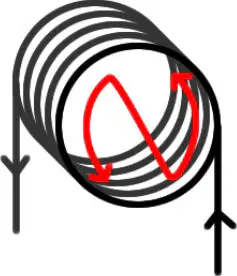
Looking at the two end-on coil sketches, the end where the current appears to circulate counterclockwise when viewed from that end corresponds to which pole?
South pole
North pole
Either pole depending on core material
No pole forms
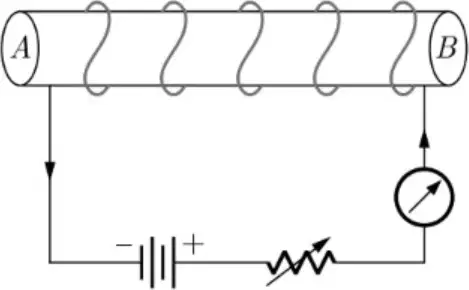
Which change will increase the strength of the magnetic field inside a current-carrying solenoid most directly?
Decrease the number of turns of the coil.
Insert a soft iron core and/or increase the current through the coil.
Reverse the battery terminals only.
Place the solenoid near a bar magnet without changing current.
What is a compass needle?
A device that measures electric current.
A small pivoted magnet that aligns with the local magnetic field direction.
A soft iron rod used as a core inside a solenoid.
A coil that produces magnetic field when current flows.
When a compass needle is placed in a region with no magnetic field, what happens?
It aligns pointing North-South.
It rotates rapidly and settles randomly.
It shows no preferred direction and does not align.
It points toward the nearest electric charge.
If the magnitude of current in a straight conductor within a uniform magnetic field is doubled (with field and orientation unchanged), how does the magnetic force change?
It halves.
It remains the same.
It doubles.
It becomes zero.
What happens to the direction of magnetic force on a current-carrying conductor if the direction of current is reversed while the magnetic field is unchanged?
The force direction stays the same.
The force direction reverses.
The force magnitude becomes infinite.
The conductor experiences no force.
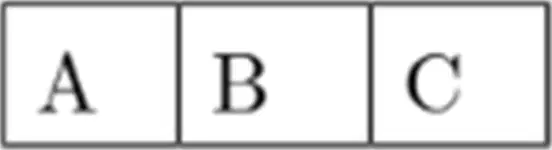
A bar magnet is divided into three labelled parts A, B, and C from left to right. Where is the magnetic field strength maximum and where is it minimum? Choose the best option.
Maximum at A and C; minimum at B
Maximum at B; minimum at A and C
Maximum at A only; minimum at C only
Equal at A, B, and C
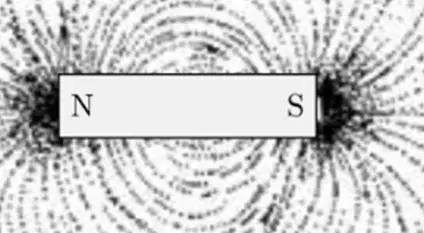
In a diagram showing iron filings around a bar magnet labelled N (left) and S (right), what does the observed closed-curve alignment of filings demonstrate?
Electric field lines form open curves
Magnetic field lines are closed loops emerging from N and entering S
Magnetism acts only at the poles and not in space around the magnet
Iron filings repel each other and form circles
Which statement best compares the magnetic field of a current-carrying solenoid with that of a bar magnet?
A solenoid has no field inside, unlike a bar magnet
Both show strong, nearly uniform field lines inside and similar external field patterns with identifiable north and south poles
A solenoid’s field exists only outside the coil
A bar magnet’s field lines are straight everywhere, while a solenoid’s are random

