
 Worksheets
Unit 2: Soil, Weathering and Erosion
Total questions: 10
Worksheet time: 20mins
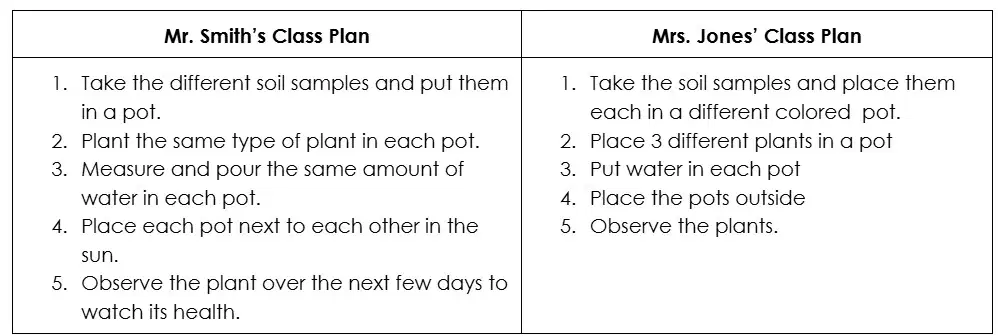
Two third grade classes come up with a plan to investigate which type of soil would best support plant growth. The teachers put the two plans on a chart next to each other. Their chart is below. Which plan do you think would be BEST to investigate which soil would be best to support plant growth and why?
Mr. Smith’s plan because they put the same type of plant in each pot.
Mrs. Jones’ because they take 3 different soil samples
Mrs. Jones’ because they need to have different colored pots
Mr. Smith because they placed the pots outside.
Janelle wants to investigate to determine three different soils’ textures based on their particle size. She says “I only need to use a hand lens to look at them. Then I will write down what I see. This will tell me all I need to know about their texture based on their particle size.” Is Janelle correct in her thinking?
Yes, because a hand lens helps you see particle size and then you will know about the soils’ texture
No, because in order to determine texture, you also need to know what the soils feels like.
Yes, because to see texture you just need to look at the soil closely.
No, because you do not need to use a hand lens to determine texture
If a student wanted to tell if a soil is mostly sand, what could they do to identify the soil and why?
They could look at the particle size because sand has the smallest particles.
They could add water because it will pass through sand easily.
They could feel the texture because sand is slippery when wet.
They could add water because sand holds the most water.
A student wanted to find out what type of soil could grow lima beans the best. What would be the best investigation to carry out?
Add lima beans to sand and measure the growth of plants.
Add water to each soil and plant the lima beans in the one that holds the most water.
Plant a lima bean in each type of soil and measure the growth of the plants.
Plant three lima beans in a mixture of all of the soils and measure the growth of the plants.
Mia is digging a hole. She finds an unknown soil that is made of very large, gray grains. It does not hold water well. Mia most likely found which type of soil?
Clay
Gravel
Sand
Loam

Using the information in the table above, which soil should Shania’s use to plant her pumpkin seeds?
Sand would be the best soil for the pumpkin seeds because it retained less water than clay.
Loam would be the best soil because it retained less water than clay but more water than sand.
Sand would be the best soil for the pumpkin seeds because it allowed the most water to be filtered through.
Loam would be the best soil because it retained more water and allowed the most water to be filtered through.
Which of the following best describes loam?
It does not hold water well.
It does not have any nutrients.
It has too much organic matter.
It has a mixture of particle sizes.
During the fall, Robert noticed a small crack in a rock in his backyard. Over the winter, the area that Robert lives in got a lot of rain and temperatures dropped below freezing many nights. When Robert observed the rock again in the spring, he noticed the crack was much larger. What caused the crack to get bigger?
The rain water continued to carve out the crack over time.
Wind from the freezing nights would cause erosion to the rock.
Over time, the rain would freeze to ice, which expanded the crack in the rock.
There was a flood that moved with a fast speed that caused the crack to expand.
A rock falls from a mountain into a river below. How would the rock most likely look 100 years later?
It would be smaller and smoother.
It would be larger and smoother.
It would be smaller and jagged.
It would be larger and jagged.
The third graders in Mr. Miller’s class were looking at pictures of mountain ranges in the United States. The students observed that the Appalachian Mountains were round and short, while the Rocky Mountains were taller and more jagged. What would cause the mountain ranges to be so different?
The Appalachian Mountains have had more exposure to erosion from wind and water.
More people have traveled over the Rocky Mountains than the Appalachian Mountains.
More animals live in the Appalachian Mountains, so they have been worn down more from the animals walking over them.
The snow in the Rocky Mountains keeps them for eroding as quickly as the Appalachian Mountains.

