
 Worksheets
DNA and Protein Synthesis Unit Study Guide 10-22-25
Total questions: 20
Worksheet time: 13mins
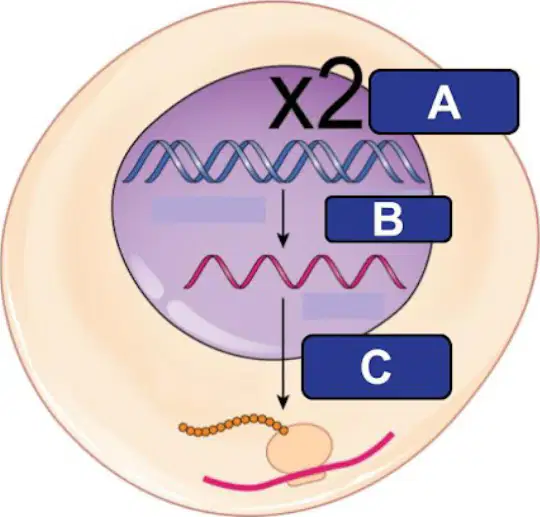
Which process is represented by Letter B in the diagram?
DNA Replication
Transcription
Translation
Cell Division
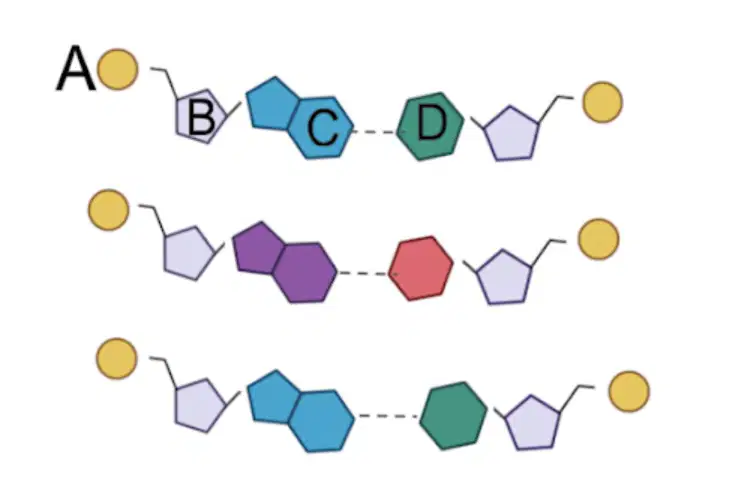
Which letter in the diagram represents the phosphate group in a DNA nucleotide?
A
B
C
D
Transcription (DNA to RNA): Please select the new RNA bases that would pair with the partial DNA strand CCA.
TGA
GGU
ACU
UCU

Translation (RNA to protein): What amino acid would be created by the following RNA codon? ACU
Thr (T)
His (H)
Arg (R)
Pro (P)
Traveling away from the equator, what happens in general to the amount of UV intensity?
The intensity decreases.
The intensity increases
The intensity stays the same.
It is impossible to predict.
Which statement best describes how to use the base pairing rule for DNA replication?
The new strand of DNA should only have thymine to pair with adenine from the original DNA.
The new strand of DNA can have both thymine and uracil as possible bases.
The new strand of DNA should only have uracil to pair with adenine from the original DNA.
None of the above.
Which answer is more appropriate?
Traits are good or bad.
Traits can be harmful or hurtful depending on the environment.
Traits are always helpful or hurtful, regardless of the environment.
Traits are helpful or bad.

Which process is represented by Letter A in the diagram?
DNA Replication
Transcription
Translation
Protein Folding
What is the process of making a copy of DNA called?
Replication
Transcription
Translation
Amino Acid Synthesis
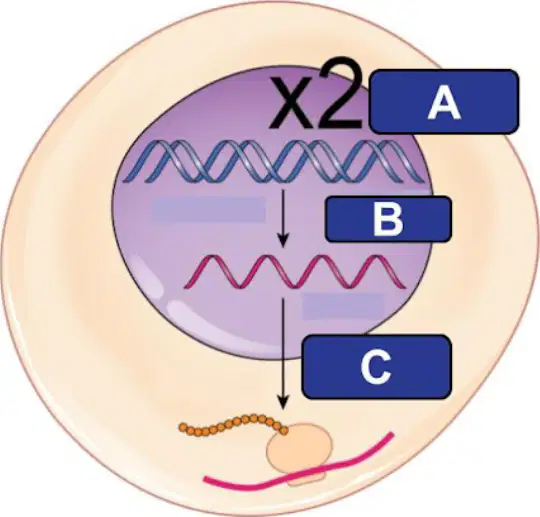
Which process is represented by Letter C in the diagram?
DNA Replication
Transcription
Translation
Mutation
The cell reads the DNA and makes a complementary strand of RNA. What is this process called?
Transcription
Replication
Amino Acid
Translation

Which molecule is represented by letter A in the diagram?
RNA
DNA
Protein
Carbohydrate
What is the process called when the RNA strand is used to make an amino acid chain, allowing the cell to make proteins?
Translation
Mutation
Polymerase
Replication
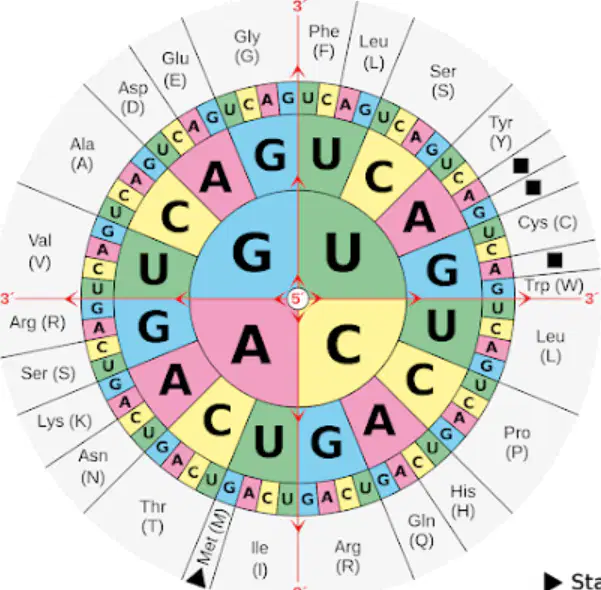
Translation (RNA to protein): Which step describes how to use the first letter in an RNA codon (CAU for example) to make the amino acid?
The first letter of RNA indicates the largest letter on the chart.
The first letter of RNA indicates the medium sized letter on the chart.
The first letter of RNA indicates the smallest letter on the chart.
None of the choices are correct

If a person lives in an environment with low radiation (UV light) what kind of skin color would be the best adapted
Which molecule makes up part of the backbone of DNA and can bond to a base or phosphate?
Deoxyribose sugar
Nitrogenous base
Phosphate
Ribose sugar

What does this image represent?
weather conditions
amount of ultraviolet light intensity
skin color
altitude
The graph in Figure 2 summarizes the age at which people are diagnosed with melanoma, the most serious form of skin cancer. Why does protection from skin cancer not explain the strong selective pressure for dark skin in high UV ares.
Because the median age is 63.
Because most people get skin cancer at a young age.
Because most people get skin color at an old age.
Because many people get skin color at an older age after they have already had children and probably passed the gene onto them.

