Worksheets
Latitude & Longitude, GPS, Seasons
Total questions: 100
Worksheet time: 58mins
What is longitude?
A measure of location from north to south
A measure of location from east to west
A measure of location from west to east
A measure of location from south to north
How does longitude differ from latitude?
Longitude measures north and south, while latitude measures east and west.
Longitude measures east and west, while latitude measures north and south.
Longitude measures both east and west and north and south.
Longitude and latitude are the same.
What is latitude?
A measure of location from north to south
A measure of location from east to west
A measure of location from west to east
A measure of location from south to north
How many miles are in one degree of latitude? (2)
100 miles
111 kilometers
15 miles
69 miles
Why is the prime meridian where it is?
It marks the equator.
It's the starting point for measuring longitude.
It is where the committee met to determine a universal system of latitude and longitude
It's the reference point for time zones.
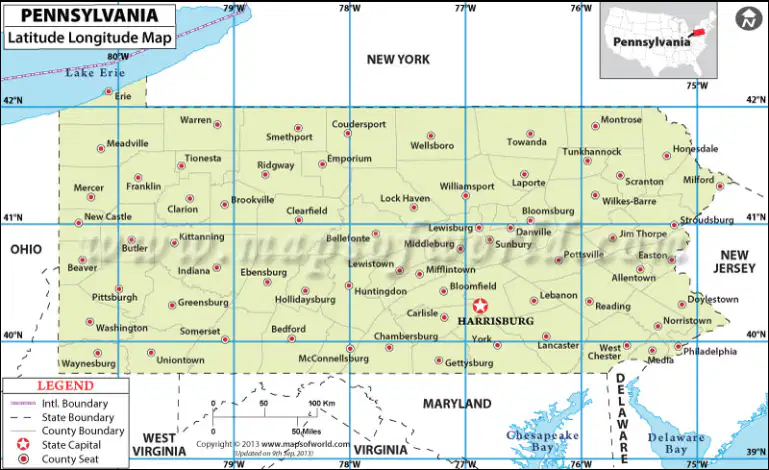
What is the approximate longitude of Philadelphia?
39° S
35° N
37° N
39.9° N
75.1° W
What is the foundation of the global coordinate system used in navigation and mapping?
Latitude and longitude
Equator and prime meridian
Tropic of Cancer and Tropic of Capricorn
International Date Line
What is GPS?
A system for measuring latitude only
A system for measuring longitude only
A technology that uses latitude and longitude to find locations
A global weather monitoring system
How does GPS work?
It uses signals from satellites to measure altitude.
It uses signals from satellites to measure temperature.
It uses signals from satellites to find exact locations using latitude and longitude.
It uses signals from satellites to navigate under the ocean.
How many satellites are part of the GPS system?
2
4
12
24
What is the December Solstice? (2)
The day with the longest daylight hours in the Northern Hemisphere
The day with the shortest daylight hours in the Southern Hemisphere
The day with the shortest daylight hours in the Northern Hemisphere
The day with the longest amount of daylight hours in the Southern Hemisphere
The day with the longest daylight hours in the Southern Hemisphere
The Spring Equinox occurs on which date?
March 21
June 21
September 23
December 21
It depends on if you are in the Northern or Southern Hemisphere
During the Summer Solstice in the Northern Hemisphere, the North Pole is: (2)
Tilted away from the Sun
Tilted toward the Sun
Tilted at a right angle to the Sun
Receiving almost 24 hours of daylight
Not tilted
What happens during the Fall Equinox (Autumnal Equinox)?
The Northern Hemisphere experiences the shortest daylight hours.
Both hemispheres receive about the same amount of daylight.
The Southern Hemisphere experiences the shortest daylight hours.
The equator experiences the shortest daylight hours.
It depends on which hemisphere you are in.
What causes direct and indirect sunlight on Earth's surface?
The rotation of the Earth
The tilt of the Earth's axis
The distance from the Sun
The position of the Moon
During which month is the Earth closest to the sun in its revolution?
June
July
August
January
December
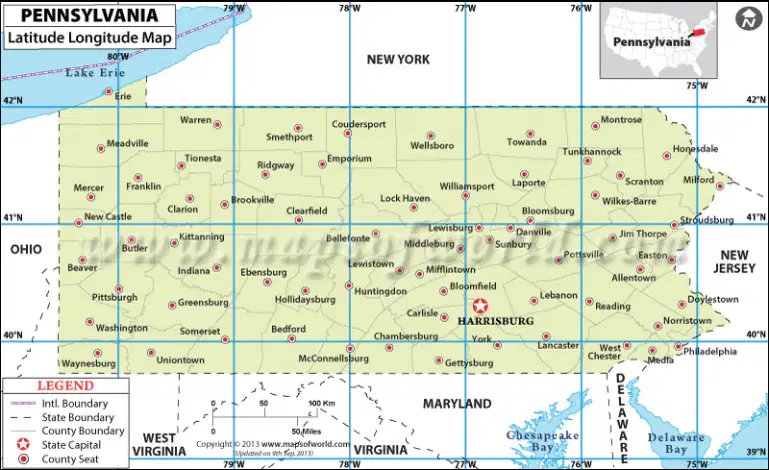
What is the latitude of Philadelphia?
76 degrees north
23.5 degrees north
39.95 degrees north
40.5 degrees north
75.1 degrees north
During which solstice does the Tropic of Capricorn receive the most direct sunlight?
December solstice
March equinox
June solstice
December Equinox
September equinox
What causes the changing of seasons on Earth?
The Earth's orbit around the Moon
The Earth's tilt on its axis and its orbit around the Sun
The Earth's rotation on its axis
The Earth's distance from the Moon
What is the purpose of the Tropic of Cancer and Tropic of Capricorn?
To mark the equator
To divide the Earth into four quadrants
To define the boundaries of the polar regions
To mark the point the sun will be directly overhead on the solstices and define the tropical climate zone.
What is the latitude of the Antarctic Circle?
0 degrees south
23.5 degrees south
66.5 degrees north
39.95 degrees south
66.5 degrees south
How do latitude and longitude help us locate places on Earth?
Latitude tells us how far east or west we are, and longitude tells us how far north or south we are.
Latitude and longitude are unrelated to location.
Latitude tells us how far north or south we are, and longitude tells us how far east or west we are.
Latitude and longitude have no impact on locating places.
What is longitude?
A measure of location from north to south
A measure of location from east to west
A measure of location from west to east
A measure of location from south to north
How does longitude differ from latitude?
Longitude measures north and south, while latitude measures east and west.
Longitude measures east and west, while latitude measures north and south.
Longitude measures both east and west and north and south.
Longitude and latitude are the same.
What is latitude?
A measure of location from north to south
A measure of location from east to west
A measure of location from west to east
A measure of location from south to north
What does latitude measure?
How far north or south you are from the equator
How far east or west you are from the prime meridian
How far north or south you are from the International Date Line
How far east or west you are from the equator
What is the equator? (2)
0 degrees longitude
0 degrees latitude
An imaginary line that divides the Earth into four quadrants
An imaginary parallel that circles the Earth east / west.
What is the prime meridian? (3)
An imaginary line that divides the Earth into two hemispheres
An imaginary line that circles the Earth vertically
0 degrees latitude
An imaginary line that passes through Greenwich, England
0 degrees longitude
Why is the prime meridian significant? (2)
It marks the equator.
It's the starting point for measuring longitude.
It divides the Earth into the Northern and Southern Hemispheres.
It's the reference point for time zones.
What is Greenwich Mean Time (GMT)?
The time at the equator
The time at the International Date Line
The time at the Prime Meridian
The time at the North Pole
How does the International Date Line work? (2)
It divides the Earth into Eastern and Western Hemispheres.
It marks the equator.
It marks the beginning of the next day
It creates a 24-hour time difference from north to south.
What are the coordinates of the North Pole?
90 degrees east longitude
90 degrees south latitude
90 degrees north latitude
90 degrees north longitude
90 degrees west longitude
What is the Arctic Circle? (2)
An imaginary line that circles the Earth horizontally
An imaginary line that divides the Earth into two hemispheres
An imaginary line located at approximately 66.5 degrees north latitude
An imaginary line located at approximately 66.5 degrees south latitude
What marks the boundaries of the tropical zone?
23.5 degrees North and 23.5 degrees East
The Arctic Circle and Antarctic Circle
The equator and prime meridian
The Prime Meridian and the International Date Line
During which solstice does the Tropic of Cancer experience the sun directly overhead?
December solstice
March equinox
June solstice
September equinox
What is the Antarctic Circle?
An imaginary line that divides the Earth into two hemispheres
An imaginary line located at approximately 66.5 degrees north latitude
An imaginary line located at approximately 66.5 degrees south latitude
An imaginary line that marks the equator
How are latitude lines measured?
In meters
In kilometers
In degrees
In miles
How many degrees of latitude between the equator and the poles?
0 degrees
45 degrees
90 degrees
66.5
180 degrees
How many degrees of longitude are there in a complete circle around Earth? (2)
90 degrees
180 degrees East and 180 West
270 degrees
360 degrees total
180 degrees
Longitude lines are measured from the prime meridian in which way?
In degrees east and west
In kilometers north and south
In hours ahead and behind
In meters above and below
Which of the following is the correct unit for measuring longitude?
In degrees east or west
In degrees north or south
In kilometers
In feet
What is the significance of the Arctic Circle's latitude?
It marks the boundary of the polar zone.
It marks the equator.
It divides the Northern and Southern Hemispheres.
It marks the boundary of the tropical zone.
It has no significance.
How do latitude and longitude work together to pinpoint locations?
Longitude tells you how far north or south you are, and latitude tells you how far east or west you are (from a fixed point - zero degrees).
Latitude tells you how far north or south you are, and longitude tells you how far east and west you are (from a fixed point - zero degrees).
Latitude tells you how far east or west you are, and longitude tells you how far north or south you are (from a fixed point - zero degrees).
None of these are correct
What is the foundation of the global positioning system used in navigation and mapping?
Longitude and latitude
The equator and the prime meridian
Time zones
The International Date Line
What does GPS stand for?
Global Postal Service
Global Planet System
Global Positioning System
Global Protection Service
How does GPS determine your exact location on Earth's surface?
By sending signals to satellites and back
By measuring how far you are from the equator
By measuring the distance to the North Pole
What are uses of GPS technology?
To help planes and ships navigate
To track packages
To connect your phone to a cell phone tower
Allows AirTags to work
To find lost iPhones
Which imaginary line(s) divides the Earth into two hemispheres? Select all that apply.
The Equator
The International Date Line
The Prime Meridian
The Tropic of Cancer
The Tropic of Capricorn
Which date does the Northern Hemisphere experience the shortest daylight hours?
June 21st
March 22nd
September 21st
December 21st
January 1st
How does the amount of daylight in Philadelphia change after the December Solstice?
It remains constant.
It decreases by about 1-3 minutes a day
It increases by about 1-3 minutes a day
It decelerates.
It reverses.
Which event marks the beginning of Summer in the Northern Hemisphere?
September Equinox
June Equinox
December Equinox
December Solstice
June Solstice
In Philadelphia, what is the main difference between the September Equinox and the March Equinox?
The September Equinox has shorter daylight hours, while the March Equinox has longer daylight hours.
The Spring, or "Vernal" Equinox occurs in September, while the Autumnal Equinox occurs in March.
The September Equinox is when the Northern Hemisphere is tilted away from the Sun, while the March Equinox is when it is tilted toward the Sun.
The September Equinox marks the start of autumn in the Northern Hemisphere, while the March Equinox marks the start of spring.
How does direct sunlight affect temperature on Earth's surface?
Direct sunlight leads to cooler temperatures.
Direct sunlight has no effect on temperature.
Direct sunlight leads to warmer temperatures.
Direct sunlight leads to precipitation.
How many equinoxes and solstices are there in a year?
2 equinoxes and 2 solstices
4 equinoxes and 4 solstices
1 equinox and 1 solstice
3 equinoxes and 3 solstices
Which event marks the official start of Spring in the Northern Hemisphere?
June Solstice
December Solstice
March Equinox
September Solstice
March Solstice
What is the approximate angle of Earth's tilt on its axis?
0°
23.5°
45.5°
66.5°
90°
What is the primary reason for the changing of seasons?
The Earth's rotation
The Earth's distance from the Sun
The Earth's tilt on its axis and position in its orbit around the Sun
The Earth's magnetic field
How does the rate of daylight change after the June Solstice in the Northern Hemisphere?
It remains constant.
It begins to increase daily.
It begins to decrease by 1+ minute a day
It reverses.
What is the purpose of the Tropic of Cancer and Tropic of Capricorn?
To mark the equator
To divide the Earth into four quadrants
To define the boundaries of the polar regions
To mark the tropical zone
To mark the farthest points North/South at which the sun will appear directly overhead (direct light)
Which event marks the beginning of winter in the Northern Hemisphere?
December Solstice
June Solstice
June Equinox
December Equinox
March Equinox
How does indirect sunlight affect temperature on Earth's surface?
Indirect sunlight is diffused, so it’s weaker.
Indirect sunlight has no effect on temperature.
Indirect sunlight leads to warmer temperatures.
Indirect sunlight leads to precipitation.
What is the main factor responsible for the rate of daylight change after the Summer Solstice?
The Earth's rotation speed
The Earth's orbital movement and spherical shape
The Earth's latitude
The Earth's magnetic field
What event marks the beginning of autumn in the Northern Hemisphere?
Winter Solstice
Summer Solstice
September Equinox
March Equinox
How does the length of daylight change the month before the Fall Equinox?
It remains constant.
Loss of daylight accelerates.
Loss of daylight per day decreases.
It reverses.
What is the main factor responsible for the rate of daylight change before the winter Solstice?
The Earth's rotation speed
The Earth's position in its revolution
The Earth's latitude
The Earth's magnetic field
Parallel lines go in the same direction as the:
The equator
The prime meridian
The Tropic of Cancer
The International Date Line
Which line of latitude is closest to the North Pole?
90° N.
Tropic of Capricorn
Arctic Circle
Antarctic Circle
90° S.
The meridian at 180 degrees is known as the:
Equator
Tropic of Cancer
Prime meridian
International Date Line
Which line marks the transition from one calendar day to the next and is important for timekeeping? (2)
Tropic of Capricorn
Prime meridian
International Date Line
Arctic Circle
180°
The region between the Tropic of Cancer and the Tropic of Capricorn is known as the:
Temperate zone
Arctic zone
Tropics
Antarctic zone
Which zone is located between the Arctic Circle/Antarctic Circle and 23.5 N/S?
Tropical zone
Temperate zone
Polar zone
Equatorial zone
What is the primary reason for the changing seasons on Earth?
The Earth's distance from the Sun
The tilt of the Earth's axis
The rotation of the Earth
The Earth's elliptical orbit
When it is summer in the Northern Hemisphere, what season is it in the Southern Hemisphere?
Fall
Winter
Spring
Summer
During which celestial events are day and night approximately equal in length? (2)
Spring equinox
Summer solstice
Fall equinox
Winter solstice

Based on the image, what day of the year is it?
June 21st
September 21st
December 21st
March 21st
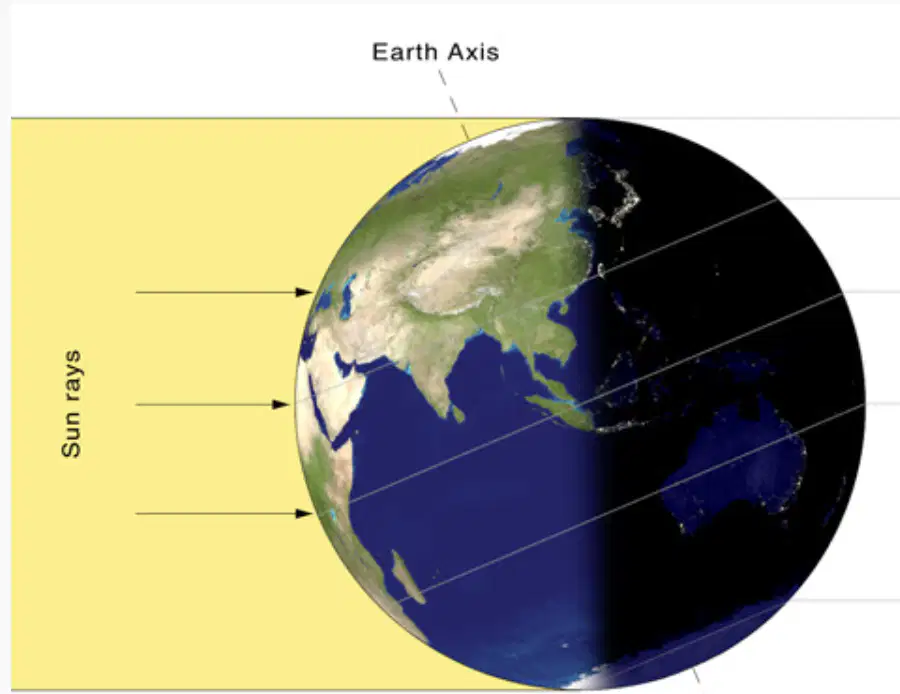
Based on the image, what day of the year is it?
June 21st
September 21st
December 21st
March 21st

Based on the image, what day of the year is it?
Either March or September 21st
Either June or December 21st
June 21st
December 21st
Which statement about Earth’s aphelion and perihelion is correct?
Earth is closest to the Sun at perihelion (early January) and farthest at aphelion (early July).
Earth is farthest from the Sun at perihelion (early January) and closest at aphelion (early July), which causes winter and summer.
Aphelion and perihelion always happen on the solstices (June 21 and December 21), making the days longest and shortest.
Aphelion means the Sun is closest to Earth at noon, and perihelion means it is farthest at midnight.
Perihelion happens every month at the new moon, while aphelion happens at the full moon.
About how fast does Earth rotate at the equator, and why don’t we “feel” it?
About 1,040 miles per hour (≈1,670 km/h); we move with Earth at a nearly constant speed, the atmosphere rotates with us, and we mainly feel acceleration—not steady motion.
About 100 miles per hour; we don’t feel it because gravity completely cancels motion.
About 67,000 miles per hour; we don’t feel it because Earth’s core spins the opposite way.
About 1,040 miles per hour; we don’t feel it because Earth’s spin turns gravity off during the day.
It changes wildly every day; we don’t feel it because our senses can’t detect any motion at all.
If Earth spans 360° of longitude and each time zone is 15° wide, how many standard time zones are there?
12
15
18
24
30
Which phrasing summarizes Philadelphia’s post-summer solstice daylight trend?
Random fluctuations with no pattern.
Steady gain all summer, then steady gain all winter.
Slow loss → faster loss into early fall → slower loss into winter.
Fast loss in July that stops in August.
No notable change until the equinox.

Which coordinates best match Ottawa, Canada?
50°N, 80°W
45°N, 76°E
45°S, 80°W
45°N, 76°W
50°N, 76°E
Why do many leaves change color in autumn?
Shorter days cause chlorophyll to break down; the green fades, revealing the leaf’s “true” colors.
Cold air adds red pigment to leaves from the atmosphere.
Trees absorb colored minerals from the soil that dye the leaves.
The Earth moves farther from the Sun, which paints leaves in different colors.
Fungi on the leaf surface create the red, orange, and yellow colors.
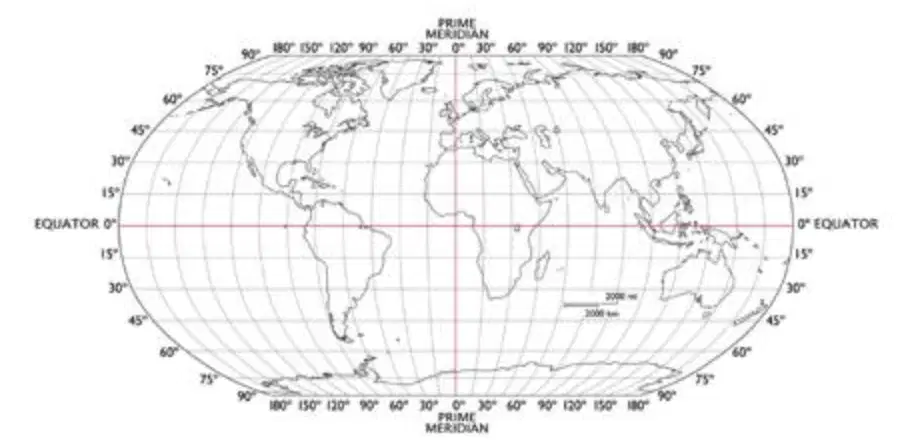
When GPS shows 0°, 0°, where is that?
Greenwich, UK.
Gulf of Guinea, off the coast of Africa.
North Pole.
South Pole.
International Date Line at equator.
In December, which line receives the most direct Sun?
Tropic of Capricorn
Prime meridian
Tropic of Cancer
International Date LIne
Prime Meridian
Why are summers warmer than winters (outside the tropics)?
Earth is much closer to the Sun in summer.
Oceans stop moving in summer.
Moonlight adds heat in summer.
Winds blow heat from the equator.
Sunlight arrives more directly and for longer hours in summer.
At an equinox, the Sun is directly over…
Tropic of Cancer.
The equator.
Arctic Circle.
Tropic of Capricorn.
Antarctic Circle.
Which city likely has less seasonal daylight variation?
A city at 70° N.
A city at 60° N.
A city at 50° N.
A city near the equator.
A city at 40° N.
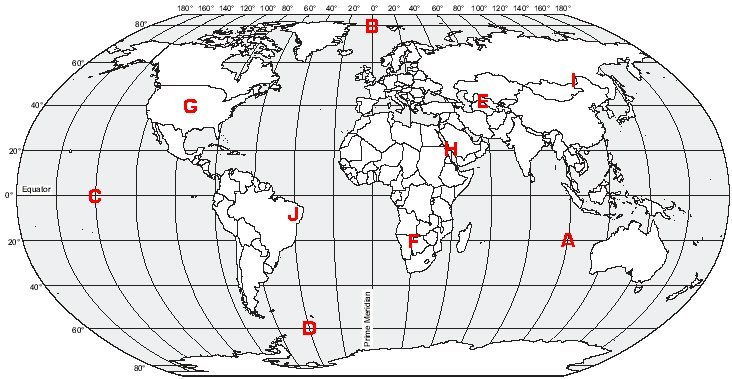
Click on the dot that identifies:
0°, 0°
Click on the dot that identifies:
0°, 105°W
Click on the dot that identifies:
45°N, 75°E
Click on the dot that identifies:
30°N, 120°W
Look at the map. Click the point that has the coordinates:
0o, 90o W

Match the following
Red
51° N, 0°
Light Blue
60° N, 105° E
Purple
33° S, 22° E
Hawaii
20° N, 159° W
Brazil
5° S, 60° W
What spot on Earth receives the most solar radiation?
Europe, Asia, Australia
Eastern Hemisphere
North America, South America
Western Hemisphere
Antarctica
Antarctica