
Font size
 Worksheets
Industrial Activity - Classification of Economic Activity
Total questions: 57
Worksheet time: 29mins
What are the four main groups of work in the classification of economic activity?
Primary, Secondary, Tertiary, Quaternary
Agriculture, Manufacturing, Services, Retail
Mining, Construction, Education, Technology
Farming, Fishing, Teaching, Computing
Primary activities employ people to collect or produce natural resources from the land or the sea. This involves acquiring _________.
raw materials
finished goods
machinery
services
Which of the following is an example of a secondary activity?
Farming
Making plastics from oil
Teaching
Computing
Tertiary activities are also called the ________ sector since it involves the selling of services and skills.
service
primary
industrial
agricultural
Quaternary activities are a type of ________ that carries out research and provides information and advice.
high-tech service industry
primary industry
manufacturing industry
agricultural sector
Which group of activities involves research in scientific fields and ICT?
Primary
Secondary
Tertiary
Quaternary
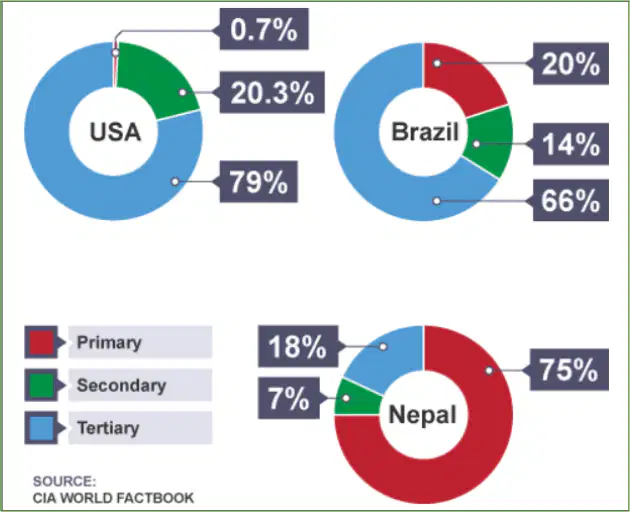
Look at the diagram below. Based on the employment structure, which countries do you think are the richest and poorest? Fill in the blanks: In the richest country (______________), most people work in the tertiary sector. In the poorest country (______________), most people work in the primary sector. In ____________, the labour force is more evenly distributed between the three sectors.
In the richest country (USA), most people work in the tertiary sector. In the poorest country (Nepal), most people work in the primary sector. In Brazil, the labour force is more evenly distributed between the three sectors.
In the richest country (Nepal), most people work in the tertiary sector. In the poorest country (USA), most people work in the primary sector. In Brazil, the labour force is more evenly distributed between the three sectors.
In the richest country (Brazil), most people work in the tertiary sector. In the poorest country (USA), most people work in the primary sector. In Nepal, the labour force is more evenly distributed between the three sectors.
In the richest country (Brazil), most people work in the tertiary sector. In the poorest country (Nepal), most people work in the primary sector. In USA, the labour force is more evenly distributed between the three sectors.
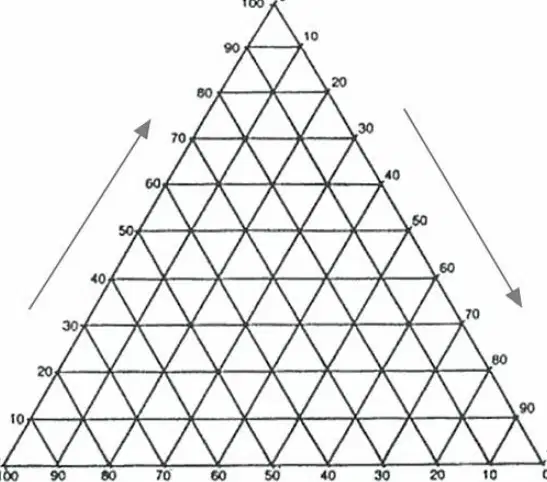
Label each side of the triangular graph to represent the three sectors: Agriculture, Industry, and Services.
Agriculture, Industry, Services
Agriculture, Mining, Services
Industry, Services, Technology
Agriculture, Services, Technology
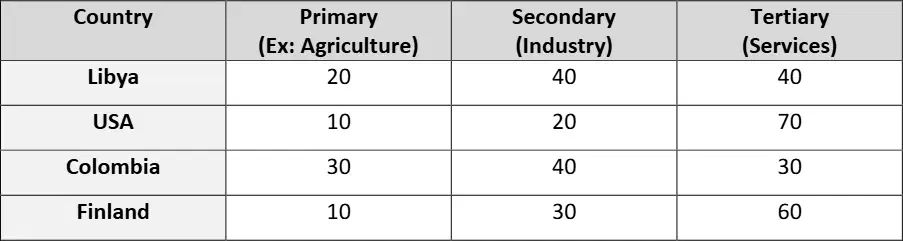
Look at the below table of employment structures in different countries and choose the correct method to plot the data on the triangular graph.
Plot each country's employment percentages for the three sectors at the corresponding points on the triangular graph.
Add the employment percentages together and plot the total on the graph.
Plot only the highest employment percentage for each country on the graph.
Ignore the table and plot random points on the triangular graph.
According to the passage, what are secondary activities also called?
Manufacturing industries
Primary activities
Service industries
Agricultural activities
In the context of industry as a system, what are the things that a factory needs to operate called?
Inputs
Outputs
Processes
Products
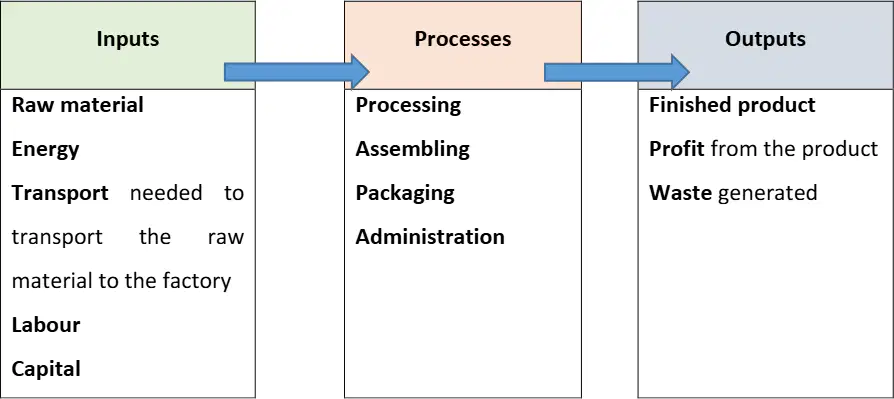
Match the following items to the correct category:
Raw material
Inputs
Processing
Processes
Finished product
Outputs
Energy
Inputs
Packaging
Processes
According to the passage, for an industry to be profitable and remain in business, what must be true about the value of its outputs compared to the cost of its inputs?
The value of its outputs must be greater than the cost of the inputs.
The value of its outputs must be equal to the cost of the inputs.
The value of its outputs must be less than the cost of the inputs.
The value of its outputs must not be considered against the cost of the inputs.

Which of the following flow charts correctly represents the process of how milk is changed to form products like yogurt and other milk products?
Milk → Pasteurization → Fermentation → Yogurt → Packaging
Milk → Freezing → Yogurt → Packaging
Milk → Boiling → Yogurt → Drying
Milk → Mixing with water → Yogurt → Packaging
Fill in the blank: Industries are more likely to locate where inputs are ______ and ______ available.
readily and cheaply
rarely and expensively
slowly and poorly
sporadically and costly
All factories have the same location factors.
True
False
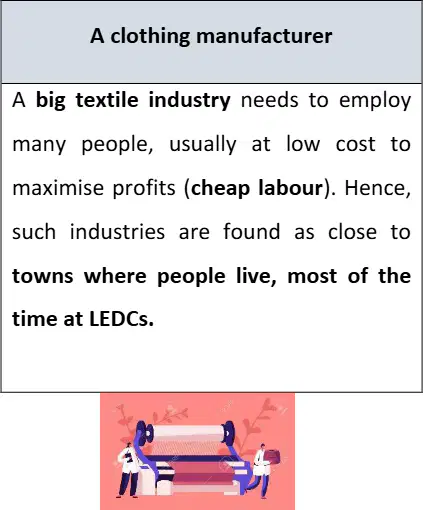
A big textile industry is usually located close to:
Raw material sources
Towns where people live
Seaside resorts
Forests

Can you think of some physical and human factors that influence the location of industries? Fill in the table below with examples of both physical factors and human and economic factors that influence industrial location.
Physical factors: availability of raw materials, climate, land, water supply. Human and economic factors: labor supply, transport, market, government policies.
Physical factors: high population, advanced technology, government incentives. Human and economic factors: rainfall, soil type, altitude.
Physical factors: internet connectivity, education level, entertainment options. Human and economic factors: mountain ranges, ocean currents, wildlife.
Physical factors: fashion trends, advertising, social media. Human and economic factors: mineral deposits, river valleys, forest cover.
Read the following text and fill in the blanks. If we take the example of the UK in the 1800 most people would have been employed in the ____________ sector. Many people worked on the land and made their living from ____________ and related products.
primary, farming
secondary, mining
tertiary, manufacturing
quaternary, fishing
During the ____________________, more people were needed to build ships, work in steel-making and with textiles. All of these jobs are found in the secondary sector.
Industrial Revolution
Renaissance
Information Age
Stone Age
Read the following text and fill in the blanks. Foreign industries also became more competitive and imports such as coal became more ________________.
cheaper
scarce
expensive
unavailable
Read the following text and fill in the blanks. As the availability of coal declines in the UK, it became more ____________ to extract, more coal ended up being imported. This led to a further decline in the primary sector employment in the UK.
expensive
abundant
profitable
efficient
Read the following text and fill in the blanks. Many people left the ____________ areas in the search for jobs in the towns and cities.
rural
urban
coastal
mountainous
By the year 2000 over half of the UK workforce were employed in ________________ industries and only a small number were employed in primary industries.
tertiary
secondary
quaternary
manufacturing
This has changed the work that people do, and also where they work. ______________ industries are a relatively new concept. However, it is becoming an important and growing sector in the UK as many firms want to carry out research and development for their products.
Footloose
Heavy
Primary
Cottage

Some reasons why deindustrialisation occurs include:
Technological advancements and automation
Increase in industrial investment
Growth in manufacturing jobs
Expansion of heavy industries
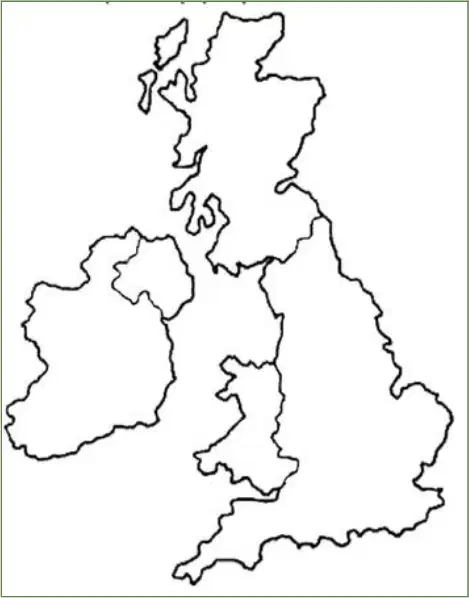
Mark the M4 Corridor on map 1.
The M4 Corridor runs from London to South Wales on map 1.
The M4 Corridor runs from Manchester to Birmingham on map 1.
The M4 Corridor runs from Edinburgh to Glasgow on map 1.
The M4 Corridor runs from Liverpool to Newcastle on map 1.
The physical factors that influenced the location of industries in South Wales include:
Availability of coal resources
Proximity to tropical forests
High annual rainfall
Access to desert minerals
In the past, industry in the UK was mainly located in areas where which two factors were available?
Skilled labor and government grants
Raw materials and energy
High technology and communication links
Retail outlets and transport links
Name the three raw materials needed to make iron and steel that were available in South Wales. (Fill in the blanks) Iron ore, ________, and limestone.
coal
sand
clay
copper
As materials became exhausted and imports became more available, what happened to the industry in these areas?
The industry in these areas declined.
The industry in these areas grew rapidly.
The industry in these areas became more innovative.
The industry in these areas shifted to agriculture.
During industrialisation, most retail outlets were located in the ______ because it was the most accessible part of a town.
CBD
suburbs
industrial area
residential zone
The M4 corridor stretches from ______ airport in the east to Bath and Bristol in the west.
Heathrow
Gatwick
Manchester
Birmingham
Which of the following is an advantage of the M4 Corridor?
Land on the edge of cities is often cheaper than in the centre
Demand for housing puts pressure on green belt land
House prices increase
Less skilled workers are priced out of the market
Fill in the blank: Motorway links and ______ also provide access for commuters and for transporting components and products in the M4 Corridor.
railways
airports
shopping malls
hospitals
Which of the following is a disadvantage of the M4 Corridor?
Easy access to workers in the suburbs
Motorway links and railways
Demand for housing puts pressure on green belt land
Nice environment close to countryside
List three improvements that have accompanied the re-industrialisation in South Wales.
The development of business parks, improvements in public transport, refurbishment of old industrial buildings.
Decline in employment, reduction in public services, closure of schools.
Increase in pollution, loss of green spaces, decrease in tourism.
Reduction in investment, deterioration of infrastructure, rise in unemployment.
Which of the following is NOT a major city in the Rhine-Ruhr industrial region of Western Germany?
Dusseldorf
Dortmund
Cologne
Munich
Bonn
Why do the government and the EU intervene in areas that have undergone de-industrialisation, such as South Wales?
To improve the environment and quality of life for local people.
To increase the number of factories in the area.
To reduce the population of the region.
To encourage people to move to other countries.
Natural resources such as coal, iron ore and limestone enabled the development of which industry in the Ruhr?
Textile industry
Iron and steel industry
Food processing industry
Automobile industry
The chemical and textile industries in the Ruhr grew due to good transport links and ________.
available workforce
mountainous terrain
scarcity of water
lack of raw materials
Canals and rivers such as the Rhine were used for what purposes in the Ruhr?
Transport and power
Fishing and tourism
Agriculture and irrigation
Recreation and sports
The decline in the Ruhr's importance as a heavy industrial area has caused ______ in steelworks and coal mines.
job losses
increased exports
higher wages
new investments
Many of the original raw materials in the Ruhr are ______, leading to high labour costs and outdated machinery.
exhausted
abundant
renewable
imported
Problems and issues: Cheaper steel is being imported from which region due to lower labour costs?
North America
South East Asia
South America
Africa
The Ruhr today: There is still a large workforce living in the area that have had to learn ______ as industries have changed.
new skills
old habits
foreign languages
ancient traditions
One of the factors which have influenced the process of globalisation is:
Advancements in technology
Decrease in international trade
Isolationist policies
Reduction in communication
Factors attracting TNCs to a country may include: One factor attracting TNCs to a country is _________.
cheap raw materials
high taxes
strict labor laws
limited infrastructure
expensive energy
One factor attracting TNCs to a country is _________.
cheap labour supply
high tax rates
strict environmental laws
limited market access
expensive transportation
Factors attracting TNCs to a country may include: Fill in the blank: One factor attracting TNCs to a country is _________.
good transport
high unemployment
poor infrastructure
unstable government
Factors attracting TNCs to a country may include: Fill in the blank: One factor attracting TNCs to a country is _________.
access to markets where the goods are sold
high levels of political instability
lack of infrastructure
strict environmental regulations
Which of the following is a world renowned multinational corporation that is also found in Malta?
McDonald's
Taco Bell
Tim Hortons
In-N-Out Burger
Which of the following statements is correct?
All MEDCs are in the southern hemisphere.
Most LEDCs are in the northern hemisphere.
Most MEDCs are in the northern hemisphere, but there are exceptions.
Australia and New Zealand are LEDCs.
What does NIC stand for in the context of global development?
Newly industrialised countries
National Investment Council
Network Interface Card
Nonprofit International Committee
List two reasons why NICs have grown according to the worksheet.
Strong, stable government; a switch from agricultural to manufacturing and service jobs
Weak, unstable government; reliance on agriculture
Lack of foreign investment; low literacy rates
High unemployment; limited infrastructure
What is the multiplier effect as described in the worksheet?
The multiplier effect happens when a positive change occurs, which then has a knock-on effect on other businesses. For example, a new office may open, leading to an increase in lunchtime sandwich sales at a nearby café.
The multiplier effect is when a business reduces its workforce, causing other businesses to close down.
The multiplier effect refers to the process of increasing prices to maximize profits.
The multiplier effect is when a company invests in technology to reduce its costs, with no impact on other businesses.
NICs focus on exports and trade as a reason for their growth.
True
False

