
 Worksheets
Learning Aim A,B & C Recap
Total questions: 95
Worksheet time: 48mins
What is good posture called?
Neutral Spine Alignment
Kyphosis
Scoliosis
Thoracic vertebrae
Kyphosis is referred to as having a _________
hunchback
flatback
swayback
round shoulders
Scoliosis is referred to as a ________ curvature of the spine at the thoracic vertebrae.
lateral
vertical
posterior
anterior
Kyphosis is caused by:
Poor posture or a vertebral deformity at the thoracic cavity
Inheritable condition in young children
Lateral curvature of the spine
Neutral spine alignment
Scoliosis occurs in young children and is ________.
inheritable
contagious
curable with antibiotics
always fatal

Which part of the spine contains the intervertebral discs?
Cervical vertebrae
Thoracic vertebrae
Lumbar vertebrae
All of the above
Bones are formed through ossification. What is the initial composition of the skeleton?
Bone
Cartilage
Muscle
Ligament
As the amount of ______ increases, the bones harden.
calcium
water
fat
sugar
What is the function of the epiphyseal plates in bone growth?
They produce blood cells
They fuse with the bone to form a thin line of hyaline cartilage
They break down cartilage
They form the periosteum
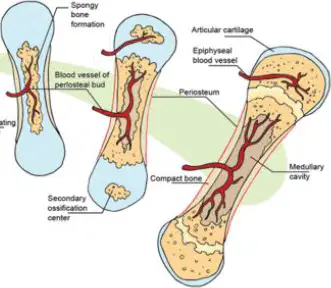
Which part of the bone is responsible for the formation of spongy bone?
Primary ossification center
Hyaline cartilage
Blood vessel of periosteal bud
Compact bone
The articulating bones for the Shoulder joint are _________.
Scapula & Humerus
Femur & Tibia
Radius & Ulna
Clavicle & Sternum
The articulating bones for the Elbow joint are _________.
Humerus, Radius & Ulna
Femur, Tibia & Fibula
Scapula, Clavicle & Humerus
Radius, Ulna & Carpals
The articulating bones for the Wrist joint are _________.
Radius & Carpals
Humerus & Ulna
Femur & Tibia
Scapula & Clavicle
The articulating bones for the Hip joint are _________.
Pelvis & Femur
Scapula & Humerus
Tibia & Fibula
Radius & Ulna
The articulating bones for the Knee joint are _________.
Femur & Tibia
Femur & Fibula
Tibia & Fibula
Femur & Humerus
The articulating bones for the Ankle joint are _________.
Tibia, Fibula & Tarsals
Femur, Patella & Tibia
Radius, Ulna & Carpals
Scapula, Clavicle & Humerus
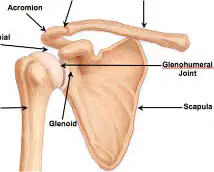
Which bone is labeled as 'Scapula'?
Clavicle
Humerus
Scapula
Acromion
What type of joint is fixed and allows no movement?
Synovial
Cartilaginous
Fibrous/Fixed
Ball and Socket
Which type of joint is slightly moveable, for example, between the lumbar vertebrae?
Synovial
Cartilaginous
Fibrous/Fixed
Hinge
Which type of joint is freely moveable and provides the greatest range of movements?
Synovial
Fibrous
Cartilaginous
Immovable
The coccyx is an example of a ______ joint.
Fibrous/Fixed
Synovial
Cartilaginous
Ball and Socket
Why are synovial joints important in sport?
They provide the greatest range of movements.
They are the strongest type of joint.
They are the least flexible joints.
They do not allow any movement.
Increased production of ________ fluid ensures the articular cartilage doesn’t dry out during exercise.
synovial
serous
cerebrospinal
pleural
Increase of ________ uptake within the bones is a short term response to exercise.
calcium
glucose
oxygen
potassium
Increased ________ of the ligaments is a short term response to exercise.
pliability
rigidity
density
thickness
Reduction in the ________ of synovial fluid is a short term response to exercise.
viscosity
volume
temperature
color
Stimulates the production of ________ due to increased stress on bones is a short term response to exercise.
collagen
insulin
adrenaline
hemoglobin
Increased bone ________ and strength due to mineral content is a long term adaptation of the skeletal system to exercise.
density
flexibility
length
elasticity
Increased ligament ________ thus reducing opportunity of dislocation is a long term adaptation of the skeletal system to exercise.
strength
length
flexibility
weakness
Increased thickness of ________ cartilage which protects bones from wear and tear is a long term adaptation of the skeletal system to exercise.
articular
elastic
fibrocartilage
costal
What does Osteoarthritis cause? Osteoarthritis causes ________ which causes a lack of mobility in over 40s of both genders.
articular cartilage thins
bone density increases
muscle mass grows
ligament lengthens
What does Rheumatoid Arthritis cause? Rheumatoid Arthritis causes ________ of the joints in 40 - 50 year old women.
an inflammation
a fracture
a dislocation
a tumor
Osteoporosis is a reduction in ________ caused by a lack of calcium and Vitamin D as well as a sedentary lifestyle.
bone density
muscle mass
blood pressure
body temperature

Weight training in children tends to do more harm than good. The reason for this is that children's bones are still growing and putting too much force on them can damage the epiphyseal plates. Damage to these plates during childhood can result in ________ growth.
stunted
accelerated
normal
delayed
According to the notes, what is the main reason weight training is harmful for children?
It makes them tired
It can damage their epiphyseal plates
It helps them grow faster
It improves their strength
Weight training in children is recommended because it helps their bones grow stronger.
True
False
The ________ is the prime mover or contracting muscle. Directly responsible for the movement at a joint.
Agonist Muscle
Antagonist Muscle
Synergist Muscle
Fixator Muscle
Which muscle relaxes as the agonist works and opposes the action of the agonist?
Agonist Muscle
Antagonist Muscle
Fixator Muscle
Synergist Muscle
The ________ contacts isometrically and allows the agonist to work effectively by stabilising the origin of the agonist.
Fixator Muscle
Antagonist Muscle
Synergist Muscle
Prime Mover
Which muscle neutralises undesired action and assists the agonist in performing the desired movement?
Agonist Muscle
Antagonist Muscle
Fixator Muscle
Synergist Muscle
What is a concentric contraction?
When a muscle lengthens and relaxes
When a muscle shortens in length and develops tension as it contracts
When a muscle remains the same length
When a muscle loses tension
Concentric contractions occur when a muscle _______ in length and develops tension as it contracts.
shortens
lengthens
remains the same
relaxes
Concentric contractions are common in power sports where you need explosive force.
True
False
What does an eccentric contraction involve?
Development of tension as the muscle shortens
Development of tension as the muscle lengthens
No tension development
Muscle remains the same length
Eccentric contractions are common when you need to control the movement or work against gravity.
True
False
Eccentric contractions involve the development of tension as the muscle _________
lengthens
shortens
relaxes
contracts
Isometric Contractions are when the muscle contracts but does not change in _______.
length
shape
temperature
color
Which of the following best describes isometric contractions?
The muscle contracts and changes in length
The muscle contracts but does not change in length
The muscle relaxes and changes in length
The muscle relaxes but does not change in length
Isometric contractions are common when there is no movement occurring.
True
False
Which muscle fibre type has slow twitch and slow contraction speed?
Type I
Type IIa
Type IIx/b
Which muscle fibre type is best suited for endurance sports such as 1500m, Tour de France, Football, and Rugby?
Type I
Type IIa
Type IIx/b
Type IIx/b muscle fibres have _____ twitch and _____ contraction speed.
fast; fast
slow; slow
slow; fast
fast; slow
Which muscle fibre type has high myoglobin and mitochondria levels?
Type I
Type IIa
Type IIx/b
Which muscle fibre type has high fatigue resistance and does not tire easily?
Type I
Type IIa
Type IIx/b
Type IIa muscle fibres have _____ force of contraction and are used in moderate sports like tennis and swimming.
medium
low
high
very high
Which muscle fibre type is aerobic and anaerobic?
Type I
Type IIa
Type IIx/b
Type IIx/b muscle fibres have _____ fatigue resistance and tire easily.
low
high
moderate
excellent
According to the notes, what percentage of muscle loss occurs on average between the ages of 50 to 70?
10%
20%
30%
40%
The rate of muscle loss decreases after the age of 70.
True
False
What lifestyle accelerates muscle loss according to the notes?
Active lifestyle
Sedentary lifestyle
Balanced diet
Regular exercise
Remaining ______ and following an appropriate strength training programme can reduce the effects of aging.
active
sedentary
inactive
passive
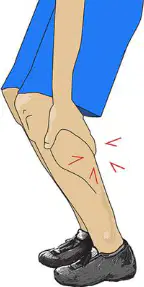
What is a cramp?
A slow, weak contraction of a muscle
A sudden, strong, uncontrollable contraction of a muscle which can last for a few seconds or minutes and is very painful
A gentle stretching of a muscle
A muscle relaxing after exercise
Which of the following is NOT a cause of cramp?
Overuse of the muscle
Dehydration
Eating too much sugar
Mineral depletion
One cause of cramp is _________.
Overuse of the muscle
Lack of sleep
Excessive sugar intake
Low body temperature
High blood pressure
Dehydration can lead to _________?
cramp
fever
rash
cough
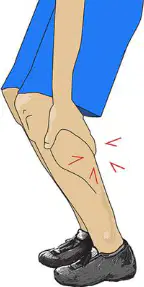
What should a performer do if they suffer a cramp during exercise?
Continue exercising
Stop exercising, stretch and massage the affected muscle
Drink coffee
Ignore the pain
Which of the following is recommended to prevent cramps?
Remain hydrated
Maintain electrolyte balance
Stretch before and after exercise
All of the above
Air passes through the _______ cavity where dust and bacteria are filtered out by sticky mucus.
nasal
oral
thoracic
abdominal
The function of the epiglottis in the respiratory system is:
to prevent food from entering the windpipe during swallowing
to produce sound for speech
to filter dust and microbes from inhaled air
to exchange oxygen and carbon dioxide
At the bottom of the trachea, it divides into two _______.
bronchi
alveoli
capillaries
lobes
Each bronchus subdivides again into a mass of fine branches known as _______.
bronchioles
alveoli
tracheoles
capillaries
The tiny hollow bags with bulb-like pockets in which gases are exchanged are called:
Bronchioles
Alveoli
Trachea
Ribs
The walls of the alveoli are only one cell thick.
True
False
The process where oxygen diffuses through the alveoli and capillary walls into the blood is called:
Osmosis
Filtration
Diffusion
Active transport
Blood releases _______ which diffuses in the opposite direction to alveoli.
carbon dioxide
oxygen
nitrogen
water vapor
What happens to the internal intercostal muscles during inspiration?
They relax.
They contract.
They expand.
They stiffen.
What is the role of internal intercostal muscles during expiration?
They contract to push the ribs downwards and inwards.
They relax to allow the ribs to move upwards and outwards.
They contract to expand the chest cavity.
They help the diaphragm to contract.
During inspiration, what do the external intercostal muscles do?
They contract to lift the ribs upwards and outwards.
They relax to allow the ribs to move downwards.
They contract to push the ribs inwards.
They remain inactive during inspiration.
What happens to the diaphragm during inspiration?
It contracts and flattens.
It relaxes and rises.
It becomes rigid and immobile.
It contracts and bulges upward.
During expiration, what happens to the diaphragm?
It relaxes and pushes up.
It contracts and moves down.
It expands and flattens.
It remains unchanged.
What happens to the size of the lungs/thoracic cavity during inspiration?
It increases in size.
It decreases in size.
It remains the same.
It collapses.
What happens to the size of the lungs/thoracic cavity during expiration?
It decreases in size.
It increases in size.
It remains the same.
It fluctuates randomly.
During inspiration, does the air pressure in the lungs drop or rise?
It drops (low air pressure).
It rises (high air pressure).
It remains the same.
It fluctuates randomly.
During expiration, does the air pressure in the lungs drop or rise?
It rises (high air pressure).
It drops (low air pressure).
It remains unchanged.
It fluctuates randomly.
What is the oxygen content in the lungs during inspiration?
High.
Low.
Moderate.
Very low.
What is the oxygen content in the lungs during expiration?
Low.
High.
Moderate.
Zero.
Which gases are involved in the process of gaseous exchange in the lungs?
Nitrogen and Oxygen
Carbon Dioxide and Oxygen
Hydrogen and Carbon Dioxide
Oxygen and Helium
What is gaseous exchange? Gaseous Exchange occurs through ______ between gases in the alveoli and blood in the capillaries.
diffusion
osmosis
filtration
active transport
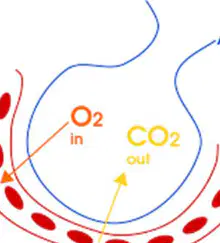
Refer to the diagram showing the alveolus and blood capillary. Which gas moves into the blood capillary from the alveolus?
Oxygen
Carbon Dioxide
Nitrogen
Helium
Where does gaseous exchange take place in the human body?
Heart
Alveoli in the lungs
Kidneys
Stomach
Diffusion occurs between the air in the alveoli and blood in the capillaries that surround the _______.
alveoli
bronchi
trachea
diaphragm
Which structures form a respiratory membrane?
Alveoli walls and capillary walls
Bronchi and trachea
Red blood cells and plasma
Diaphragm and ribs
Gases diffuse from an area of _______ concentration to an area of _______ concentration.
high; low
low; high
equal; equal
low; equal
Carbon Dioxide diffuses back into the alveoli from the blood plasma while oxygen diffuses into the blood plasma from the alveoli.
True
False
What is the tidal volume?
The amount of air that can be forced in and out of the lungs after maximum inspiration or expiration
The volume of air breathed in and out with each breath
The amount of air that is left in the lungs after fully exhaling
The total lung capacity

