
 Worksheets
World History Common Assessment 1
Total questions: 50
Worksheet time: 25mins
Name
Class
Date
1.

Leonardo Da Vinci was considered the "Renaissance Man" because
a)
he translated the bible into the vernacular of the day
b)
of his devotion to the Catholic Church
c)
he painted the Mona Lisa and Sistine Chapel
d)
he was an accomplished artist, inventor, and thinker
2.
What did Charles "The Hammer" Martel accomplish?
a)
Unified Christendom in 800 AD
b)
Lost the Battle of Tours enabling a Muslim takeover of Iberia (Spain)
c)
Saved Europe from a Muslim invasion in 732 AD
d)
Defeated Harold to claim his rightful place as King of England in 1066 AD
3.
What period followed the Middle Ages?
a)
Renaissance
b)
Enlightenment
c)
Age of Humanism
d)
Age of Intellect
4.
One of the key characteristics of the Renaissance was ....
a)
encouraging people to use reason to solve problems.
b)
proving the existence of natural rights.
c)
a revival of ancient technology & machinery .
d)
the destruction of the Roman Catholic Church and its replacement by Calvinist doctrine.
5.
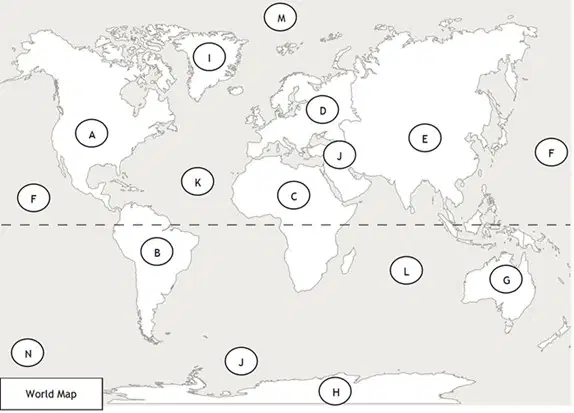
Asia is at point
a)
D
b)
B
c)
C
d)
E
e)
A
6.
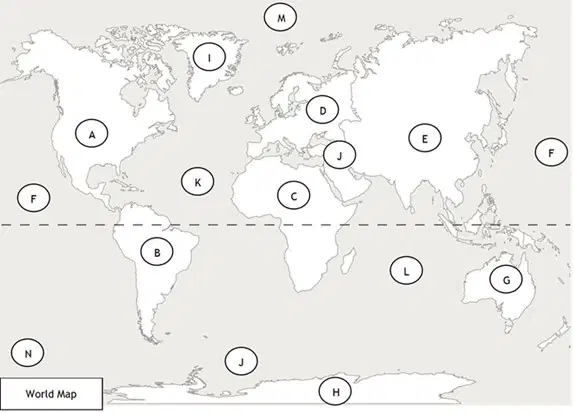
Europe is at point
a)
A
b)
C
c)
D
d)
E
e)
B
7.
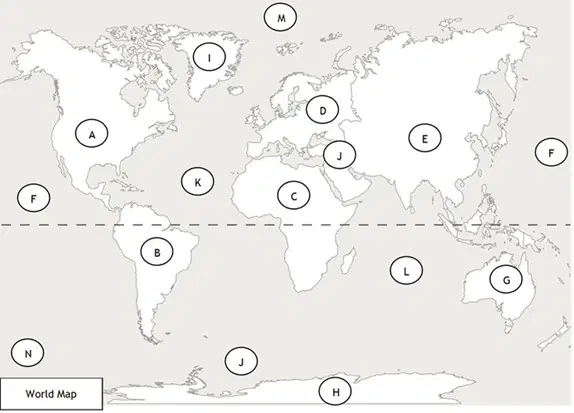
The "Middle East" is at point
a)
E
b)
D
c)
G
d)
J
e)
C
8.
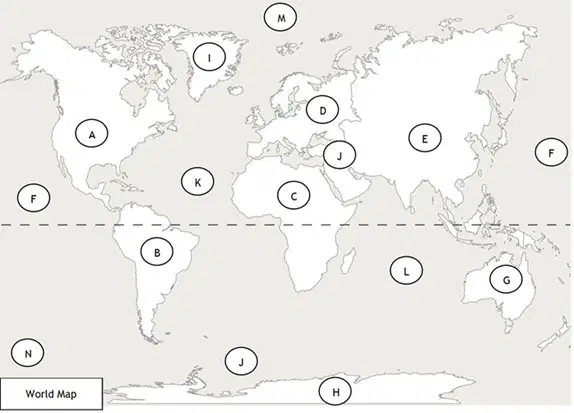
The Atlantic is at point
a)
L
b)
M
c)
J
d)
K
e)
F
9.
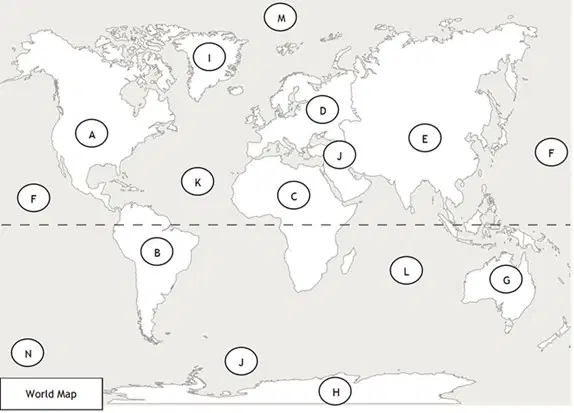
The Pacific is at point
a)
L
b)
M
c)
J
d)
K
e)
F
10.
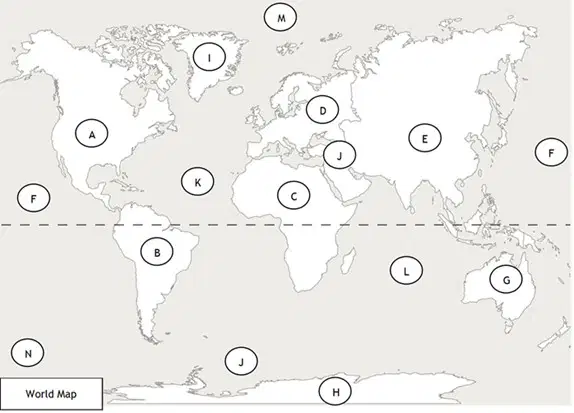
The Indian Ocean is at point
a)
J
b)
M
c)
K
d)
L
e)
F
11.
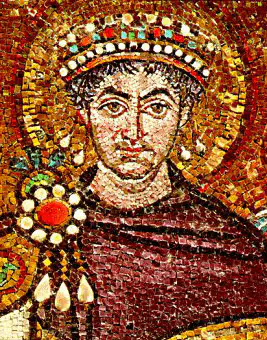
The unified code of Roman Law used in the Byzantine Empire and passed on to Western Europe was known as
a)
Constantine's Rule
b)
Justinian's Code
c)
Charlemagne's Code
d)
Theodora's Law
e)
Caesars 12 Tables of Rome
12.
What was the unifying force that most influenced the development of Western Civilization?
a)
Realism
b)
Humanism
c)
Christianity
d)
Feudalism
e)
Laissez Faire Economics
13.
During the 100 Years War, cannon and longbows ...
a)
were used by Joan of Arc to win the Battle of Actium
b)
ended the reliance of Kings on feudalism
c)
changed warfare in Europe
d)
were eliminated in favor of firearms and crossbows
14.
This empire saved Roman law, science and learning.
a)
Ottoman Empire
b)
Holy Roman Empire
c)
Byzantine Empire
d)
French Empire
15.
A list of statements criticizing the policies of the Church, particularly the selling of indulgences
a)
The Catholic Counter-Reformation
b)
the Calvinist Declarations
c)
The Wittenberg Bible
d)
Martin Luther's 95 Thesis
16.
Which statement best describes how Renaissance era scientific theories and methods impacted the lives of Europeans?
a)
Europeans began to use technology and machines to improve their lives
b)
Europeans began to use reason and knowledge to understand the world around them
c)
Europeans began to reject ideas of charity or sympathy to those unable to achieve or contribute to society
d)
Europeans lost interest in religion
17.
Constantinople was chosen to be the capital of the Byzantine Empire because
a)
it was at the crossroads of major trade routes.
b)
it was far inland and protected by mountains.
c)
it was close to the wealthy Russian Empire
d)
it was an Islamic holy site.
18.
(select 3 that apply) Feudalism was
a)
A system based on mutual obligations that developed from a need for protection
b)
A system where nobles granted land in exchange for service
c)
A system similar to communism
d)
A political and economic system
19.
During the Middle Ages, there was an ongoing controversy between Kings and the Pope over who had the power to appoint Church Officials. What was the practice known as?
a)
Lay Investiture
b)
Interdict
c)
Indulgences
d)
Simony
e)
Cannon Law
20.
English Barons forced King John to sign this document at Runnymede to ensure Englishmen had certain basic rights including trial by jury, equal protection under the law, and the elimination of taxation without representation.
a)
The Treaty of Versailles
b)
The Magna Carta
c)
The Bill of Rights
d)
The Concordat of Worms
e)
The Treaty of Paris
21.
Killed approximately 1/3 to 1/2 of the population of Europe in the 1300s.
a)
The Napoleonic Wars
b)
Bubonic Plague
c)
Polio
d)
The Crusades
e)
Cholera
22.
Judaism, Christianity, and Islam share a belief in ...
a)
The Four Noble Truths
b)
Monotheism and Ethical Conduct
c)
Papal Supremacy
d)
Reincarnation
23.
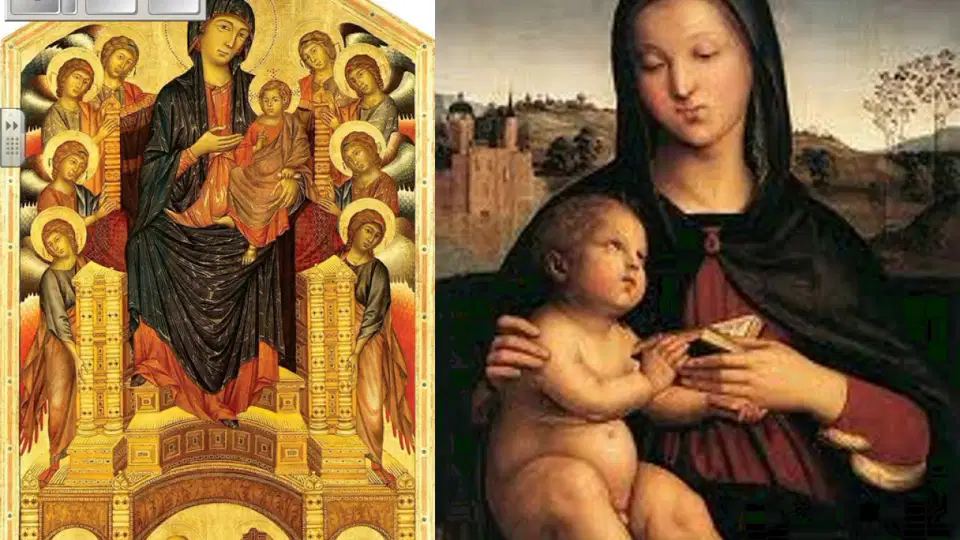
Which painting is from the Renaissance?
a)
Left
b)
Right
24.
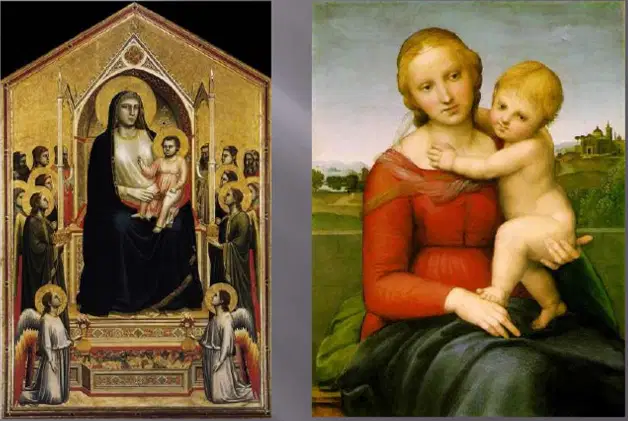
Which painting is from the Renaissance?
a)
Left
b)
Right
25.
An appreciation for the basic worth of the individual was a major characteristic of
a)
Protestantism
b)
Humanism
c)
Anglicanism
d)
Roman Theology
26.
What was the primary cause of the Protestant Reformation?
a)
The corruption and worldliness of the Church
b)
A reform movement within the Catholic church itself
c)
A shift towards humanism
d)
Demands for marriage rights for priests and nuns as well a church sanctioned divorces for those desiring a new spouse
27.
The supremacy of the bible over the policies of the church was a key belief of Martin Luther and a cause of conflict with the church establishment.
a)
False
b)
True
28.
Why was the Church of England (Anglican) created?
a)
to align with the teachings of Martin Luther and John Calvin
b)
to end the corruption of the church
c)
to end the selling of indulgences
d)
to allow Edward VI to become King
e)
to allow Henry VIII to get a divorce
29.
This new technique gave Renaissance art it's 3 dimensional appearance.
a)
tempura paints
b)
realism
c)
perspective
d)
illusionism
e)
texture
30.
The decline and fall of the Roman empire in approximately 476 AD began this period.
a)
Renaissance
b)
Age of Exploration
c)
Middle Ages (Dark Ages)
d)
Scientific Revolution
e)
Reformation
31.
This invention of Johann Gutenberg helped mass produce books and supported the Protestant Reformation in Europe.
a)
Moveable Type Printing Press
b)
Steam Power
c)
Interchangeable Parts
d)
Cursive Writing and Illumination
32.
Pope Alexander launched the Crusades at the Council of Clermont in 1495 by declaring "From Jerusalem and the city of Constantinople comes a grievous report... An accursed race...has violently invaded the lands of those Christians and has depopulated them from by pillage and fire."
a)
True
b)
False
33.
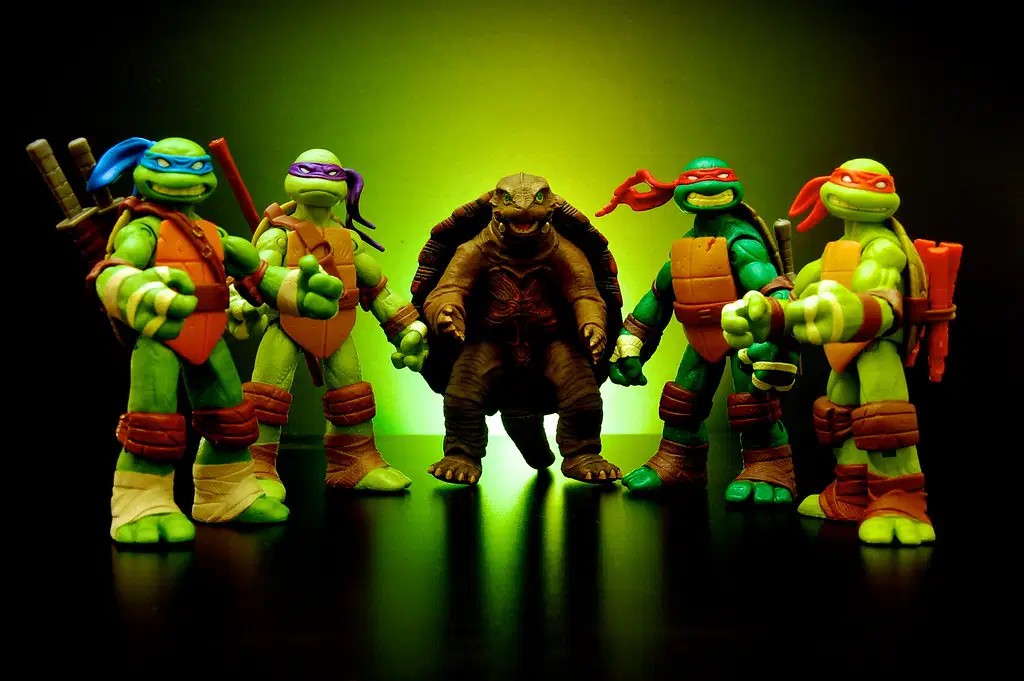
The Ninja Turtles - Michelangelo, Leonardo, Raphael, and Donatello - were named after these great artists of the …
a)
Greek City-States
b)
Scientific Revolution
c)
Protestant Reformation
d)
Renaissance
34.
The real power of the Church came from these two methods of denying salvation and religious services.
a)
the Tithe and Corruption
b)
Excommunication and interdict
c)
Lay Vestiture and church corruption
d)
Indulgences and simony
e)
interdict and lay vestiture
35.
In the Hundred Years War, French troops were motivated by the inspirational figure _____.
a)
Pop Boniface VIII
b)
Mary Queen of Scots
c)
Joan of Arc
d)
William Shakespeare
36.
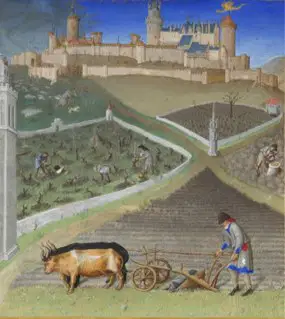
This painting is a representation of
a)
the hacienda system.
b)
the encomienda system.
c)
the feudal system.
d)
the slave system.
e)
the manorial system.
37.
The Great Schism (1054) resulted in the creation of
a)
the Scientific Revolution and the Age of Exploration.
b)
the Eastern Orthodox Church and the Roman Catholic Church.
c)
the Roman Catholic Church and the Protestant Reformation.
d)
the Southern Renaissance and the Northern Renaissance.
38.
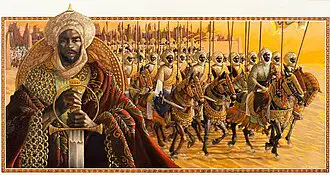
Mansa Musa, the 14th Century leader of Mali, was known for
a)
becoming the first Christian African ruler.
b)
being a devout and powerful Muslim ruler.
c)
being the last ruler of Mali.
d)
becoming a Buddhist monk.
39.
Which invention is the best reason why the Ottomans were able to conquer the Byzantine empire?
a)
biological warfare
b)
steel
c)
gunpowder
d)
astrolabe
e)
stirrup
40.
Why did the Islamic religion SPLIT in 632 AD?
a)
Muhammad's wife Fatima wanted peace with all non-Muslims instead of war
b)
Disagreements over who would lead the Muslims after Muhammad died
c)
The Muslims argued over who would appoint Imams and who was the head of the religion
d)
Abu Bakr wanted war with Western Europe and Persia
41.
These two resources helped the African empire of Mali become wealthy.
a)
Diamonds
b)
Gold
c)
Pepper
d)
Salt
e)
Oil
42.
Which of the following is NOT true of the impact of the Printing Press on Europe?
a)
it circulated the ideas of the Protestant Reformation
b)
Renaissance ideas spread
c)
it stimulated the scientific revolution
d)
literacy was reduced/suppressed in Europe
43.
Which Roman Emperor split the Roman Empire into East and West in an attempt to save the empire and make it more manageable?
a)
Constantine
b)
Maximus
c)
Julius Caesar
d)
Diocletian
44.

The cathedral of Notre Dame, built from 1220 to 1402 CE in Paris, France, is in which style of architecture?
a)
Romanesque
b)
Byzantine
c)
Gothic
d)
Baroque
45.
A Byzantine-made version of the ancient Roman legal code became known as ...
a)
"Justinian's Code."
b)
the "Twelve Tables."
c)
the "Ten Commandments"
d)
the "Byzantine Constitution"
46.
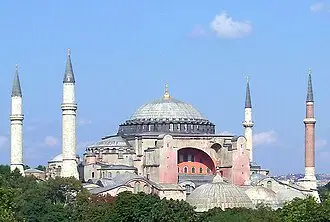
This basilica, considered the epitome of Byzantine architecture, was completed in 537 AD by Emperor Justinian I. It was the largest cathedral in the world for one thousand years, and it has been said to have "changed the history of architecture." It is known as ..
a)
the Pantheon.
b)
the Vatican.
c)
the Hagia Sophia.
d)
St. Peter's Cathedral
47.

· He was born in Florence, Italy in 1469.
· His best-known book (The Prince) describes the methods by which a ruling prince can maintain control of his realm.
" It is better to be feared than loved"
"The ends justify the means"
· His name has become synonymous with the use of cunning and deceitful tactics in politics.
Which Renaissance figure is being described in these statements?
a)
Cosimo Medici
b)
Piero Soderini
c)
Leonardo da Vinci
d)
Niccolo Machiavelli
48.
Julius Caesar was assassinated in 44 BC because ….
a)
The Senate feared his growing power and popularity and refused to share power.
b)
The Senate were jealous and wanted absolute power for themselves. Caesar was in their way.
c)
Crassus, Pompey, and Marc Antony conspired to eliminate and takeover from Caesar in a Third Triumvirate.
d)
Caesar was a tyrannical and incompetent leader who was failing to properly manage the Republic.
e)
Octavian wanted power and engineered the assassination.
49.
What was the Edict of Milan?
a)
Allowed freedom of worship to Christians in Rome
b)
An order that sentenced 2000 Christians to be executed in the Colosseum
c)
Expanded rights for slaves
d)
Established Islam as the primary religion of Rome
50.
The Magna Carta, signed in 1215, is significant because it
a)
Created the Church of England
b)
Established the first English Parliament
c)
Limited the power of the English monarch
d)
Ended the Hundred Years War
100 %

