
 Worksheets
Imperialism and Progressivism Family Fued
Total questions: 94
Worksheet time: 53mins
What was the goal of Roosevelt’s Corollary to the Monroe Doctrine?
To allow European colonization of Latin America
To justify U.S. intervention in Latin America
To promote free trade with Asia
To limit U.S. naval expansion
The “Rough Riders” were—
Spanish soldiers in Cuba
Filipino rebels
Volunteer cavalry led by Theodore Roosevelt
Naval officers led by George Dewey
Which best describes the message of the political cartoon “School Begins” (1899)?
It celebrates equality among new U.S. territories
It shows Uncle Sam teaching new territories American ideals
It criticizes Britain’s colonial rule in Africa
It praises Spain for granting independence
What foreign policy idea is most associated with Theodore Roosevelt?
Moral Diplomacy
Dollar Diplomacy
Big Stick Diplomacy
Open Door Policy
What was a major result of the Spanish-American War?
The U.S. became an isolationist power
Spain gained new territories in Asia
The U.S. acquired the Philippines, Guam, and Puerto Rico
Cuba became a U.S. state
What was one major cause of the Spanish-American War?
U.S. fear of communism in Cuba
Spain’s invasion of Puerto Rico
Yellow journalism and the explosion of the U.S.S. Maine
U.S. neutrality during Cuban independence
The Teller Amendment stated that the United States—
would annex Cuba after the war
could not permanently control Cuba
The phrase “Open Door Notes” by John Hay referred to—
Limiting immigration to the U.S.
Keeping trade with China open to all nations
Closing ports to European powers
Building the Panama Canal
Which was the primary purpose of the Jim Crow laws enacted in the South after Reconstruction?
To provide equal rights to African Americans
To encourage industrial development
To enforce racial segregation and limit Black rights
To grant voting rights to freedmen
What was one effect of the U.S. building the Panama Canal?
It limited U.S. naval strength
It increased U.S. trade and global influence
It caused war with Colombia
It ended European colonization
What was the purpose of the Platt Amendment?
To end U.S. occupation of the Philippines
To make Cuba a U.S. protectorate
To ban the sale of weapons to Spain
To annex Puerto Rico
What was the purpose of the de Lôme Letter?
To demand Cuban independence
To criticize President McKinley
To declare war on the U.S.
To request peace negotiations
Which U.S. naval commander won the Battle of Manila Bay?
Theodore Roosevelt
George Dewey
Emilio Aguinaldo
John Hay
What was President Wilson’s foreign policy called?
Dollar Diplomacy
Open Door Policy
Moral/Mission Diplomacy
Square Deal
During the Populist and Progressive Eras, what did the term “graft” refer to?
A. A new farming technique developed by Populists
B. The illegal use of political influence for personal gain
C. A government grant to expand railroads
D. The practice of merging large companies into trusts
How did the writings of Alfred Thayer Mahan encourage United States imperialism?
His books demonstrated the importance of obtaining colonies for naval bases, increasing overseas trade, and building a canal in Central America.
His published speeches to the U.S. Senate persuaded public opinion to favor acquiring colonies in order for America to remain an industrial power.
His letters as Secretary of State persuaded President McKinley to annex territories from Spain.
His articles for popular newspapers condemned Spain on humanitarian grounds for its treatment of the Cuban rebels.
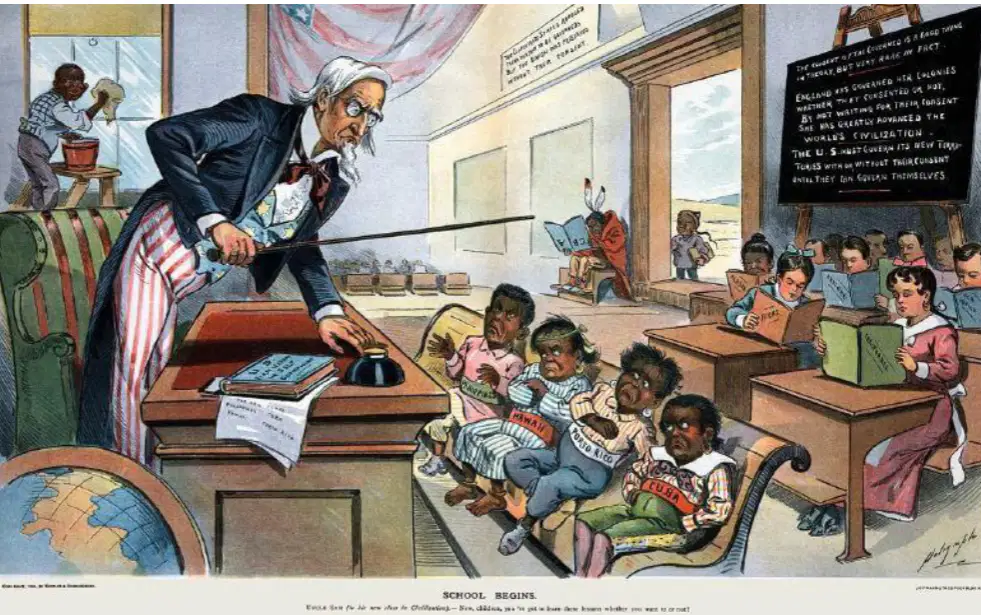
Directions: Identify the choice that best completes the statement or answers the question. SS.912.A.4.1 Analyze the major factors that drove United States imperialism. The cartoon below was published in 1898. The text at the bottom of this cartoon reads: “Uncle Sam: Now, children, you’ve got to learn those lessons whether you want to or not! But just take a look at the class ahead of you, and remember that, in a little while, you will be glad to be here as they are!” Based on the cartoon, with which statement would the artist most likely agree?
A. Imperialists generally planned to replace local peoples with American colonists.
B. Imperialists refused to use local populations as an inexpensive labor force.
C. Imperialists intended to rule over colonial peoples whether they consented or not.
D. Imperialists planned to spend more on development costs than they could ever recover in profits.
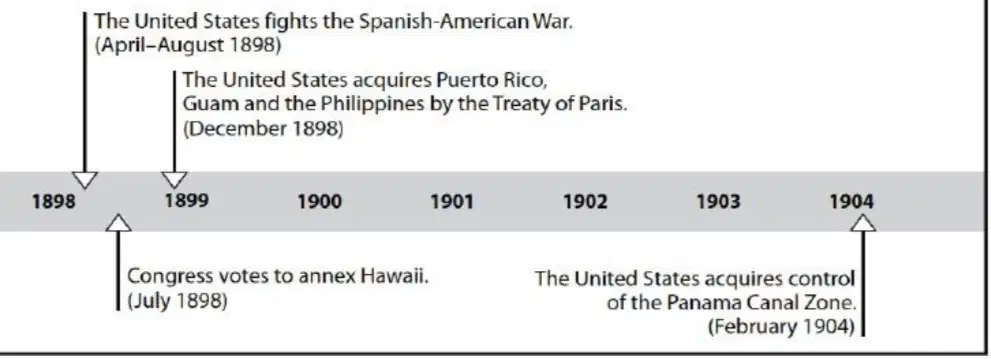
The timeline below shows events in U.S. history between 1898 and 1904. Based on the timeline, which conclusion can be made about American policy in these years?
Americans took new steps because they feared attacks by foreign powers
Colonial peoples welcomed American leadership to develop their economies.
American imperialists triumphed over those opposing the annexation of overseas territories.
Congressional leaders overcame the reluctance of U.S. Presidents to acquire overseas possessions.
The excerpt below was written by Mark Twain in 1900. I said to myself, here are a people who have suffered for three centuries. We can make them as free as ourselves, give them a government and country of their own, put a miniature of the American constitution afloat in the Pacific, start a brand new republic to take its place among the free nations of the world. But since then . . .I have seen that we do not intend to free, but to subjugate the people of the Philippines. We have gone there to conquer, not to redeem… And so I am an anti-imperialist. I am opposed to having the eagle put its talons on any other land.
Filipinos were not ready for a system of government based on the American Constitution.
Americans intended to rule the Philippines as conquerors instead of bringing democracy.
Filipinos had already suffered for three centuries and therefore had suffered enough.
American ships no longer needed coaling stations on their way to Asia.
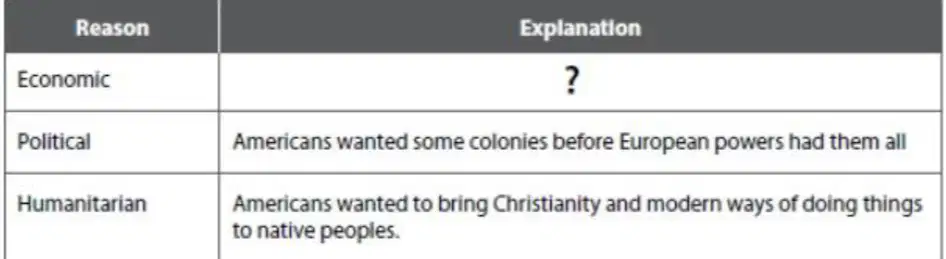
The table below explains some of the reasons for American imperialism. Reason | Explanation Economic | ? Political | Americans wanted some colonies before European powers had them all Humanitarian | Americans wanted to bring Christianity and modern ways of doing things to native peoples. Which sentence completes the table?
Americans supported free trade.
Americans wanted overseas markets for their goods.
Americans wanted to manufacture goods in overseas factories.
Americans wanted to import colonial laborers to the United States.
How did the “yellow press” encourage United States entry into the Spanish-American War?
by providing financial support to the Cuban rebels
by sending newspapers with hostile articles to Spain
by lobbying with members of Congress for a declaration of war
by publicizing Spanish atrocities and blaming Spain for the explosion of the USS Maine

Which phrase best completes the diagram?
The annexation of overseas territories led to increased trade in the Pacific and the Caribbean.
Wartime expenses led to increased taxation, a decline in trade, and an economic recession.
The loss of U.S. overseas territories to Spain led to a decline in American foreign trade.
The war with Spain led to an economic boycott of the United States.
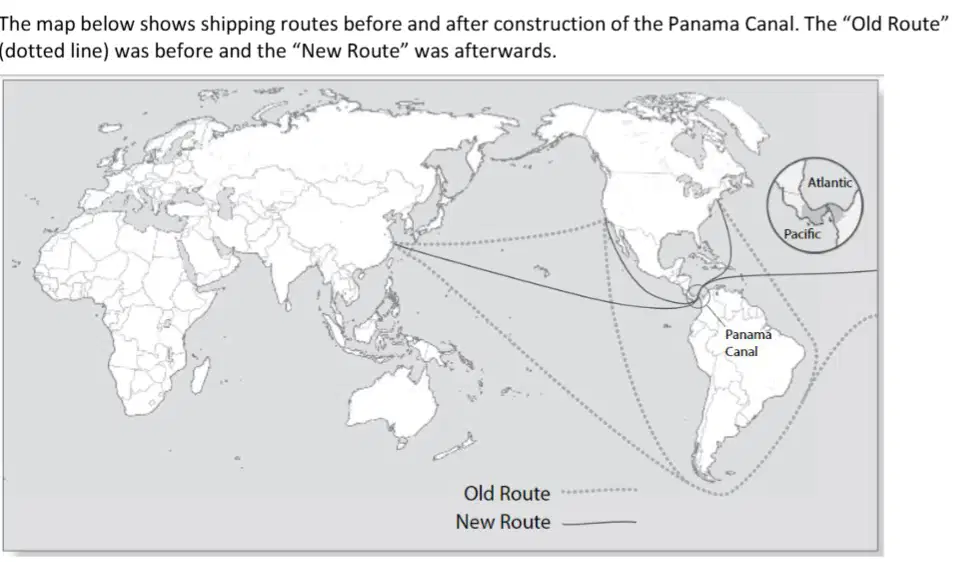
The map below shows shipping routes before and after construction of the Panama Canal. The “Old Route” (dotted line) was before and the “New Route” was afterwards. Based on the map, why did many Americans want to build the Panama Canal?
to shorten the shipping route from New York to Panama
to shorten the shipping route from San Francisco to China
to shorten the shipping route from New York to San Francisco
to shorten the shipping route from San Francisco to the tip of South America
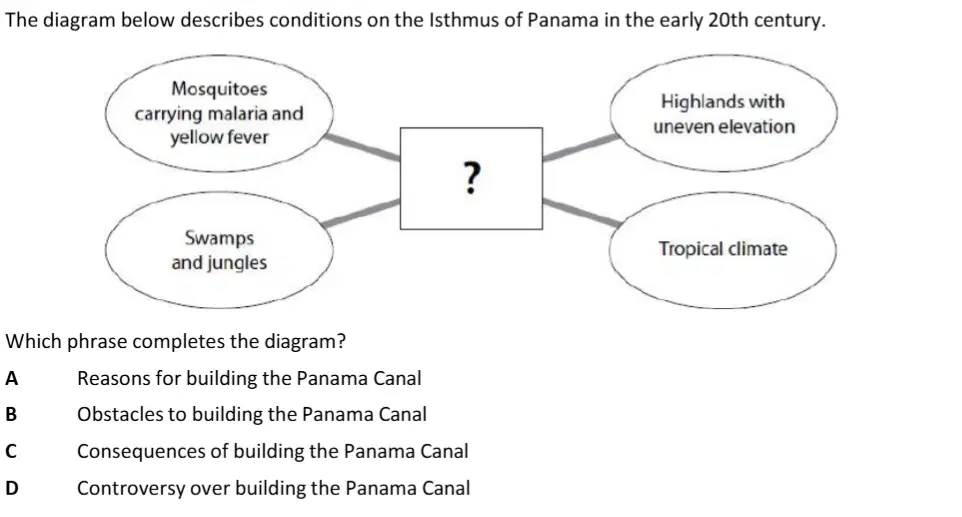
The diagram below describes conditions on the Isthmus of Panama in the early 20th century. Which phrase completes the diagram?
Reasons for building the Panama Canal
Obstacles to building the Panama Canal
Consequences of building the Panama Canal
Controversy over building the Panama Canal
The excerpt below was part of a Joint Resolution of Congress, made in April 1917. Therefore be it resolved by the Senate and the House of Representatives . . . that the state of war between the United States and the Imperial German Government . . . is hereby formally declared; and that the President be, and he is hereby, authorized and directed to employ the entire naval and military forces of the United States and the resources of the Government to carry on war against the Imperial German Government. Which events led to the resolution above?
the sinking of the U.S.S. Maine and the De Lôme telegram
unrestricted submarine warfare and the Zimmerman telegram
the signing of the Atlantic Charter and the attack on Pearl Harbor
disputes over German colonial claims to Samoa and the Marshall Islands
How was Florida affected by the construction of the Panama Canal?
Tampa became a major port for shipping goods to Latin America.
Tampa lost most of its commercial traffic to Panama City.
Cuban refugees in Tampa left for other cities in Florida.
Tampa became a center of U.S. steel production.
One key motivation of American imperialism in the late 19th and early 20th centuries was economic expansion, and a consequence was increased U.S. influence overseas. How did this shape U.S. foreign policy during that period?
It led to a more interventionist and expansionist foreign policy.
It resulted in complete isolation from world affairs.
It caused the U.S. to focus solely on domestic issues.
It made the U.S. form no alliances with other countries.
One of the main causes of the Spanish-American War was the explosion of the USS Maine, which impacted the United States' role in global affairs in the late 19th century by:
Increasing U.S. involvement in international conflicts and marking the emergence of the U.S. as a world power.
Leading to the immediate independence of all Spanish colonies worldwide.
Causing the U.S. to withdraw from all foreign territories and focus on domestic issues.
Resulting in the permanent alliance between the U.S. and Spain.
This cartoon effectively conveys the anti-imperialist sentiment of the period, especially in the context of the Spanish-American War, by:
depicting the negative consequences of imperialism and criticizing expansionist policies.
celebrating American victories and promoting imperial expansion.
showing support for the annexation of new territories by the United States.
portraying imperialism as a positive force for civilization.
What was the Boxer Rebellion?
A joint stock company that grew incredibly powerful through trade in the East Indies
The survival of the fittest—the idea that certain people become powerful in society because they are innately better
A conflict between Great Britain and China over opium
An uprising against foreign/Western influence in China that was crushed when Western powers sent in a military force
What is Social Darwinism?
A joint stock company that grew incredibly powerful through trade in the East Indies
The extension of a nation's power over other lands
The survival of the fittest—the idea that certain people become powerful in society because they are innately better
A colonial government in which local rulers are allowed to maintain their position of authority and status
What is Imperialism?
policy or practice of acquiring full or partial political control over another country
The extension of a nation's power over other lands
A conflict between Great Britain and China
A joint stock company that grew incredibly powerful through trade in the East Indies
What was the main crop the United States was interested in from Hawaii?
Sugar
Apples
Tabacco
Wheat
What was an important legacy of the Social Gospel Movement?
an end to racial segregation in the South
the conversion of most Catholic immigrants to Protestantism
the intervention of prominent religious leaders into electoral politics
more attention was paid to the needs of the poor in industrial society
What was the role of settlement houses in 19th-century America?
They offered free education to former slaves in the South.
They offered English classes and other services to poor immigrants.
They provided favors for immigrants in exchange for receiving their votes in local elections.
They organized workers to achieve better working conditions through strikes and collective bargaining.
How did migration from farms to cities encourage the growth of reform movements?
Political machines were more active on farms than in cities.
Overcrowded, congested cities were in greater need of reform.
Urban workers were less likely to read and write than farm laborers.
American farmers feared losing their farms if they joined reform movements.
Examine the importance of social change and reform in the late 19th and early 20th centuries (class system, migration from farms to cities, Social Gospel movement, role of settlement houses and churches in providing services to the poor). The passage below, from the Hull-House Charter, describes the objects of Hull House. "To provide a center for the higher civic and social life; to institute and maintain educational and philanthropic enterprises, and to investigate and improve the conditions of the industrial districts of Chicago." Which association shared similar objects?
Ku Klux Klan
Social Gospel movement
American Federation of Labor
Tammany Hall in New York City
The information below lists several major labor actions in the late 19th century. - Haymarket Riot (1886) - Homestead Strike (1892) - Pullman Strike (1894) How were these actions similar?
They ended in important defeats for organized labor.
They were stopped by the intervention of the U.S. Army.
They led to armed conflicts between workers and Pinkertons.
They were secretly organized by the American Socialist Party.
The excerpt below is adapted from the Preamble to the Constitution of the Knights of Labor (1874). "The recent alarming development and aggression of aggregated wealth make it necessary that a check should be placed upon its power and upon unjust accumulation, and a system adopted which will secure to the laborer the fruits of his toil. And . . .this much-desired object can only be accomplished by the thorough unification of labor." Which groups did the authors of this document hope to unite?
unskilled white male workers, but not recent immigrants
affiliated craft unions restricted to white, male skilled workers
all skilled and unskilled white, male workers, including immigrants
skilled and unskilled workers, including women and African Americans
In which event did anarchists and other demonstrators clash with Chicago police?
Haymarket riot (1886)
Pullman strike (1894)
Homestead strike (1892)
Coal miners' strike (1902)
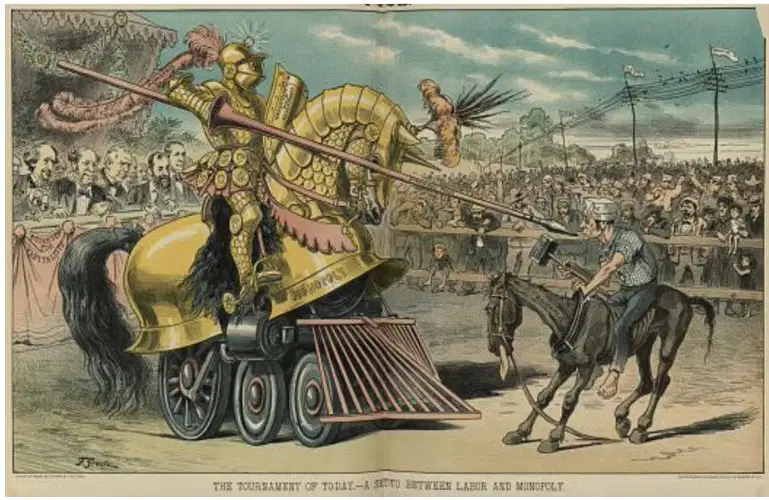
The cartoon below was published in the early 1880s. The horse on the left is labelled 'Monopoly.' The text below the cartoon states: 'The Tournament of Today—A Set-To Between Labor and Monopoly.' Based on the cartoon, with which statement would the artist have agreed?
Capitalists did more than workers in building the economy.
Workers held greater power than the owners of big business.
Big business enjoyed unfair advantages over American workers.
Violence from workers was threatening the country's social stability.
Which Progressive reform is correctly matched with its definition?
Referendum - Voters can directly introduce bills into the state legislature
Recall - Voters can remove an elected official from office
Initiative - Voters can repeal a law already passed by the state legislature
Primary - Voters, rather than state legislators, directly elect U.S. Senators

The diagram below provides details about legislation during the Progressive era. Which phrase completes the diagram?
Encouraged U.S. consumers to buy local beef
Insured the safety of meat eaten by consumers
Helped American ranchers by taxing foreign beef
Led to public criticism of meat-packing processors
Which change to family life happened as more people moved to cities during industrialization?
Families relied on farming for food and income.
Children stayed home to help with household chores.
Extended families lived together in large rural homes.
More family members worked outside the home for wages.
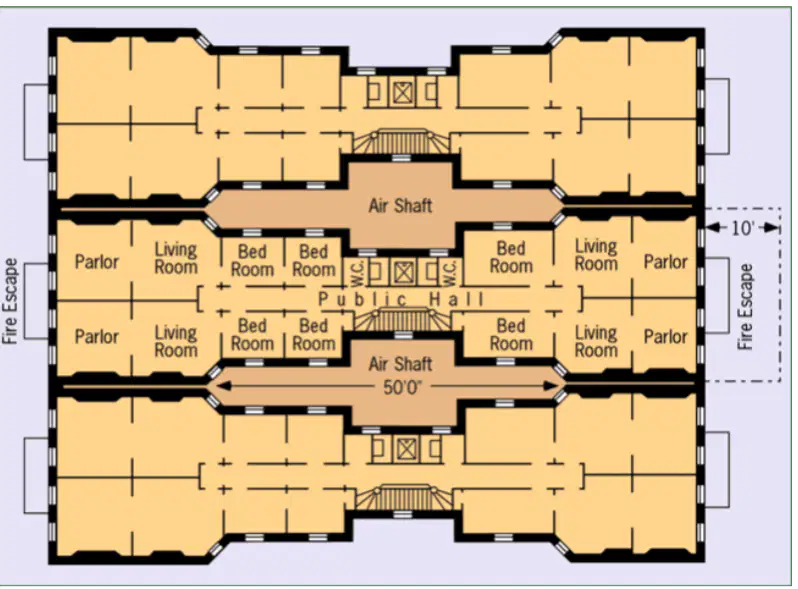
How did dumbbell tenements contribute to urban problems during industrialization?
They improved the health and safety of working-class families
They encouraged the construction of luxury housing near factories
They created crowded living spaces that lacked proper sanitation
They allowed city governments to better regulate immigrant populations
The chart below compares life in the United States in 1840 and 1890. Life in Agrarian Society, 1840: - Most people live on farms. - Most people make their own goods or exchange goods. - Most people do not travel far. Life in Industrial Society, 1890: - An increased number of people live in towns and cities. - ? - People travel more often. Which statement completes the chart?
People consume food they have grown themselves.
People living in towns and cities work in factories or workshops.
Workers receive higher wages because of the efforts of labor unions.
Farms close because they cannot compete with overseas producers.
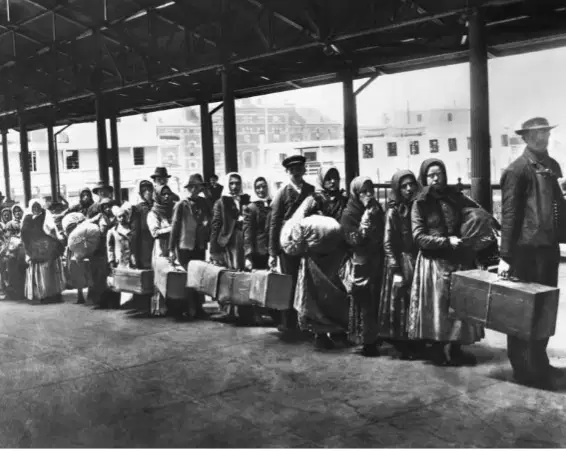
Which conclusion is best supported by evidence from this photograph?
Many immigrants planned on sending money back to their families.
Many immigrants arrived with their families with the intention of remaining here.
Many immigrants were unable to find work and later returned to their native lands.
Many immigrants were from wealthy families who came in search of new opportunities.
The measures below took place in the late 19th and early 20th centuries. Chinese Exclusion Act Gentlemen’s Agreement with Japan What was the primary goal of these measures?
to prevent immigration from East Asia (Moderate)
to allow Asian immigrants to bring other family members
to encourage Chinese and Japanese investment in the United States
to encourage the immigration of Chinese and Japanese settlers with labor skills
The act below was passed by Congress on May 6, 1882. An Act to execute certain treaty stipulations relating to Chinese. Whereas in the opinion of the Government of the United States the coming of Chinese laborers to this country endangers the good order of certain localities within the territory thereof: Therefore, Be it enacted by the Senate and House of Representatives of the United States of America ... that ... the coming of Chinese laborers to the United States be ... suspended; and during such suspension it shall not be lawful for any Chinese laborer to come, or ... to remain within the United States. Which two groups would have supported this legislation?
labor union leaders and nativists
sharecroppers and tenant farmers
women suffragists and social workers
industrial entrepreneurs and mining company operators
What was the role of settlement houses in late 19th-century America?
They offered free education to former slaves in the South.
They offered English classes and other services to poor immigrants.
They provided favors for immigrants in exchange for receiving their votes in local elections.
They organized workers to achieve better conditions through strikes and collective bargaining.
What did the Social Gospel movement and settlement houses have in common?
They emphasized the duty of wealthier Americans to help the poor.
They argued that private property was the chief source of social inequality.
They believed that performing good works was essential to personal salvation.
They established places where middle-class, educated reformers could live alongside the poor.
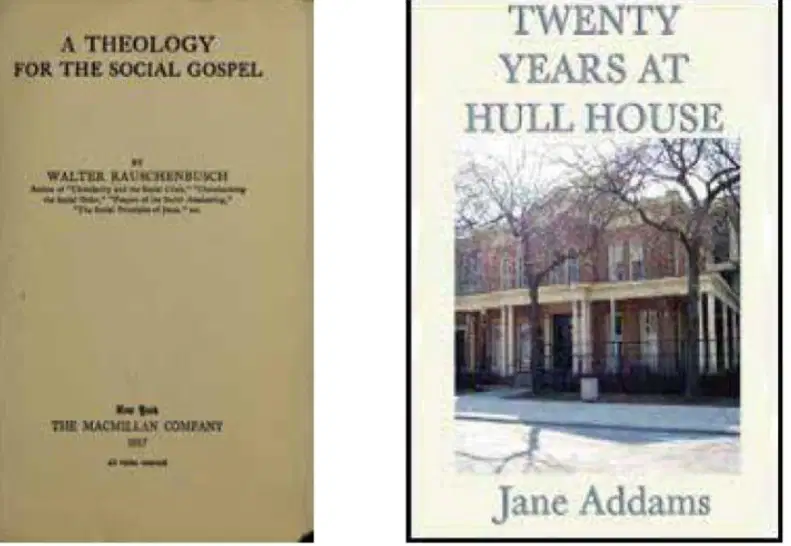
What long-term impact did these two movements have on American society?
They helped to improve conditions for the urban poor.
They led people to question their personal religious beliefs.
They increased the role of government in resolving social issues.
They encouraged industrial workers to challenge their employers.
What was a positive impact of political machines in the late 19th and early 20th centuries?
They bribed local officials in order to win public bids.
They instructed new citizens in how they should vote.
They made fortunes by overcharging through corrupt city contracts.
They provided essential services to immigrants, such as finding housing.
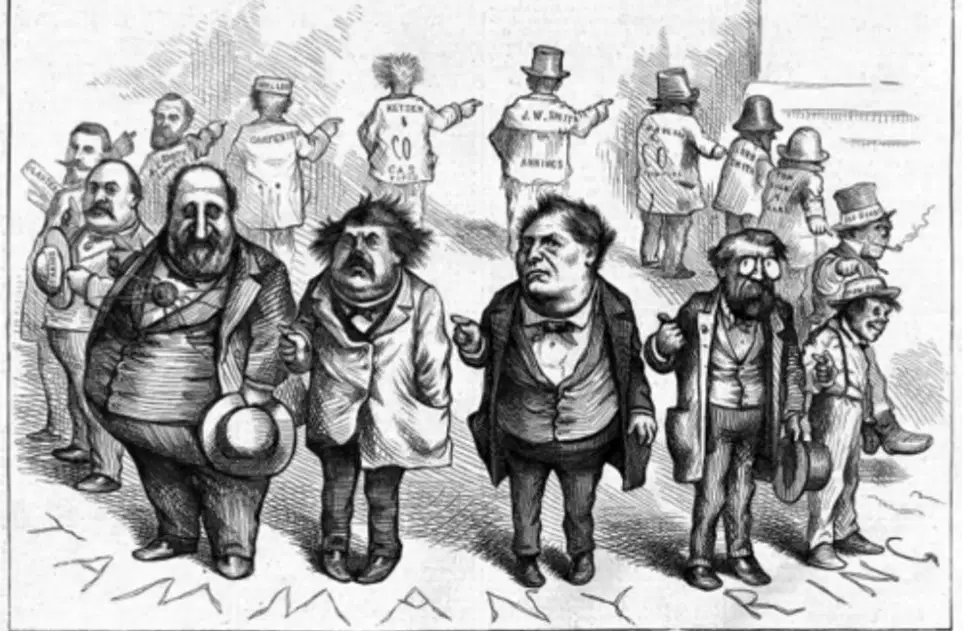
What is the cartoonist suggesting about the members of the Tammany Ring?
They were trusted officials serving their communities.
They were unfairly blamed without any real evidence.
They were involved in corruption but denied responsibility.
They were confused about who had stolen public money.
The excerpt below is from Lincoln Steffens’ book, The Shame of the Cities. In all cities, the better classes—the businessmen—are the sources of corruption, but they are so rarely pursued and caught that we do not fully realize whence the trouble comes. Based on the excerpt, with which statement would Steffens agree?
A. Political machines have corrupted many of America’s cities.
B. City officials are doing a good job at exposing sources of corruption.
C. Progressive reforms have successfully eliminated most sources of urban corruption.
D. Americans are no longer willing to tolerate the corrupt practices of political machines.
Which two Constitutional amendments were passed with the support of the Progressives?
A. Abolition of poll taxes + Term limits for President
B. Change in the dates of Presidential terms + Limits on changing congressional salaries
C. Enfranchising 18-year-olds + Representing Washington D.C. on the Electoral College
D. Power to impose a federal tax on incomes + Direct election of U.S. Senators
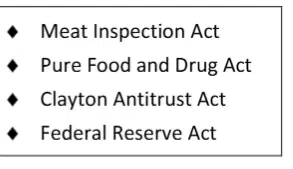
What do these laws demonstrate about the views of Progressives on public policy?
They favored a laissez faire policy in which government did not interfere in the economy.
They believed that states rather than the federal government should regulate the economy.
They favored a socialist approach in which the federal government owned and ran the most important businesses.
They thought some federal regulation of the economy was necessary to prevent the worst abuses of industrialization.
Jane Addams and Hull House contributed to social change in American cities by:
Providing social services and support to immigrants and the urban poor
Leading the fight for women's suffrage in the federal government
Establishing the first labor union in the United States
Founding the first public library in New York City

Based on the cartoon, what was the attitude of Progressives towards trusts?
Progressives condemned all trusts as a form of monopoly power.
Progressives opposed those trusts committing unfair business practices.
Progressives admired trusts as the most efficient form of business organization.
Progressives defended businesses from attacks by President Theodore Roosevelt.
One example of how Asian immigrants in the West were treated differently from European immigrants in the East is:
Asian immigrants faced exclusion laws like the Chinese Exclusion Act, while European immigrants were generally allowed entry.
Asian immigrants were given land grants, while European immigrants were denied entry.
Asian immigrants were encouraged to assimilate, while European immigrants were forced to leave.
Asian immigrants received citizenship automatically, while European immigrants did not.
One example of a public health or housing concern in industrial cities that reflected broader changes in American society at the time was:
Overcrowded tenements and poor sanitation
Expansion of rural farmland
Decline in factory jobs
Increase in suburban home ownership
One criticism of political machines like Tammany Hall was that they:
Engaged in corruption and patronage to maintain power
Promoted fair and transparent elections
Reduced the influence of special interest groups
Encouraged strict government regulation of businesses
One major social reform or policy initiative during the Progressive Era in the United States was the establishment of which act, which aimed to address unsafe working conditions and child labor?
The Pure Food and Drug Act
The Social Security Act
The Civil Rights Act
The Voting Rights Act
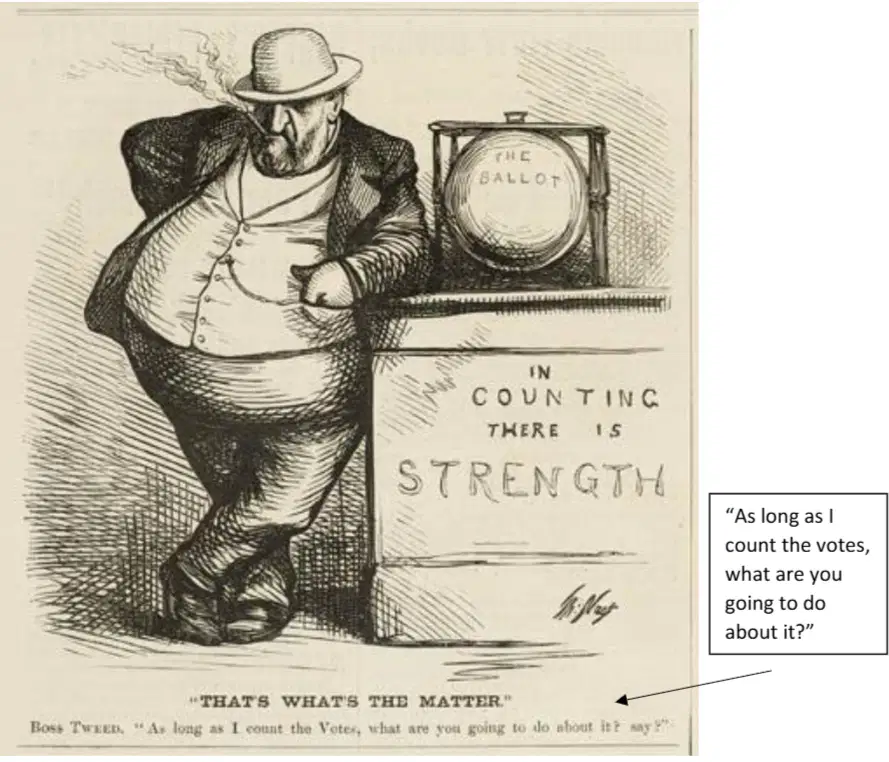
The phrase "In counting there is strength" in Thomas Nast's political cartoon "That's What's the Matter," featuring "Boss" Tweed, symbolizes which theme in the context of 19th-century New York City politics?
The manipulation of votes and political corruption by powerful figures like Boss Tweed
The importance of military strength in politics
The rise of industrialization in New York City
The influence of foreign powers on local elections

The political cartoon depicting President Theodore Roosevelt "cleaning up the meat scandal" symbolizes the role of government and the significance of the Pure Food and Drug Act and Meat Inspection Act in addressing public health concerns and ensuring food safety in the early 20th century by:
Demonstrating government intervention to protect public health and regulate food safety standards.
Showing the government's focus on expanding overseas territories.
Highlighting Roosevelt's efforts to reduce taxes for large corporations.
Emphasizing the government's role in promoting industrial monopolies.
Match the term to its correct definition: Temperance Movement
Belief that people need to protect the environment.
Teddy Roosevelt’s plan that included conserving natural resources and controlling corporations.
Groups that wanted the country to either drink less or stop drinking entirely.
Allows the people to propose and vote on a new law.
Match the term to its correct definition: Square Deal
Belief that people need to protect the environment.
Teddy Roosevelt’s plan that included conserving natural resources and controlling corporations.
Groups that wanted the country to either drink less or stop drinking entirely.
Allows the people to propose and vote on a new law.
Match the term to its correct definition: Referendum
B. Teddy Roosevelt’s plan that included conserving natural resources and controlling corporations.
C. Groups that wanted the country to either drink less or stop drinking entirely.
D. Allows the people to propose and vote on a new law.
E. Allows the people to vote on a new law passed by the government.
What was the goal of places like the Hull House and other settlement houses?
Promoting economic and business improvements
Protecting social welfare
Increasing religious belief
Reforming political problems
A major purpose of the Progressive movement was to
Grow the economy through the free market
Support increases in factory production
Encourage migration from southern and eastern Europe
Correct the economic and social problems of industrialization.
President Roosevelt earned the nickname “trust buster” for aggressively using the ______________ against large monopolies.
Sherman Anti-Trust Act
Pure Food and Drug Act
Meat Inspection Act
19th Amendment
After one year from the ratification of this article the manufacture, sale, or transportation of Intoxicating liquors within, the importation thereof into, or the exportation thereof from the United States and all territory subject to the jurisdiction thereof for beverage purposes is hereby prohibited.
18th Amendment
21th Amendment
Meat Inspection Act
Pure Food and Drug Act
The right of citizens of the United States to vote shall not be denied or abridged by the United States or by any State on account of sex.
17th Amendment
19th Amendment
Meat Inspection Act
Pure Food and Drug Act
The 17th Amendment does what?
Prohibits the sale of Alcohol
Gives women the right to vote
Allows for popular election of senators
Repeals Prohibition
The 19th Amendment does what?
Prohibits the sale of Alcohol
Gives women the right to vote
Allows for popular election of senators
Repeals Prohibition
Susan B Anthony started what organization?
NWO
NASA
NOWAY
NAWSA
What did the Missouri Compromise do?
Abolished slavery in all states
Allowed Missouri as a slave state and Maine as a free state
None of the above
Ended the Civil War
The president who had the Square Deal was:
Theodore Roosevelt
Woodrow Wilson
Franklin D. Roosevelt
William Howard Taft
Which president started the Food and Drug Act?
McKinley
Wilson
Taft
Roosevelt
What did the Thirteenth Amendment do?
None of the above
Made slavery legal everywhere
Allowed slavery in certain states
Made slavery illegal in the United States
Which state was admitted as a free state as part of the Compromise of 1850?
California
New Mexico
Utah
Texas
What did the Compromise of 1850 abolish in the District of Columbia?
Slavery
The slave trade
The Fugitive Slave Act
The Missouri Compromise
What was one of the most controversial aspects of the Compromise of 1850?
The admission of California as a free state
The strengthening of the Fugitive Slave Act
The abolition of the slave trade in the District of Columbia
The use of popular sovereignty in New Mexico and Utah
Which of the following repealed the Missouri Compromise’s use of latitude as the boundary between slave and free
territory and instead, instituted popular sovereignty?
The Compromise of 1850
The Dred Scott v. Sanford Case
The Kansas-Nebraska Act
The Fugitive Slave Act
Which statement explains an effect of the Missouri Compromise
The compromise enabled Southerners to pursue fugitive slaves into the North.
The compromise maintained the balance between the number of free states and slave states.
The compromise allowed slaves to be counted toward a state’s population for representation in Congress.
The compromise ended the slave trade in Washington, D.C.
Caring only about the interests of your state or region
sectionalism
nationalism
nullification
federalism
What state was added as a slave state by the Missouri Compromise
Missouri
Maine
Texas
California
A(n) (a) is a person who wants to end the practice of slavery


The August 27, 1858, debates in Freeport, Illinois, drew more than 15,000 spectators. At the time, the town of Freeport only had a population of 5,000. It was at this debate that Douglas gave the answer that became known as the Freeport Doctrine.
What was the Freeport Doctrine?
What was the purpose of the Interstate Commerce Commission?
To regulate unfair business practices.
To promote interstate trade.
To support state regulations.
To establish new railroads.
What was a major challenge for farmers in selling their crops?
Lack of buyers
High shipping costs
Poor crop quality
Limited market access
What did the Grange Movement reduce the power of?
Small businesses
Big businesses
Local governments
Foreign investors

