
 Worksheets
MT 4.1 & 4.2
Total questions: 64
Worksheet time: 33mins
Gastro-
Small Intestines
Stomach
Gas
The gallbladder stores the bile that the liver makes.
True
False
The small intestine contains three parts;
duodenum, cecum, colon
ileum, jejunum, colon
cecum, duodenum, ileum
duodenum, jejunum, ileum
Chole-
gall, bile
Stone
colon
sac
sial
Tooth
opening
saliva
Stomach
entero-
intestines
liver
colon
enter
hepat-
pancreas
stone
liver
mouth
gloss-
glow
taste
chew
tongue
pharyng
throat, pharynx
stomach
intestine
mouth
phag
throat, pharynx
eat, swallow
mouth
intestines
Which structure controls the flow from the stomach to the small intestine?
cardiac sphincter
ileocecal valve
pyloric sphincter
tricuspid valve
Where does the digestive system start?
The liver
The throat
The stomach
The mouth
What are the functions of the digestive system?
Digestion
Ingestion
Elimination
Absorption, Line of Defense
All of the above
What is the term for "chewing"?
Tearing it up
Chomping
Eating
Mastication
The opening that allows food to enter the stomach is the Lower Esophageal Sphincter (LES).
True
False
Chyme is the liquid like mixture of partially digested food and secretions produced in the large intestine
True
False
What are the finger like projections in the small intestines called?
Villians
Valiant
Villa's
Villi
Phagia means _____?
rectum or anus
eating or ingesting
difficult or painful swallowing
feeling a need to vomit
Cholecyst means ____?
inflammation of the gall bladder
gall bladder
indigestion
bloody vomit
Peristalsis is _____?
Include any/all correct answer(s).
muscle contractions that push food through the digestive tract
muscle that separates the esophagus and the stomach
muscle that controls the passage of food from the stomach into the small intestine
a type of smooth muscle contrations
The root word col refers to ____?
Include any/all correct answer(s).
the mouth
colon
large intestine
liver
Which of the following carries bile into the duodenum?
cystic duct
portal vein
lymph duct
hepatic duct
common bile duct
What is the muscular wave-like movement to transport food through the digestive system called?
mastication
peristalsis
regurgitation
emulsification
anastomosis
Put the following parts of the digestive system in the correct order:
A. transverse colon
B. anus
C. esophagus
D. duodenum
E. rectum
A, B, C, D, E
B, C, A, E, D
C, D, A, E, B
E, A, D, B, C
What is the meaning of the root (1st root if more than one) in the term: lipoma?
protein
sugar
fat
pus
Which term describes gas expelled through the anus?
flatus
eructation
dysphagia
diarrhea
nausea
Cholecyst/o
Gallbladder
Kidney
Lungs
heart
The root word or means ____?
tongue
mouth
liver
bile
anus and rectum
-phagia
-pepsia
proct/o
rect/o
sigmoid/o
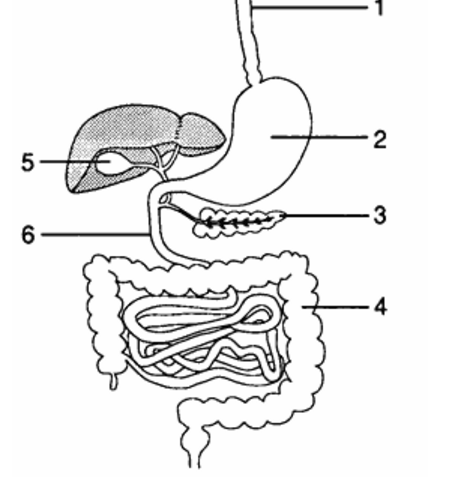
Which organ is the primary site for nutrient absorption?
Stomach
Small intestine
Large intestine
Liver
Which structure in the digestive system is primarily involved in the reabsorption of water?
Small intestine
Stomach
Large intestine
Liver
What carries food from the pharynx to the stomach?
larynx
trachea
esophagus
bronchioles
What enzyme is found in saliva that starts digesting carbohydrates?
amylase
chyme
pepsin
bile

What is organ R?
(a)
What is the response of the digestive system to chemical irritants or sensory stimuli?
The stomach immediately stops producing gastric juices.
The intestines contract to expel all contents rapidly.
The salivary glands secrete more saliva in response to the stimulus presented by food in preparation for digestion.
The pancreas ceases all enzyme production.
What enzyme is found in saliva that starts digesting carbohydrates?
amylase
chyme
pepsin
bile
A protein that speeds up a chemical reaction.
nutrient
enzyme
bolus
peristalsis
A semi-fluid pulp formed in the stomach made of partly digested food and the secretions of the gastrointestinal tract
chyme
bolus
bile
epiglottis
Where does the appendix attach to the large intestine?
Cecum
Ascending Colon
Duodenum
Illeum

Label E is the:
Rectum
Appendix
Liver
Stomach
Label I is the:
Rectum
Appendix
Small intestine
Large intestine
Label K is the:
Rectum
Appendix
Stomach
Anus
Label J is the:
Liver
Appendix
Anus
Large intestine
Ileum
FATS---->FATTY ACIDS/GLYCEROL
______ is the enzyme that breaks down lactose
Lactase
Lactose

