
 Worksheets
3.1 Sound as a Wave Objectives
Total questions: 30
Worksheet time: 15mins
Which statement best aligns with the objective of describing the longitudinal nature of sound waves?
Explaining that sound waves travel as transverse peaks and troughs in air
Explaining that sound waves involve condensations and rarefactions along the direction of travel
Showing that sound waves cannot propagate through any medium
Stating that sound frequency is the same as amplitude

Which statement best describes how sound is produced?
Sound is produced through vibrations.
Sound is produced only by chemical reactions.
Sound is created by light waves interacting with matter.
Sound is generated without any motion in the source.

Why is sound classified as a mechanical wave?
It can travel through a vacuum without particles.
It requires a medium whose particles transmit the disturbance.
It produces its own electromagnetic field.
It only travels through air and not through liquids or solids.

In the context of sound, what is the term for the region where a forward-moving loudspeaker diaphragm pushes air molecules together, increasing the local air pressure?
Rarefaction
Condensation
Diffraction
Attenuation
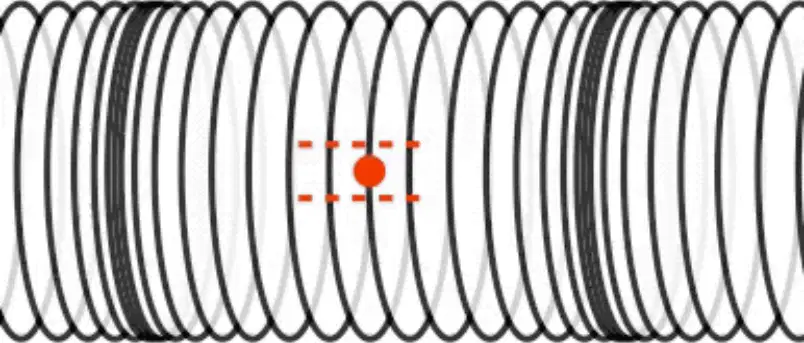
Which statement best distinguishes a longitudinal sound wave from a transverse wave, according to the slinky and loudspeaker diagrams?
Particles vibrate perpendicular to the direction of wave propagation.
Particles are carried along with the wave to new positions.
Particles vibrate along the same line as the direction of wave propagation, causing pressure and density changes.
There is no alternation between high- and low-pressure regions.

Which statement best describes why a sound wave is considered a pressure wave?
It consists of alternating high and low pressure regions that propagate through a medium.
It is visible as ripples on the surface of water.
It only travels in a vacuum without air molecules.
It requires the medium to rotate rather than vibrate.

In the context of acoustic longitudinal waves, what is the wavelength (λ) of sound?
The time for one oscillation of the source.
The distance between the loudspeaker and the ear.
The distance between consecutive condensations, equivalently between consecutive rarefactions.
The maximum displacement of an air molecule from equilibrium.

Which frequency range defines audible waves for the average human ear?
Below 20 Hz
20 Hz to 20,000 Hz
Above 20 kHz
2 Hz to 200 Hz

Which statement best explains why elephants and rhinoceroses can communicate over large distances using infrasound?
Infrasonic waves have short wavelengths and lose energy quickly.
Infrasonic waves have long wavelengths and can get around obstacles with little energy loss.
Infrasonic waves are within the human audible range, so they travel farther.
Infrasonic waves are produced only underwater.

A bat emits sound at 40 kHz for navigation. How should this sound be classified, and why?
Audible, because it is within 20 Hz to 20 kHz
Infrasonic, because it is below 20 Hz
Ultrasonic, because it is greater than 20 kHz
Ultrasonic, because it has a low pitch

Based on the stated objectives for this lesson, which task best aligns with the goals for studying sound waves and music?
Memorize the dates of famous composers
Distinguish characteristics of waves as observed in sound and relate these wave properties to musical properties
Calculate the speed of light in a vacuum
Identify the colors in a rainbow
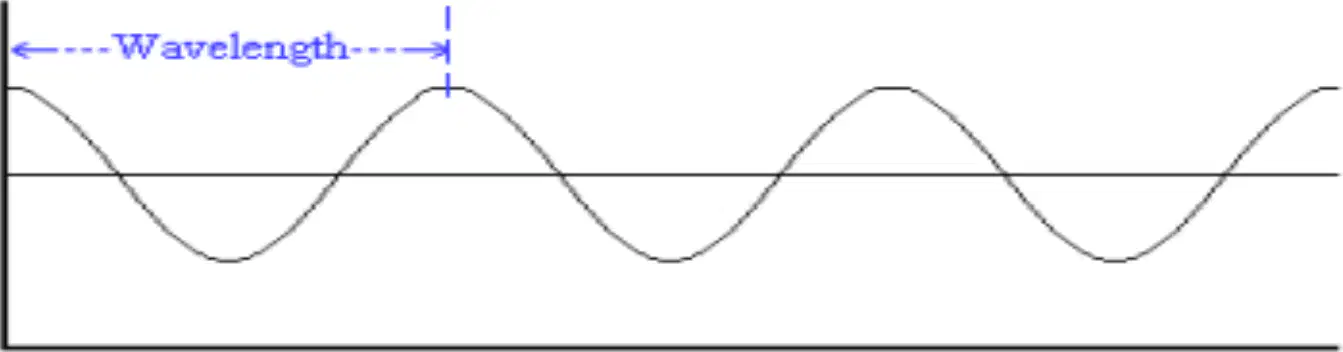
Which statement best distinguishes what determines sound speed versus amplitude in a longitudinal sound wave?
Speed is set by the source of sound, while amplitude is set by the medium’s properties.
Both speed and amplitude are set only by the source of sound.
Speed is determined by the properties of the medium, while amplitude is determined by the source of sound.
Both speed and amplitude are determined only by the medium through which sound travels.
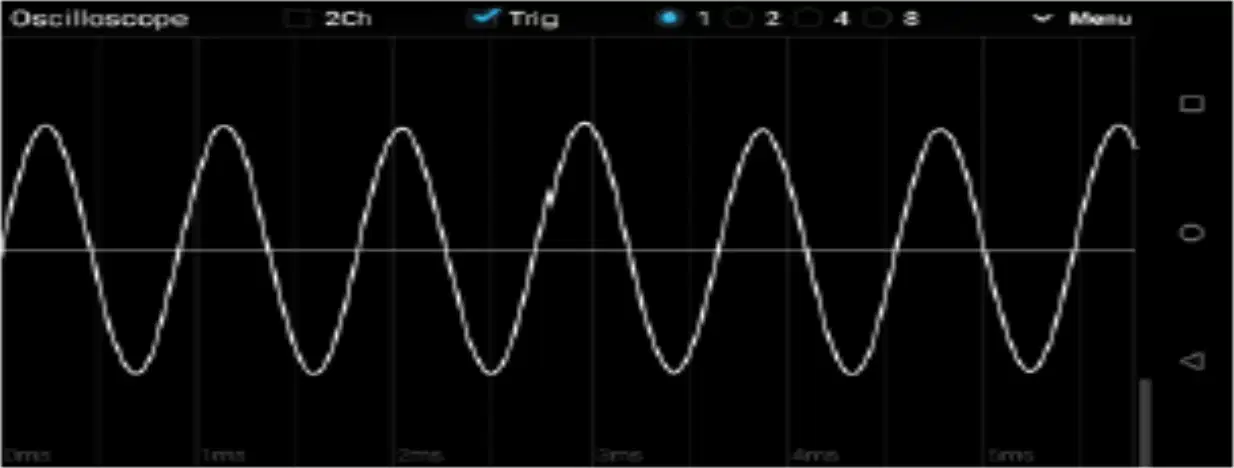
Which statement best describes the relationship between amplitude and loudness in sound waves?
Amplitude determines the pitch of the sound, not its loudness.
Greater amplitude means the wave carries more energy and is perceived as louder.
Amplitude only affects the speed of the sound wave in air.
Lower amplitude increases the frequency, making the sound louder.
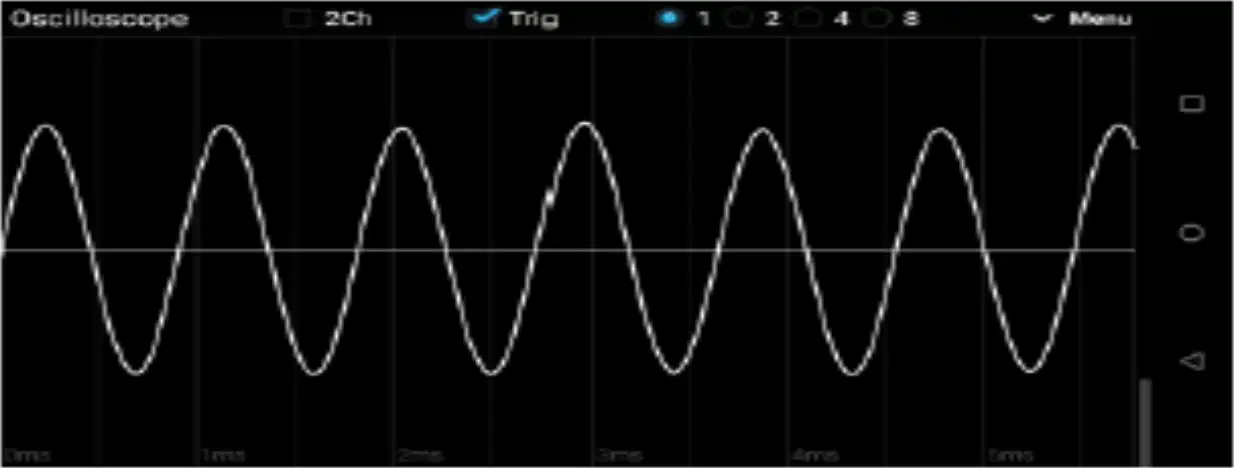
On an oscilloscope, two sine waves have the same frequency but different amplitudes. The first trace has taller peaks and deeper troughs than the second. What can you conclude about the sounds they represent?
They have different pitches but the same loudness.
They have the same pitch, and the taller-trace sound is louder.
They have different speeds through air.
They will be perceived as equally loud because frequency is the same.
Which statement best describes the relationship between frequency and pitch as presented?
Amplitude determines pitch, while frequency determines loudness.
Frequency is perceived as pitch; higher pitched sounds have higher frequencies.
Loudness and pitch both increase only with amplitude.
Pitch is unrelated to any measurable property of sound.
Which statement best defines harmonics in musical sounds?
Single-frequency tones like a phone keypad beep
Varying frequencies that combine to form most musical sounds
Random noise without any periodicity
Frequencies that are always equal to the fundamental frequency
Based on the diagrams and description, how does the frequency of the 2nd and 3rd harmonics compare to the fundamental frequency f1?
f2 = same as f1; f3 = double f1
f2 = double f1; f3 = triple f1
f2 = half of f1; f3 = same as f1
f2 = triple f1; f3 = quadruple f1

A guitar and a piano both play the note E at 330 Hz. Based on the diagrams of harmonic content, which statement best explains why they sound different even at the same fundamental frequency?
The guitar and piano have different fundamental frequencies.
The amplitudes of corresponding harmonics differ between the instruments, changing timbre.
The piano produces no harmonics while the guitar does.
Only the instrument with the highest overall amplitude sets the pitch.

Which objective best aligns with using the decibel (dB) scale in studying acoustics?
Understanding sound pitch variations
Expressing sound intensity quantitatively
Identifying sound sources by timbre
Measuring sound frequency in hertz
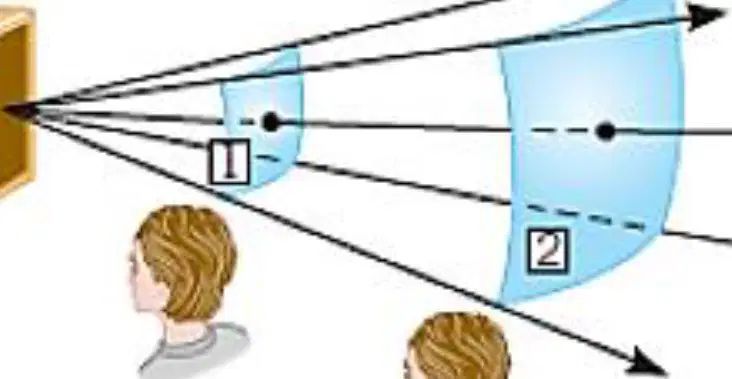
Which statement best defines sound intensity as presented in the lesson?
The total energy a wave carries
The rate at which a wave transfers energy per unit area, measured in Watts/m^2
How loud a person perceives a sound to be
The frequency of a sound wave
If you move from distance r to distance 2r from a loudspeaker, how does the sound intensity change according to the inverse square law I∝r21 ?
It stays the same
It doubles
It becomes one-half
It becomes one-fourth

Which pairing correctly distinguishes loudness from intensity in this lesson?
Loudness is measurable in Watts/m^2; intensity is subjective.
Loudness is subjective perception; intensity is an objective measurable quantity.
Both loudness and intensity are subjective perceptions.
Both loudness and intensity are measured in decibels (dB).
Why is the decibel (dB) scale introduced for sound?
To measure frequency directly
Because the human ear detects intensities only at a single value
To compare a very wide range of detectable sound intensities from about 1×10⁻¹²W/m2 to 10W/m2
To replace Watts as the unit of power
Which formula defines the sound intensity level β in decibels for a sound of intensity I relative to the threshold of hearing I₀?
β = (10 dB) log(I/I₀)
β = (10 dB) ln(I/I₀)
β = (20 dB) log(I/I₀)
β = (10 dB) log(I₀/I)
At the threshold of hearing where I = I₀ and I₀ = 1 × 10⁻¹² W/m², what is the sound intensity level and what does it signify?
β = 0 dB; it means no sound is present
β = 0 dB; it is a very faint sound at the limit of human hearing
β = 10 dB; it is the quietest audible sound
β = −10 dB; it indicates negative intensity
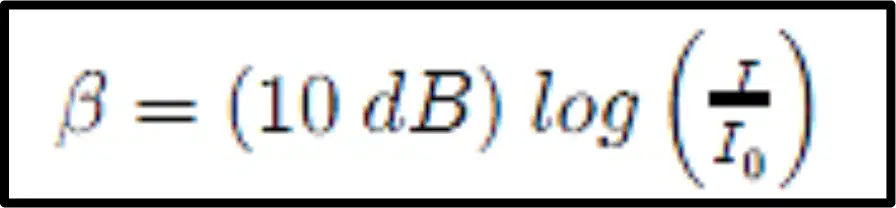
Which statement best explains why the sound intensity level β is described as dimensionless in the formula β = (10 dB) log(I/I0)?
Because β measures true intensity in watts per square meter
Because it is a ratio of two intensities with the same unit, so the units cancel
Because decibel is a base SI unit like kilogram
Because β must always equal 10 dB
Using the provided reference data: Which statement best describes the relationship between sound intensity and intensity level (β) on the decibel scale?
A tenfold increase in intensity raises β by 1 dB.
A tenfold increase in intensity raises β by 10 dB.
A doubling of intensity raises β by 10 dB.
A tenfold increase in intensity halves β.
At a busy street corner, the sound level is 75 dB. Using I0=1×10⁻¹²W/m2 , what is the sound intensity I ?
1.0×10⁻⁷W/m2
3.2×10⁻⁵W/m2
1.0×10⁻⁵W/m2
3.2×10⁻⁷W/m2
7.5×10⁻⁶W/m2
The sound level measured 30 m from a jet plane is 140 dB. Estimate the sound level at 300 m, ignoring ground reflections. Use the inverse square law relation β2 = β1 + 20 log(r1/r2).
100 dB
110 dB
120 dB
130 dB
140 dB
A whisper has intensity I = 1×10⁻¹⁰W/m2 and I0 = 1×10⁻¹²W/m2 . What is its sound intensity level β?
10 dB
15 dB
20 dB
30 dB
40 dB

