
 Worksheets
DP SEHS B.2.1 Newtons laws (Part 1)
Total questions: 22
Worksheet time: 11mins

According to Newton's 2nd Law of Motion, what is the relationship between force, mass, and acceleration?
Force equals mass times acceleration
Force equals mass divided by acceleration
Force equals acceleration divided by mass
Force equals mass plus acceleration
How can understanding the laws of motion help improve performance in sports and exercise?
By explaining how forces affect movement and how to optimize actions for better results
By teaching only the history of physics
By focusing only on the equipment used in sports
By ignoring the effects of external forces
What is the primary focus of kinematics?
The study of forces acting on objects
The study of energy transformations
The study of motion (change in position of a body or object)
The study of chemical reactions
Which of the following best defines a vector quantity?
A measurement that has both size and direction.
A measurement that only has size.
A measurement that only has direction.
A measurement that has neither size nor direction.
What distinguishes a scalar quantity from a vector quantity?
A scalar has only size, while a vector has both size and direction.
A scalar has only direction, while a vector has only size.
A scalar has both size and direction, while a vector has only size.
A scalar has neither size nor direction, while a vector has both.
What is the definition of displacement in linear kinematics?
The difference between an object's final position and its initial position.
The total time taken for an object to move.
The speed at which an object travels.
The force applied to an object.
Given the formula Δx = x_final - x_initial, what does Δx represent?
Displacement
Distance
Velocity
Acceleration
What is the displacement of a runner after completing one full lap (400 meters) in the first lane of a competitive running track?
400 meters
200 meters
0 meters
800 meters
Which formula is used to calculate velocity?
Velocity = Distance × Time
Velocity = Displacement / Time taken
Velocity = Mass / Volume
Velocity = Force × Acceleration
If an object moves 20 meters forward in 5 seconds, what is its velocity?
2 meters per second
4 meters per second
5 meters per second
10 meters per second
What is the formula for calculating speed?
Speed = Distance × Time taken
Speed = Distance / Time taken
Speed = Time taken / Distance
Speed = Distance + Time taken
What does the term "scalar" mean in the context of speed?
Only direction is described
Only size is described
Both size and direction are described
Neither size nor direction is described
Which of the following best describes the process to find acceleration when given initial velocity, final velocity, and time interval?
Subtract the initial velocity from the final velocity, then divide by the time interval.
Add the initial and final velocities, then multiply by the time interval.
Multiply the initial velocity by the final velocity, then divide by the time interval.
Subtract the time interval from the final velocity, then add the initial velocity.
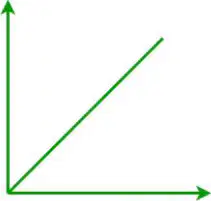
A student observes a distance-time graph with a straight, sloped line. What can they infer about the object's speed and direction?
The object is at rest
The object is moving at a constant speed in one direction
The object is speeding up
The object is slowing down

Which type of line represents constant speed on a velocity-time graph?
A straight horizontal line parallel to the x-axis
A straight line sloping upwards
A curved line
A straight vertical line
What is the main focus of kinematics in mechanics?
The forces acting on an object.
The motion of objects without reference to the forces causing the motion.
The energy changes during motion.
The mass of moving objects.
Which of the following best defines force?
The mechanical interaction between two objects or bodies
The color change in an object
The temperature difference between two objects
The sound produced by an object
Astronauts do not float away from Earth while orbiting in a spacecraft because:
Because Earth's gravity keeps them in orbit
Because they are attached to the spacecraft
Because there is no gravity in space
Because the spacecraft is heavier than they are
According to Newton's first law of motion, what happens to an ice hockey puck that is stationary on the ice before any player hits it?
It remains at rest because the forces acting on it are balanced.
It starts moving on its own.
It accelerates in the direction of the ice.
It melts due to friction.
Which of Newton’s laws explains the relationship between force, mass, and acceleration?
Newton’s First Law
Newton’s Second Law
Newton’s Third Law
Newton’s Law of Universal Gravitation
Which of the following statements is true regarding acceleration?
Acceleration is always positive.
Acceleration is a vector quantity.
Acceleration does not depend on time.
Acceleration is the same as speed.
In a velocity-time graph, what does the area under the curve represent?
Force applied
Speed
Acceleration
Distance traveled

