
 Worksheets
Engine Lubrication Systems Revision
Total questions: 27
Worksheet time: 14mins
A system where oil is returned from the engine by gravity and carried in a sump below the engine is defined as which term?
Dry sump
Hydrodynamic lubrication
Wet sump
Full-fluid film
Which statement best describes the primary purpose of a lubricant in an engine?
To cool the engine by absorbing combustion heat
To reduce or remove friction between moving parts and prevent metal-to-metal contact
To increase oil pressure in worn bearings
To thicken fuel to improve efficiency
Which condition characterises full-fluid film lubrication?
No metal-to-metal contact between surfaces
A thin layer only one molecule thick
Possibility of some metal-to-metal contact
Oil mist thrown around by the revolving shafts
When boundary lubrication predominates due to high temperatures and pressures, what failure mode is most likely if the film breaks down?
Improved fuel economy
Overheating, rapid wear, and/or seizure causing total failure
Reduced oil pressure causing smoother operation
Oil foaming that cushions impacts without damage
Which pair correctly matches an oil property with when it is most critical according to the material?
Body—during cold starting in the first few seconds; Flow—at high bearing pressures
Flow—during cold starting in the first few seconds; Body—at high bearing pressures
Body—only at low loads; Flow—only at high temperatures
Body and Flow—only matter at steady cruise
Which statement best defines viscosity index in the context of engine oils?
A scale indicating oil quality and cleanliness
A number indicating the change of oil viscosity with temperature (in °C)
A measure of oil pressure at operating speed
A grade showing the oil’s resistance to oxidation
Which pair correctly lists typical multigrade viscosities?
10W/60 and 0W/10
5W/30 and 15W/40
SAE 5 and SAE 50
30W/5 and 40W/15
Why might a 5W/30 oil be preferred over a 15W/40 oil?
It produces more sludge at low temperature
It is a thinner oil that reduces drag and improves fuel consumption
It has higher quality regardless of grade
It is less stable at high temperature
Which contaminant-source pairing is correct for engine oil contamination?
Metal particles — cold running
Acid — normal wear
Carbon — over-rich mixture or excessive blow-by gases
Sludge (high temperature) — water condensation
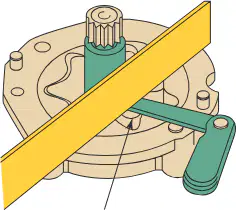
In the rotor-type pump diagram, what is the function of the pressure relief valve integrated near the outlet?
Increase pump speed relative to the crankshaft
Maintain system oil at a constant pressure and prevent over-pressurisation at high engine speeds, particularly when oil is cold and thick
Filter contaminants before oil enters the pump
Reverse the direction of rotor rotation at idle
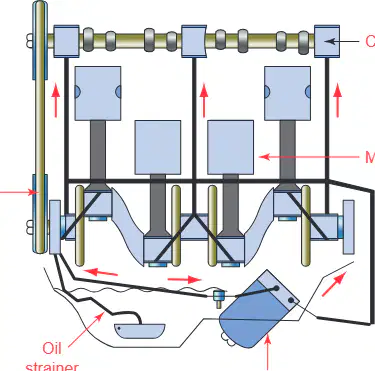
Which description best matches a full-flow filtration system as depicted?
Only a small portion of oil bypasses the filter to reduce pressure drop
All oil from the pump to the main gallery passes through the main external filter
Oil is filtered only when the pressure relief valve opens
Oil is filtered in the sump before reaching the pump
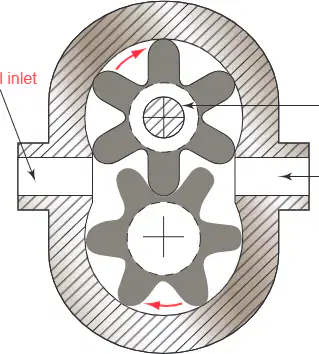
A gear-type oil pump is labelled with an oil inlet on the left and an oil outlet on the right. The drive gear rotates clockwise. Which arrowed flow pattern is correct within the housing?
Oil moves across the meshing gear teeth at the centre toward the outlet
Oil is trapped between gear teeth and the casing wall and carried around the outside from inlet to outlet
Oil only flows through the hollow gear shafts to the outlet
Oil flows backward from outlet to inlet due to gear suction at the mesh point
Which statement best describes how an oil pressure relief valve controls excess pressure in the lubrication system?
It diverts oil to the filter once the engine is hot, increasing pressure.
When oil pressure equals the relief valve spring pressure, the valve lifts off its seat and bleeds oil back to the sump.
It closes the oil passage to the bearings to prevent flow at high speed.
It opens only when the oil pump stops to prevent backflow.
How is oil flow to an external oil cooler controlled and what type of hoses are typically used?
Manually operated gate valve; rigid copper pipes.
Thermostatically controlled oil pressure valve in the filter head that remains closed until a specific temperature in Celsius; flexible, steel-reinforced plastic hoses.
Electronic solenoid valve in the sump; rubber garden hose.
Check valve at the pump outlet; braided fabric hoses only.
In the reverse scroll and oil flinger arrangement, where is the oil ultimately directed?
Into the sump
Into the combustion chamber
Into the air filter
Into the rocker cover
Into the radiator
What is the guidance for use of oil in routine operation?
Check levels regularly and change at the recommended period
Change oil only when it appears dark
Never top up between services
Use any available container for oil
Reuse drained oil after filtering
What is a stated risk of lip type seals as they age with heat?
They may get hard and brittle and look serviceable but not flex, causing leaks
They melt and contaminate oil
They expand and jam the shaft
They lose the metal case
They become too flexible and eject
Which general precaution is emphasised for routine maintenance involving disassembly?
Use logical work procedures, especially when dismantling
Work as fast as possible without checks
Rely on memory without labelling parts
Skip safety gear to improve dexterity
Ignore instructions if experienced
What initial step ensures safe and effective routine maintenance?
Ensure correct tools and equipment are used
Drain coolant first
Disconnect the battery in all cases
Remove the engine from the vehicle
Which statement best integrates two protections for the lubrication system during repair?
Clean the area before opening the oil filler and reassemble using only clean oil from clean containers
Delay warming up and leave the filler cap off
Use any available oil and avoid cleaning to save time
Check oil levels rarely to prevent overuse
Block the crankcase breather to maintain pressure
What is the correct response if oil leaks are found during operation?
Repair them when they occur
Ignore until next overhaul
Tighten all bolts randomly
Switch to a lower grade oil only
Block vents to stop leaks
Which maintenance schedule item is tied to ensuring consistent pressure regulation?
Keep oil changes at regular intervals
Inspect spark plugs daily
Replace coolant weekly
Grease suspension monthly
Retorque head bolts after each trip
Which symptom most directly indicates low oil pressure rather than oil contamination or overfilling?
Oil level on dipstick is higher than normal
Oil warning light comes on when engine is warm
Oil is very black when checked
Blue smoke from exhaust after cold start
A relief valve is fitted to the main gallery of an engine. What is its primary purpose?
Stop the oil flow to the bearings when oil pressure is low
Limit the maximum oil pressure in the engine gallery
Maintain oil supply if the gallery becomes blocked
What is the main function of an oil filter in an engine lubrication system?
To cool the engine oil
To thicken the oil for better lubrication
To increase oil pressure
To remove contaminants from circulating oil
Which type of oil pump uses rotating gears to move oil through the engine?
Diaphragm pump
Piston-type pump
Rotor-type pump
Gear-type pump
What is a common consequence of using engine oil with too low a viscosity in high-temperature conditions?
Increased risk of metal-to-metal contact and wear
Improved sealing of piston rings
Lower fuel consumption
Reduced oil flow to bearings

