
 Worksheets
Learning Implementation Plan (RPP) - Pancasila Education
Total questions: 94
Worksheet time: 47mins
Fill in the blank: DPL 1 is _________.
Keimanan dan Ketakwaan terhadap Tuhan YME
Kepedulian terhadap lingkungan
Kedisiplinan dalam belajar
Kreativitas dalam berkarya
DPL 2 adalah _________.
Kewargaan
Matematika
Sejarah
Geografi
Fill in the blank: DPL 3 is _________.
Penalaran Kritis
Penalaran Numerik
Pengetahuan Umum
Bahasa Inggris
Fill in the blank: DPL 4 is _________.
Kreativitas
Teknologi
Ekonomi
Sosial
DPL 5 adalah _________.
Kolaborasi
Kompetisi
Evaluasi
Simulasi
Fill in the blank: DPL 6 is _________.
Kemandirian
Kedisiplinan
Kerjasama
Kepemimpinan
DPL 7 adalah _________.
Kesehatan
Teknologi
Pendidikan
Ekonomi
DPL 8 adalah _________.
Komunikasi
Matematika
Fisika
Biologi
Identify the various roles played as a child at home, as a student at school, and as a member of the community in the surrounding environment.
Roles include being a child at home, a student at school, and a community member in the neighborhood.
Roles include being a teacher at home, a principal at school, and a mayor in the community.
Roles include being a parent at home, a librarian at school, and a shopkeeper in the community.
Roles include being a guest at home, a visitor at school, and a tourist in the community.
Explain the importance of responsibility in carrying out roles at home, school, and in the community.
Responsibility is important to ensure that roles are carried out properly and contribute to the well-being of the family, school, and community.
Responsibility is only important for adults and not for children or students.
Responsibility means doing whatever you want without considering others.
Responsibility is not necessary as long as tasks are completed eventually.
Differentiate between rights and obligations in daily life as a child, student, and community member.
Rights are entitlements or freedoms, while obligations are duties or responsibilities that must be fulfilled.
Rights are only for adults, while obligations are only for children.
Obligations are optional, while rights are mandatory for everyone.
Rights and obligations mean the same thing in all situations.
Show attitudes of responsibility, discipline, and care in daily life at home, school, and in the community.
Attitudes include being responsible, disciplined, and caring in all environments.
Attitudes include ignoring responsibilities and being careless.
Attitudes include being undisciplined and selfish.
Attitudes include only caring about yourself and not others.
Reflect on the importance of balancing rights and obligations for the common good.
Balancing rights and obligations is important for the well-being and harmony of everyone involved.
Balancing rights and obligations only benefits a select few in society.
Balancing rights and obligations is not necessary for a functioning community.
Balancing rights and obligations leads to more conflicts among people.
Pilih siapa yang tadi pagi membantu orang tua di rumah.
Murid yang membantu orang tua di rumah
Murid yang bermain sepanjang pagi
Murid yang tidur sampai siang
Murid yang menonton televisi sejak pagi
Pilih siapa yang sudah menjaga kebersihan kelas hari ini.
Andi
Budi
Siti
Rina
Pernahkah kamu merasa tidak mendapat hak di rumah atau sekolah?
Ya, pernah
Tidak pernah
Selalu mendapat hak
Tidak tahu
Apa definisi hak dan kewajiban sebagai murid di sekolah?
Hak adalah sesuatu yang diterima murid, seperti belajar dan mendapat perlakuan adil. Kewajiban adalah sesuatu yang harus dilakukan murid, seperti menjaga kebersihan dan menaati peraturan sekolah.
Hak adalah sesuatu yang harus dilakukan murid, seperti menjaga kebersihan. Kewajiban adalah sesuatu yang diterima murid, seperti belajar.
Hak dan kewajiban murid hanya berlaku di luar sekolah.
Hak adalah hukuman yang diterima murid, kewajiban adalah hadiah yang didapat murid.
Jika semua orang di kelas hanya menuntut haknya saja tanpa mau piket, membuang sampah sembarangan, dan tidak mau meminjamkan alat tulis, maka yang akan terjadi adalah...
Kelas menjadi kotor dan tidak nyaman
Kelas menjadi lebih rapi
Semua murid menjadi rajin
Suasana kelas menjadi harmonis
Kewajiban harus dilakukan sebelum menuntut hak karena:
menunjukkan tanggung jawab sebelum memperoleh hak
hak lebih penting dari kewajiban
kewajiban bisa diabaikan jika hak sudah didapat
hak dan kewajiban tidak saling berkaitan
Akibat jika murid tidak bertanggung jawab di sekolah adalah...
Mendapatkan hukuman atau teguran
Menjadi teladan bagi teman-teman
Mendapatkan penghargaan
Membuat suasana kelas menjadi lebih baik
Menjalankan hak dan kewajiban dengan seimbang berarti:
Melaksanakan hak dan kewajiban secara bersamaan dan adil
Mengutamakan hak daripada kewajiban
Hanya menjalankan kewajiban saja
Menunda pelaksanaan hak dan kewajiban
Salah satu contoh tanggung jawab anak di rumah adalah...
Membantu membersihkan rumah
Menonton televisi sepanjang hari
Bermain di luar rumah tanpa izin
Mengabaikan tugas sekolah
Pilih salah satu tugas dan hakmu di rumah berikut ini.
Tugas: membantu membersihkan rumah, Hak: mendapatkan makanan
Tugas: bermain sepanjang hari, Hak: tidak membantu orang tua
Tugas: tidak belajar, Hak: tidak makan
Tugas: menonton TV terus-menerus, Hak: tidak tidur
Pilih salah satu ajakan yang tepat untuk menjalankan tanggung jawab di sekolah!
Mari menjaga kebersihan kelas bersama-sama.
Datang terlambat ke sekolah setiap hari.
Membuang sampah sembarangan di halaman sekolah.
Mengabaikan tugas piket kelas.
Pentingnya menjalankan hak dan kewajiban adalah...
Agar kehidupan menjadi tertib dan harmonis
Agar semua orang mendapatkan hak lebih banyak
Supaya tidak perlu mematuhi aturan
Agar bisa mengabaikan kewajiban
Membuat jurnal kegiatan di rumah bersama orang tua termasuk tanggung jawab peserta didik sebagai apa?
Anak di rumah
Guru di sekolah
Tetangga di lingkungan
Teman di kelas
Select the person who helped their parents at home this morning.
Ali
Sara
John
Maya
Select the person who has helped keep the classroom clean today.
John
Sarah
Michael
Emily
I have felt that my rights were not fulfilled at home or at school.
Yes, I have felt this way.
No, I have never felt this way.
I am not sure if I have felt this way.
I have only felt this way outside of home and school.
What attitude did Dika show in the story above?
Dika showed a positive attitude.
Dika showed a negative attitude.
Dika was indifferent.
Dika was arrogant.
Dika scolded Tio when he littered because:
littering is a bad habit and harms the environment
Tio was late to class
Dika wanted to show off
Tio forgot his homework
Dika carries out the following responsibilities at school:
Cleaning the classroom and helping organize school events
Skipping classes and ignoring assignments
Disrupting lessons and not following rules
Avoiding group activities and not participating in school events
Dika's attitude towards his friend shows that he is:
caring and supportive
indifferent and cold
selfish and rude
unreliable and dishonest
You should behave in the following way if you see a friend not fulfilling their responsibilities:
Talk to your friend and encourage them to fulfill their responsibilities.
Ignore the situation and do nothing.
Tell others about your friend's behavior.
Take over all of your friend's responsibilities yourself.
Dika has the following rights at school:
The right to be treated fairly and equally.
The right to skip all classes.
The right to ignore school rules.
The right to grade other students' work.
Have you ever experienced a situation like Dika?
Yes, I have experienced a situation like Dika.
No, I have never experienced a situation like Dika.
I am not sure if I have experienced a situation like Dika.
I have only heard about situations like Dika.
One of your responsibilities at school that you might want to improve is:
Completing homework on time
Skipping classes
Ignoring group work
Disrupting lessons
The impact of Dika's actions on Tio was:
Tio was affected by Dika's actions.
Tio ignored Dika's actions.
Dika's actions had no impact on Tio.
Tio benefited greatly from Dika's actions.
Emulating Dika's attitude in your daily life can be done by:
Being diligent and responsible in your actions.
Ignoring your responsibilities.
Procrastinating on important tasks.
Being disrespectful to others.
Rights and obligations are best described as:
Rights are entitlements or freedoms granted to individuals, while obligations are duties or responsibilities that individuals must fulfill.
Rights and obligations both mean the same thing in law.
Obligations are entitlements, and rights are duties.
Rights are only for governments, and obligations are only for citizens.
The rights and obligations at home include:
Respecting family members and sharing responsibilities.
Ignoring household rules and duties.
Only demanding rights without fulfilling obligations.
Disregarding the needs of others at home.
The following best describes the rights and obligations at school:
Students have the right to learn and the obligation to follow school rules.
Students only have the right to play and no obligations.
Students are only obligated to do homework, with no rights.
Students have the right to skip classes whenever they want.
The rights and obligations in society include:
Respecting laws and enjoying freedoms
Ignoring rules and avoiding duties
Only claiming rights without responsibilities
Disregarding others' rights
The importance of rights and obligations is that they:
help maintain order and fairness in society.
allow people to ignore laws.
encourage selfish behavior.
eliminate the need for rules.
Identify the various roles played as a child at home, as a student at school, and as a member of the community in the surrounding environment.
Roles include being a child at home, a student at school, and a member of the community.
Roles include being a teacher at home, a principal at school, and a leader in the community.
Roles include being a parent at home, a librarian at school, and a shopkeeper in the community.
Roles include being a guest at home, a visitor at school, and a tourist in the community.
Explain the importance of responsibility in carrying out roles at home, school, and in the community.
Responsibility is important to ensure that each role is performed well and contributes positively to the environment.
Responsibility is only important for adults, not for children or students.
Responsibility means doing whatever you want without considering others.
Responsibility is not necessary as long as tasks are completed eventually.
Differentiate between rights and obligations in daily life as a child, student, and community member.
Rights are entitlements or freedoms, while obligations are duties or responsibilities that must be fulfilled.
Rights are only for adults, while obligations are only for children.
Obligations are optional, while rights must always be followed.
Rights and obligations mean the same thing in all situations.
Show attitudes of responsibility, discipline, and care in daily life at home, school, and in the community.
Attitudes include being responsible, disciplined, and caring in all environments.
Attitudes include ignoring responsibilities and being careless.
Attitudes include being undisciplined and selfish.
Attitudes include only caring about oneself and not others.
Reflect on the importance of balancing rights and obligations for the common good.
Balancing rights and obligations is important to achieve harmony and collective well-being.
Balancing rights and obligations is not necessary for a peaceful society.
Only rights matter, obligations are not important for the common good.
Obligations should always outweigh rights for the common good.
Fill in the blank: Rights are ___ .
something that we deserve to receive as humans
a set of rules for animals only
privileges given only to adults
punishments for breaking laws
Fill in the blank: Rights are ___ .
things that we may receive or enjoy
rules that we must always follow
punishments for breaking laws
responsibilities we must fulfill
Fill in the blank: Rights are ___ .
something that is given to us
something that can be bought
something that can be sold
something that can be stolen
Fill in the blank: Obligations are ___ .
something we must do responsibly
things we can ignore
optional activities for fun
rewards for good behavior
suggestions from friends
Fill in the blank: Obligations are ___ .
tasks that we must carry out
things we can ignore
rewards for good behavior
optional activities
Fill in the blank: Obligations are ___
a form of responsibility towards ourselves and others
a type of financial investment
an optional activity for leisure
a form of entertainment
What is one of the rights of a child at home?
To feel safe and protected
To clean the house
To respect parents
To help wash dishes
What is one of the rights of a child at home?
To receive love and affection
To study diligently
To help tidy up the bed
To respect other family members
What is one of the rights of a child at home?
To be heard and to speak
To clean the house
To help wash dishes
To respect parents
What is one of the rights of a child at home?
To play and learn
To study diligently
To help tidy up the bed
To respect other family members
What is one of the obligations of a child at home?
To clean the house
To receive love and affection
To be heard and to speak
To play and learn
What is one of the obligations of a child at home?
To respect parents and other family members
To feel safe and protected
To play and learn
To be heard and to speak
What is one of the obligations of a child at home?
To study diligently and honestly
To receive love and affection
To play and learn
To be heard and to speak
What is one of the obligations of a child at home?
To help parents sweep, wash dishes, or tidy up the bed
To feel safe and protected
To receive love and affection
To play and learn
What is one of the rights of students at school?
The right to get an education.
The right to skip school.
The right to break school rules.
The right to ignore teachers.
Fill in the blank: Students have the right to use ________ at school.
school facilities
personal vehicles
private offices
teacher's lounge
principal's desk
Which of the following is a right of students at school?
The right to feel safe and protected.
The right to be late every day.
The right to not do homework.
The right to leave school early.
Fill in the blank: Students have the right to express their ________.
opinions
uniforms
grades
homework
What is one of the obligations of students at school?
The obligation to study.
The obligation to skip class.
The obligation to ignore rules.
The obligation to be late.
Fill in the blank: Students have the obligation to obey ________ at school.
school rules
homework assignments
cafeteria menus
sports schedules
Which of the following is an obligation of students at school?
The obligation to respect teachers and friends.
The obligation to make noise.
The obligation to litter.
The obligation to fight.
Fill in the blank: Students have the obligation to keep the school ________.
clean
noisy
crowded
locked
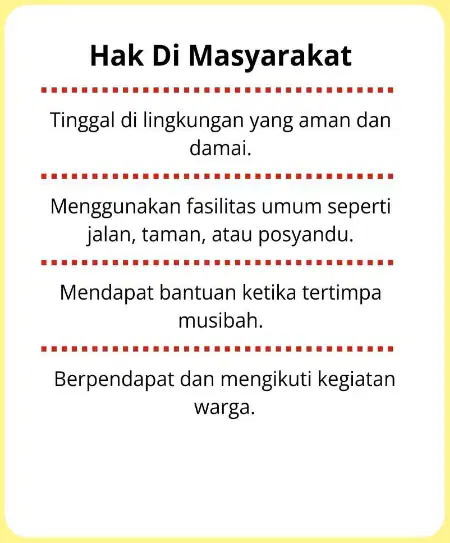
Which of the following is a right in society?
Menjaga ketertiban dan keamanan lingkungan. (Maintaining order and security in the environment)
Tinggal di lingkungan yang aman dan damai. (Living in a safe and peaceful environment)
Tidak membuang sampah sembarangan. (Not littering)
Mengikuti kerja bakti dan kegiatan sosial. (Participating in community service and social activities)
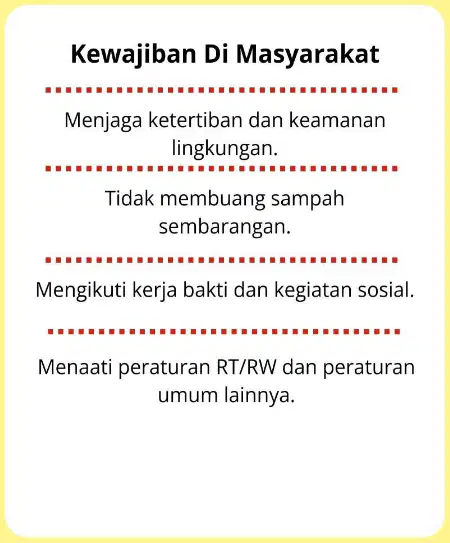
Which of the following is an obligation in society?
Menggunakan fasilitas umum seperti jalan, taman, atau posyandu. (Using public facilities such as roads, parks, or health posts)
Mendapat bantuan ketika tertimpa musibah. (Receiving help when affected by disaster)
Menjaga ketertiban dan keamanan lingkungan. (Maintaining order and security in the environment)
Berpendapat dan mengikuti kegiatan warga. (Expressing opinions and participating in community activities)
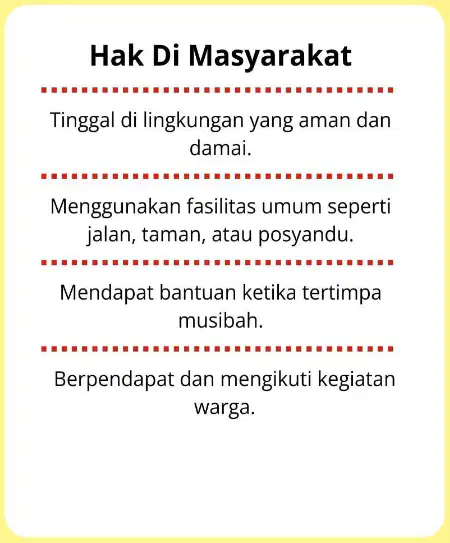
Fill in the blank: One of the rights in society is _________.
Using public facilities such as roads, parks, or health posts
Owning all public property
Breaking laws without consequences
Ignoring community rules
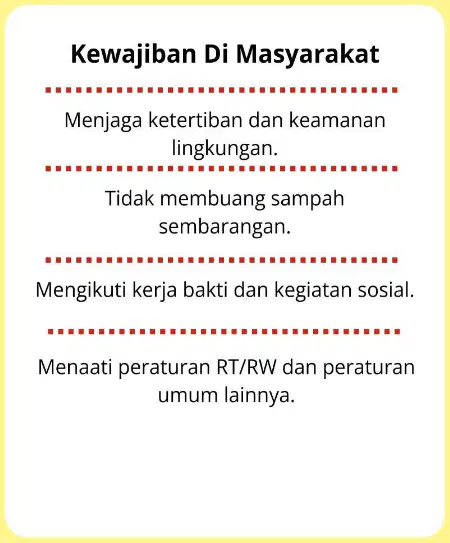
Fill in the blank: One of the obligations in society is _________.
Not littering
Being late to meetings
Ignoring traffic rules
Avoiding community service
Refusing to pay taxes
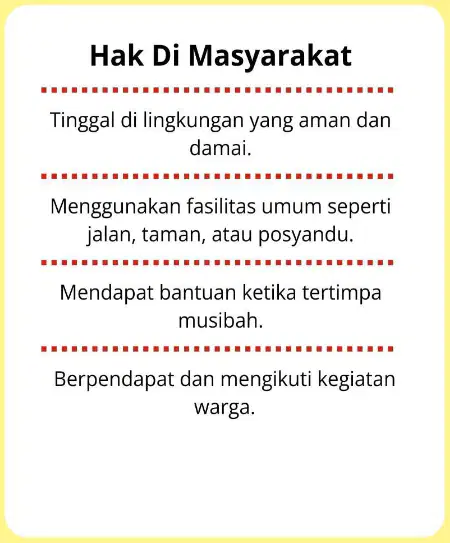
Which of the following is a right in society?
Mendapat bantuan ketika tertimpa musibah. (Receiving help when affected by disaster)
Menjaga ketertiban dan keamanan lingkungan. (Maintaining order and security in the environment)
Tidak membuang sampah sembarangan. (Not littering)
Mengikuti kerja bakti dan kegiatan sosial. (Participating in community service and social activities)
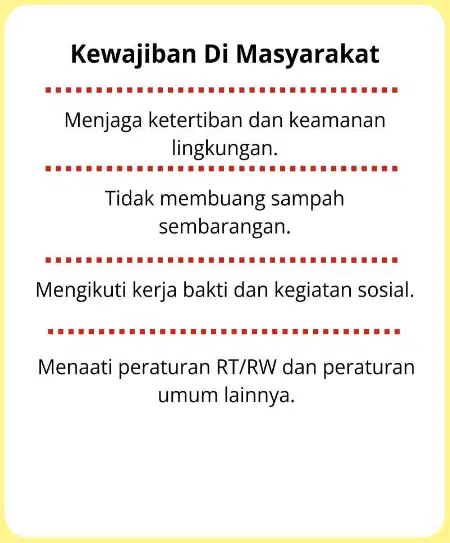
Which of the following is an obligation in society?
Berpendapat dan mengikuti kegiatan warga. (Expressing opinions and participating in community activities)
Mengikuti kerja bakti dan kegiatan sosial. (Participating in community service and social activities)
Menggunakan fasilitas umum seperti jalan, taman, atau posyandu. (Using public facilities such as roads, parks, or health posts)
Tinggal di lingkungan yang aman dan damai. (Living in a safe and peaceful environment)
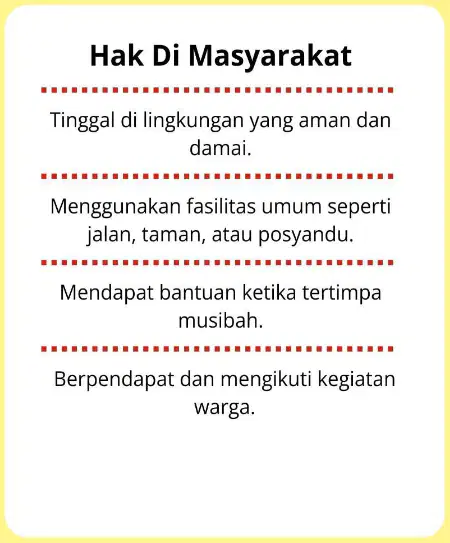
Fill in the blank: One of the rights in society is _________.
Expressing opinions and participating in community activities
Ignoring the laws and rules of society
Discriminating against others based on their beliefs
Refusing to help others in need
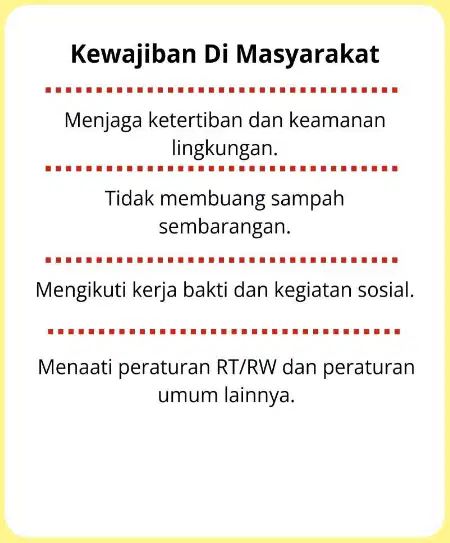
Fill in the blank: One of the obligations in society is _________.
Obeying neighborhood and general rules
Ignoring community guidelines
Breaking the law
Disrespecting others
What does it mean to balance rights and obligations?
Balancing rights and obligations means not only demanding rights but also fulfilling obligations responsibly. If rights and obligations are balanced, life becomes orderly, fair, and harmonious.
Balancing rights and obligations means only focusing on your own rights and ignoring obligations.
Balancing rights and obligations means giving up all your rights for the sake of obligations.
Balancing rights and obligations means fulfilling obligations only when convenient.
Why is it important to practice responsibility and discipline?
Practicing responsibility and discipline makes us accustomed to being responsible. Rights will feel more deserved if we have tried and carried out our duties earnestly.
Practicing responsibility and discipline makes us less productive in daily life.
Practicing responsibility and discipline causes us to ignore our rights.
Practicing responsibility and discipline makes us dependent on others.
How does balancing rights and obligations help in forming a fair attitude?
Balancing rights and obligations helps us become fair individuals—not prioritizing ourselves and willing to respect others.
It makes us focus only on our own needs, ignoring others.
It encourages us to always put our interests above everyone else.
It leads us to disregard the rights of others in favor of our own.
What can we achieve by using our rights wisely and fulfilling our obligations well?
We can achieve goodness for ourselves and others.
We can avoid all responsibilities.
We can ignore the needs of others.
We can break the rules without consequences.
Why is it important to balance rights and obligations in daily life?
It makes life more difficult
It creates a harmonious and pleasant environment
It causes conflict
It is not important
What will happen if everyone fulfills their obligations and respects each other's rights?
Life at home, school, and in society will become more harmonious.
There will be more conflicts and misunderstandings.
People will lose their sense of responsibility.
Rules and laws will become unnecessary.
Fill in the blank: Rights and obligations must run ________.
in balance / seimbang
in conflict / bertentangan
in isolation / terpisah
in excess / berlebihan
According to the summary, what happens if we fulfill our obligations and respect the rights of others?
Life becomes more chaotic
Life becomes more orderly, fair, and harmonious
We lose our rights
There is no change
We only need to focus on our rights and not our obligations.
True
False
Fill in the blank: What is one duty or responsibility you have at home?
Cleaning your room
Going to the moon
Becoming invisible
Flying a spaceship
Fill in the blank: What is one right you get at home as a result of your duties or responsibilities?
Being cared for and having a place to live.
Getting to skip all chores.
Never having to listen to your parents.
Being allowed to eat only candy for dinner.
What is one duty or responsibility you have at school?
Doing homework
Skipping classes
Ignoring teachers
Breaking school rules
Sleeping in class
What is one right you get at school as a result of your duties or responsibilities?
Receiving an education
Skipping all classes
Ignoring school rules
Disrespecting teachers
Your duties and rights are already balanced.
Yes, they are balanced.
No, they are not balanced.
I am not sure about the balance.
Only my rights are balanced, not my duties.
Which of the following should NOT be included when creating a poster invitation as described: 1) An invitation sentence, 2) An interesting picture or illustration, 3) Your group name, 4) A list of homework assignments?
An invitation sentence
An interesting picture or illustration
Your group name
A list of homework assignments

