
 Worksheets
Ch. 6: Muscular System (Sliding Filament Review)
Total questions: 15
Worksheet time: 8mins
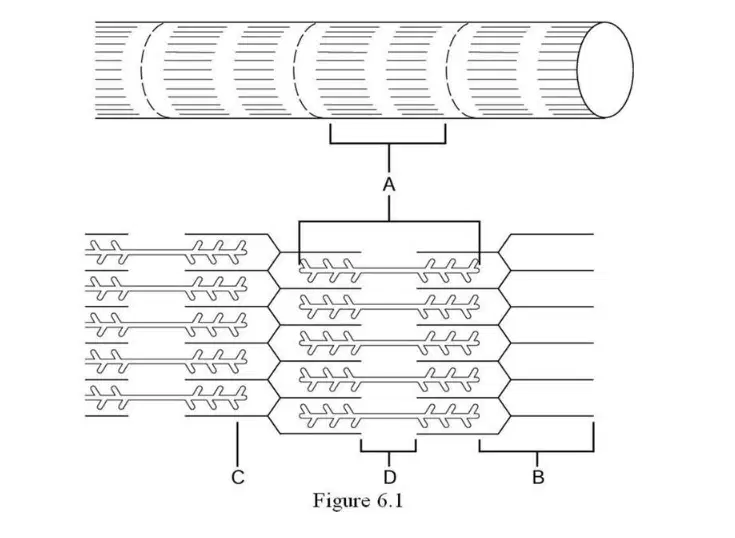
Using Figure 6.2, the myofilament composed of actin is indicated by ________.
Label A
Label B
Label C
Label D
The I band within a skeletal muscle fiber is indicated by ________.
Label A
Label B
Label C
Label D
The A band within a myofibril is indicated by ________.
Label A
Label B
Label C
Label D
The H zone, located within the A band, lacks thin filaments and is represented by ________.
Label A
Label B
Label C
Label D
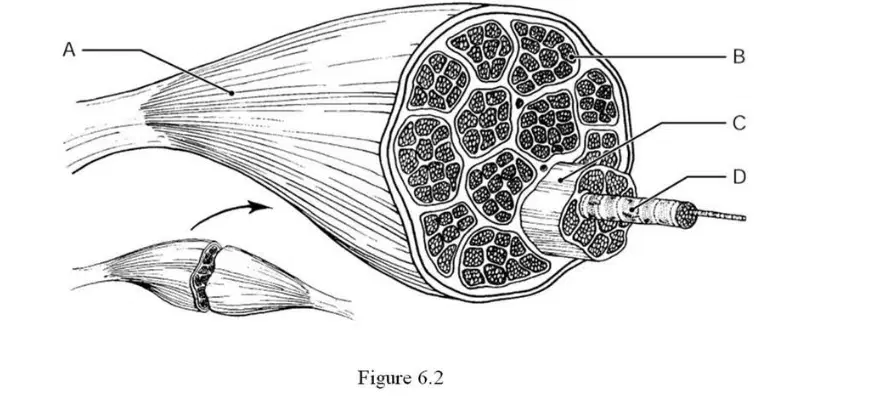
Using Figure 6.2, the epimysium is represented by ________.
Label A
Label B
Label C
Label D
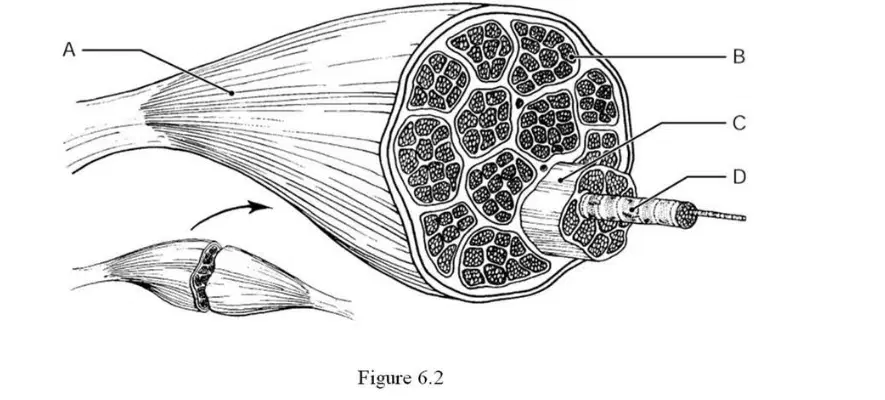
Using Figure 6.2, the perimysium wraps a fascicle of muscle cells and is represented by ________.
Label A
Label B
Label C
Label D
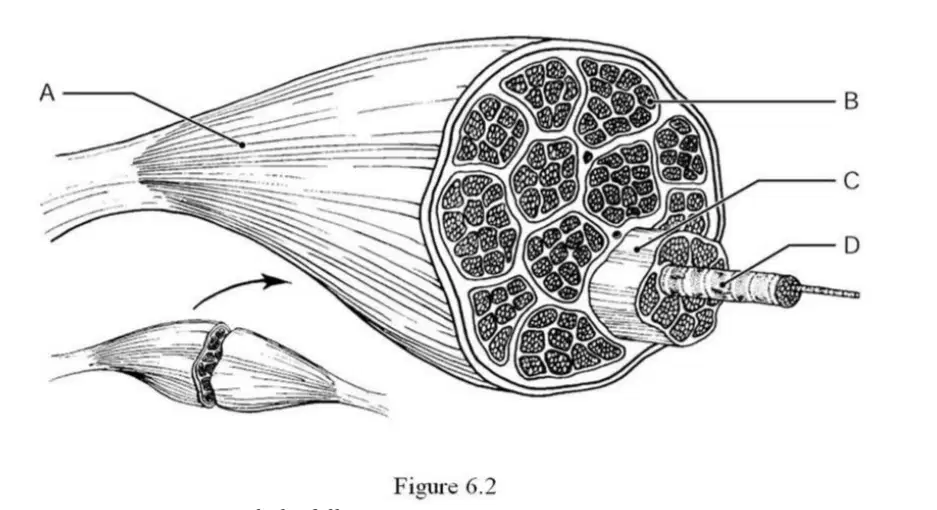
Using Figure 6.2, the muscle fiber (cell) is indicated by ________.
Label A
Label B
Label C
Label D
Which term does not describe smooth muscle cells?
Visceral
Nonstriated
Skeletal
Involuntary
What organelle wraps and surrounds the myofibril and stores calcium?
Cross bridge
Sarcomere
Sarcolemma
Sarcoplasmic reticulum
Striated involuntary muscle tissue is classified as ________ muscle.
skeletal
cardiac
smooth
either smooth or skeletal
One neuron and all the skeletal muscles it stimulates is known as a ________.
sarcoplasmic reticulum
motor unit
synaptic cleft
neuromuscular junction
The heads of the myosin myofilaments are called ________ when they link the thick and thin filaments together during skeletal muscle contraction.
neuromuscular junctions
synapses
cross bridges
motor units
What is the unstoppable electrical current that travels down the length of the entire surface of a sarcolemma?
Neuromuscular junctions
Action potential
Neurotransmitter
Acetylcholine
According to the sliding filament theory, how does muscle contraction occur?
Myosin heads form cross bridges and pull thin filaments, causing them to slide.
Both thick and thin filaments shorten as the muscle contracts.
A bands bunch up and shorten as myosin heads attach to thin filaments.
Myosin heads attach and detach from thin filaments, causing thin filaments to shorten.
Leaning against an immovable wall while waiting for a bus is a type of ________.
isotonic contraction
twitch
isometric contraction
resistance exercise

