
NEW
Font size
 Worksheets
ESS Unit 2 Quiz 3 Review: Weathering and Erosion
Total questions: 11
Worksheet time: 6mins
What is the difference between physical weathering and chemical weathering?
Physical weathering does not result in a change in the composition of the rock (it is the same materials, just maybe a different shape or size). Chemical weathering does result in a change in the composition of the rock (there is some new chemical created).
Physical weathering involves the addition of new minerals to rocks, while chemical weathering only breaks rocks into smaller pieces.
Physical weathering only occurs in hot climates, while chemical weathering only occurs in cold climates.
Physical weathering changes the color of rocks, while chemical weathering changes their size.
Provide an example of physical weathering of rock.
A rock crack widening due to “frost wedging” when water inside a rock freezes, expands and splits the rock; A rock getting smooth as it is rolled back and forth across other rocks by waves.
A rock dissolving in acid rain and forming a new substance.
A rock changing color due to exposure to air and moisture.
A rock melting due to extreme heat from a wildfire.
Provide an example of chemical weathering of rock.
Sinkholes forming as a result of acid rain reacting with the calcium carbonate in limestone to form a new substance which is washed away; Oxygen in the air reacting with minerals containing iron to form iron oxide.
A rock breaking apart due to repeated freezing and thawing of water in its cracks.
A tree root growing into a rock and splitting it apart.
Wind blowing sand against a rock, wearing it down over time.
In lab, when we shook the sugar cubes and rocks in the closed container, what was this representing in nature that weathers rocks?
This represented sediment being transported across the bottom of a stream or river that causes the sediment to become smoother and more rounded as it loses mass and volume from its sharp edges and corners.
This represented the process of rocks melting and reforming deep underground.
This represented the growth of crystals on the surface of rocks due to evaporation.
This represented the effect of wind blowing dust onto rocks, causing them to change color.
In lab, when we rubbed rocks with sandpaper, what was this representing in nature that weathers rocks?
This represented the sand or other sediment in the wind physically weathering rock.
This represented rainwater dissolving minerals in the rock.
This represented plant roots breaking apart the rock.
This represented ice expanding in cracks of the rock.
In lab, when we put items in vinegar, what was this representing in nature that weathers rocks?
The vinegar (an acid) was representing acid rain that chemically weathers rock.
The vinegar was representing wind erosion that physically breaks down rocks.
The vinegar was representing freezing and thawing that cracks rocks apart.
The vinegar was representing plant roots growing into rocks and breaking them.
In lab, when we watched the video of water in a bottle freezing, what was this representing in nature that weathers rocks?
This represented the physical weathering of rocks caused by the expansion of water when it freezes, called “frost wedging”.
This represented the chemical weathering of rocks by acid rain.
This represented the biological weathering of rocks by plant roots.
This represented the erosion of rocks by wind.
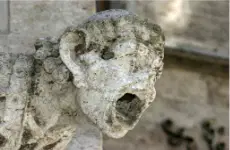
What type of weathering is most responsible for the slow weathering of statues over time?
Chemical weathering - acid rain reacting with minerals in the rock.
Physical weathering - wind abrasion on the surface.
Biological weathering - roots growing into cracks.
Thermal weathering - expansion and contraction from temperature changes.

This image is showing which type of weathering?
Physical weathering
Chemical weathering
Biological weathering
Mechanical erosion
Temperature affects chemical weathering by:
Increasing temperature speeds up chemical weathering.
Decreasing temperature speeds up chemical weathering.
Temperature has no effect on chemical weathering.
Chemical weathering only occurs at freezing temperatures.
A rock weathers more quickly once it has been broken apart into smaller pieces because:
the surface area exposed to weathering increases
the rock becomes heavier
the color of the rock changes
the rock moves to a different location

